
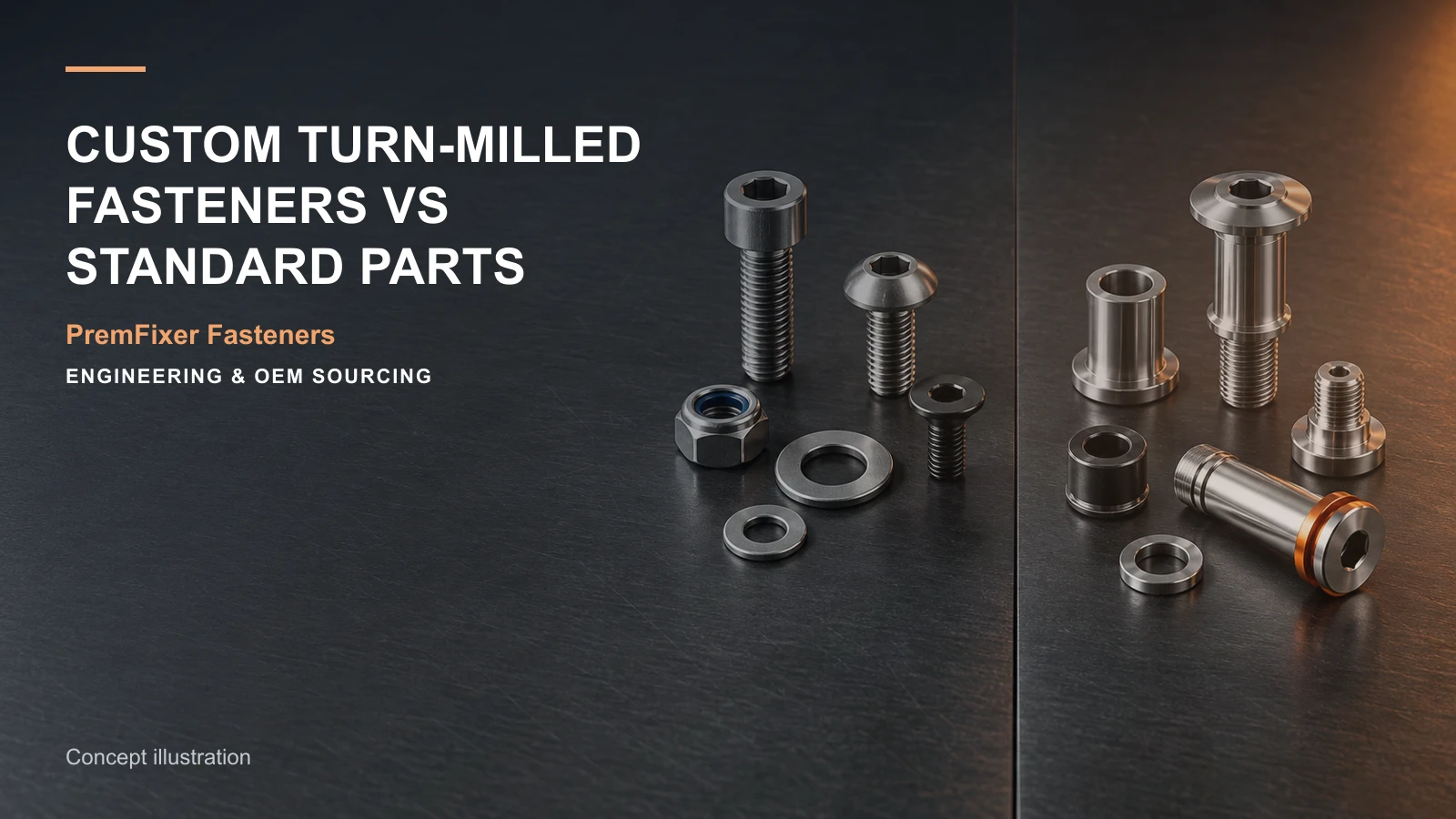
Standard bicycle fasteners are usually the fastest route when the thread, head style, grip length and installation envelope already fit the assembly. Custom turn-milled hardware becomes valuable when one component must locate a bearing, carry a shoulder, control spacing, protect a carbon or aluminium interface, or combine several functions in a restricted package.
The buying decision is therefore not simply ‘catalogue part or custom part’. It is a lifecycle decision covering design work, sample approval, recurring production, replacement supply and revision control. A low unit price can be expensive if the assembly needs extra spacers, sorting or rework; a custom part can also be poor value if it adds drawing and tooling work without changing the joint.
Use this guide to separate the functions that justify a drawing-controlled component from the positions that should remain standard. The goal is a mixed hardware strategy: standardize where the interface allows it and customize only where the bicycle needs a controlled geometry or delivery condition.
Start with the joint, not the fastener catalogue
A standard screw is defined mainly by an established thread, head and length. A bicycle pivot axle or shouldered bolt is defined by the surfaces around it. The bearing inner ring, frame tab, linkage plate, spacer stack, tool approach and locking method all influence whether an off-the-shelf part can do the job without adaptation.
Mark each feature by function before requesting prices. Threads create clamp load or retention; shoulders locate or support mating parts; under-head faces transfer load; recesses provide assembly access; and cosmetic surfaces influence finish handling. This function map prevents a decorative feature from receiving the same tolerance attention as a bearing-contact diameter.
If a standard part satisfies the functional interfaces and leaves acceptable installation access, keep it standard. If the assembly depends on a non-standard shoulder length, concentric bearing seat, captive feature or combined axle-and-spacer geometry, treat it as a drawing-controlled component from the beginning.
| Decision signal | Standard part is usually suitable | Custom part deserves review |
|---|---|---|
| Interface | Threaded clamp with no locating shoulder | Bearing, bushing or frame location depends on geometry |
| Packaging | Normal head and tool clearance are available | Low profile, two-sided access or captive assembly is required |
| Part count | No adapters or special washers are needed | One component may replace spacers, sleeves or a separate nut |
| Service | Common replacement size is preferred | Model-specific identity prevents an incorrect service part |
Compare lifecycle cost in four buckets
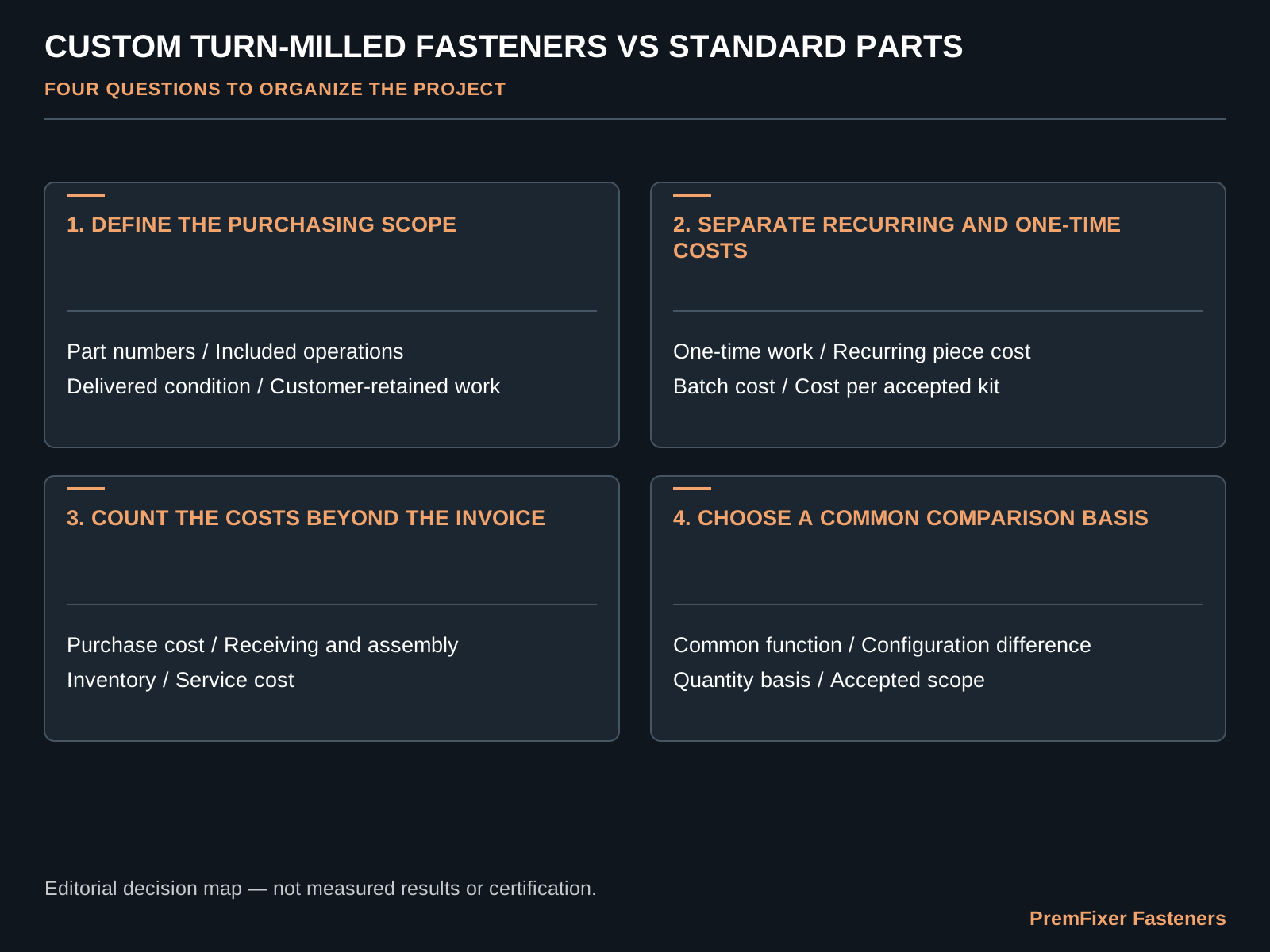
Purchase price is only the recurring part of the comparison. Add the one-time engineering work, the factory operations needed for each lot, the assembly work at the bicycle plant and the cost of keeping the correct replacement available. The result is not a universal formula; it is a way to expose costs that otherwise sit in different departmental budgets.
For a custom part, one-time inputs may include drawing preparation, fixture planning, sample measurement and assembly review. Recurring inputs may include CNC cycle time, secondary operations, finish handling and dedicated inspection. A standard part can avoid much of that work, but it may create recurring kitting, spacer or receiving tasks if the assembly is not naturally compatible.
Compare the same delivered condition. A loose catalogue screw should not be compared directly with a labelled pivot kit that includes mating hardware and inspection records. State whether the quoted unit is one component, one joint set or one complete frame kit.
Protect the dimensions that control the assembly
Custom does not mean every dimension should be tight. Identify the dimensions that locate bearings, set the clamp stack, control thread engagement or keep the tool clear of the frame. Give those characteristics an inspection method that can be used during sampling and production. Allow non-functional geometry to follow a practical manufacturing tolerance where the design permits it.
This distinction matters for cost and repeatability. Blanket precision can add inspection and machining time without improving the bicycle. Missing precision on one shoulder or runout relationship can create play, preload variation or difficult assembly even when every individual dimension appears close to nominal.
A useful drawing review ends with a short list of critical-to-function characteristics, not a longer list of generic notes. That list should follow the part into the sample report and the approved production revision.
Use prototypes to answer specific questions
Order a prototype with a stated purpose. A geometry sample can confirm fit, tool access and component stack-up. A finished sample can reveal masking, colour and post-treatment dimensional effects. A small assembly lot can test kitting, line handling and service identification. One sample does not automatically answer all three groups of questions.
Record the sample revision and which processes are representative of production. If a temporary material or finish is used to accelerate the first check, mark that difference clearly. The next decision should be visible: revise the drawing, approve the geometry, request a production-equivalent sample or stop the custom route.
This keeps development proportional. Simple custom spacers may need only a concise dimensional check; a multi-interface pivot axle may justify a fuller assembly and inspection review.
Plan service parts before production release
A standard fastener can be easier to replace globally, but only if a substitute with the same functional condition is readily identifiable. A custom part needs a clearer service identity: bicycle model, joint position, part number, revision and the other items included in the replacement set.
Decide whether service stock will be held as individual pieces or complete joint kits. For visually similar axles, add packaging or marking rules that help the service team distinguish length, shoulder or thread variations. Keep superseded revisions separated when they are not interchangeable.
Service planning should influence the original part split. If a wear item can be replaced independently, avoid integrating it into an expensive component unless the assembly benefit is compelling. If incorrect mixing is a greater risk, a controlled kit may be the safer commercial unit.
Prepare an RFQ that allows a real comparison
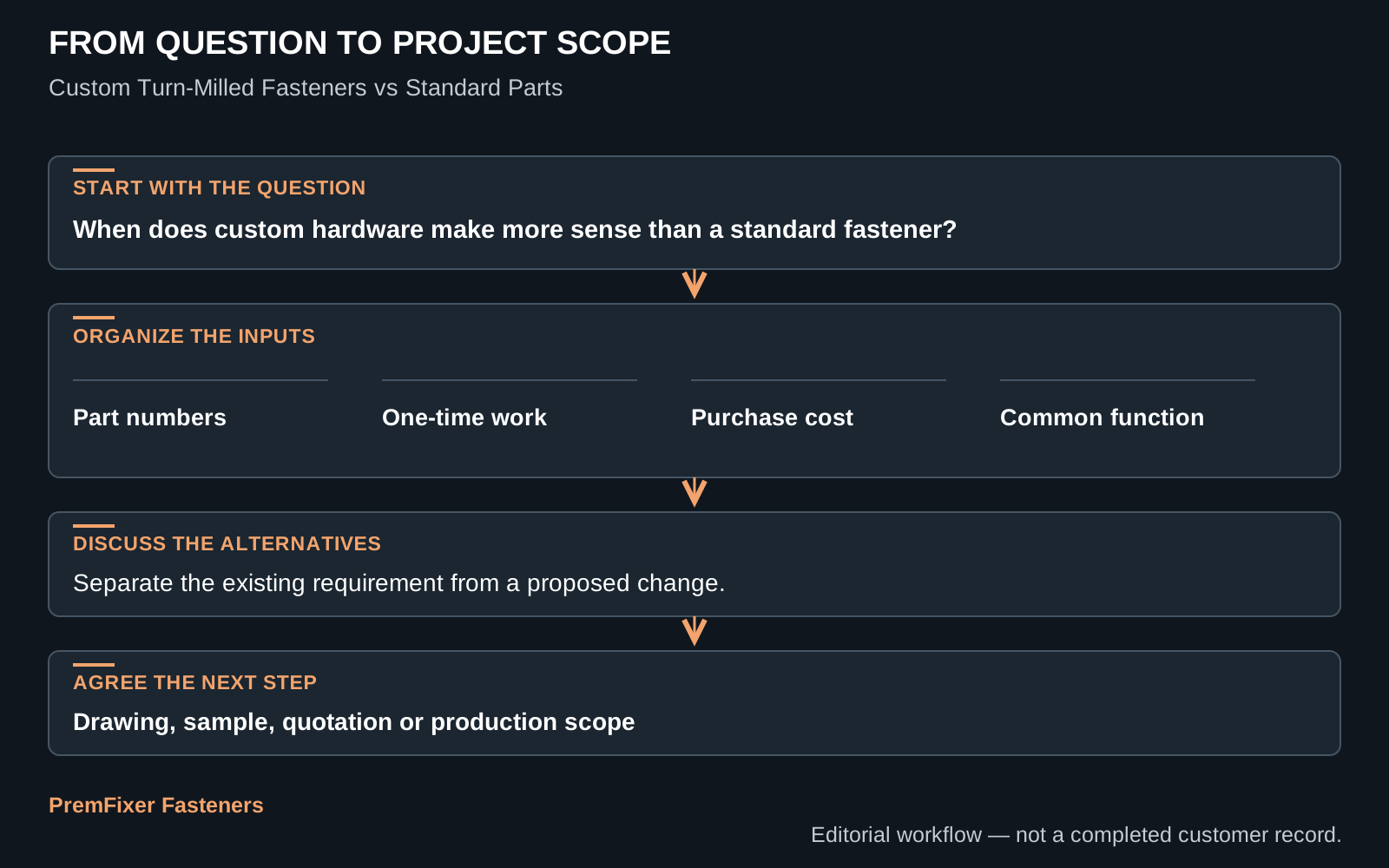
Send the current drawing or model, annual and batch quantities, mating-part information, material and finish preferences, sample objective and required delivery condition. Identify which requirements are fixed and which are open to manufacturing feedback. Photos of the assembly and the available tool envelope often resolve questions that a single component drawing cannot.
Ask the supplier to separate one-time charges from recurring piece cost and to identify excluded processes or customer-supplied inputs. For a standard alternative, request the exact designation and any adapters it needs. For a custom proposal, request the proposed process route, sample condition and critical inspection outputs.
PremFixer can review a drawing, BOM or physical sample and organize the discussion around joint function, manufacturable geometry and delivered scope. The fastest useful first contact is not a perfect specification; it is a clear statement of the assembly problem and the decision the next sample must support.
Questions buyers ask
When should a bicycle OEM use a standard fastener?
Use a standard fastener when the joint accepts a recognized thread, head, length and strength condition without special spacers, restricted tool access or model-specific locating features. Standardization is especially useful for serviceable positions where global replacement matters.
What usually justifies a custom bicycle fastener?
A custom part is easier to justify when it controls bearing location, shoulder stack-up, captive assembly, restricted packaging, weight distribution or part consolidation. The benefit should be tied to the joint rather than appearance alone.
Does a custom part always cost more?
Its unit price is often higher than a catalogue screw, but lifecycle cost can move either way. Compare engineering, adapters, assembly labour, receiving, inventory and service packaging in addition to the quoted piece price.
What should I send for a custom fastener quotation?
Send the drawing or 3D model if available, mating-part or assembly context, quantities, material and finish requirements, critical dimensions, sample purpose and delivery format. Mark open questions so the supplier can respond to them directly.
Can one bicycle use both standard and custom hardware?
Yes. A mixed strategy is usually the most practical: standard screws for conventional clamping positions and drawing-controlled parts for pivots, axles, sleeves or interfaces whose geometry is specific to the frame.
Decide Which Parts Should Stay Standard
Share the hardware BOM and assembly context. PremFixer can separate catalogue positions from the joints that need drawing-controlled geometry.
Review My Hardware BOM