
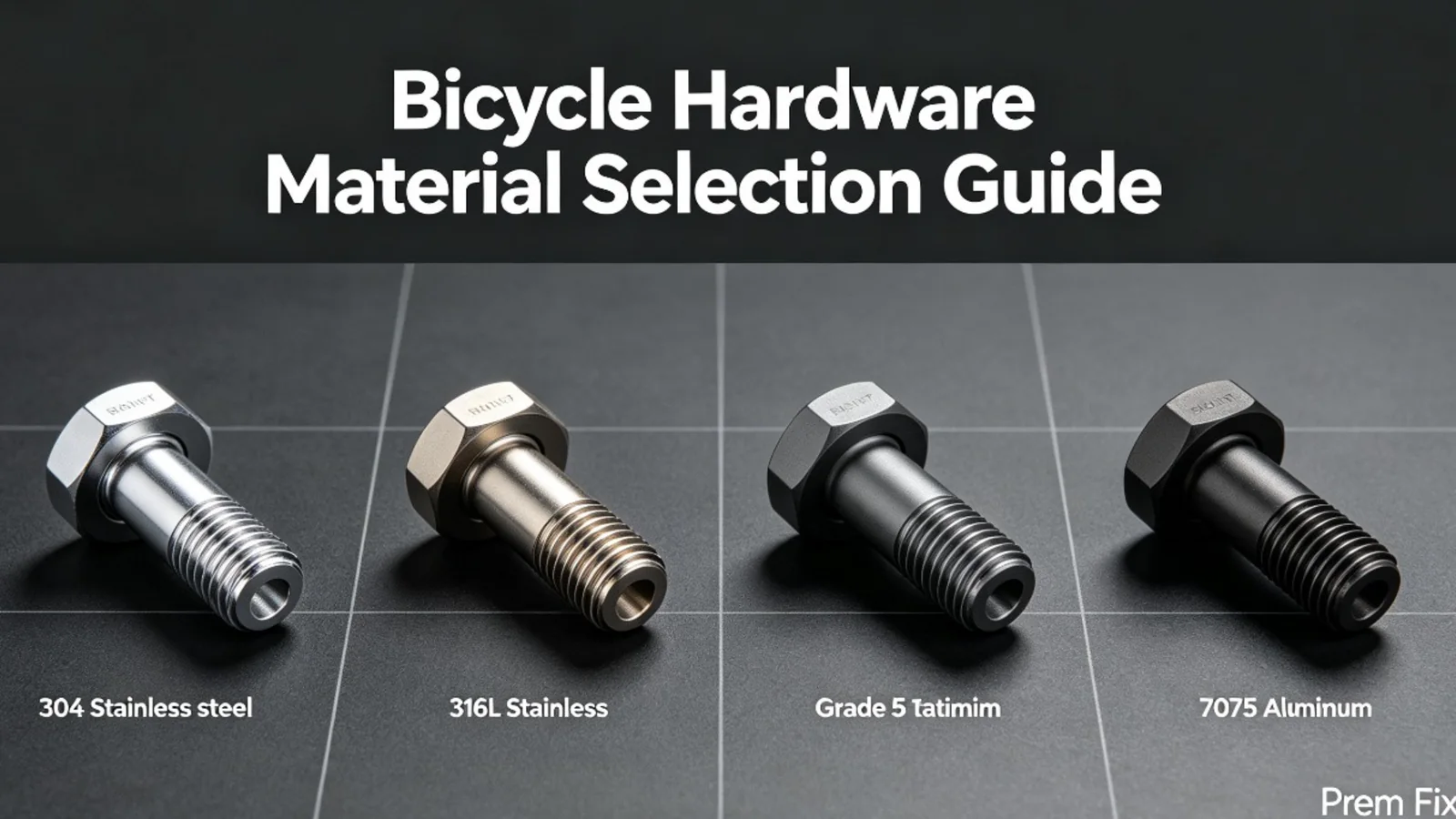
Why Material Selection Defines Fastener Performance
Fasteners are the smallest engineered components on a bicycle frame — yet they carry some of the highest responsibility loads. A stem faceplate bolt failing at 40 km/h, a brake caliper bolt loosening on a descent, or a pivot bolt corroding in coastal conditions: every one of these failures traces back to choosing the wrong material for the wrong application.
This guide compares the five material families used in bicycle fasteners and helps you match each to your frame platform, riding environment, and production budget.
This is a deep-dive companion to our Bolt Selection Hub and Surface Treatment Hub — refer to those pillar guides for the complete selection and coating compatibility frameworks.
Material Comparison at a Glance
| Material | Grade | Tensile (MPa) | Salt Spray | Weight vs Steel | Relative Cost | Best Application |
|---|---|---|---|---|---|---|
| 316 Stainless | A4-70 | 700 | 1,000+ h | +5% | $$ | Pivot bolts, marine & coastal use |
| 304 Stainless | A2-70 | 700 | 500 h | +5% | $ | General frame assembly, urban bikes |
| Alloy Steel | 12.9 | 1,200 | 150 h (bare) | Baseline | $ | DH, high-impact, coated for corrosion |
| Ti-6Al-4V | Grade 5 | 950 | 500 h | −42% | $$$$ | Ultra-lightweight premium builds |
| 7075-T6 Aluminum | T6 | 570 | 200 h (anodized) | −65% | $$$ | Non-structural: bottle cage, accessory |
304SS vs 316SS: Real Salt Spray Test Data
There's a common misconception that "stainless steel doesn't rust." In reality, 304SS and 316SS perform very differently in chloride-rich environments. At PremFixer, we ran ASTM B117 neutral salt spray testing on M6 hex socket bolts in both grades — here are the actual results:
| Material | First Red Rust (h) | 5% Surface Rust (h) | Functional Failure (h)* | Test Standard |
|---|---|---|---|---|
| A2-70 304SS | 96 | 240 | 480 | ASTM B117 |
| A4-70 316SS | 480 | 720 | 1,200+ | ASTM B117 |
| 12.9 Steel + Dacromet | 480 | 600 | 1,000 | ASTM B117 |
| 12.9 Steel + Zn-Ni | 240 | 400 | 720 | ASTM B117 |
| TC4 Ti-6Al-4V | No rust | No rust | 1,000+ | ASTM B117 |
*Functional failure defined as torque-to-remove exceeding 150% of installation torque.
Application × Material Selection Matrix
The following matrix maps every major bicycle application to its recommended fastener material, with the engineering rationale:
| Application | Recommended Material | Rationale | Coating Required |
|---|---|---|---|
| MTB Pivot Bolt (DH/Enduro) | 12.9 Steel | Max tensile at 1,200 MPa for impact loads | Dacromet |
| MTB Pivot Bolt (Trail/XC) | A4-70 316SS | 700 MPa sufficient, no coating degradation risk | None (passivated) |
| Stem Faceplate Bolt | A4-70 316SS | Safety-critical, corrosion immunity essential | None |
| Brake Caliper Mount | 12.9 Steel | High shear load at caliper interface | Dacromet |
| Seatpost Clamp | A4-70 316SS | External, exposed to rain and sweat | None |
| Bottle Cage Boss | 7075-T6 Al | Non-structural, max gram savings | Anodized |
| Derailleur Hanger | 12.9 Steel | Safety: failure = derailleur into spokes | Dacromet |
| Carbon Frame (any bolt) | TC4 Ti or 316SS | Galvanic potential <0.25V mandatory | Anti-seize |
| E-Bike Motor Mount | 12.9 Steel | 85 N·m continuous motor torque | Dacromet + Nord-Lock |
| Folding Hinge Pin | A4-70 316SS | Urban exposure + 10,000 cycle durability | None (ground) |
1. A4-70 316 Stainless Steel — The All-Round Workhorse
Best for: Pivot bolts, suspension hardware, brake caliper mounts, coastal/marine environments.
A4-70 (316SS) is the default standard at PremFixer for good reason. It combines 700 MPa tensile strength with 1,000+ hour salt spray resistance — making it the only material that delivers structural-grade strength plus near-immunity to corrosion. It is our recommended baseline for any bicycle fastener exposed to wet conditions, road salt, or coastal air.
Key advantage: No coating required. The corrosion resistance is intrinsic to the material — meaning no coating degradation over service life.
2. A2-70 304 Stainless Steel — The Value Alternative
Best for: General frame assembly, urban/commuter bikes, indoor-stored bicycles.
A2-70 (304SS) offers the same tensile strength as 316SS at a lower cost, but with reduced corrosion resistance (500h salt spray vs 1,000+ h). Suitable for dry-climate and urban applications where the bike isn't regularly exposed to salt or coastal air.
3. 12.9-Grade Alloy Steel — Maximum Strength
Best for: Downhill, freeride, high-impact MTB applications where ultimate tensile strength matters more than corrosion resistance.
At 1,200 MPa, 12.9-grade steel is the strongest common fastener material. The trade-off: bare steel rusts quickly. This is solved with Dacromet coating (600h salt spray) or Zn-Ni plating (400h). For DH frames, pair 12.9 bolts with Dacromet and apply anti-seize at assembly.
4. Ti-6Al-4V Grade 5 Titanium — Premium Lightweight
Best for: High-end road, XC race, and weight-critical custom builds.
Ti-6Al-4V delivers 950 MPa tensile strength at 42% less weight than steel — the holy grail of strength-to-weight ratio. The premium cost (4–6× steel) is justified for gram-critical applications. Critical note: Ti bolts must be paired with anti-seize when used in aluminum or carbon frames to prevent galvanic corrosion.
5. 7075-T6 Aluminum — Best Value per Gram Saved
Best for: Bottle cage mounts, computer mounts, fender hardware — any non-structural accessory bolt.
At 65% lighter than steel and available in color-anodized finishes, 7075-T6 aluminum bolts deliver the lowest cost per gram saved in the entire bike BOM. Not for structural applications — 570 MPa is insufficient for brake, stem, or pivot loads.
Material Selection Decision Tree
- Is the bolt safety-critical (stem, brake, pivot)? → Use A4-70 316SS (standard) or 12.9 + Dacromet (DH/high-impact).
- Will the bike see salt, rain, or coastal air? → Use A4-70 316SS or 304SS minimum. Avoid bare steel.
- Is weight the primary design driver? → Use Ti-6Al-4V for structural, 7075-T6 Al for accessory.
- Is cost the primary constraint? → Use 12.9 + Dacromet for structural, A2-70 for general assembly.
- Is the frame carbon fiber? → Use TC4 Ti or 316SS only. Apply anti-seize. Never use 12.9 steel on carbon.
Explore Related PremFixer Products
Get a Material-Optimized BOM for Your Frame
Send your frame BOM to the PremFixer engineering team. We'll return a joint-by-joint material recommendation with cost analysis — within 48 hours.
Request Material Consultation