
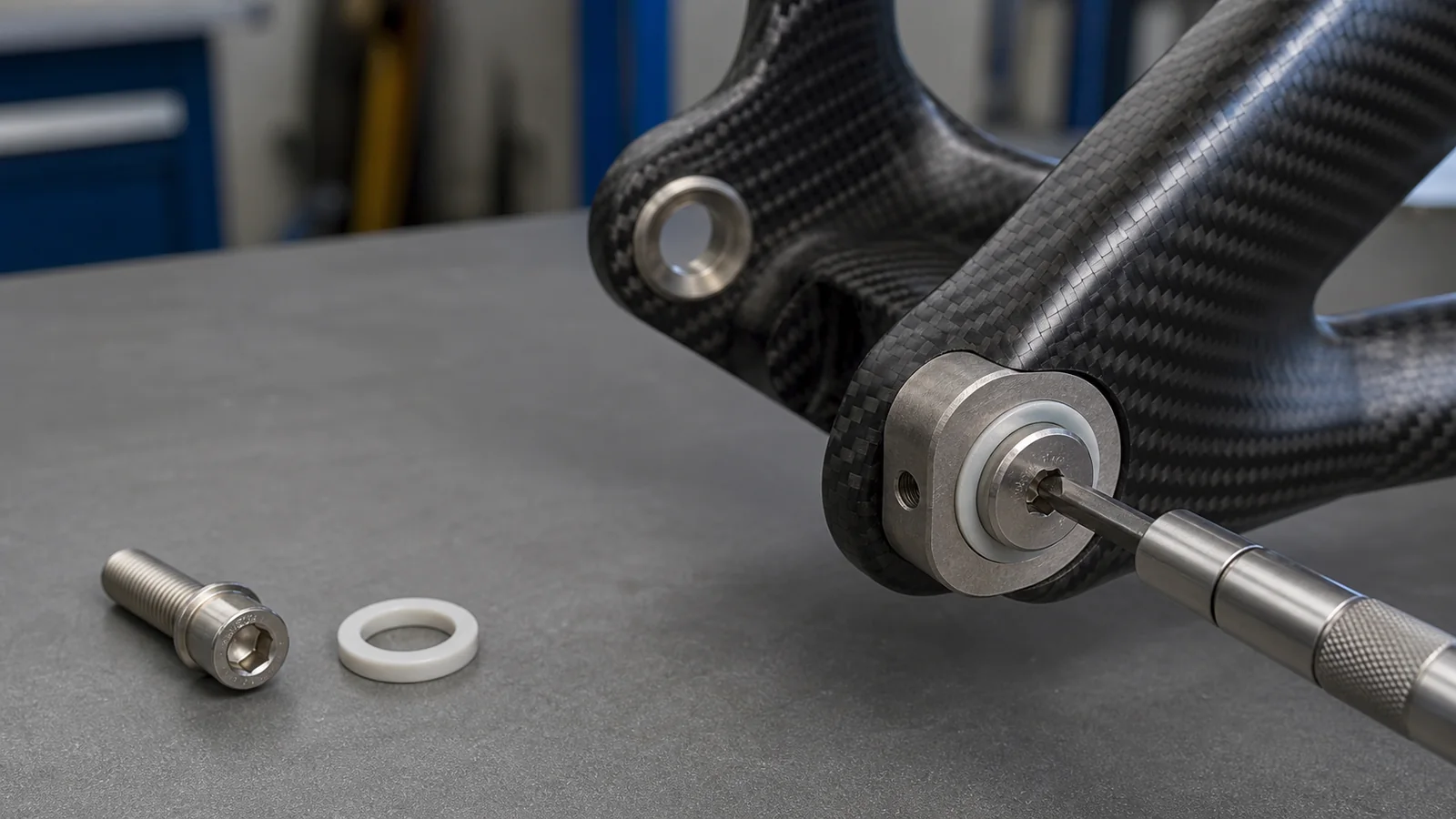
The Hidden Risk in Every Carbon Frame
Carbon fiber composite frames are engineering marvels — stiff, light, and vibration-damping. But they carry a hidden vulnerability at every threaded interface: galvanic corrosion. When a steel bolt contacts a carbon fiber laminate in the presence of an electrolyte (rainwater, sweat, humidity), an electrochemical cell forms. The carbon acts as a noble cathode and the steel bolt becomes a sacrificial anode — corroding from the inside out, often invisibly, until structural failure occurs.
This isn't theoretical. We've seen stem faceplate bolts seized solid in carbon steerer tubes after a single wet season. We've diagnosed delamination around bottle cage bosses caused by expanding corrosion product. The fix is material selection — applied at the BOM stage, before the first bolt is torqued.
This is a deep-dive companion to our Carbon Frame Fastener Hub — the pillar guide covers the complete galvanic safety framework, titanium compatibility, and material selection for every carbon frame interface.
Galvanic Series: What Contacts Carbon Safely?
| Fastener Material | Galvanic Potential vs Carbon (V) | Risk Level | Recommendation |
|---|---|---|---|
| TC4 Ti (Ti-6Al-4V) | <0.10 V | Minimal | Safest choice |
| 316 Stainless (A4-70) | ~0.15 V | Low | Recommended |
| 304 Stainless (A2-70) | ~0.20 V | Low–Moderate | Acceptable with anti-seize |
| 12.9 Alloy Steel (bare) | >0.50 V | Severe | Never use on carbon |
| 7075-T6 Aluminum | ~0.30 V | Moderate | Accessory only, with isolation |
Rule of thumb: The galvanic potential difference between fastener and carbon should be below 0.25 V. This makes TC4 titanium and 316SS the only unconditionally safe choices for structural carbon frame fasteners.
Real-World Case: Galvanic Corrosion on a Production Carbon Frame
In 2024, a mid-volume carbon frame manufacturer contacted PremFixer after field reports of seized bottle cage bolts on their flagship endurance road frame. The symptoms were identical across 47 warranty claims:
| Finding | Measurement | Root Cause |
|---|---|---|
| Bolt material | 10.9-grade alloy steel, ED black zinc | Steel-to-carbon galvanic cell |
| Average time to seizure | 8–14 months | Coastal/humid climate acceleration |
| Corrosion product pH | 3.8 (acidic) | Accelerated carbon laminate degradation |
| Frame boss delamination | 4 of 47 frames (8.5%) | Expanding corrosion product at thread root |
| Torque-to-remove (seized) | 22–35 N·m (spec: 3 N·m) | Galvanic corrosion welding bolt to insert |
| Warranty cost per frame | $480–$720 | Frame replacement + labor + shipping |
The fix: We replaced all frame fasteners with A4-70 316SS bolts pre-coated with anti-seize, and added 0.5 mm nylon insulating washers at all bottle cage and fender mount interfaces. Total BOM cost increase: $0.34 per frame. Warranty claims dropped to zero within 6 months.
Insulation Washer Solutions — When You Can't Avoid Steel
Sometimes a steel bolt is unavoidable — for example, when an M5 12.9-grade brake caliper bolt is required for structural safety. In these cases, a physical insulation barrier becomes mandatory. We evaluated four insulation approaches:
| Insulation Method | Galvanic Isolation (V) | Durability (cycles) | Cost per Bolt | Recommended For |
|---|---|---|---|---|
| Nylon 66 washer (0.5 mm) | >10 MΩ | 500+ assembly cycles | $0.02 | Bottle cage, fender, accessory |
| PEEK washer (0.3 mm) | >100 MΩ | 2,000+ assembly cycles | $0.18 | Brake caliper, derailleur hanger |
| Fiber-reinforced PTFE tape | >50 MΩ | Single assembly | $0.01 | Prototype / one-off |
| Anodized Al sleeve + washer | 5–50 kΩ | 1,000+ cycles | $0.09 | High-temperature (disc brake mount) |
PremFixer recommendation: PEEK washers at all safety-critical steel-to-carbon interfaces, nylon 66 washers for accessory mounts. Both ship pre-installed on every carbon-frame bolt in our catalog.
Three-Layer Protection Protocol
At PremFixer, we apply a three-layer protection protocol to every carbon frame fastener we ship:
Layer 1: Material Selection
Choose TC4 Ti or 316SS. Period. Never specify steel bolts (even coated) for direct carbon contact. The coating will eventually wear or scratch, creating a galvanic pathway.
Layer 2: Anti-Seize Pre-Application
Every Ti and stainless bolt destined for carbon frames ships with anti-seize compound pre-applied to the threads. This creates a physical barrier between the bolt shank and the carbon laminate, further suppressing galvanic activity.
Layer 3: Torque Management
Carbon laminate crushes at significantly lower clamping forces than aluminum or steel. We publish carbon-specific torque values that are 30–40% below the standard metal-frame spec for the same bolt size. Every PremFixer carbon fastener ships with a carbon-safe torque card.
Carbon-Safe Torque Reference
| Application | Bolt Size | Metal Frame Torque | Carbon Frame Torque |
|---|---|---|---|
| Stem Faceplate | M5 | 5–6 N·m | 3.5–4 N·m |
| Brake Caliper Mount | M6 | 8–10 N·m | 5–6 N·m |
| Seatpost Clamp | M5/M6 | 5–8 N·m | 3–5 N·m |
| Bottle Cage Boss | M5 | 3–4 N·m | 2–2.5 N·m |
| Derailleur Hanger | M4/M5 | 3–5 N·m | 2–3 N·m |
Explore Related PremFixer Products
Don't Let Galvanic Corrosion Kill Your Carbon Frame
Specifying the right fastener material for carbon frames costs pennies per bolt. Let our engineers review your carbon frame BOM for galvanic compatibility.
Request Carbon Frame BOM Review