
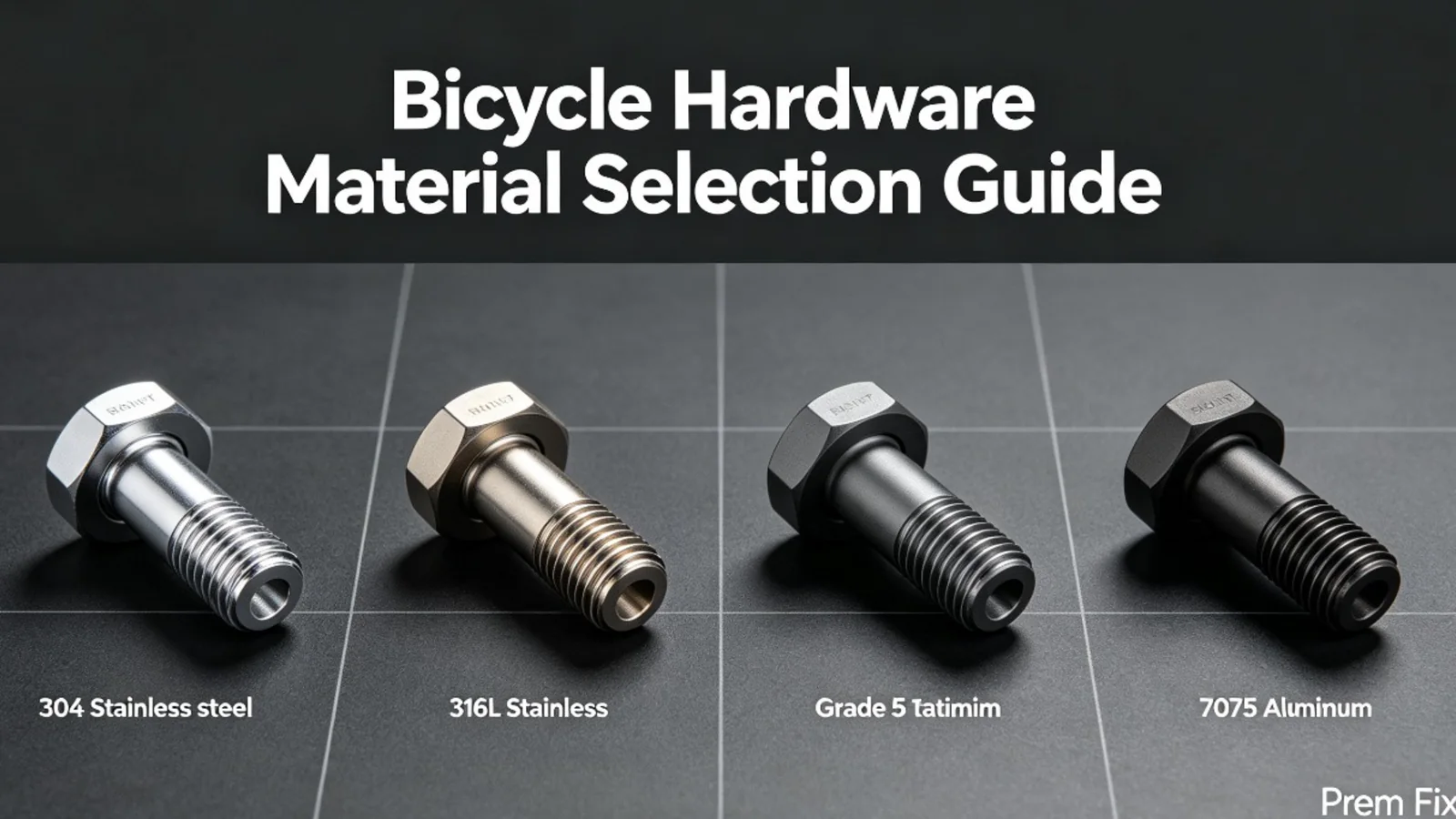
Selecting the right fastener is a critical engineering decision that directly impacts product safety, reliability, and service life. This guide provides technical criteria for material grade selection, property class identification, coating comparison, and dimensional specification tailored specifically for bicycle and motorcycle applications.
Material & Property Class Selection
Choose the right material grade based on strength, weight, and corrosion requirements
| Material | Property Class | Tensile (MPa) | Yield (MPa) | Hardness | Density (g/cm³) | Corrosion Resistance | Typical Bicycle / Motorcycle Use |
|---|---|---|---|---|---|---|---|
| Carbon Steel | 4.6 / 4.8 | 400 | 240 / 320 | — | 7.85 | Low — requires coating | Non-critical brackets, fender mounts, accessory bolts |
| Carbon Steel | 8.8 | 800 | 640 | 22 – 32 HRC | 7.85 | Low — requires coating | Stem bolts, brake caliper mounts, saddle clamps, general chassis |
| Alloy Steel | 10.9 | 1040 | 940 | 32 – 39 HRC | 7.85 | Low — requires coating | Rotor bolts, crank bolts, shock mounts, motorcycle engine fasteners |
| Alloy Steel | 12.9 | 1220 | 1100 | 39 – 44 HRC | 7.85 | Low — hydrogen risk | Suspension pivot axles, motorcycle brake caliper bolts, steering stem |
| Stainless A2 (304) | A2-50 / A2-70 | 500 / 700 | 210 / 450 | — | 7.90 | Good — indoor / mild outdoor | Water bottle bolts, decorative hardware, non-structural fittings |
| Stainless A4 (316) | A4-70 / A4-80 | 700 / 800 | 450 / 600 | — | 8.00 | Excellent — marine / coastal | Marine-grade applications, coastal motorcycle hardware, all-weather fasteners |
| Titanium Gr.5 | Ti-6Al-4V | 895 | 828 | 32 – 36 HRC | 4.43 | Excellent — naturally passive | High-end racing bicycles, weight-critical motorcycle components (40% lighter) |
| Aluminum 7075-T6 | — | 572 | 503 | 150 HB | 2.81 | Good — anodized | Non-structural cosmetic bolts, chainring bolts (specialized), lightweight accessories |
Application-Specific Recommendations
Fastener selection by bicycle and motorcycle subsystem
| Application Area | Recommended Size | Property Class | Material | Coating | Key Requirements |
|---|---|---|---|---|---|
| Bicycle | |||||
| Stem / Handlebar Clamp | M5 × 16–20 | 8.8 / 10.9 | Alloy Steel | Zn-Ni / Dacromet | High clamp force, corrosion resistant |
| Brake Caliper Mount | M6 × 15–20 | 10.9 / 12.9 | Alloy Steel | Dacromet | Safety-critical, high shear strength |
| Rotor Bolts | M5 × 10–12 | 10.9 | Stainless / Alloy | DLC / Zn-Ni | Heat resistance, shear, Loctite-compatible |
| Crank Bolts | M8 / M12 × 15–25 | 10.9 / 12.9 | Alloy Steel | Dacromet / Zn-Ni | High torque, fatigue resistance |
| Bottom Bracket | M8 × 15–25 | 10.9 | Alloy Steel | Dacromet | Preload retention, corrosion |
| Suspension Pivot Axle | M8 – M10 × custom | 12.9 | Alloy Steel | Dacromet / Zn-Ni | Fatigue endurance, precise tolerance |
| Saddle Rail Clamp | M6 – M8 | 8.8 / 10.9 | Alloy / Stainless | Zn-Ni / Passivation | Repeated adjustment, weather exposure |
| Water Bottle Cage | M5 × 10–12 | 4.6 / A2-50 | Stainless A2 | Passivation | Low load, cosmetic appearance |
| Derailleur Hanger | M3 – M4 × 8–12 | 8.8 / 10.9 | Alloy Steel | Zn-Ni | Precision thread, sacrificial design |
| Motorcycle | |||||
| Brake Caliper / Disc Bolt | M8 – M10 × 20–30 | 10.9 / 12.9 | Alloy Steel | Dacromet | Safety-critical, high temp, threadlock pre-applied |
| Engine Case Bolt | M6 – M8 | 8.8 / 10.9 | Alloy / Stainless | Zn-Ni / Black Oxide | Heat cycles, oil resistance, gasket sealing |
| Footpeg / Bracket Bolt | M8 – M10 | 8.8 / 10.9 | Alloy Steel | Dacromet | Corrosion (road spray), high static load |
| Fork Clamp / Triple Tree | M8 – M10 | 10.9 / 12.9 | Alloy Steel | Dacromet / Zn-Ni | Safety-critical, precise torque specification |
| Fairing / Body Panel | M5 – M6 | 4.6 / A2-50 | Stainless / Alloy | Passivation / Zn-Ni | Vibration resistance, removable, cosmetic |
| Exhaust Mount | M8 | 8.8 / A4-70 | Stainless A4 | Passivation | High temperature, thermal cycling, vibration |
Surface Coating Selection
Match coating to environment and performance requirements
| Coating | Corrosion (NSS Hours) | Thickness (μm) | Friction μ | Hydrogen Risk | Appearance | Best For |
|---|---|---|---|---|---|---|
| Dacromet | 480 – 1000+ | 5 – 15 | 0.10 – 0.14 | None — safe for 12.9 | Silver-gray, matte | All-weather, outdoor riding, high-strength bolts |
| Zinc-Nickel (Zn-Ni) | 720 – 1000 | 8 – 15 | 0.12 – 0.18 | Low — post-baked | Silver, semi-bright | Automotive-grade corrosion, balanced cost-performance |
| DLC (Diamond-Like Carbon) | Moderate (substrate dependent) | 2 – 5 | 0.05 – 0.10 | None | Black, glossy | Low friction moving parts, rotor bolts, cosmetic black finish |
| TiN (Titanium Nitride) | Moderate (substrate dependent) | 2 – 4 | 0.40 – 0.50 | None | Gold, metallic | Wear-resistant surfaces, high-visibility identification |
| Passivation | 96 – 200 (base material) | — | — | None | Natural stainless (no color) | Stainless steel fasteners, clean aesthetic, clinical hygiene |
| Black Oxide | 24 – 48 (with oil) | < 1 | 0.16 – 0.22 | None | Matte black, deep | Indoor / dry climate, aesthetic preference, low cost |
| Zinc Flake (Geomet) | 600 – 1500 | 5 – 15 | 0.10 – 0.15 | None | Silver-gray, matte | Maximum corrosion protection, automotive spec, 12.9 compatible |
Thread & Size Reference
Metric thread dimensions for bicycle and motorcycle fasteners
Coarse Thread (Standard)
| Nominal Size | Pitch (mm) | Stress Area (mm²) | Typical Head Type | Common Torque (Nm)* |
|---|---|---|---|---|
| M3 | 0.5 | 5.03 | Socket cap / countersunk | 1.0 – 1.5 |
| M4 | 0.7 | 8.78 | Socket cap / button head | 2.5 – 3.5 |
| M5 | 0.8 | 14.2 | Socket cap / button head | 5.0 – 7.0 |
| M6 | 1.0 | 20.1 | Socket cap / hex head | 8.0 – 12 |
| M8 | 1.25 | 36.6 | Hex head / socket cap | 20 – 30 |
| M10 | 1.5 | 58.0 | Hex head / flange bolt | 40 – 55 |
| M12 | 1.75 | 84.3 | Hex head / flange bolt | 65 – 90 |
* Indicative torque for 8.8 property class, clean dry threads. Always verify with engineering specification.
Fine Thread (Precision / Thin-Wall)
| Nominal Size | Pitch (mm) | Stress Area (mm²) | Advantage | Typical Application |
|---|---|---|---|---|
| M6 × 0.75 | 0.75 | 21.9 | Higher strength, vibration resistance | Suspension adjusters, precision clamps |
| M8 × 1.0 | 1.0 | 38.5 | Larger stress area, finer adjustment | Stem bolts, hydraulic fittings, axle nuts |
| M10 × 1.0 | 1.0 | 64.5 | Higher preload, less self-loosening | Motorcycle axle nuts, steering stem |
| M10 × 1.25 | 1.25 | 60.1 | Common fine pitch for automotive | Brake banjo bolts, hub bolts |
| M12 × 1.5 | 1.5 | 88.1 | Vibration resistant, higher strength | Suspension linkage, bottom bracket shells |
| M12 × 1.25 | 1.25 | 91.5 | Maximum stress area for M12 | Motorcycle engine mounts, critical chassis |
Fine threads provide approximately 10% higher tensile stress area and superior vibration resistance compared to coarse threads of the same nominal diameter.
Head Style Selection
Choose the correct drive and head geometry for your application
| Head Style | Drive | Torque Transfer | Clearance | Socket Size Range | Typical Bicycle / Motorcycle Use |
|---|---|---|---|---|---|
| Socket Cap (DIN 912) | Hex (Allen) | High | Medium | 1.5 – 14 mm | Stem bolts, seatpost clamp, caliper bolts, engine covers |
| Button Head | Hex (Allen) | Medium-Low | Very Low | 2 – 6 mm | Rotor bolts, chainring bolts, low-profile panel fasteners |
| Countersunk (DIN 7991) | Hex (Allen) | Medium | Flush | 2 – 8 mm | Brake rotor mounting, cleat bolts, aerodynamic fairings |
| Hex Head (DIN 933 / 931) | External Hex | Very High | High (requires wrench clearance) | 8 – 19 mm | Suspension pivots, axle pinch bolts, motorcycle engine mounts |
| Flange Bolt | External Hex | Very High | High | 8 – 17 mm | Motorcycle engine cases, primary covers, high-vibration joints |
| Torx (TX) | Torx Star | Very High | Medium | T10 – T55 | Brake calipers, high-torque precision, cam-out resistant |
Need Custom Fastener Engineering Support?
Our engineering team can provide application-specific recommendations, torque calculations, and material selection guidance for your bicycle or motorcycle product. Send us your technical requirements or CAD drawings for a tailored solution.