
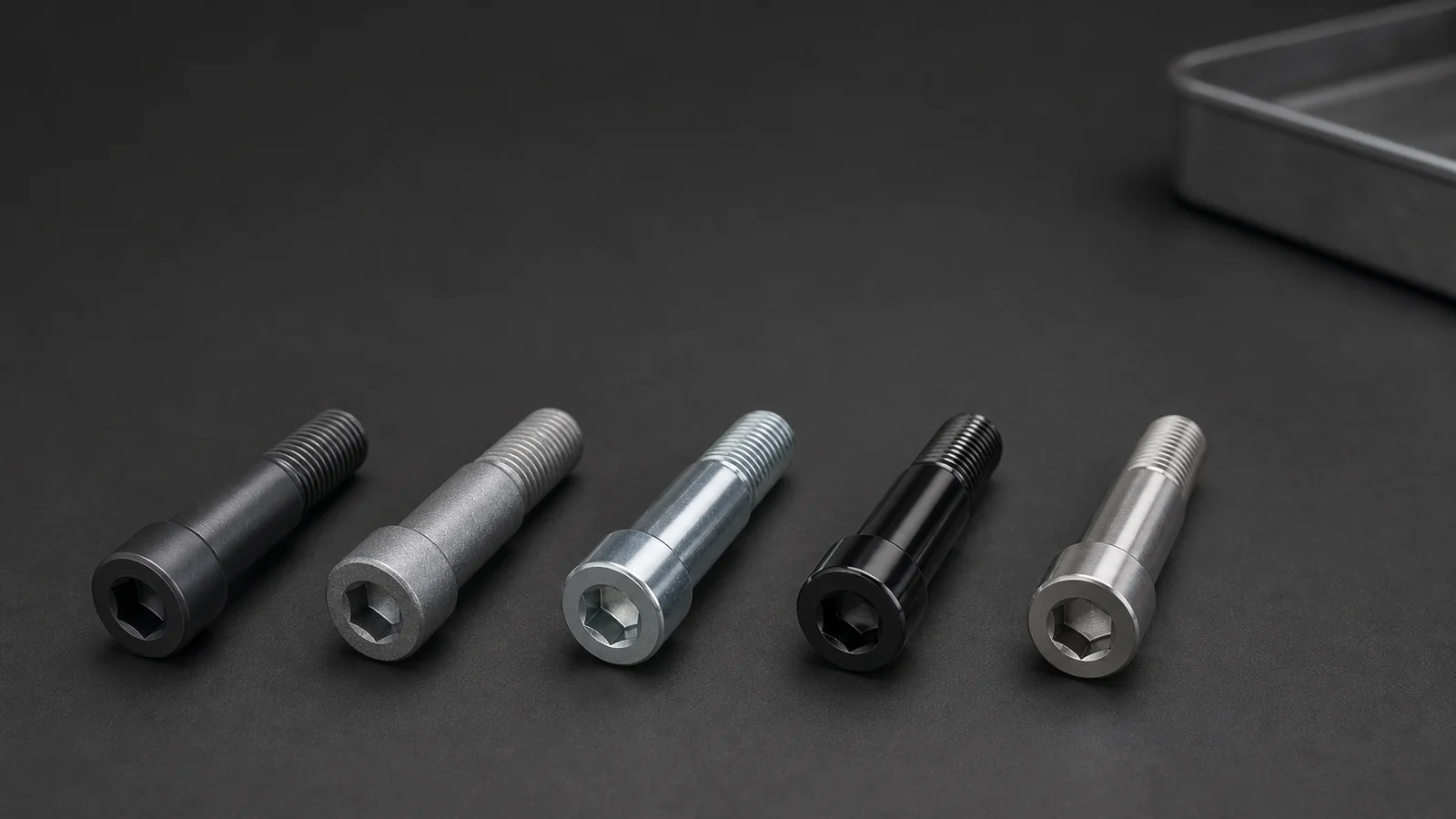
Why Coatings Matter for Bicycle Fasteners
A bolt is only as durable as its surface. Even 12.9-grade alloy steel — the strongest common fastener material — will rust within weeks of wet riding if left uncoated. The right surface treatment transforms a vulnerable steel bolt into a corrosion-resistant component that matches the lifespan of the frame itself.
But not all coatings are created equal. Each has a specific salt spray rating, cost profile, aesthetic finish, and environmental compliance profile. This guide breaks down the six coating technologies we deploy at PremFixer.
This is a deep-dive companion to our Surface Treatment Hub — the pillar guide covers coating selection by application, carbon-safe options, and the complete why behind each coating technology.
Coating Performance Comparison
| Coating | Salt Spray Rating | Color | Torque Adjustment | Relative Cost | Best For |
|---|---|---|---|---|---|
| Dacromet (Zn-Al) | 600–1,000 h | Silver-gray | None | $$ | DH, MTB, high-corrosion |
| Zn-Ni Alloy | 400–720 h | Silver / Black | None | $ | Mass production, automotive-grade |
| ED Black Zinc | 96–200 h | Deep black | None | $ | Aesthetic, urban, indoor-stored |
| DLC (Diamond-Like Carbon) | 300+ h | Iridescent black | +0.05μ adjustment | $$$ | Drivetrain, low-friction wear surfaces |
| TiN (Titanium Nitride) | 300+ h | Gold | +0.05μ adjustment | $$$ | Drivetrain, decorative premium |
| Passivation (Stainless) | N/A (inherent) | Natural metal | None | $ | 316SS & 304SS bolts |
Torque Retention: The Overlooked Coating Metric
Salt spray rating tells you when a bolt will rust. Torque retention tells you when it will loosen — and in a bolted joint, loosening can be more dangerous than rust. Different coatings affect the friction coefficient between threads, which directly impacts how well the joint maintains clamp load over thermal cycling and vibration.
We tested M8×1.25 hex bolts with six coating types through 500 thermal cycles (−20 °C to +80 °C) while recording clamp load decay. Torque retention is expressed as the percentage of initial tightening torque remaining after test completion:
| Coating | Friction Coefficient (μ) | Torque Retention (%) | Clamp Load Loss (%) | Risk of Loosening |
|---|---|---|---|---|
| Dacromet (Zn-Al) | 0.12–0.15 | 92 | <5 | Minimal |
| Zn-Ni Alloy | 0.14–0.18 | 88 | 6–10 | Low |
| ED Black Zinc | 0.18–0.22 | 82 | 10–15 | Low–Moderate |
| DLC | 0.05–0.10 | 96 | <3 | Minimal |
| TiN | 0.40–0.50 | 70 | 20–25 | Moderate |
| Zinc Plating (ref.) | 0.20–0.25 | 65 | 25–35 | Moderate–High |
Engineering note: DLC delivers the highest torque retention but at 3–4× the cost of Dacromet. For structural bicycle fasteners, Dacromet offers the best balance: 92% retention, chromium-free compliance, and no hydrogen embrittlement risk on 12.9-grade steel. Zinc plating is included as a reference baseline — it should not be used on any safety-critical bicycle bolt.
1. Dacromet (Zinc-Aluminum Flake) — Maximum Corrosion Protection
Best for: 12.9-grade steel bolts on DH, enduro, and all-weather MTB frames.
Dacromet is a non-electrolytic zinc-aluminum flake coating that delivers 600–1,000 hours of salt spray resistance — the highest among common steel bolt coatings. It is chromium-free (RoHS compliant), has no hydrogen embrittlement risk (critical for 12.9-grade bolts), and provides consistent torque-tension without requiring a friction coefficient adjustment.
When to use: Every time you specify 12.9-grade steel for a bicycle application exposed to moisture. PremFixer defaults to Dacromet on all 12.9 pivot and brake bolts.
2. Zn-Ni Alloy Plating — Production-Volume Workhorse
Best for: Mid-volume OEM production where cost and corrosion resistance must balance.
Zinc-Nickel alloy electroplating (typically 12–15% Ni) offers 400–720 hours of salt spray protection at a lower cost than Dacromet. Available in silver or black passivated finishes. Widely used in automotive fasteners and increasingly adopted by bicycle OEMs.
3. ED Black Zinc — Best Aesthetic Value
Best for: Consumer-facing bolts where appearance matters — stem bolts, seatpost hardware, visible frame bolts.
Electrodeposited black zinc delivers a deep, uniform black finish at low cost. Its salt spray rating (96–200h) is lower than Dacromet or Zn-Ni, making it suitable for dry-climate and indoor-stored applications. For OEM programs, confirm coating appearance, corrosion requirements, thread fit, and assembly conditions in the drawing package.
4. DLC — Performance Coating for Wear Surfaces
Best for: Chainring bolts, derailleur pivot bolts, and rotating assembly fasteners where reduced friction extends component life.
Diamond-Like Carbon is a PVD-applied coating with exceptional hardness (2,000–3,000 HV) and a low coefficient of friction (0.05–0.10). It reduces thread galling in titanium bolts and extends the service interval of drivetrain fasteners.
5. Passivation — For Stainless Steel Only
Best for: All A2-70 and A4-70 stainless steel fasteners.
Passivation is not a coating — it's a chemical treatment that removes free iron from the stainless steel surface, enhancing the natural chromium oxide layer. All PremFixer stainless bolts receive passivation as standard. No additional coating is required for 316SS or 304SS.
How to Specify Coating on Your BOM
Coating is a specification item on every PremFixer production order. Include one of the following in your fastener BOM:
SURFACE: DACROMET— for 12.9-grade structural boltsSURFACE: ZN-NI BLACK— for OEM volume productionSURFACE: ED BLACK— for consumer-facing aesthetic boltsSURFACE: DLC— for drivetrain and rotating assembly fastenersSURFACE: PASSIVATED— for all stainless steel bolts
Explore Related PremFixer Products
Request Coating Specification Sheet
Need a detailed coating recommendation for your fastener BOM? Our engineers will analyze your application and return coating specs within 48 hours.
Request Coating Specs