
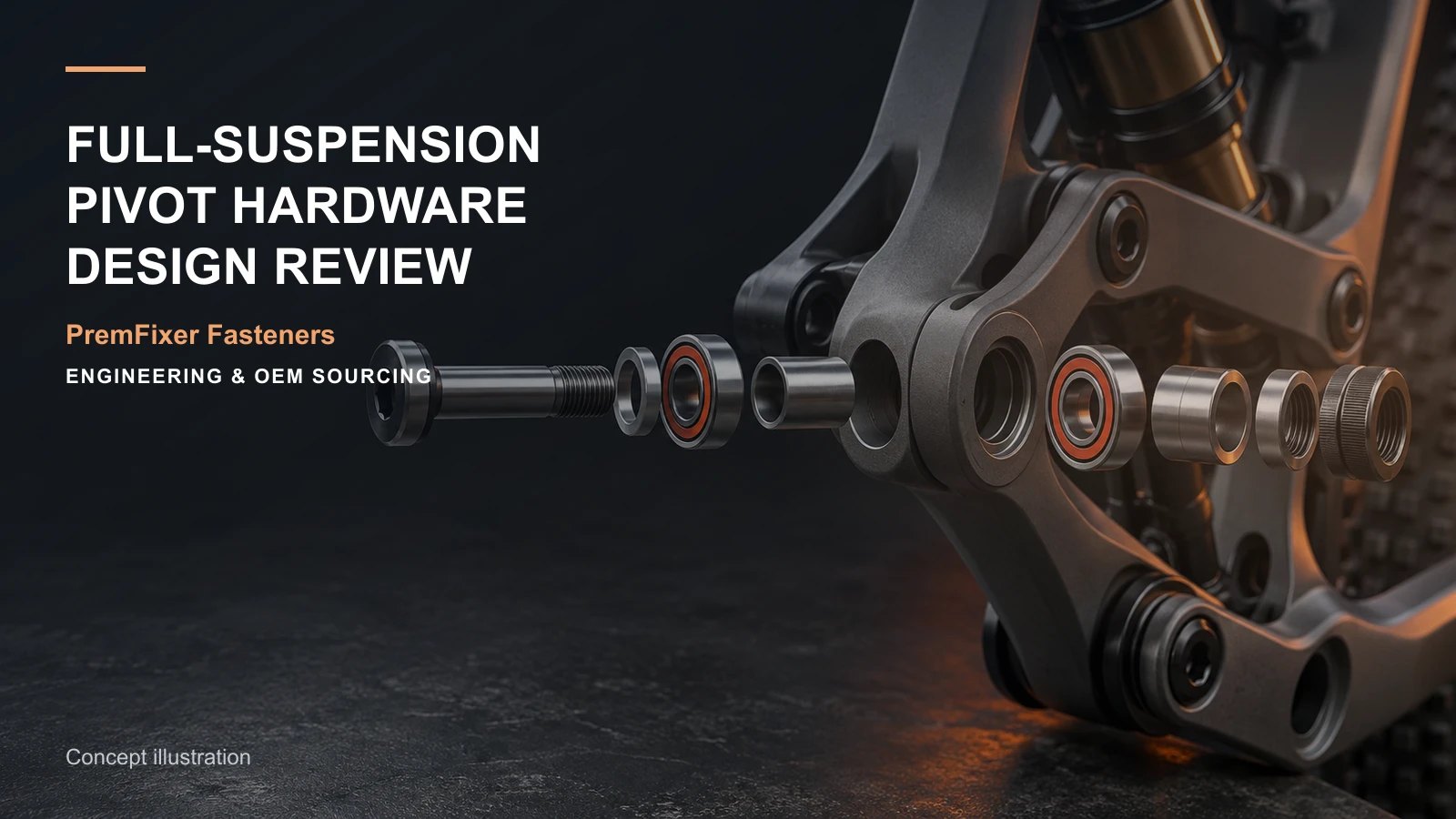
A rider may report play, drag, noise or early wear at the same pivot location, yet each symptom can originate from a different interface. Replacing the axle or tightening the bolt without reconstructing the stack can mask the symptom while leaving the assembly definition unresolved.
Full-suspension frame designers need to review the axle, bearings, spacers, frame and locking method as one assembly. The review should use the current drawing, BOM and project stage so that the recommendation applies to a real component or release.
Use this case as the working baseline: a linkage has correct nominal dimensions but develops side load after tightening. Each section turns one part of the case into a reviewable project output.
Describe the symptom without guessing the cause
Record play, binding, noise and wear as separate observations with assembly state and service history. A precise symptom description prevents the investigation from starting with an assumed bad dimension.
Build the working record around Observed symptom, Assembly state, Service history and Affected position. The practical output is a symptom register tied to the actual platform.
For the "Describe the symptom without guessing the cause" review, put symptom, component stack, contact path, assembly state on the same sheet. Name the current revision, the decision owner and the condition that allows the part or program to move forward. The technical discussion then has a clear purchasing and release action.
Do not assign the cause to one component before the stack is reviewed.
Reconstruct the pivot interface
Map the installed order and contact relationships among the axle, bearings, sleeve, spacers, locking end and frame. The same part can locate radially, control an axial stack or simply transmit clamp load.
Keep the review anchored to Installed order, Radial contact, Axial contact and Locking end. The practical output is an assembly-level interface map.
Under "Reconstruct the pivot interface," compare the current and proposed conditions using Installed order, Radial contact, Axial contact, Locking end. Record the evidence source and any item that remains open. The buyer should be able to approve, reject or sample a specific supplier proposal.
Do not discuss a fastener tolerance without the mating dimensions and contact sequence.
| Review stage | Project question | Inputs to connect | Expected output |
|---|---|---|---|
| 01 | Describe the symptom without guessing the cause | Observed symptom / Assembly state / Service history / Affected position | a symptom register tied to the actual platform |
| 02 | Reconstruct the pivot interface | Installed order / Radial contact / Axial contact / Locking end | an assembly-level interface map |
| 03 | Review geometric alignment and contact | Datum relationship / Alignment feature / Clearance location / Wear surface | a prioritized list of geometric questions |
| 04 | Develop an improvement proposal | Affected part / Manufacturing suggestion / Design change / Approval path | a controlled improvement matrix by component |
| 05 | Use platform references without copying designs | Reference function / Own interface / Different constraint / Design owner | a function-based benchmark note |
| 06 | Bring the revised system into prototype discussion | Current configuration / Proposed configuration / Sample quantity / Assembly question | a revision-controlled pivot prototype brief |
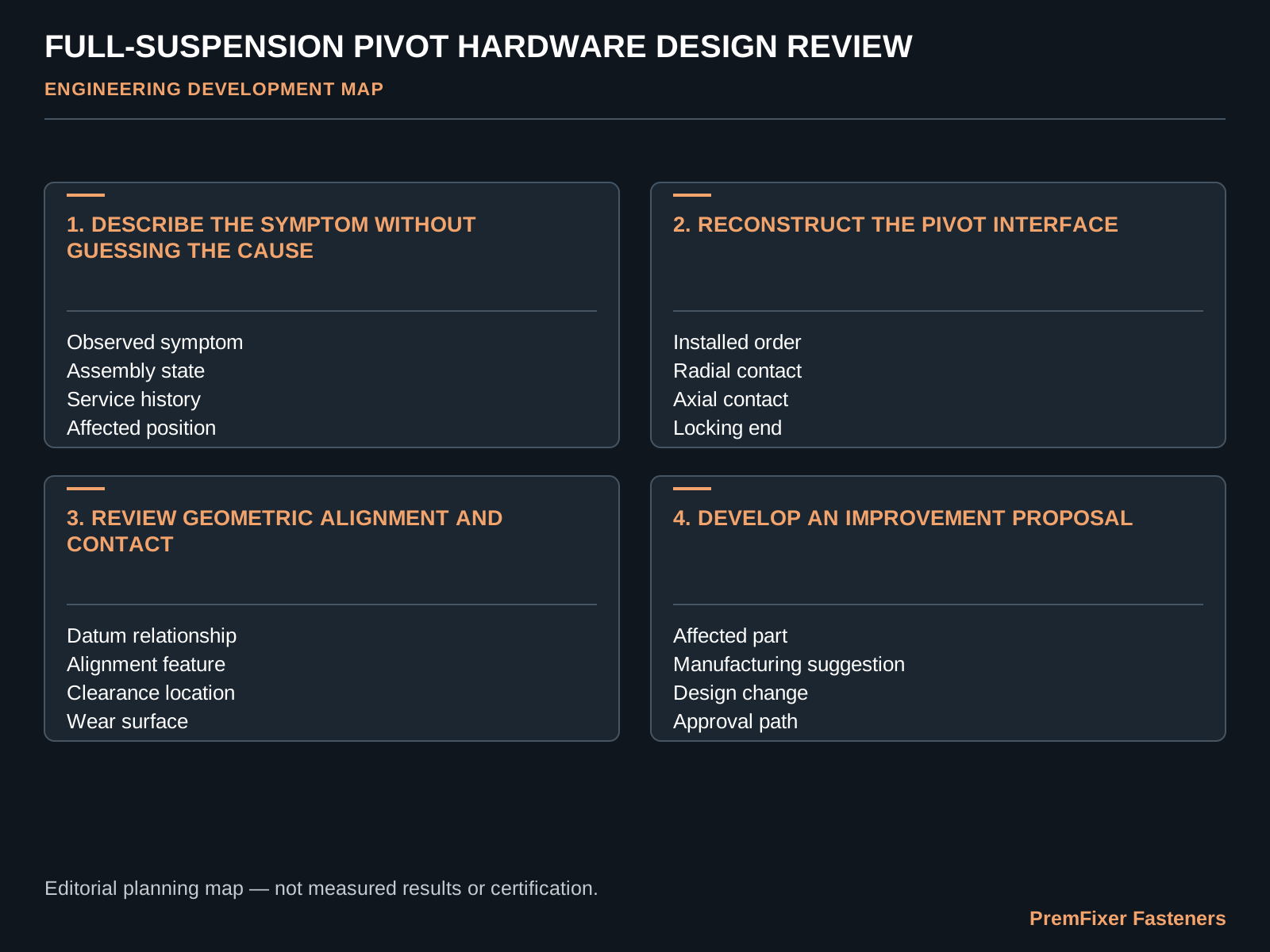
Review geometric alignment and contact
Evaluate alignment, running contact, clearance and wear surfaces against the approved drawing and assembly intention. A universal tolerance cannot replace the complete stack and datum relationship.
Put the following fields on the same revision-controlled page: Datum relationship, Alignment feature, Clearance location and Wear surface. The practical output is a prioritized list of geometric questions.
In "Review geometric alignment and contact," follow symptom, component stack, contact path, assembly state through the relevant handoff. The output from one operation or team should be a usable input for the next. Missing ownership at that boundary often causes more disruption than the operation itself.
Keep numeric limits specific to the drawing and measurement method.
Develop an improvement proposal
Separate manufacturing suggestions from changes to the product structure and assembly instruction. The approval path differs even when both appear on the same marked-up drawing.
Build the working record around Affected part, Manufacturing suggestion, Design change and Approval path. The practical output is a controlled improvement matrix by component.
Use symptom, component stack, contact path, assembly state to define the sample question for "Develop an improvement proposal." The sample record should state what represents production, what is temporary and which decision follows the review. A conforming sample without that context can still leave the production route unsettled.
Do not release a structural change as a shop-floor adjustment.
Use platform references without copying designs
Publicly visible pivot layouts can suggest questions about stack organization, but they do not establish compatibility or permission to copy geometry. A useful reference identifies a function rather than imitating a branded shape.
Keep the review anchored to Reference function, Own interface, Different constraint and Design owner. The practical output is a function-based benchmark note.
After "Use platform references without copying designs," carry symptom, component stack, contact path, assembly state into repeat orders and service planning. Approved conditions should remain visible in stock, inspection records and packaging so that later lots do not depend on personal memory.
Do not imply supplier status, authorization or universal interchangeability.
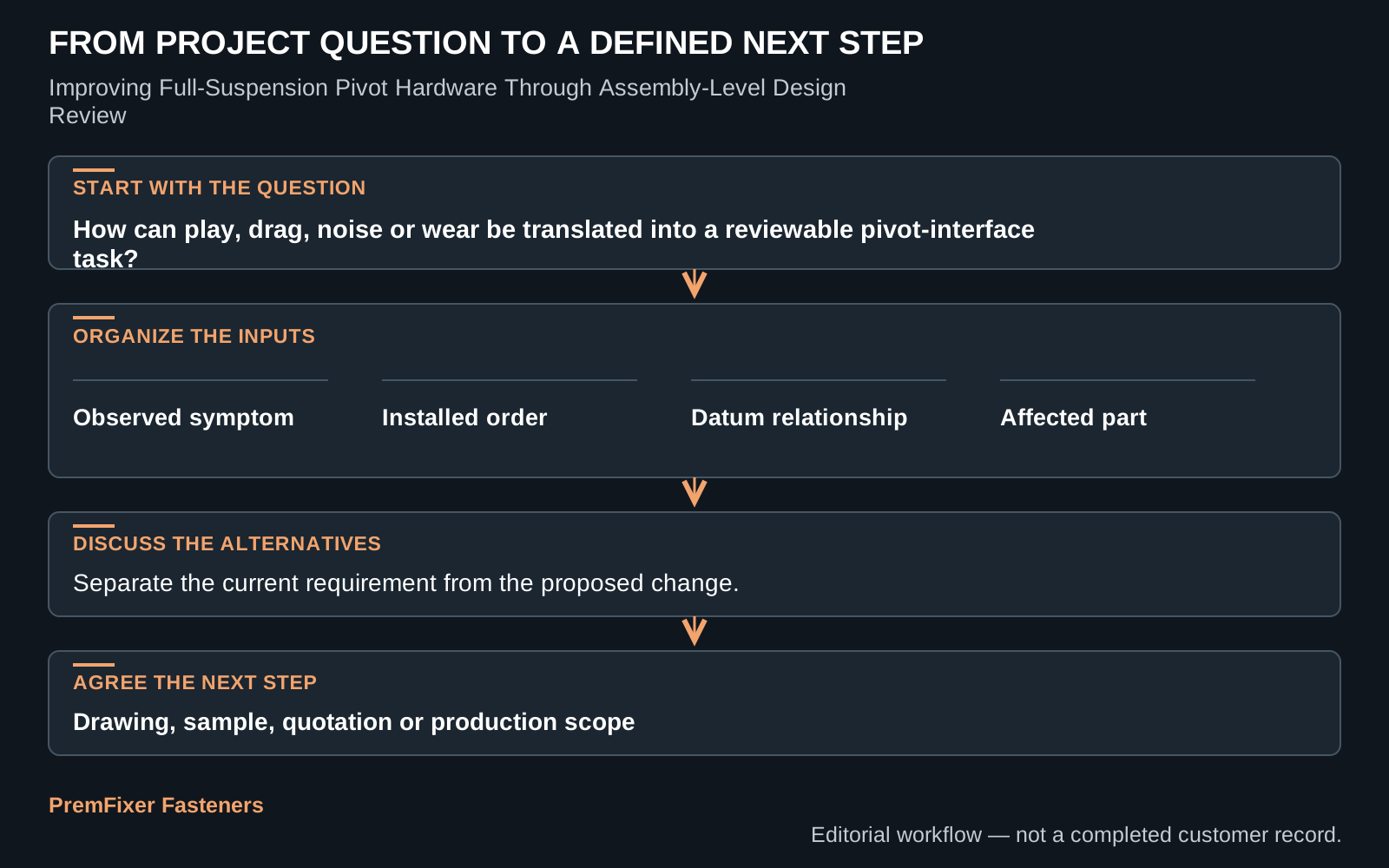
Bring the revised system into prototype discussion
Compare the current and proposed configurations through drawings, BOM identity, sample quantity and named assembly questions. This keeps prototype feedback linked to the correct stack.
Put the following fields on the same revision-controlled page: Current configuration, Proposed configuration, Sample quantity and Assembly question. The practical output is a revision-controlled pivot prototype brief.
Convert the result of "Bring the revised system into prototype discussion" into a quotation line that identifies symptom, component stack, contact path, assembly state. Ask the supplier to state included work, customer inputs, open assumptions and release evidence. Alternative offers are easier to compare when scope is not hidden inside one unit price.
Prototype work should answer defined interface questions rather than substitute for vehicle-level approval.
Check the decision against a production scenario
A production scenario gives the discussion a clear boundary: a linkage has correct nominal dimensions but develops side load after tightening. State the model, volume stage, revision and destination before comparing alternatives.
For improving full-suspension pivot hardware through assembly-level design review, list the decisions that the customer has already made and the items still open to supplier input. Each open item should have one owner and one expected output.
Part drawings can pass independently while the stack, clearances or clamp path remain wrong. Test the control where the issue can first be detected, then decide how the accepted condition will remain visible during repeat orders.
Use the pilot result for improving full-suspension pivot hardware through assembly-level design review to update the drawing, BOM, process or packing record. Avoid carrying an informal email decision into production when the controlled file still says something else.
Start the quotation with the frame and linkage section, bearing data, stack dimensions, tightening method and service access. Ask for inclusions, exclusions, one-time work and the evidence supplied with the sample or lot.
Questions buyers ask
What baseline should the OEM freeze first?
Fix the drawing and project state that frame the decision, then review the axle, bearings, spacers, frame and locking method as one assembly. A recommendation without that baseline may solve a different configuration.
Which commercial inputs change the answer?
Provide the frame and linkage section, bearing data, stack dimensions, tightening method and service access, including any requirement that is still open to supplier feedback. That distinction prevents assumptions from being priced as approved scope.
How does the team close an open point?
A linkage has correct nominal dimensions but develops side load after tightening. Use the pilot to examine that condition rather than treating one conforming part as approval of the complete route.
What can make an accepted part fail in the program?
Part drawings can pass independently while the stack, clearances or clamp path remain wrong. The review should show where the issue can be detected and who can stop the next release.
When should PremFixer join the discussion?
For this improving full-suspension pivot hardware through assembly-level design review decision, PremFixer can return clarification questions, a proposed route and the records expected at sample or production release.
Review the complete pivot assembly
Share the frame and linkage section, bearing data, stack dimensions, tightening method and service access. The response will identify the proposed scope, open questions and the evidence needed before release.
Discuss This Project