
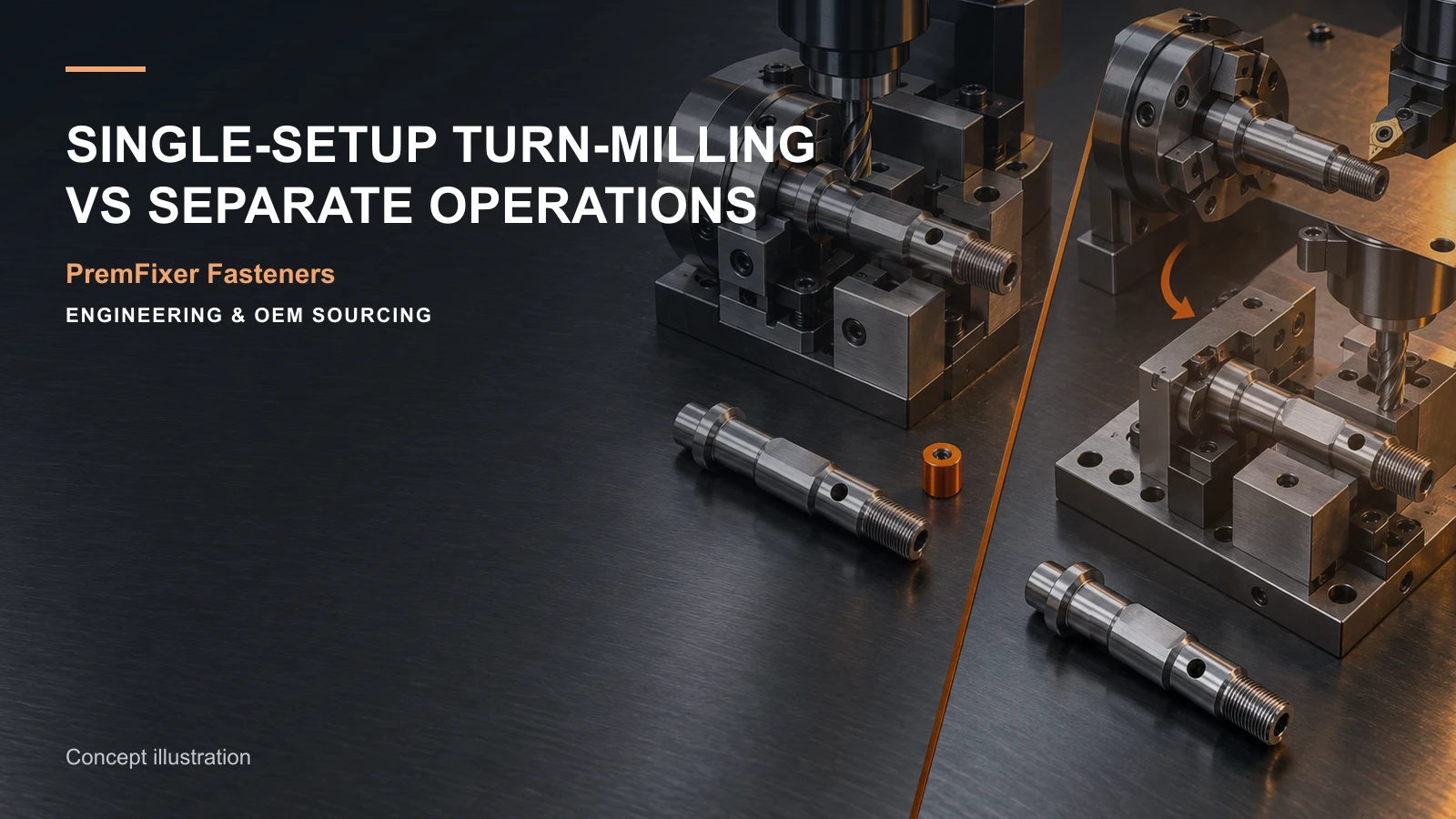
A multi-feature bicycle axle may combine turned diameters, shoulders, threads, flats, cross-holes or other milled features. Producing selected features in one turn-mill setup can reduce transfers and preserve a shared workholding reference. That is a meaningful process advantage when the drawing depends on relationships between those features.
It is not the same as zero machining error. Tool access, cutting forces, thermal conditions, workholding, tool condition and measurement still matter. Separate turning and milling operations can also produce an acceptable axle when the re-clamping route re-establishes the required datum relationships and verifies the result.
Consider this working situation: a pivot pin needs a turned bearing diameter and a cross feature clocked to the head interface. It connects the topic to the records, approvals and quotation inputs the program needs.
Define the comparison before comparing the price
Why consider single-setup machining for a multi-feature axle? It may let selected turned and milled features share one setup and reduce the number of times the part must be relocated. This can simplify control of a feature relationship, but only when those features, datums and requirements are clear on the drawing.
Compare the same component revision, stock condition, material, finish, quantity and delivered inspection scope. Then ask each route to show its operation sequence. A single-setup quote that excludes a difficult later feature is not comparable with a separate-operation quote that includes it, and a difference in inspection scope can be as important as a difference in machining sequence.
For the "Define the comparison before comparing the price" review, put single setup fastener coaxiality, turn-mill bicycle axle, re-clamping datum control, custom axle machining on the same sheet. Name the current revision, the decision owner and the condition that allows the part or program to move forward. The technical discussion then has a clear purchasing and release action.
Price should be read after the routes are aligned. Integrated machining may require a capable machine, programming and tool access that are justified by the part geometry.
Compare integrated and separate operations
Start by marking the features that can be produced from the same workholding reference. Turned bearing seats, shoulders and a concentric thread may be natural candidates for a turning sequence. A flat or cross-hole may be added with live tooling where access and stability permit. One setup still contains multiple tools, cuts and intermediate states; it is not one operation in the everyday sense.
For the separate route, identify where the turned blank leaves the first machine, how it is protected, what surface locates it in the next fixture and which features are then milled. This route can be technically sound. Its control plan simply needs to make the transfer and its checks visible.
Under "Compare integrated and separate operations," compare the current and proposed conditions using single setup fastener coaxiality, turn-mill bicycle axle, re-clamping datum control, custom axle machining. Record the evidence source and any item that remains open. The buyer should be able to approve, reject or sample a specific supplier proposal.
Final inspection remains part of both routes. Producing features together can reduce one source of variation, but it does not establish conformance by itself.
| Route field | Integrated turn-milling | Separate operations |
|---|---|---|
| Features machined together | Identify the turned and milled features that share the chosen setup reference. | Identify which feature group is completed before the transfer. |
| Transfers | Show any remaining reorientation, secondary process or later handling step. | Name each re-clamping point and the datum re-established there. |
| Tool access | Confirm reach, clearance, support and sequence inside the integrated route. | Confirm fixture access and protection of finished surfaces in each operation. |
| Final inspection | Measure the drawing requirement after all relevant operations are complete. | Use the same acceptance requirement and a method suited to the finished part. |
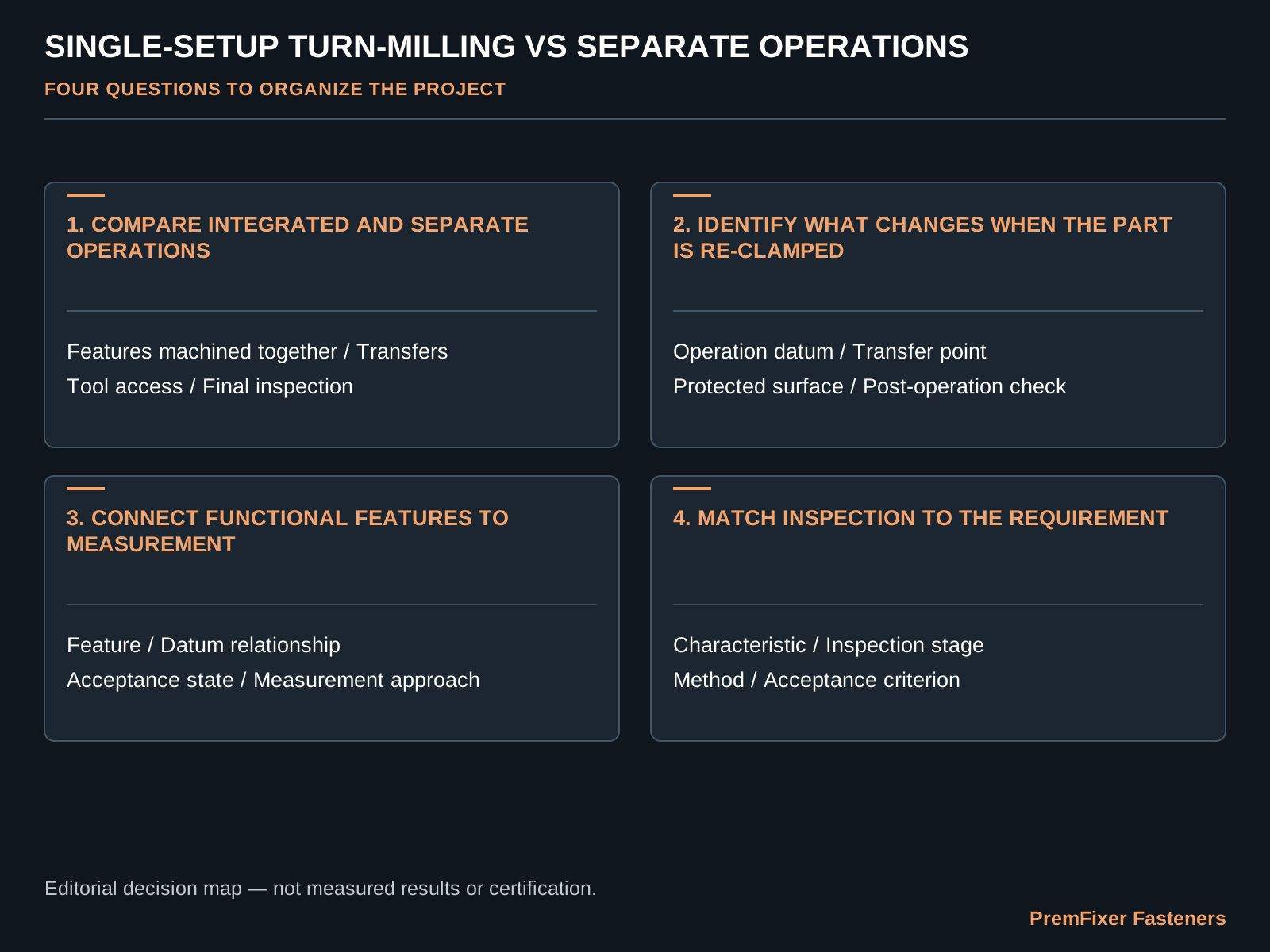
Identify what changes when the part is re-clamped
Re-clamping replaces or re-establishes a locating relationship. The second fixture may locate from a turned diameter, a face, centers, soft jaws or another designed reference. The important question is how that operation datum relates to the feature that the drawing uses as its datum or controlled element.
Record the transfer point, the protected surface and the post-operation check. A finished diameter used for relocation may need suitable contact and protection. A face used as an axial stop may need cleanliness and controlled seating. Those are process details to manage, not evidence that every transferred part will fail.
In "Identify what changes when the part is re-clamped," follow single setup fastener coaxiality, turn-mill bicycle axle, re-clamping datum control, custom axle machining through the relevant handoff. The output from one operation or team should be a usable input for the next. Missing ownership at that boundary often causes more disruption than the operation itself.
A single-setup route reduces selected re-location events, yet the part may still be reversed, parted off, deburred, finished or inspected in later stages. Describe the actual sequence rather than treating the process name as a complete control plan.
| Transfer record | Question to answer | Control output |
|---|---|---|
| Operation datum | Which surface or feature locates the part in this operation? | A named reference linked to the fixture or workholding plan. |
| Transfer point | When is the original setup relationship released and re-established? | A visible step in the operation sequence. |
| Protected surface | Which finished or functional surface contacts the next fixture? | A handling and contact plan appropriate to that surface. |
| Post-operation check | Which relationship could be affected by the transfer? | An in-process or finished-part check tied to the drawing requirement. |
Connect functional features to measurement
A useful requirement identifies the feature, its datum relationship, the condition of the part and the acceptance method. A size tolerance controls size; a geometric requirement controls a defined relationship; assembly clearance is the result of several components and conditions. These terms should not be treated as interchangeable versions of precision.
Avoid using a single small plus-or-minus value as a general promise for every feature. The shoulder length, bearing-seat diameter, thread, flat position and cross-hole may have different functional jobs and therefore different ways to specify and inspect them. Apply tighter control where function requires it, not as decoration across the drawing.
Use single setup fastener coaxiality, turn-mill bicycle axle, re-clamping datum control, custom axle machining to define the sample question for "Connect functional features to measurement." The sample record should state what represents production, what is temporary and which decision follows the review. A conforming sample without that context can still leave the production route unsettled.
Measurement planning should be discussed while the drawing is being interpreted. If a relationship is difficult to access after finishing or assembly, the team can agree an appropriate state and method before production.
| Requirement field | What to define | Why it matters |
|---|---|---|
| Feature | The diameter, face, thread, flat, hole or other controlled element. | Prevents a general precision claim from replacing the actual requirement. |
| Datum relationship | The reference feature or datum system used to locate the requirement. | Connects manufacture and measurement to the same interpretation. |
| Acceptance state | Machined, finished, free-state or another agreed condition. | Clarifies when the requirement applies. |
| Measurement approach | A method capable of evaluating the specified characteristic. | Lets both parties plan inspection without inventing a machine-based guarantee. |
Match inspection to the requirement
First-piece, in-process and final inspection serve different purposes. A first-piece review can confirm the setup and interpretation before the run continues. In-process checks can monitor selected characteristics or process drift. Final inspection supports release of the finished parts against the agreed drawing and sampling or inspection plan.
For each characteristic, name the stage, method and acceptance criterion. If every piece is checked for one diameter, describe that scope precisely. It does not mean every dimension, geometric relationship, finish property or fatigue behavior has received one-hundred-percent testing.
After "Match inspection to the requirement," carry single setup fastener coaxiality, turn-mill bicycle axle, re-clamping datum control, custom axle machining into repeat orders and service planning. Approved conditions should remain visible in stock, inspection records and packaging so that later lots do not depend on personal memory.
Equipment names can help explain capability, but they are not acceptance results. The useful evidence is a record that links the measured characteristic, part revision, inspection state and requirement.
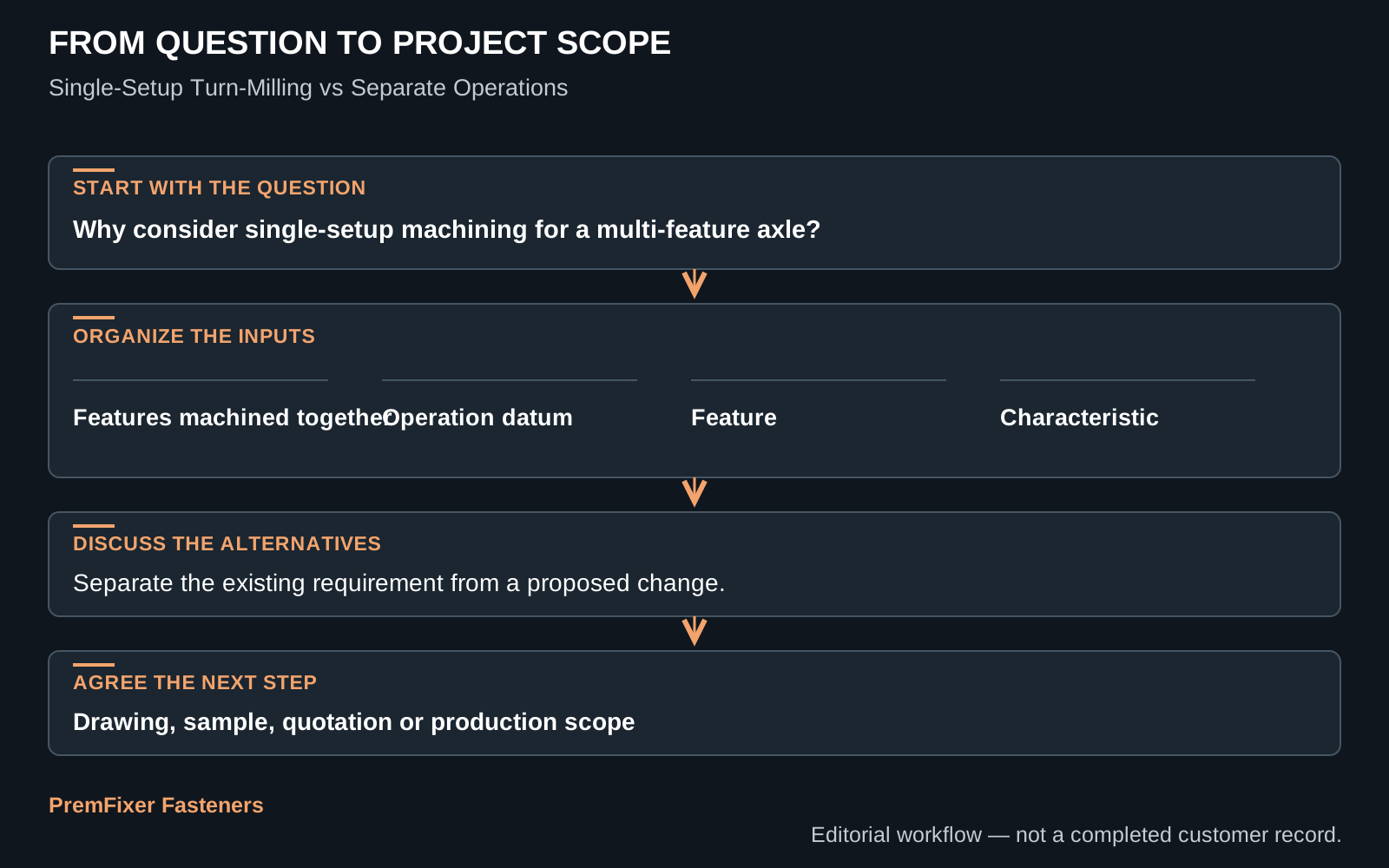
Apply the discussion to a PremFixer Fasteners project
PremFixer Fasteners can begin with an available drawing, model, BOM or sample description, together with quantity and project stage. Mark the features whose relationships matter, the drawing datums already defined and any operation or inspection question that remains open.
The manufacturing discussion can then compare features machined together, transfer points, tool access and inspection stages. A proposal should separate the released requirement from a suggested process alternative so the customer can approve the route without losing control of the component definition.
Convert the result of "Apply the discussion to a PremFixer Fasteners project" into a quotation line that identifies single setup fastener coaxiality, turn-mill bicycle axle, re-clamping datum control, custom axle machining. Ask the supplier to state included work, customer inputs, open assumptions and release evidence. Alternative offers are easier to compare when scope is not hidden inside one unit price.
Share your available drawings, BOM or project description with PremFixer Fasteners, together with quantities and the project stage, to discuss single-setup axle machining.
Check the decision against a production scenario
A production scenario gives the discussion a clear boundary: a pivot pin needs a turned bearing diameter and a cross feature clocked to the head interface. State the model, volume stage, revision and destination before comparing alternatives.
For single-setup turn-milling vs separate operations: axis-relationship control, list the decisions that the customer has already made and the items still open to supplier input. Each open item should have one owner and one expected output.
Single setup can simplify datum continuity, while separate operations need a deliberate transfer and verification plan. Test the control where the issue can first be detected, then decide how the accepted condition will remain visible during repeat orders.
Use the pilot result for single-setup turn-milling vs separate operations: axis-relationship control to update the drawing, BOM, process or packing record. Avoid carrying an informal email decision into production when the controlled file still says something else.
Start the quotation with the 3D model, datums, geometric requirements, volume, tool access and inspection method. Ask for inclusions, exclusions, one-time work and the evidence supplied with the sample or lot.
Questions buyers ask
Where should the engineering review begin?
Select a machining route that protects the required relationship between turned and milled features. The comparison is credible only when every option uses the same part revision, quantity and delivered condition.
What information should the supplier receive?
The first package should contain the 3D model, datums, geometric requirements, volume, tool access and inspection method. It should also state the immediate decision the customer needs from the supplier response.
What must a prototype demonstrate?
Base the pilot on this situation: a pivot pin needs a turned bearing diameter and a cross feature clocked to the head interface. Record the representative operations and the approval that follows the result.
Which handoff deserves extra attention?
The main risk is that single setup can simplify datum continuity, while separate operations need a deliberate transfer and verification plan. Put one person in charge of the related drawing, handoff or release action.
What output should the RFQ request?
For single-setup turn-milling vs separate operations: axis-relationship control, PremFixer can organize the files and open points into a manufacturing, sample and quotation response for the defined component or hardware set.
Review the axis relationship
Share the 3D model, datums, geometric requirements, volume, tool access and inspection method. The response will identify the proposed scope, open questions and the evidence needed before release.
Discuss This Project