
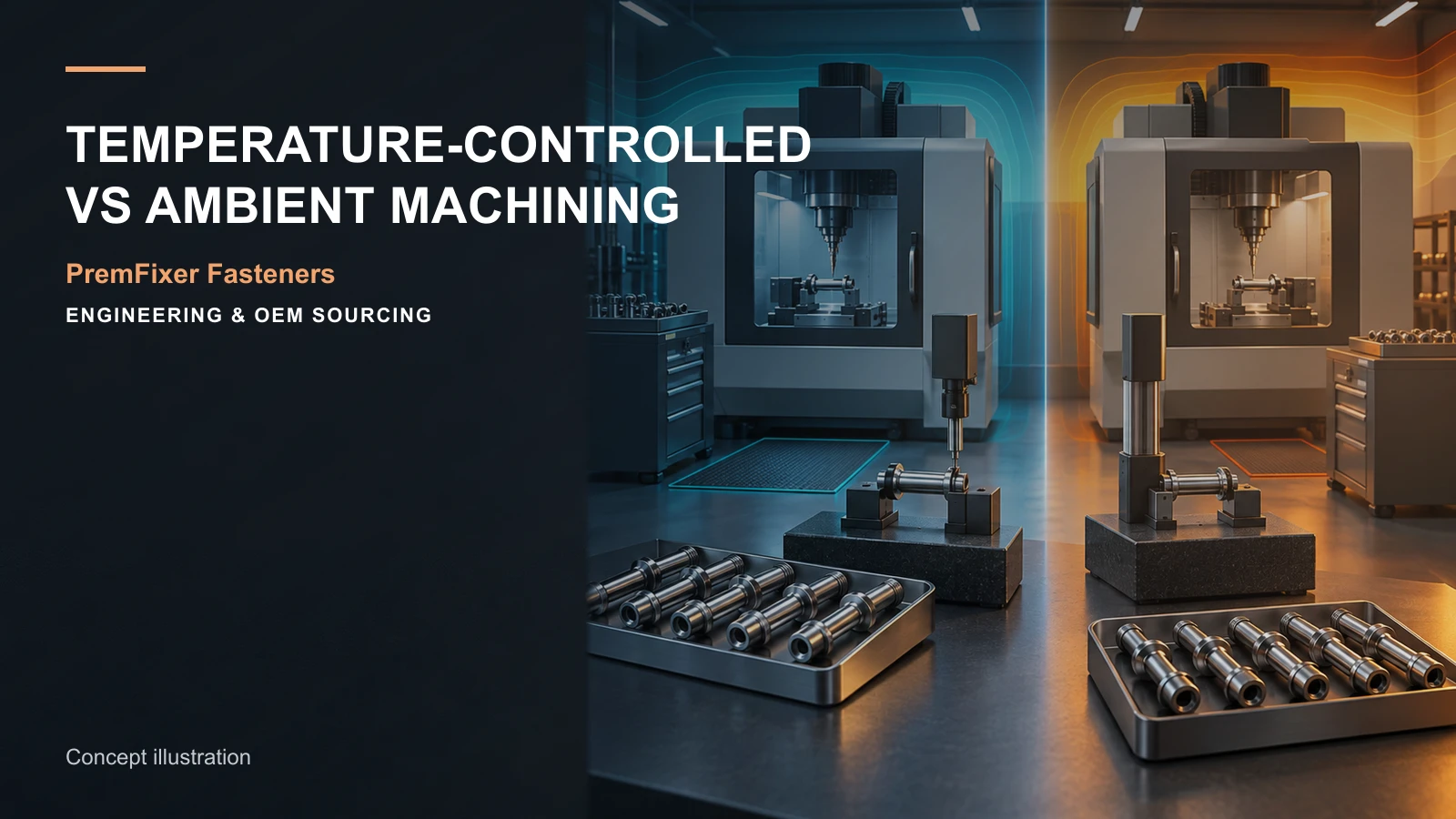
A stable workshop temperature can make seasonal production easier to compare, especially when bicycle hardware contains close-fitting shoulders, bearing seats or other functional interfaces. It cannot make every source of variation disappear. The workpiece, machine, tool, fixture and measuring equipment all have their own thermal state, and the part still has to be manufactured and inspected against a defined requirement.
Ambient machining can also produce conforming components. Its control plan may need to show more clearly when the part is stabilized, when offsets are reviewed and how inspection conditions are kept comparable. The useful purchasing question is not whether one room sounds more advanced. It is whether each proposal explains the conditions that affect the same part revision and the same acceptance decision.
Consider this working situation: a long pivot axle is measured soon after machining during a seasonal temperature change. It connects the topic to the records, approvals and quotation inputs the program needs.
Define the comparison before comparing the price
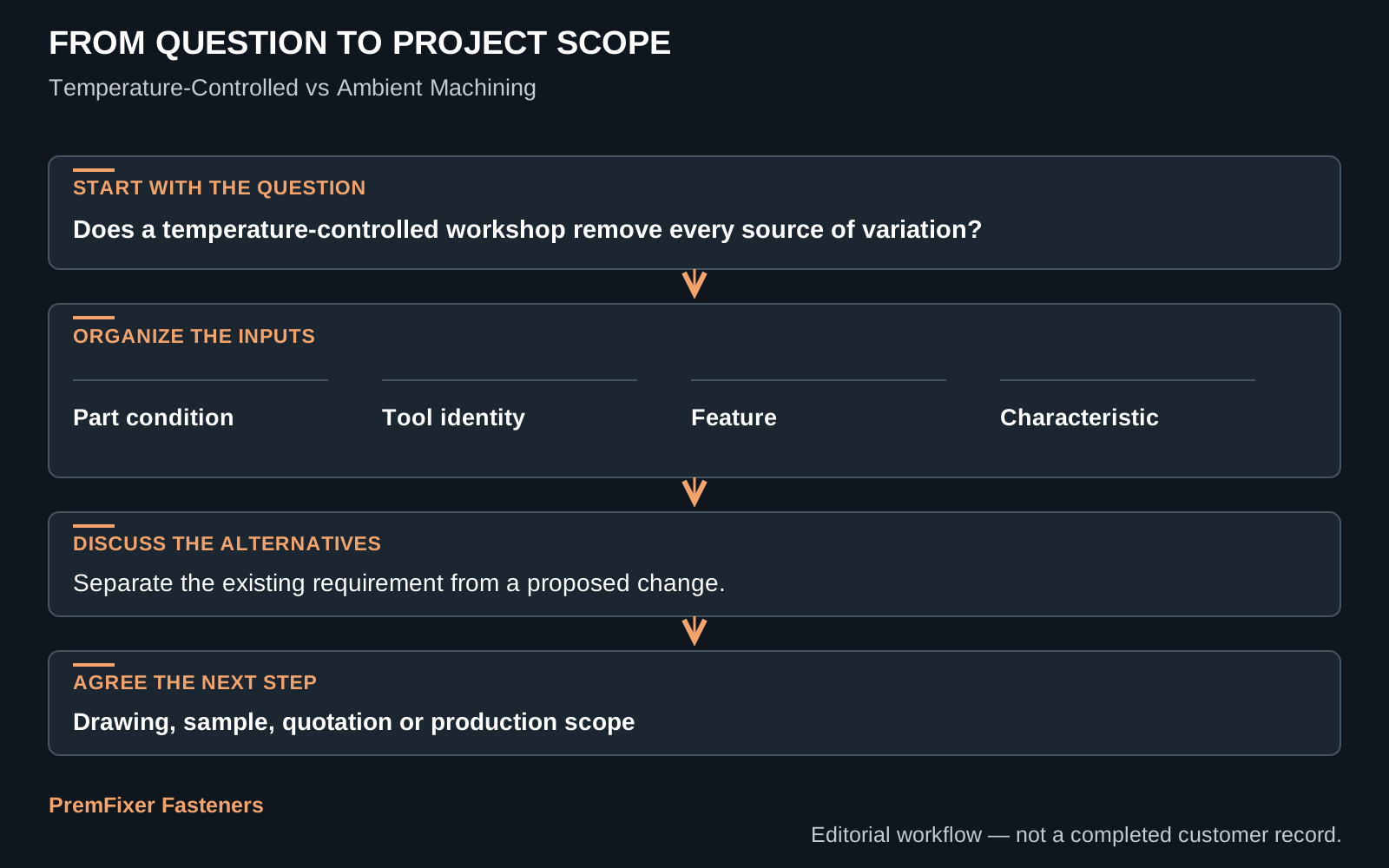
Does a temperature-controlled workshop remove every source of variation? No. It manages one part of the manufacturing environment. Tool wear, stock condition, cutting load, workholding, machine warm-up and measurement practice can still change a result. The comparison should therefore begin with the same drawing revision, material condition, quantity, finish and delivered inspection scope.
State which operations occur inside the controlled environment and which happen elsewhere. A component may be machined in one room, moved for deburring or finishing and measured in another. Ambient production may use a defined stabilization period or reference checks. Neither route can be understood from the room label alone; the actual sequence and acceptance state matter.
For the "Define the comparison before comparing the price" review, put temperature controlled bicycle fastener machining, ambient machining comparison, bicycle hardware batch accuracy, precision fastener temperature control on the same sheet. Name the current revision, the decision owner and the condition that allows the part or program to move forward. The technical discussion then has a clear purchasing and release action.
Price becomes meaningful after those boundaries are aligned. One offer may include documented environmental controls and restart checks, while another covers only machining and final sampling.
Treat temperature as part of the process
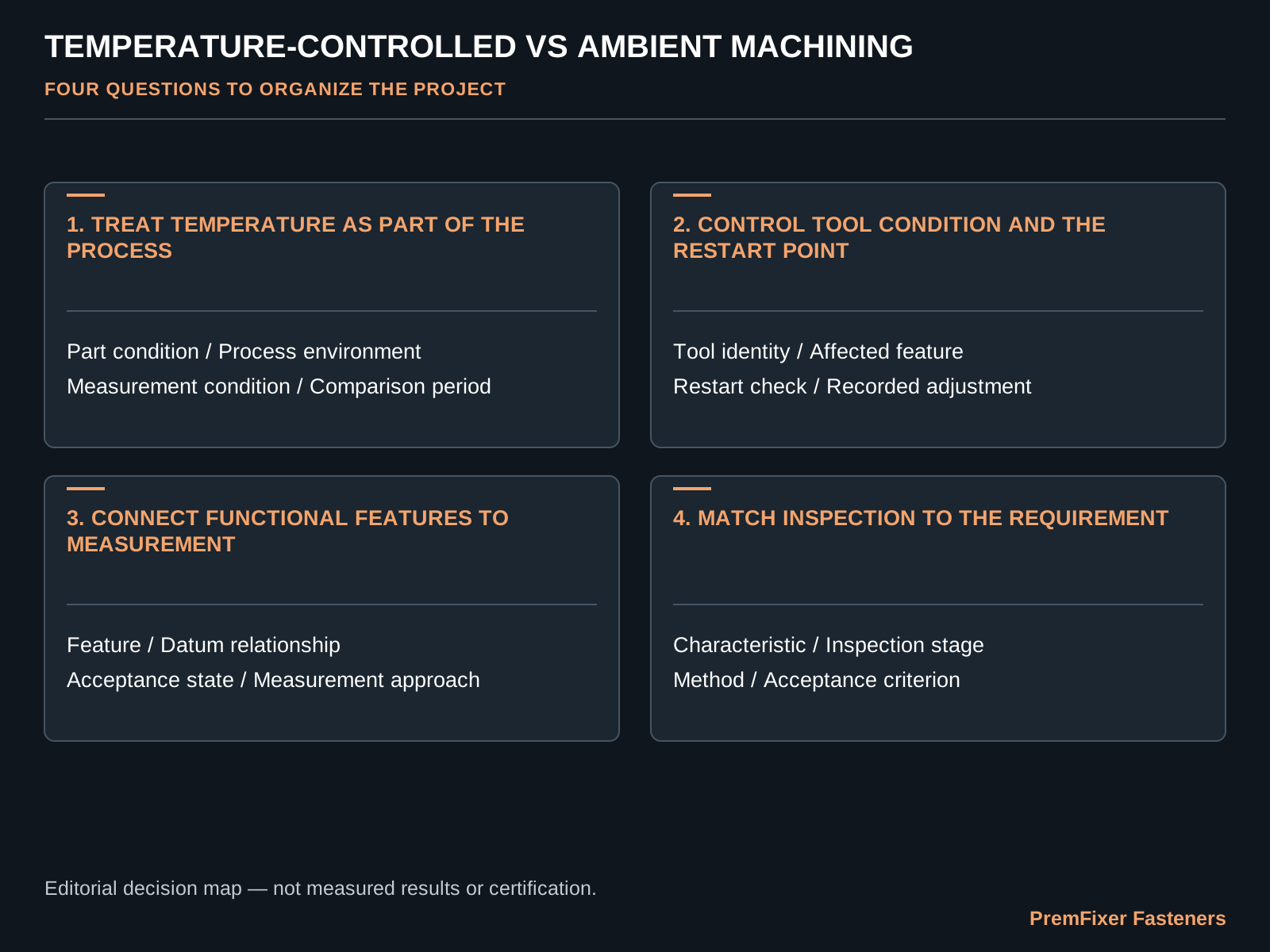
Metal dimensions respond to temperature, but a useful process record does not reduce the subject to room temperature alone. Record the condition of the stock and workpiece, the process environment, the measurement environment and the comparison period. Those fields let teams compare like with like without inventing an annual accuracy curve that the order has not produced.
The relevant thermal state depends on the feature and sequence. A freshly machined part can carry heat from cutting, while a large machine structure and a small fastener may reach equilibrium at different rates. The control plan should identify when a critical feature is produced and when it is measured, rather than assuming that every object instantly matches the room.
Under "Treat temperature as part of the process," compare the current and proposed conditions using temperature controlled bicycle fastener machining, ambient machining comparison, bicycle hardware batch accuracy, precision fastener temperature control. Record the evidence source and any item that remains open. The buyer should be able to approve, reject or sample a specific supplier proposal.
For repeat orders, preserve the agreed conditions with the part revision and manufacturing route. If the environment, stock form, machine family or measurement location changes, review the characteristics that could be affected.
| Thermal field | What to record | Decision supported |
|---|---|---|
| Part condition | Stock or finished state and the point in the operation sequence. | Whether compared measurements describe equivalent part conditions. |
| Process environment | The environment relevant to the machining stage under review. | Which source of thermal variation the route is intended to manage. |
| Measurement condition | Where and in what stabilized state the characteristic is checked. | Whether results can be interpreted against the same acceptance state. |
| Comparison period | The batches, seasons or restart events being compared. | Whether a repeatability claim is based on a defined record set. |
Control tool condition and the restart point
Thermal control does not freeze the cutting process. An insert wears, a drill is replaced, an offset is adjusted and production may restart after a planned or unplanned stop. Each event can affect a different feature. A useful route names the tool, the characteristic it creates and the check required before normal production resumes.
The restart decision should follow the approved configuration. Confirm the program revision, workholding state, replacement-tool identity and applicable first-off check. If an adjustment is made, record what changed and which characteristic was reviewed. A locked program protects revision control; it should not prevent a controlled response to tool condition.
In "Control tool condition and the restart point," follow temperature controlled bicycle fastener machining, ambient machining comparison, bicycle hardware batch accuracy, precision fastener temperature control through the relevant handoff. The output from one operation or team should be a usable input for the next. Missing ownership at that boundary often causes more disruption than the operation itself.
This logic applies in both controlled and ambient workshops. The difference may be the number of environmental variables that must be considered, not whether restart discipline is necessary.
| Restart field | Question to answer | Useful record |
|---|---|---|
| Tool identity | Which insert, drill, tap or other tool changed? | A tool reference connected to the operation and part revision. |
| Affected feature | Which diameter, face, thread or edge can the tool influence? | A defined characteristic rather than a general machine check. |
| Restart check | What must be confirmed before the order continues? | A first-off or in-process result tied to the requirement. |
| Recorded adjustment | Was an offset, tool or setup value changed? | A controlled intervention with a clear reason and scope. |
Connect functional features to measurement
Batch accuracy has meaning only when it names the feature and its function. A bearing seat, shoulder length, thread and wrenching feature can require different controls. A single small plus-or-minus value does not describe coaxiality, runout, contact sequence or the clearance created by several mating components.
Define the feature, datum relationship, acceptance state and measurement approach together. A diameter checked before coating is not automatically equivalent to the same diameter after finishing. A geometric relationship measured in a fixture depends on how the part is established. Those details let manufacturing and quality teams interpret the drawing consistently.
Use temperature controlled bicycle fastener machining, ambient machining comparison, bicycle hardware batch accuracy, precision fastener temperature control to define the sample question for "Connect functional features to measurement." The sample record should state what represents production, what is temporary and which decision follows the review. A conforming sample without that context can still leave the production route unsettled.
Avoid tightening every dimension to make the offer appear more precise. Concentrate control on the surfaces that locate, clamp, seal or move relative to another component.
| Requirement field | What to define | Why it matters |
|---|---|---|
| Feature | The diameter, face, thread, flat or other controlled element. | Keeps a general accuracy claim from replacing the actual requirement. |
| Datum relationship | The reference used to establish position or orientation. | Connects manufacturing and measurement to one interpretation. |
| Acceptance state | Machined, finished, stabilized or another agreed condition. | Clarifies when the requirement applies. |
| Measurement approach | A suitable method and access condition for the characteristic. | Makes the proposed evidence comparable across routes. |
Match inspection to the requirement
First-piece, in-process and final inspection answer different questions. A first-piece check supports setup release. In-process checks monitor selected characteristics and process changes. Final inspection supports shipment against the drawing and agreed inspection plan. Listing all three stages does not mean every characteristic is measured at every stage.
For each important characteristic, name the stage, method and acceptance criterion. If every component is checked for one diameter, say exactly that. Do not expand the statement into a claim that every geometric, finish or durability characteristic has received complete inspection or destructive testing.
After "Match inspection to the requirement," carry temperature controlled bicycle fastener machining, ambient machining comparison, bicycle hardware batch accuracy, precision fastener temperature control into repeat orders and service planning. Approved conditions should remain visible in stock, inspection records and packaging so that later lots do not depend on personal memory.
Cross-season comparison is strongest when it uses the same revision, acceptance state and measurement logic. The record may then reveal whether a process needs attention without promising that every reading will be identical.
| Inspection field | Example scope | Boundary to preserve |
|---|---|---|
| Characteristic | A named diameter, length, thread or geometric relationship. | Do not substitute a general precision label. |
| Inspection stage | First-piece, in-process or final release. | Do not imply that one result covers every stage. |
| Method | A method capable of evaluating the defined characteristic. | Equipment names alone are not acceptance evidence. |
| Acceptance criterion | The drawing or agreed project requirement. | Do not create an unstated tolerance from process capability. |
Apply the discussion to a PremFixer Fasteners project
Begin with the drawing, BOM, model or sample description available for the component. Identify the functional features, delivered finish and quantity, then mark any temperature, restart or inspection concern already known. Open inputs can remain explicit rather than being converted into assumed tolerances.
PremFixer Fasteners can organize the discussion around the proposed machining sequence, relevant environmental controls, tool-change checkpoints and inspection state. The quotation can separate the released requirement from a suggested manufacturing alternative so that engineering retains control of the component definition.
Convert the result of "Apply the discussion to a PremFixer Fasteners project" into a quotation line that identifies temperature controlled bicycle fastener machining, ambient machining comparison, bicycle hardware batch accuracy, precision fastener temperature control. Ask the supplier to state included work, customer inputs, open assumptions and release evidence. Alternative offers are easier to compare when scope is not hidden inside one unit price.
Share your available drawing, BOM or project description with PremFixer Fasteners, together with quantities and the project stage, to discuss temperature-controlled fastener production.
Use a project example to test the proposal
Use one bounded work package to test the decision. A long pivot axle is measured soon after machining during a seasonal temperature change. Give the package a part list, revision, owner and required completion state.
For temperature-controlled vs ambient machining: batch accuracy for bicycle hardware, ask engineering to mark the functional interfaces and purchasing to define the quoted delivery unit. Quality can then identify the evidence needed at sample and production release.
Room temperature is only one variable; tool wear, machine warm-up and measurement state can dominate. Build a check around the point where that failure enters the workflow, rather than adding broad inspection after every operation.
Review the first result against the stated question for temperature-controlled vs ambient machining: batch accuracy for bicycle hardware. If a material, finish, tool or quantity differs from production, keep the limitation with the sample record and decide whether another stage is required.
The RFQ should include the drawing, critical relationships, material, batch length, machine cycle and inspection condition. Request a scope matrix, timing assumptions and the exact output that will close the open project decision.
Questions buyers ask
What baseline should the OEM freeze first?
Define the thermal and restart controls needed for repeat batch accuracy. The comparison is credible only when every option uses the same part revision, quantity and delivered condition.
Which commercial inputs change the answer?
The first package should contain the drawing, critical relationships, material, batch length, machine cycle and inspection condition. It should also state the immediate decision the customer needs from the supplier response.
How does the team close an open point?
Base the pilot on this situation: a long pivot axle is measured soon after machining during a seasonal temperature change. Record the representative operations and the approval that follows the result.
What can make an accepted part fail in the program?
The main risk is that room temperature is only one variable; tool wear, machine warm-up and measurement state can dominate. Put one person in charge of the related drawing, handoff or release action.
When should PremFixer join the discussion?
For temperature-controlled vs ambient machining: batch accuracy for bicycle hardware, PremFixer can organize the files and open points into a manufacturing, sample and quotation response for the defined component or hardware set.
Review thermal process controls
Share the drawing, critical relationships, material, batch length, machine cycle and inspection condition. The response will identify the proposed scope, open questions and the evidence needed before release.
Discuss This Project