
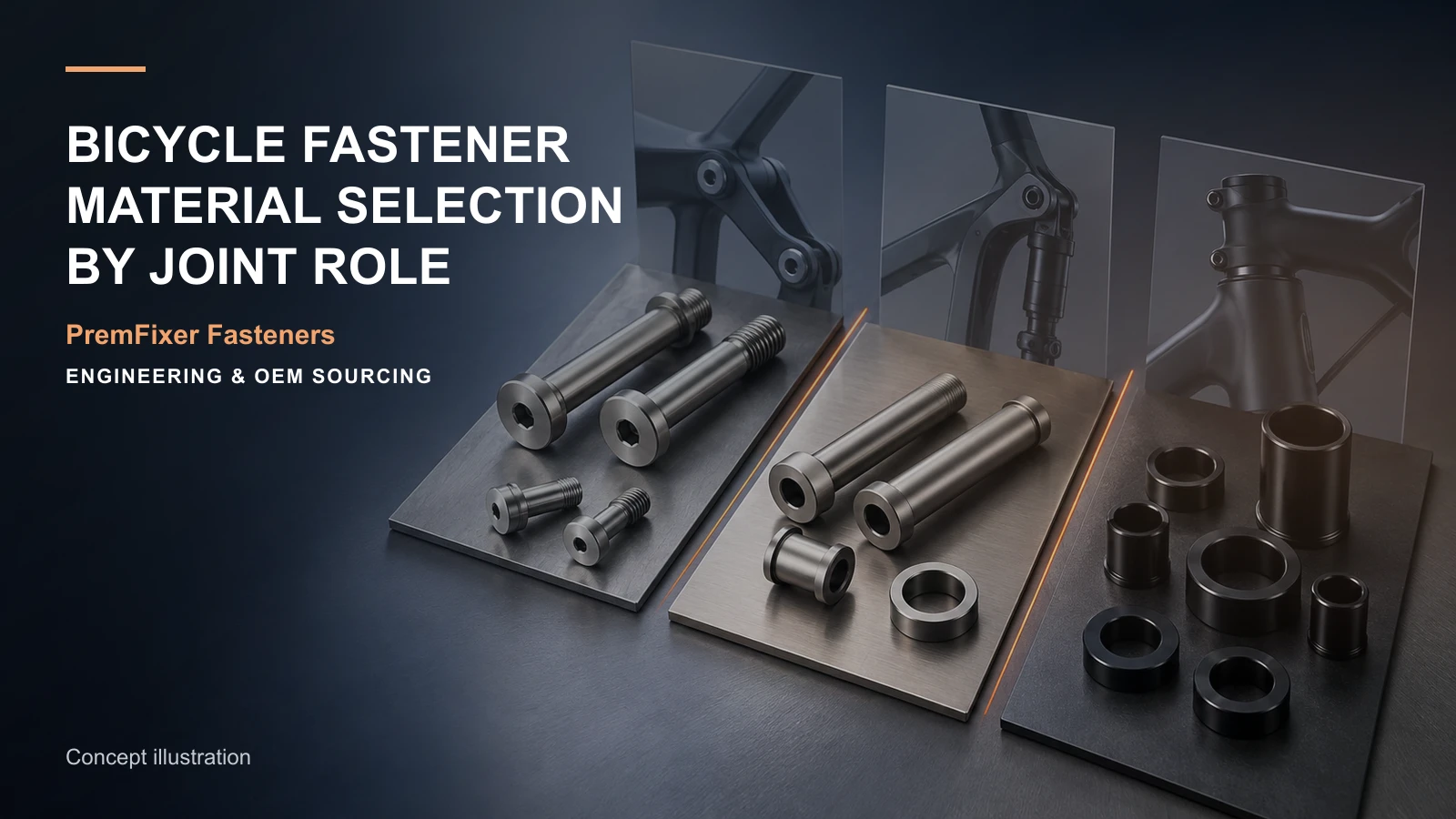
There is no single best material for every bicycle fastener. A pivot axle, brake screw, bottle-cage bolt, aluminium spacer and cosmetic cap perform different jobs and face different combinations of load, wear, corrosion, weight and service. The useful material decision is made at joint level.
Steel, stainless steel, titanium and aluminium can all be appropriate when the grade, condition, geometry, finish and mating materials are defined together. Problems occur when a family label—‘titanium’ or ‘stainless’—is treated as a complete specification, or when a lighter material is substituted without revisiting thread engagement, bearing contact and surface behaviour.
This guide gives engineering and sourcing teams a structured way to shortlist materials, identify interface risks and prepare a sample plan without turning general properties into unsupported component claims.
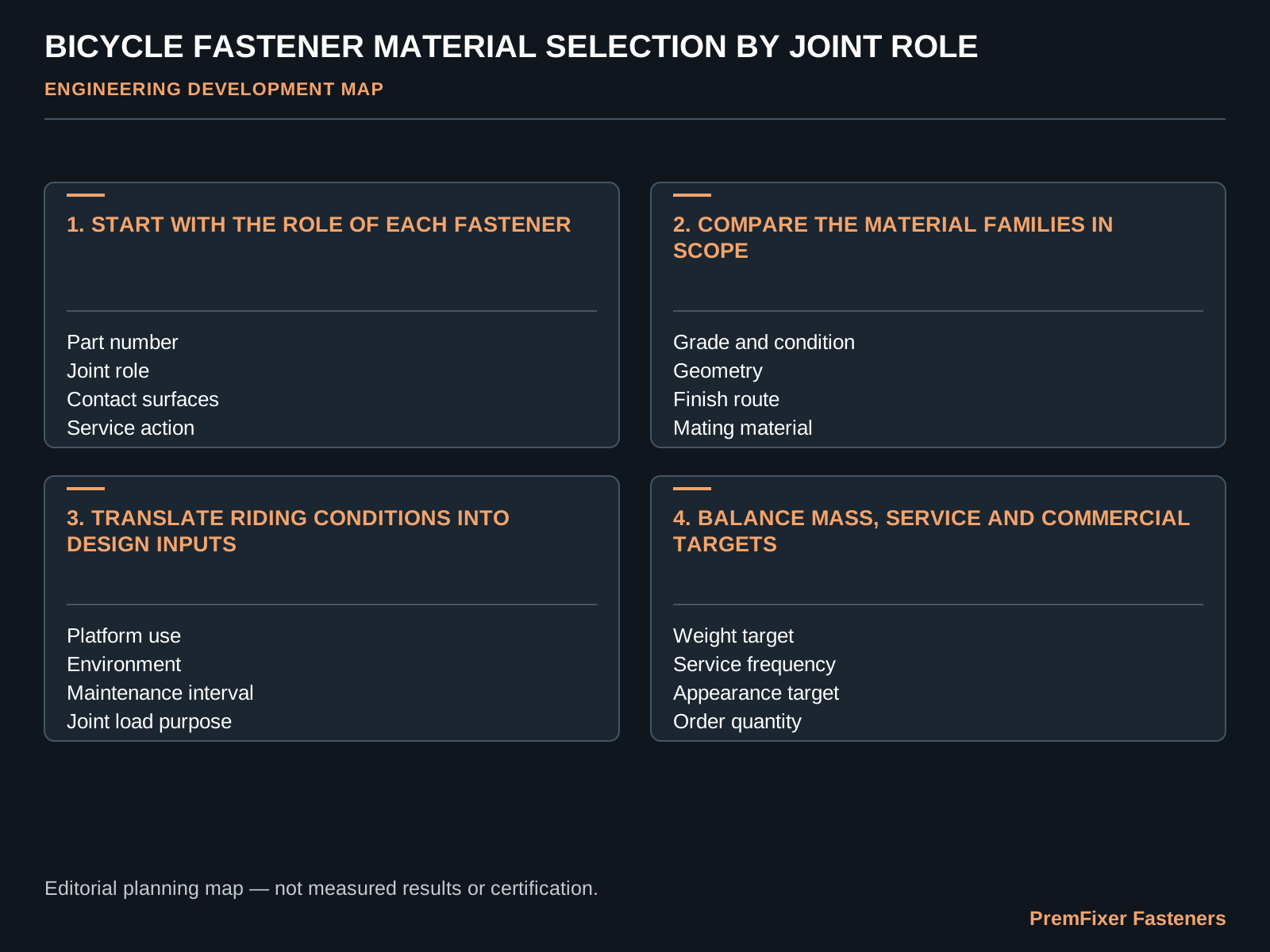
Define the fastener’s job in the joint
Classify the component as a clamp screw, locating shoulder bolt, rotating or stationary axle, sleeve, spacer, threaded insert or decorative fastener. Identify whether it carries preload, locates a bearing, resists wear, provides a sealing surface or must survive repeated service.
Map the mating materials and contact surfaces. A fastener in an aluminium frame, carbon insert, steel bearing or polymer bushing may require different attention even when its external size is similar.
Record the installation method and access. Torque control, lubrication, locking method, tool recess and replacement frequency influence the material and surface system as much as the nominal load.
| Material family | Potential advantages | Questions to resolve |
|---|---|---|
| Alloy steel | Strength options and familiar processing routes | Corrosion protection, finish damage and service environment |
| Stainless steel | Corrosion resistance options and clean appearance | Grade, galling, strength condition and mating threads |
| Titanium alloy | Low density and corrosion resistance in many environments | Grade, geometry, galling, cost and surface treatment |
| Aluminium alloy | Low density and anodizing options | Thread durability, wear interfaces, section size and condition |
Specify grade and condition—not only a family name
A material family contains grades and conditions with different mechanical, corrosion and manufacturing behaviour. The drawing or purchase specification should identify the accepted designation and any condition or treatment relevant to the part.
If alternatives are allowed, define the equivalence criteria and approval route. Do not let a commercial description become the only material control for a safety-relevant or interface-critical part.
Request traceability appropriate to the project and lot. The needed record may range from supplier declaration to material documentation defined by the OEM; it should be stated before quotation rather than added after samples arrive.
Review geometry together with the material choice
A same-shape substitution is not automatically valid. Elastic response, thread behaviour, bearing stress, fatigue-sensitive transitions and wear surfaces may require a different section or feature design. Review the complete component rather than comparing property-table values in isolation.
For a shoulder or axle, focus on diameter transitions, under-head or shoulder fillets, hollow regions, cross holes and tool features. For a threaded part, review engagement, mating material, assembly method and service cycles.
Where weight reduction is the goal, compare mass at component level after the geometry is defined. This prevents a low-density material from being credited with a saving that disappears when additional section is required.
Manage corrosion and galling at the interface
Exposure to water, sweat, cleaning chemicals, road contamination and trapped moisture varies across the bicycle. Define the actual location and drainage condition. Also consider galvanic pairing where dissimilar metals are electrically connected in the presence of an electrolyte.
Thread galling risk deserves attention for some stainless and titanium combinations, especially with repeated assembly. Material pairing, surface condition, lubrication and installation procedure should be considered as one system.
A coating or anodized appearance does not solve every interface question. Identify protected contact areas, masking, dimensional effects and how finish damage during assembly or service will be handled.
Use a material decision matrix and sample plan
Create a matrix with joint function, candidate grade, geometry changes, mating materials, finish, weight effect, manufacturing route, service condition, open risks and validation task. The matrix keeps engineering and purchasing from comparing materials on a single property or price.
Shortlist only the options that can meet the known interfaces and manufacturing needs. Then define what a prototype must answer: fit, assembly, surface condition, wear, environmental response or another OEM-approved requirement.
Keep the current design as a baseline and change one major variable at a time when practical. This makes sample evidence easier to interpret.
Prepare a material-review RFQ
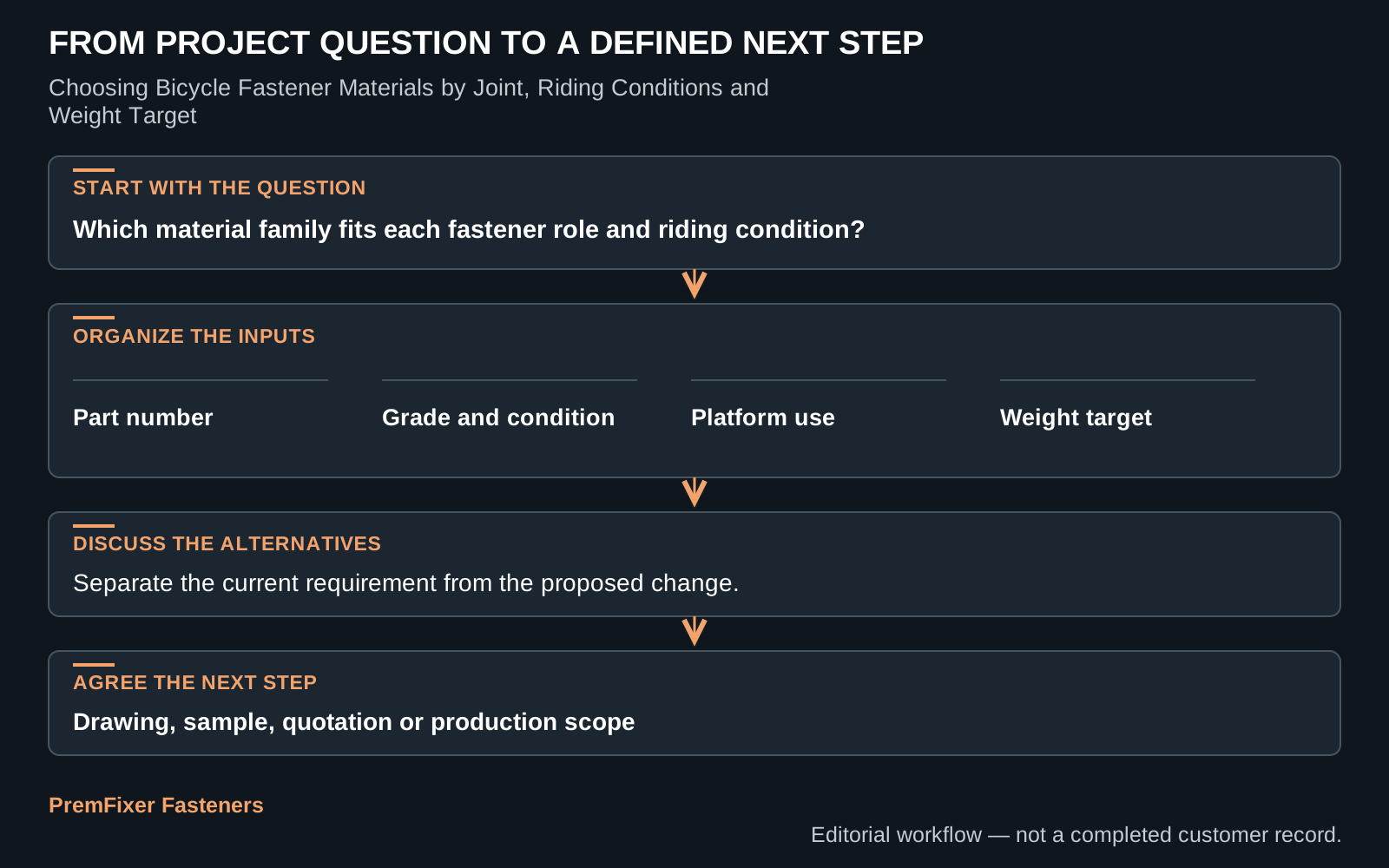
Send the drawing or model, joint section, current material, candidate direction, mating materials, environment, finish, annual volume, weight target and service expectations. State which requirements are fixed and where alternatives are welcome.
Ask for a part-specific response covering proposed grade and condition, necessary geometry implications, process route, surface system, traceability, sample condition and open questions. Avoid requesting a universal recommendation from a part name alone.
PremFixer can compare manufacturable steel, stainless, titanium and aluminium options for a defined bicycle component. Final selection and validation remain tied to the approved joint and vehicle program.
Separate purchasing substitution from engineering change
Purchasing may need alternate sources or grades, but a material change can alter machining, heat treatment, finish, friction, wear and the dimensions needed for the same joint. Define which alternatives are already approved and which require an engineering change. Do not let a supplier quotation become the approval mechanism.
For an approved dual-source material, keep equivalence evidence and any source-specific processing requirements with the part record. If different sources require different heat-treatment or surface routes, the control plan should still lead to the same accepted component condition.
When the proposed substitution is not yet approved, create a comparison sample or analysis plan that isolates the material question. State whether existing geometry is retained for screening or revised to suit the candidate. Identify the assembly, environmental and service checks the OEM requires before release.
Commercial evaluation should include availability, minimum order, material yield, processing time, finish compatibility and traceability—not only price per kilogram. A more expensive raw material can reduce or increase finished-part cost depending on geometry and route.
Close the decision in the drawing, specification and purchasing record. A clear approved-material list protects production flexibility; a vague ‘or equivalent’ note transfers an engineering decision to the point where the least context is available.
When an alternate source is added, repeat only the evidence needed for the changed source and process, but do not assume that an existing material certificate proves finished-part equivalence. Review the manufacturing route, surface condition, critical dimensions and any OEM validation affected by the new supply chain. The scope can be proportionate while the approval remains explicit and traceable to the released part. Record whether mixed-source parts may share inventory or must remain separated until the alternate route completes approval.
Questions buyers ask
What is the best material for bicycle fasteners?
There is no universal best material. Choose by joint function, grade, geometry, mating materials, environment, assembly method, weight target, service and validation needs.
Is titanium always better than steel?
No. Titanium can reduce mass and provide useful corrosion behaviour, while steel may offer different strength, stiffness, wear, cost and processing advantages. Compare the actual component and joint.
Can aluminium be used for bicycle bolts?
Aluminium can suit selected low-load or specially designed components, but thread durability, wear, geometry, grade, condition and service must be reviewed. Do not apply the choice across all positions.
Why is the material grade important?
Different grades and conditions within one family have different properties and manufacturing responses. A family name alone is not enough for drawing control or reliable quotation.
What should a material sample prove?
The sample purpose may include fit, assembly, surface condition, mass or a defined engineering validation task. State which production processes are represented and what decision follows the result.
Choose Material for the Actual Joint
PremFixer can organize a part-specific material and manufacturing review around your geometry, interfaces and sample objective.
Request a Material Review