
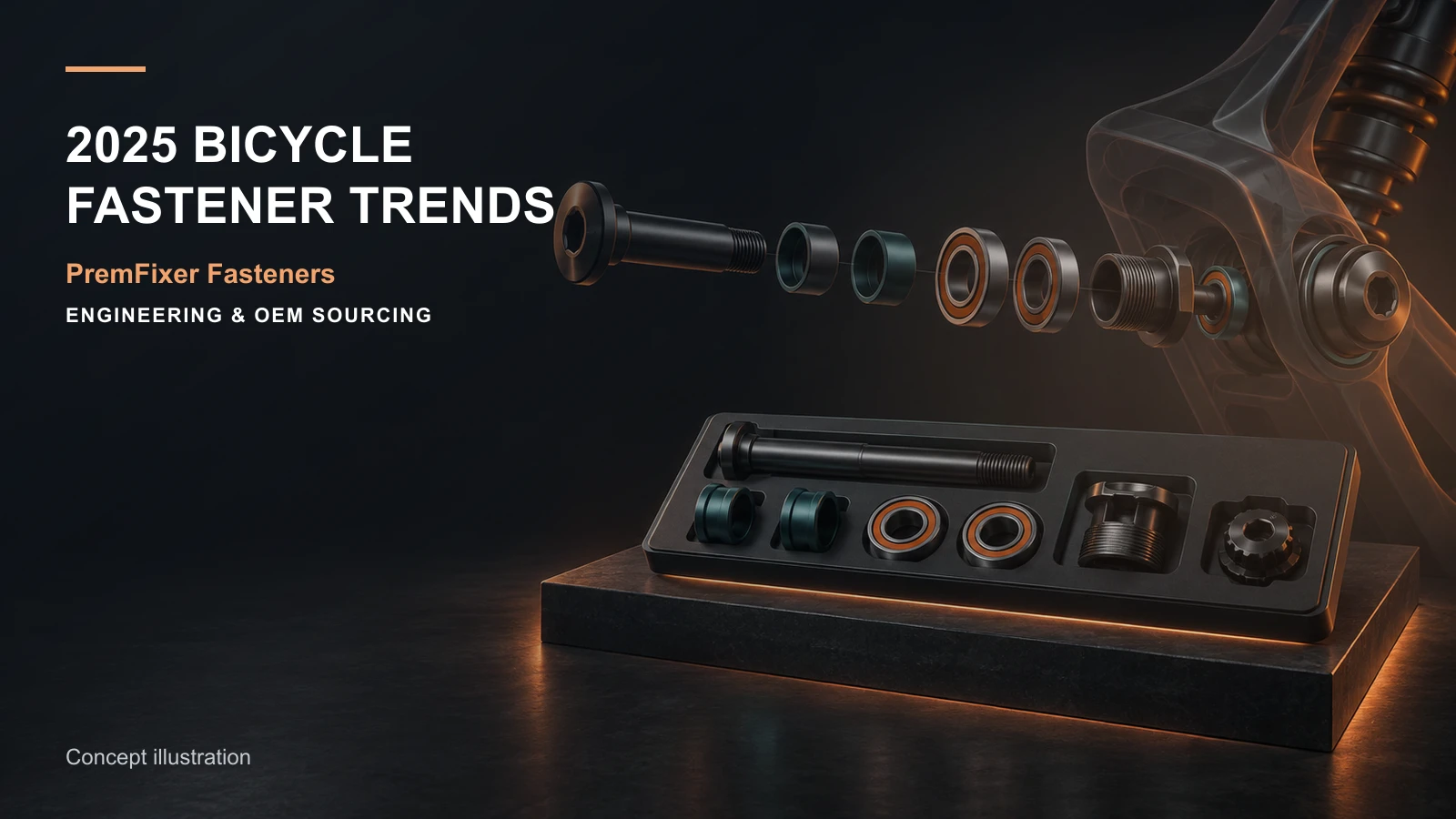
The phrase system supply appeared more often in bicycle-hardware discussions during 2025, but it can mean very different things. For one buyer it may mean a packed set of approved part numbers. For another it includes interface review, prototype coordination, matched finishes, inspection records and service stock. Treating all of those scopes as one market statistic would make the trend less useful, not more.
This article is a 2025 retrospective, not a current market forecast. It does not assign a growth rate or claim that every bicycle brand moved away from individual fasteners. Instead, it asks what engineering and purchasing work becomes necessary when an OEM wants a coordinated hardware system rather than a collection of independently sourced parts.
A brand consolidates frame hardware while adding more model variants and service kits. That example provides a practical test for the technical and commercial choices discussed below.
Define the market, period and product segment
Is this a 2025 retrospective or a current market forecast? It is a retrospective. The year in the title is the reporting frame for a qualitative discussion about movement from isolated parts toward coordinated supply. Any later market data or forecast should be dated and sourced separately rather than silently replacing that historical scope.
Define the geography and vehicle segment before drawing a product implication. A full-suspension MTB program, a road-bike upgrade line, a commuter platform and an electric cargo bicycle can use different joints, release patterns and service models. A system-supply task that matters to one segment may add little value to another.
For the "Define the market, period and product segment" review, put bicycle fastener system trends 2025, bicycle hardware system supply, bicycle fastener BOM, OEM hardware program planning on the same sheet. Name the current revision, the decision owner and the condition that allows the part or program to move forward. The technical discussion then has a clear purchasing and release action.
Separate observed market language from an OEM decision. The article can identify questions that a reported direction raises; it cannot prove that a brand needs a new supplier, different material or complete redesign.
Separate market evidence from product implications
Market evidence and engineering implications belong in different columns. Evidence describes a geographic scope, vehicle segment and reporting period. The implication is a question for the program: does the current supply model make revisions, interfaces, packing or service demand difficult to control? A qualitative trend does not answer that question by itself.
For example, a buyer may see more discussion of complete pivot kits and conclude that every component should come from one source. The more useful response is to identify which interfaces and records benefit from coordination. Standard screws can remain standard while drawing-controlled axles, sleeves and spacers receive system-level review.
Under "Separate market evidence from product implications," compare the current and proposed conditions using bicycle fastener system trends 2025, bicycle hardware system supply, bicycle fastener BOM, OEM hardware program planning. Record the evidence source and any item that remains open. The buyer should be able to approve, reject or sample a specific supplier proposal.
This distinction prevents two common errors. It avoids using an unsupported market claim as proof of product performance, and it avoids turning a real development need into generic marketing language.
| Trend field | Question to define | Program implication |
|---|---|---|
| Geographic scope | Which market or supply base does the observation cover? | Do not generalize one region to every OEM program. |
| Vehicle segment | Which bicycle or electric-mobility platform is being discussed? | Connect the observation to relevant joints and hardware families. |
| Reporting period | Is the evidence historical, current or forecast? | Keep the 2025 retrospective separate from later updates. |
| Engineering implication | What design, BOM or supply decision could change? | Assign a practical review rather than assuming the trend is a requirement. |
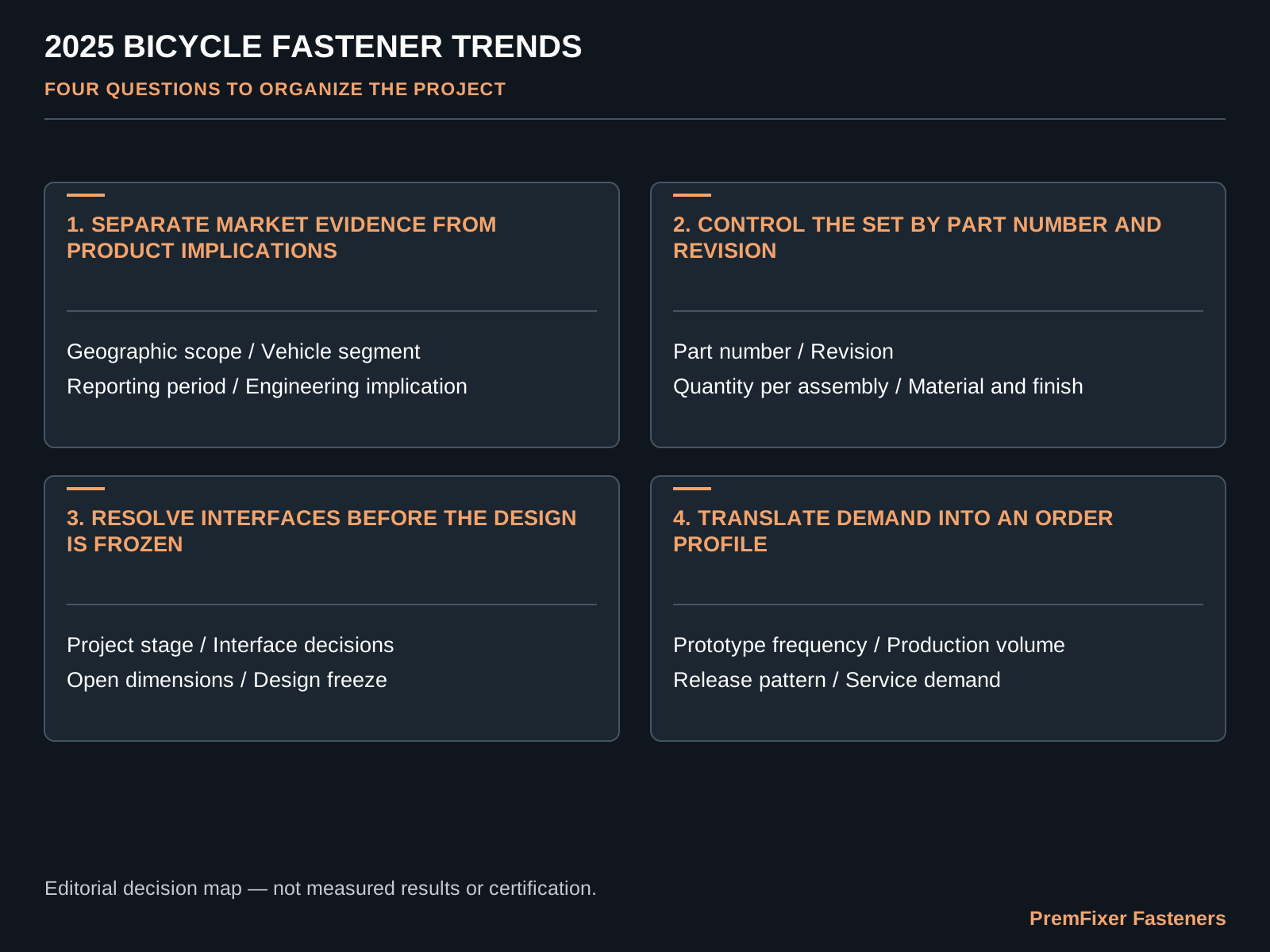
Control the set by part number and revision
System supply begins with item-level control, not with one broad kit name. Each axle, bolt, sleeve, spacer, nut or locking component needs a part number, revision, quantity and specified material or finish. Optional travel configurations, left and right parts, model-year changes and service variants should remain explicit.
The system BOM then defines what belongs to one assembly and how those items relate. Common packaging or one supplier does not mean every component shares the same tolerance, process or inspection plan. Coordination preserves approved differences and exposes dependencies; it should not erase the individual requirements that make the assembly work.
In "Control the set by part number and revision," follow bicycle fastener system trends 2025, bicycle hardware system supply, bicycle fastener BOM, OEM hardware program planning through the relevant handoff. The output from one operation or team should be a usable input for the next. Missing ownership at that boundary often causes more disruption than the operation itself.
When one component changes, review the mating parts, kit identity, sample status and service stock. This is where a system approach can add value: the change is evaluated against the complete configuration.
| BOM field | System-supply requirement | Decision supported |
|---|---|---|
| Part number | A distinct identity for every component in the set. | Prevents visually similar items from being treated as interchangeable. |
| Revision | The approved configuration for drawing, sample and order. | Shows which set is current. |
| Quantity per assembly | The number required for one joint, frame or bicycle. | Defines a complete kit and receiving check. |
| Material and finish | The delivered condition specified by line item. | Preserves necessary process differences inside one system. |
Resolve interfaces before the design is frozen
A coordinated hardware program is most useful when interface questions are visible before the surrounding frame or mechanism is frozen. The supplier can review machining access, locating and clamping surfaces, stock choices and inspection access while the product team still has options. This is collaboration around defined inputs, not a transfer of final design authority.
Begin with the project stage, interface decisions already made and dimensions that remain open. A concept review may use envelopes and functional roles. A prototype review needs identified revisions and sample objectives. A production release needs the approved drawings, BOM and acceptance scope. Calling all three stages system design hides the different decisions they require.
Use bicycle fastener system trends 2025, bicycle hardware system supply, bicycle fastener BOM, OEM hardware program planning to define the sample question for "Resolve interfaces before the design is frozen." The sample record should state what represents production, what is temporary and which decision follows the review. A conforming sample without that context can still leave the production route unsettled.
The output of early review should be a list of closed and open interfaces. If a proposed geometry or process differs from the customer's baseline, show it as an alternative.
| Development field | Input to review | Useful output |
|---|---|---|
| Project stage | Concept, prototype, validation or production release. | A review depth appropriate to the current decision. |
| Interface decisions | Known locating, clamping, movement and service requirements. | A shared description of functional roles. |
| Open dimensions | Values still dependent on mating parts or testing. | Questions retained explicitly instead of filled by assumption. |
| Design freeze | The evidence and owner required to close the interface. | A controlled point for the next configuration. |
Translate demand into an order profile
A broad trend does not tell a factory what capacity or material to reserve. Translate the program into prototype frequency, expected production volume, release pattern and service demand. Those fields can reveal whether the buyer needs small iterative batches, scheduled releases, a stable annual program or long-tail replacement support.
Different parts in one system may follow different demand profiles. A drawing-controlled pivot axle may change during development, while a standard screw remains stable. Service kits may need packaging and identity that production-line replenishment does not. The purchasing arrangement should reflect those differences rather than forcing every item into one MOQ or delivery rule.
After "Translate demand into an order profile," carry bicycle fastener system trends 2025, bicycle hardware system supply, bicycle fastener BOM, OEM hardware program planning into repeat orders and service planning. Approved conditions should remain visible in stock, inspection records and packaging so that later lots do not depend on personal memory.
Forecasts and committed releases should also remain distinct. A forecast supports planning; it is not automatically an authorization to manufacture finished stock.
| Demand field | Program question | Supply-planning use |
|---|---|---|
| Prototype frequency | How often are learning builds expected? | Plan flexible sample and revision handling. |
| Production volume | What quantity range follows approval? | Select an appropriate manufacturing and inspection route. |
| Release pattern | Are orders scheduled, variable or call-off based? | Separate planning information from firm releases. |
| Service demand | Which parts or kits remain needed after assembly production? | Preserve identity and packaging for replacement supply. |
Apply the discussion to a PremFixer Fasteners project
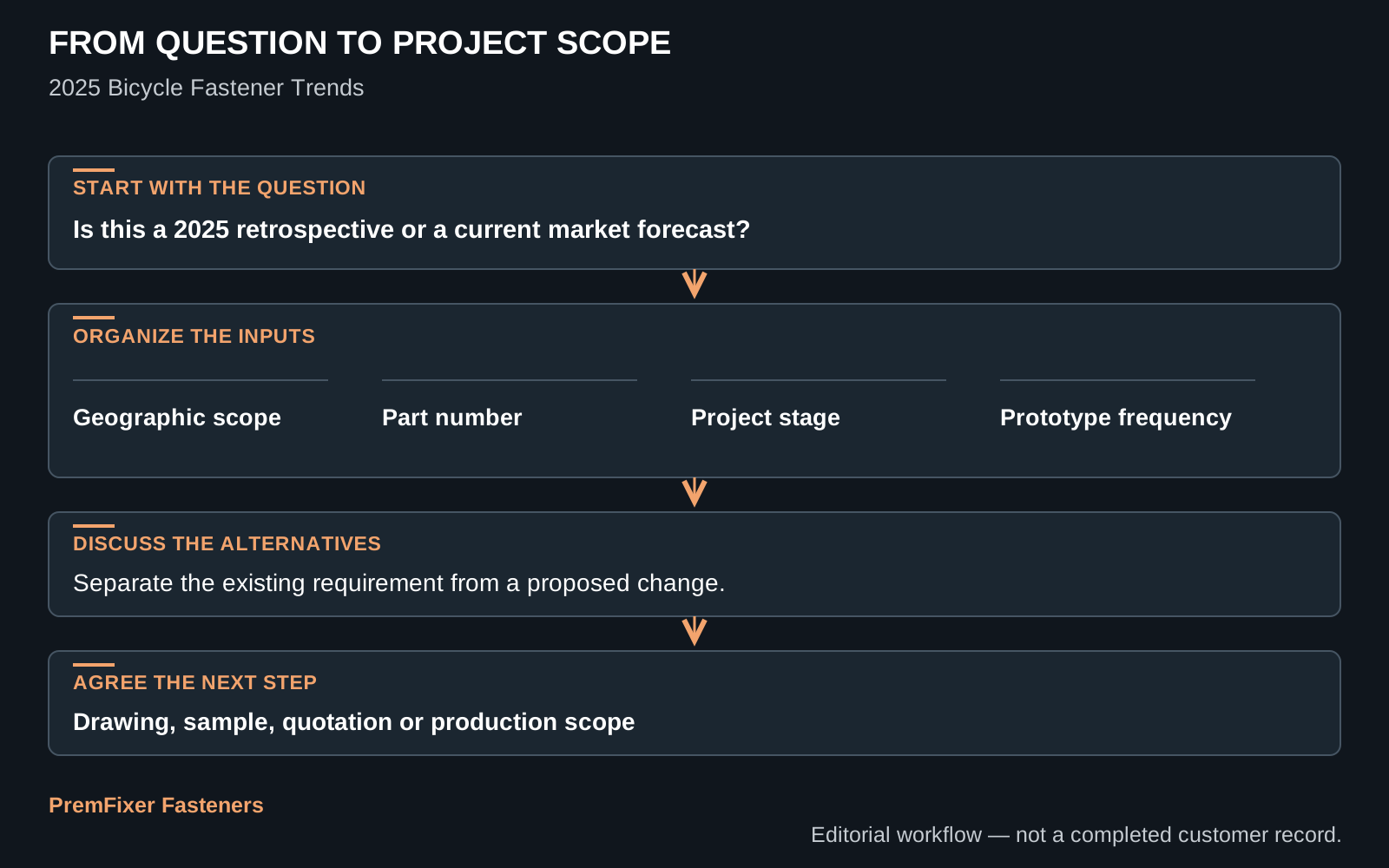
Start with the bicycle or electric-mobility segment, the hardware family under review and the current project stage. Add the available drawings, BOM or sample description, then identify which parts are standard, drawing-controlled or dependent on a shared interface. This converts the trend discussion into a bounded program scope.
PremFixer Fasteners can organize the review around item and revision control, open assembly interfaces, prototype needs and the expected order profile. The proposal can distinguish coordinated development work from manufacturing and packaging so the buyer can see what system supply means for this program rather than accepting a generic label.
Convert the result of "Apply the discussion to a PremFixer Fasteners project" into a quotation line that identifies bicycle fastener system trends 2025, bicycle hardware system supply, bicycle fastener BOM, OEM hardware program planning. Ask the supplier to state included work, customer inputs, open assumptions and release evidence. Alternative offers are easier to compare when scope is not hidden inside one unit price.
Share your available drawings, BOM or project description with PremFixer Fasteners, together with quantities and the project stage, to discuss system-based bicycle hardware supply.
Apply the decision to a working program
A brand consolidates frame hardware while adding more model variants and service kits. Identify the exact part numbers and revision involved, then name the teams that approve design, prepare supply, receive the lot and assemble the bicycle.
Place the current condition beside the proposed condition for 2025 bicycle fastener trends: from individual parts to system supply. Record the drawing or BOM effect, process change, inspection evidence, schedule consequence and delivered state. Unknown inputs should remain open instead of becoming quoted assumptions.
Trend language can encourage supplier consolidation without defining configuration control. Use the smallest sample, document check or pilot lot that can expose this issue, and state which production conditions the evidence does not cover.
Carry the accepted result for 2025 bicycle fastener trends: from individual parts to system supply into the drawing, order, inspection plan and packaging identity that depend on it. Another model or revision stays outside the approval until its interfaces are shown to be equivalent.
Send the current BOM, model family, shared interfaces, kit strategy and service plan. The supplier response should separate included work, customer approvals, external operations and open assumptions so bicycle product and sourcing leaders can make the next commitment.
Questions buyers ask
What should buyers define before comparing offers?
Translate system-supply trends into practical BOM, interface and supplier decisions. The comparison is credible only when every option uses the same part revision, quantity and delivered condition.
Which files make the review useful?
The first package should contain the current BOM, model family, shared interfaces, kit strategy and service plan. It should also state the immediate decision the customer needs from the supplier response.
When is a pilot needed?
Base the pilot on this situation: a brand consolidates frame hardware while adding more model variants and service kits. Record the representative operations and the approval that follows the result.
What commonly remains hidden?
The main risk is that trend language can encourage supplier consolidation without defining configuration control. Put one person in charge of the related drawing, handoff or release action.
How can PremFixer support the next step?
For 2025 bicycle fastener trends: from individual parts to system supply, PremFixer can organize the files and open points into a manufacturing, sample and quotation response for the defined component or hardware set.
Turn system trends into a program brief
Share the current BOM, model family, shared interfaces, kit strategy and service plan. The response will identify the proposed scope, open questions and the evidence needed before release.
Discuss This Project