
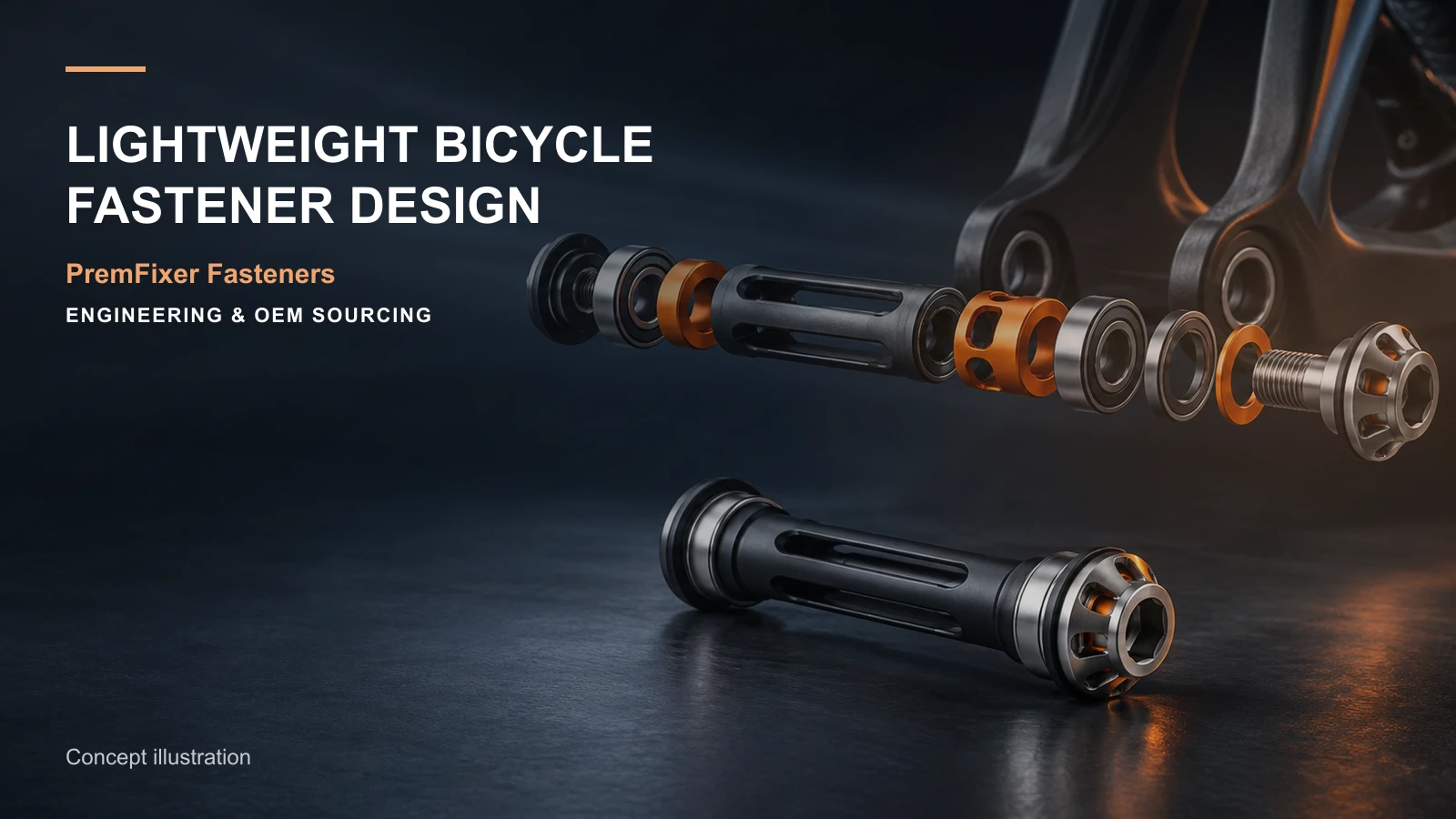
A lighter hardware set is not created by replacing every steel part with the same alternative material. The useful work starts by deciding which components carry load, locate bearings, set spacing, provide tool access or exist mainly for appearance.
Bicycle engineers pursuing mass reduction need to allocate weight targets by joint role and geometry instead of replacing materials across the BOM. The review should use the current drawing, BOM and project stage so that the recommendation applies to a real component or release.
The program becomes concrete when a frame team wants lighter pivot hardware without changing bearing support or service access. The review can then focus on the evidence required before the next commitment.
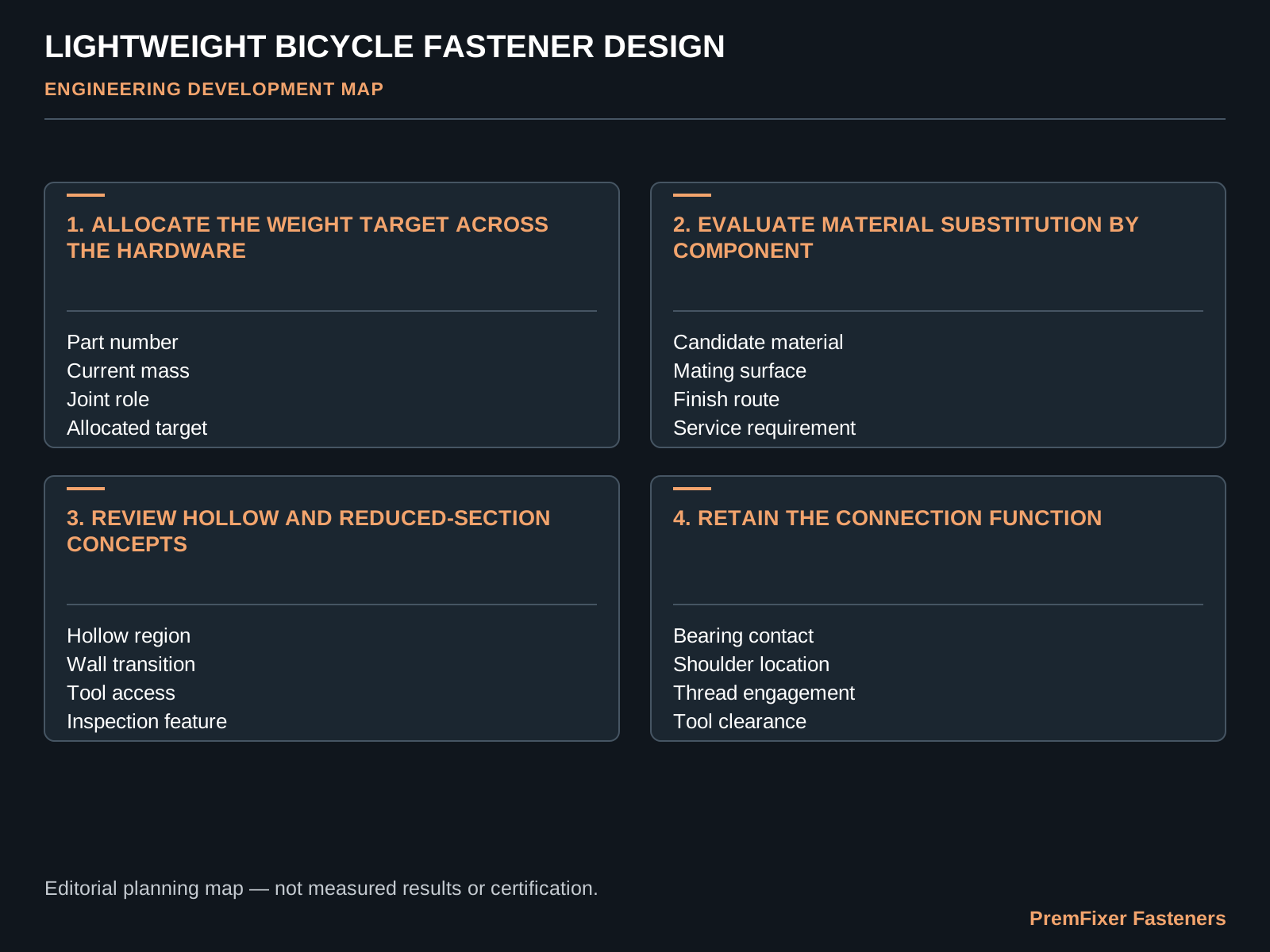
Allocate the weight target across the hardware
Map current mass by part number and separate primary load-carrying, locating, spacing and appearance roles. This turns an overall reduction target into component-level decisions.
Build the working record around Part number, Current mass, Joint role and Allocated target. The practical output is a weight-allocation table for the complete hardware set.
For the "Allocate the weight target across the hardware" review, put BOM mass, joint role, material option, prototype objective on the same sheet. Name the current revision, the decision owner and the condition that allows the part or program to move forward. The technical discussion then has a clear purchasing and release action.
Do not force every component to contribute the same percentage reduction.
Evaluate material substitution by component
Compare titanium and aluminium options only where grade, condition, interfaces, finish and service demands can be defined. A material substitution changes more than density.
Keep the review anchored to Candidate material, Mating surface, Finish route and Service requirement. The practical output is a component-specific material option with its open questions.
Under "Evaluate material substitution by component," compare the current and proposed conditions using Candidate material, Mating surface, Finish route, Service requirement. Record the evidence source and any item that remains open. The buyer should be able to approve, reject or sample a specific supplier proposal.
Do not use an aerospace label as evidence of joint suitability.
| Review stage | Project question | Inputs to connect | Expected output |
|---|---|---|---|
| 01 | Allocate the weight target across the hardware | Part number / Current mass / Joint role / Allocated target | a weight-allocation table for the complete hardware set |
| 02 | Evaluate material substitution by component | Candidate material / Mating surface / Finish route / Service requirement | a component-specific material option with its open questions |
| 03 | Review hollow and reduced-section concepts | Hollow region / Wall transition / Tool access / Inspection feature | a manufacturable concept for prototype evaluation |
| 04 | Retain the connection function | Bearing contact / Shoulder location / Thread engagement / Tool clearance | a function-retention checklist linked to the proposed part |
| 05 | Plan prototype comparisons | Baseline revision / Candidate revision / Mass record / Review task | a controlled baseline-versus-candidate comparison |
| 06 | Offer a lightweight hardware brief | Current BOM / Target mass / Priority parts / Platform use | a staged lightweight hardware development brief |
Review hollow and reduced-section concepts
Treat bores, reduced sections and non-circular reliefs as geometry concepts that require load-path, machining and inspection review. The visible removal of material is only one part of the decision.
Put the following fields on the same revision-controlled page: Hollow region, Wall transition, Tool access and Inspection feature. The practical output is a manufacturable concept for prototype evaluation.
In "Review hollow and reduced-section concepts," follow BOM mass, joint role, material option, prototype objective through the relevant handoff. The output from one operation or team should be a usable input for the next. Missing ownership at that boundary often causes more disruption than the operation itself.
Do not publish a safe wall thickness without the actual geometry and design inputs.
Retain the connection function
Check bearing contact, shoulder location, thread engagement, tool space and disassembly for every lightweight proposal. A mass reduction that moves or weakens an interface changes the joint rather than optimizing it.
Build the working record around Bearing contact, Shoulder location, Thread engagement and Tool clearance. The practical output is a function-retention checklist linked to the proposed part.
Use BOM mass, joint role, material option, prototype objective to define the sample question for "Retain the connection function." The sample record should state what represents production, what is temporary and which decision follows the review. A conforming sample without that context can still leave the production route unsettled.
Do not hide a changed assembly or maintenance requirement behind a weight figure.
Plan prototype comparisons
Compare baseline and candidate parts through mass, dimensions, assembly observations and the validation task assigned to the project. A prototype is most useful when its review purpose is named before manufacture.
Keep the review anchored to Baseline revision, Candidate revision, Mass record and Review task. The practical output is a controlled baseline-versus-candidate comparison.
After "Plan prototype comparisons," carry BOM mass, joint role, material option, prototype objective into repeat orders and service planning. Approved conditions should remain visible in stock, inspection records and packaging so that later lots do not depend on personal memory.
Do not invent a percentage reduction or claim full-system validation from a part sample.
Offer a lightweight hardware brief
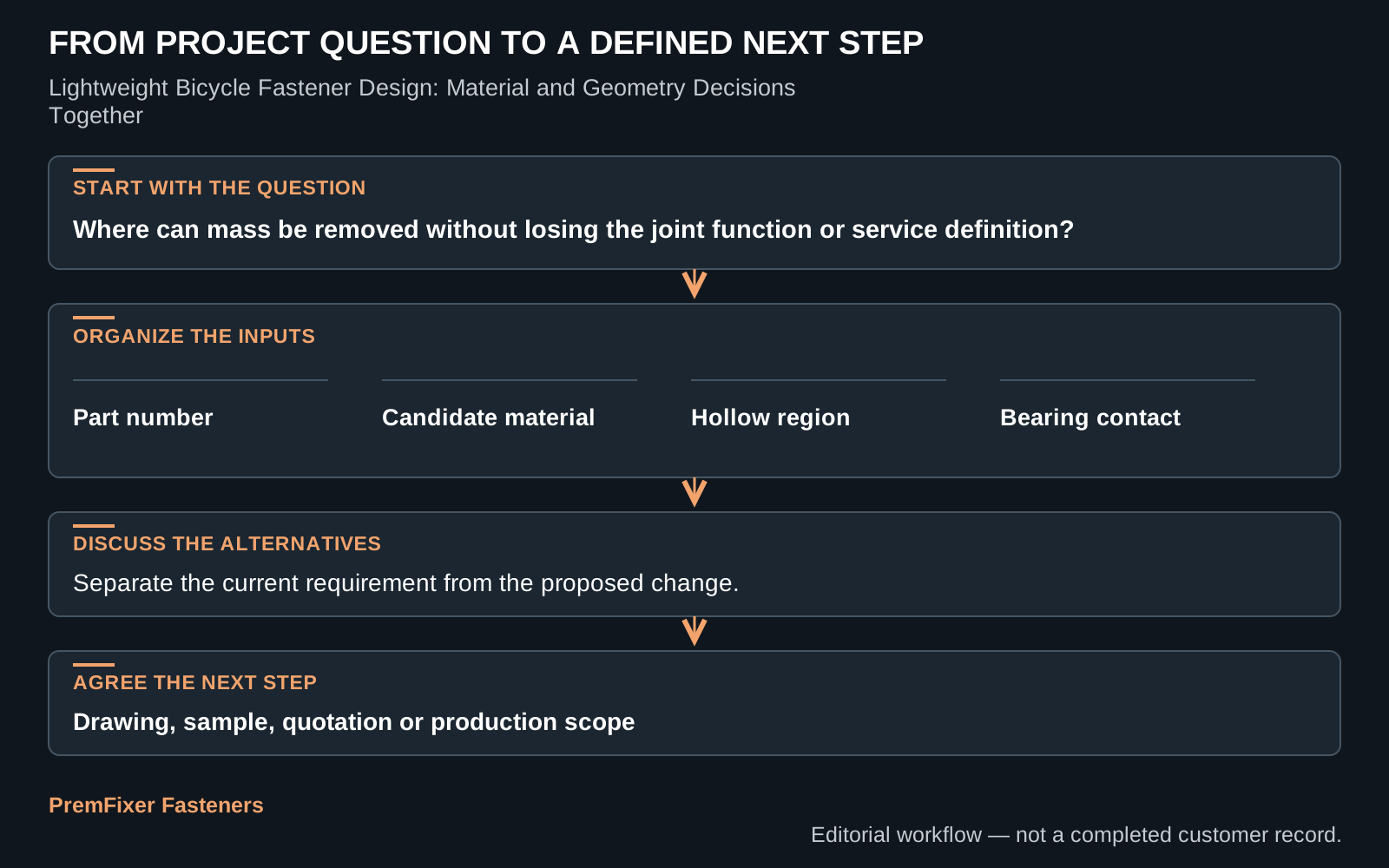
Package the current BOM, target mass, drawings and platform use into a focused development request. That allows the team to start with the highest-value parts instead of redesigning the complete bike at once.
Put the following fields on the same revision-controlled page: Current BOM, Target mass, Priority parts and Platform use. The practical output is a staged lightweight hardware development brief.
Convert the result of "Offer a lightweight hardware brief" into a quotation line that identifies BOM mass, joint role, material option, prototype objective. Ask the supplier to state included work, customer inputs, open assumptions and release evidence. Alternative offers are easier to compare when scope is not hidden inside one unit price.
Keep each proposal tied to the relevant joint and approval stage.
Use a project example to test the proposal
Use one bounded work package to test the decision. A frame team wants lighter pivot hardware without changing bearing support or service access. Give the package a part list, revision, owner and required completion state.
For lightweight bicycle fastener design: material and geometry decisions together, ask engineering to mark the functional interfaces and purchasing to define the quoted delivery unit. Quality can then identify the evidence needed at sample and production release.
Mass removed from a shoulder, thread or tool feature can shift risk into the joint. Build a check around the point where that failure enters the workflow, rather than adding broad inspection after every operation.
Review the first result against the stated question for lightweight bicycle fastener design: material and geometry decisions together. If a material, finish, tool or quantity differs from production, keep the limitation with the sample record and decide whether another stage is required.
The RFQ should include the current BOM and mass, joint roles, candidate materials, geometry and validation plan. Request a scope matrix, timing assumptions and the exact output that will close the open project decision.
Questions buyers ask
What should buyers define before comparing offers?
Begin with the current configuration, then allocate weight targets by joint role and geometry instead of replacing materials across the BOM. Name the owner and the output required before price, schedule or supplier preference is treated as final.
Which files make the review useful?
Send the current BOM and mass, joint roles, candidate materials, geometry and validation plan. Separate fixed requirements from open fields so the supplier can price the confirmed scope and respond to the engineering questions.
When is a pilot needed?
A frame team wants lighter pivot hardware without changing bearing support or service access. A sample or pilot should answer named questions and disclose any material, finish, process or quantity that differs from production.
What commonly remains hidden?
Mass removed from a shoulder, thread or tool feature can shift risk into the joint. Connect the risk to a drawing characteristic, process handoff, approval or delivery record and verify its closure.
How can PremFixer support the next step?
PremFixer can review the available drawing, model, BOM or sample with the current BOM and mass, joint roles, candidate materials, geometry and validation plan. The response can identify open questions, proposed scope and evidence for the next decision.
Build a component weight plan
Share the current BOM and mass, joint roles, candidate materials, geometry and validation plan. The response will identify the proposed scope, open questions and the evidence needed before release.
Discuss This Project