
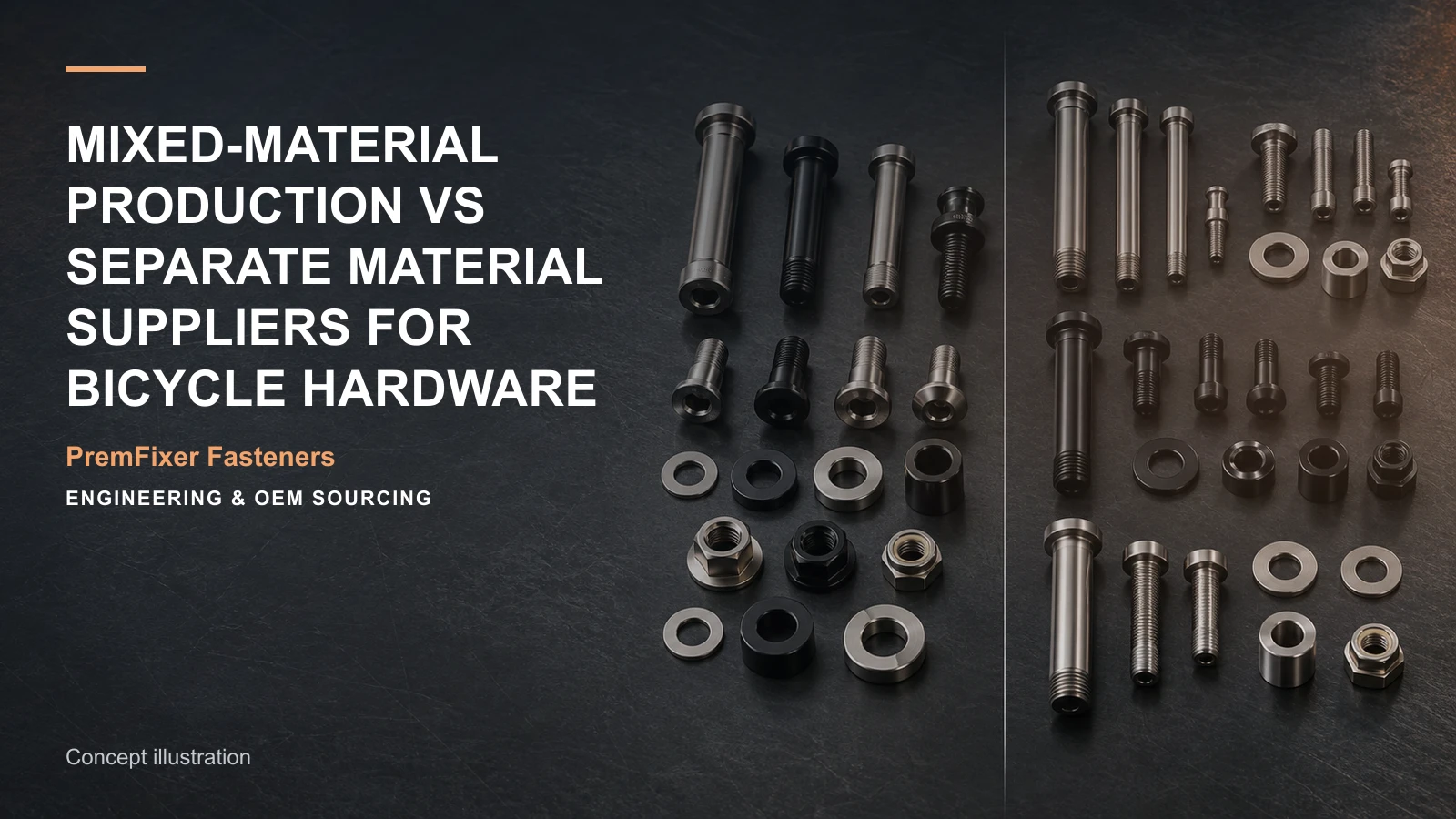
A bicycle hardware kit can include different materials for good reasons. A project may combine steel, aluminum, titanium or other materials across axles, screws, spacers and support components. The sourcing challenge is to keep those parts connected as an approved set while respecting the fact that they do not share one manufacturing route.
A single coordinating supplier can simplify BOM control, production planning and kit delivery. Separate material suppliers can also work when the buyer owns the interfaces. The comparison becomes useful when it distinguishes component-level process control from kit-level coordination.
Consider this working situation: one frame kit combines a steel locking screw, titanium axle and anodized aluminium spacers. It connects the topic to the records, approvals and quotation inputs the program needs.
Define the comparison before comparing the price
The first comparison is between supplied scope, not material labels. A mixed-material kit might include several components with different process routes, inspection needs and delivery conditions. A quote needs to show what each line item is, how it will be identified and how the complete set will be coordinated.
The question is not whether one company or several companies are involved. Ask whether the material-specific requirements, part revisions and kit relationship are visible in the purchasing record. A supplier count alone does not establish material control or delivery readiness.
For the "Define the comparison before comparing the price" review, put mixed material bicycle hardware production, titanium aluminum steel bicycle fasteners, bicycle hardware kit sourcing, material traceability on the same sheet. Name the current revision, the decision owner and the condition that allows the part or program to move forward. The technical discussion then has a clear purchasing and release action.
Keep the comparison tied to the actual bicycle assembly. A material choice may be driven by geometry, interface, mass, finish, corrosion strategy or another design input.
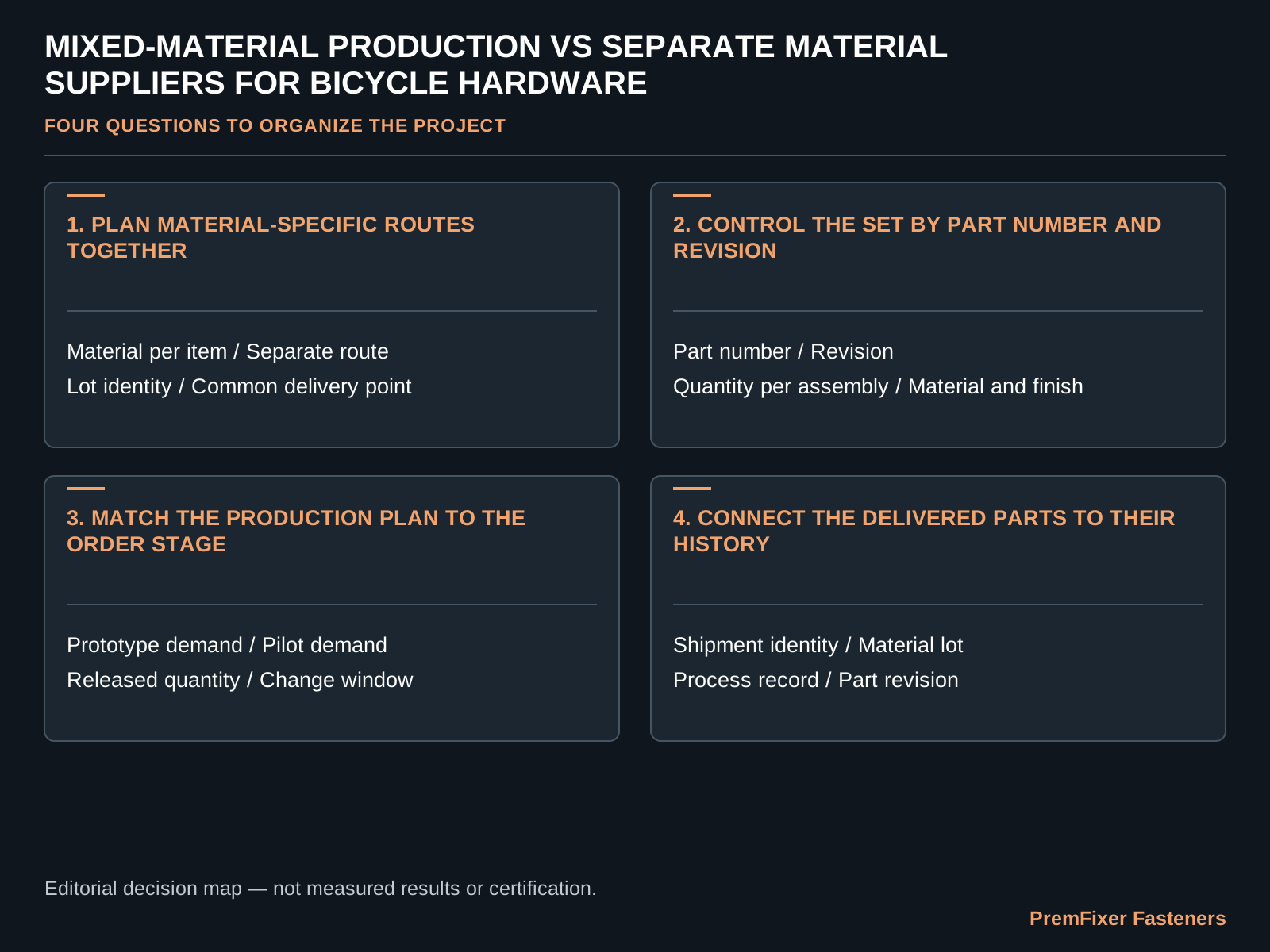
Plan material-specific routes together
A coordinated order should let every material follow its own appropriate route. The record for a steel component may differ from the record for an aluminum or titanium component. The common delivery point is a scheduling and identification task, not proof that the components were processed under identical conditions.
At the planning stage, list the material per item, the separate route, the lot identity where applicable and the agreed delivery point. This gives the team a practical way to discuss sequence, finishing, inspection and packing without blending unrelated requirements into one generic kit description.
Under "Plan material-specific routes together," compare the current and proposed conditions using mixed material bicycle hardware production, titanium aluminum steel bicycle fasteners, bicycle hardware kit sourcing, material traceability. Record the evidence source and any item that remains open. The buyer should be able to approve, reject or sample a specific supplier proposal.
| Control field | Component-level use | Kit-level use |
|---|---|---|
| Material per item | States the material requirement for the specific part number. | Prevents a kit label from hiding different material requirements. |
| Separate route | Records machining, secondary work and finish for that component. | Shows where coordinated scheduling or handoffs are needed. |
| Lot identity | Connects material or process records to the relevant line item when required. | Supports an organized review if a kit issue needs investigation. |
| Common delivery point | Defines the finished condition expected from each component. | Defines when the set can be packed and released as a kit. |
Control the set by part number and revision
A mixed-material BOM needs more than a broad material family label. It should state the part number, revision, quantity per assembly, material, finish and relevant left-right or model relationship. Those fields keep a spacer, axle or locking component from being treated as interchangeable simply because it belongs in the same kit.
When the kit includes mating parts, identify their relationship in the approved configuration. A single supplier may coordinate this internally; a buyer using separate suppliers may manage the coordination. In either case, the BOM is the shared reference for what constitutes the released set.
In "Control the set by part number and revision," follow mixed material bicycle hardware production, titanium aluminum steel bicycle fasteners, bicycle hardware kit sourcing, material traceability through the relevant handoff. The output from one operation or team should be a usable input for the next. Missing ownership at that boundary often causes more disruption than the operation itself.
| BOM field | Why it matters | Question for the RFQ |
|---|---|---|
| Part number and revision | Protects the identity of each component. | Which drawing or specification controls this line item? |
| Quantity per assembly | Makes a kit count check possible. | How many pieces are delivered for each approved set? |
| Material and finish | Prevents material requirements from being inferred from appearance. | What finished condition is included in the quote? |
| Mating relationship | Shows which parts work together in the assembly. | How is the relationship checked before packing or receiving? |
Match the production plan to the order stage
Prototype, pilot and production releases can need different levels of coordination. A prototype order may focus on a limited configuration and an assembly question. A pilot order may need a more complete delivery condition. A production release needs a stable part identity, quantity plan and change window. These stages should be described rather than assumed from the order size alone.
A flexible plan can coordinate different material routes toward the same agreed milestone. It should still state the released quantity, what can change, what is already committed and what each line item must include before the kit is ready to ship.
Use mixed material bicycle hardware production, titanium aluminum steel bicycle fasteners, bicycle hardware kit sourcing, material traceability to define the sample question for "Match the production plan to the order stage." The sample record should state what represents production, what is temporary and which decision follows the review. A conforming sample without that context can still leave the production route unsettled.
Connect the delivered parts to their history
Traceability is most useful when it answers a project question. A shipment identity can link a delivered kit to its part revision, relevant material or process record and packing label. The records should match the scope the customer has requested rather than promising a universal documentation package for every order.
Keep the traceability relationship understandable. A material record for one part is not automatically a report for the full kit. A packing label may identify a kit without proving every production or assembly condition. Clear labels help a team ask the next question without overstating what a document proves.
After "Connect the delivered parts to their history," carry mixed material bicycle hardware production, titanium aluminum steel bicycle fasteners, bicycle hardware kit sourcing, material traceability into repeat orders and service planning. Approved conditions should remain visible in stock, inspection records and packaging so that later lots do not depend on personal memory.
Turn the discussion into an RFQ conversation
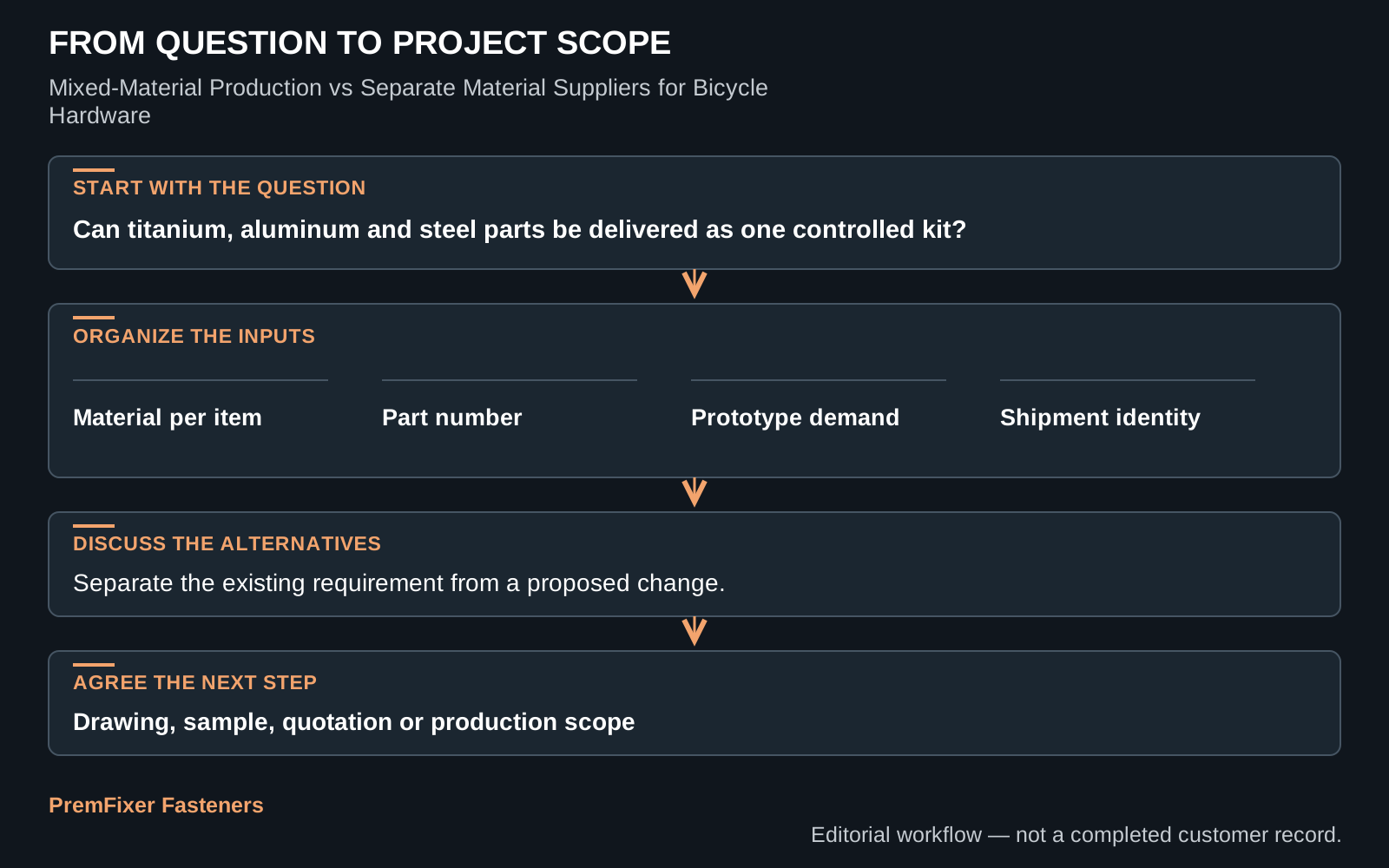
Start with the available drawing, BOM, model or sample description, and identify the material requirement for each known line item. Include quantities, project stage, desired delivery condition and the components that must arrive as a matched set. PremFixer can use that input to organize material-specific routes and an RFQ scope around the real hardware package.
If inputs remain open, list them as open items. A transparent first conversation is more useful than a generic promise that every material and process will behave the same way. The goal is a controlled kit definition that can move from discussion to sample and then to an approved release.
Convert the result of "Turn the discussion into an RFQ conversation" into a quotation line that identifies mixed material bicycle hardware production, titanium aluminum steel bicycle fasteners, bicycle hardware kit sourcing, material traceability. Ask the supplier to state included work, customer inputs, open assumptions and release evidence. Alternative offers are easier to compare when scope is not hidden inside one unit price.
Use a project example to test the proposal
Use one bounded work package to test the decision. One frame kit combines a steel locking screw, titanium axle and anodized aluminium spacers. Give the package a part list, revision, owner and required completion state.
For mixed-material production vs separate material suppliers for bicycle hardware, ask engineering to mark the functional interfaces and purchasing to define the quoted delivery unit. Quality can then identify the evidence needed at sample and production release.
Different revisions, finish partners and delivery dates can produce a kit that is individually conforming but incomplete. Build a check around the point where that failure enters the workflow, rather than adding broad inspection after every operation.
Review the first result against the stated question for mixed-material production vs separate material suppliers for bicycle hardware. If a material, finish, tool or quantity differs from production, keep the limitation with the sample record and decide whether another stage is required.
The RFQ should include the multi-material BOM, grades, finishes, quantities, kit definition and revision plan. Request a scope matrix, timing assumptions and the exact output that will close the open project decision.
Questions buyers ask
What should buyers define before comparing offers?
Choose whether one supplier should coordinate steel, titanium and aluminium hardware or split the package by material. The comparison is credible only when every option uses the same part revision, quantity and delivered condition.
Which files make the review useful?
The first package should contain the multi-material BOM, grades, finishes, quantities, kit definition and revision plan. It should also state the immediate decision the customer needs from the supplier response.
When is a pilot needed?
Base the pilot on this situation: one frame kit combines a steel locking screw, titanium axle and anodized aluminium spacers. Record the representative operations and the approval that follows the result.
What commonly remains hidden?
The main risk is that different revisions, finish partners and delivery dates can produce a kit that is individually conforming but incomplete. Put one person in charge of the related drawing, handoff or release action.
How can PremFixer support the next step?
For mixed-material production vs separate material suppliers for bicycle hardware, PremFixer can organize the files and open points into a manufacturing, sample and quotation response for the defined component or hardware set.
Review a mixed-material kit
Share the multi-material BOM, grades, finishes, quantities, kit definition and revision plan. The response will identify the proposed scope, open questions and the evidence needed before release.
Discuss This Project