
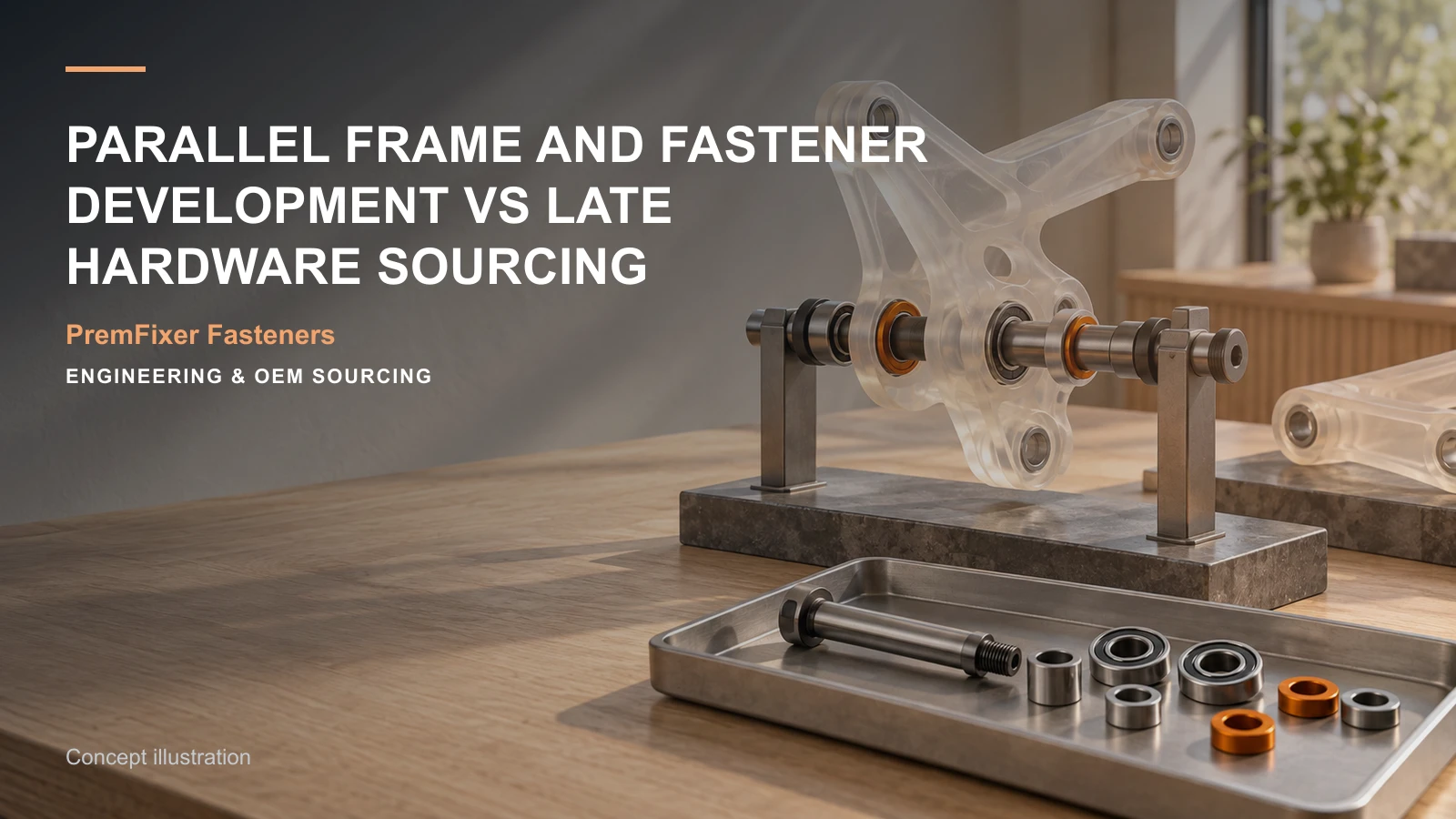
Late hardware sourcing often begins after the frame, linkage or motor package has already consumed most of the available space. At that point a fastener supplier may be asked to fit a fixed envelope, preserve tool access and solve a locating or clamping problem with little freedom to change the surrounding parts. The work may still succeed, but each unresolved interface can return to the program as a redesign or approval loop.
Parallel development brings the hardware discussion forward while those interfaces can still be reviewed. It does not mean the supplier designs the entire bicycle or that prototypes become unnecessary. It means the product team can expose the joint architecture, identify open dimensions and decide which questions must close before the frame or assembly configuration is frozen.
A frame reaches pilot tooling before the pivot head, tool path and service removal are resolved. Following that case from drawing through release exposes which questions belong to engineering, manufacturing, quality and purchasing.
Define the comparison before comparing the price
What decisions can be brought forward by developing hardware with the frame? Teams can review packaging space, locating surfaces, clamp direction, tool access, material compatibility and likely manufacturing constraints before the surrounding geometry becomes difficult to change. Prototype and validation work still follow; the advantage is that their questions are defined earlier.
Compare both routes against the same assembly, revision, quantity and delivered condition. A parallel-development offer may include interface review, proposal drawings and prototype iterations. A late-sourcing quote may begin from a released component drawing. Those are different scopes, so unit prices should not be treated as equivalent until the development work is made visible.
For the "Define the comparison before comparing the price" review, put parallel bicycle fastener development, early hardware sourcing, bicycle frame fastener design, pivot interface development on the same sheet. Name the current revision, the decision owner and the condition that allows the part or program to move forward. The technical discussion then has a clear purchasing and release action.
Identify decision ownership as well as timing. The frame team owns the assembly intent and approved geometry.
Resolve interfaces before the design is frozen
The right supplier-entry point is when important interfaces are visible but still reviewable. Share the project stage, intended joint, surrounding envelope and known service access. Dimensions do not all need to be final. Open items should be marked as open so the team knows which decisions belong before the next prototype and which can wait for a controlled revision.
An early review might expose insufficient tool clearance, an unsupported clamping face or a stock form that makes the proposed geometry unnecessarily difficult. The response is not automatically to change the frame. It is to list the alternatives, their assembly consequences and the owner who can approve one of them.
Under "Resolve interfaces before the design is frozen," compare the current and proposed conditions using parallel bicycle fastener development, early hardware sourcing, bicycle frame fastener design, pivot interface development. Record the evidence source and any item that remains open. The buyer should be able to approve, reject or sample a specific supplier proposal.
Design freeze should be a visible project event, not an assumption. Record which interface decisions have closed, which dimensions remain provisional and what evidence is required before release.
| Development field | Parallel-development question | Late-sourcing implication |
|---|---|---|
| Project stage | Which concept, prototype or release phase is active? | How much of the surrounding design can still change? |
| Interface decisions | Which locating, clamping and service choices can be reviewed now? | Which choices are already fixed by released geometry? |
| Open dimensions | Which values still depend on mating parts or tests? | Which missing inputs must be confirmed before manufacture? |
| Design freeze | What evidence closes the interface for the next phase? | What approval is required for any proposed deviation? |
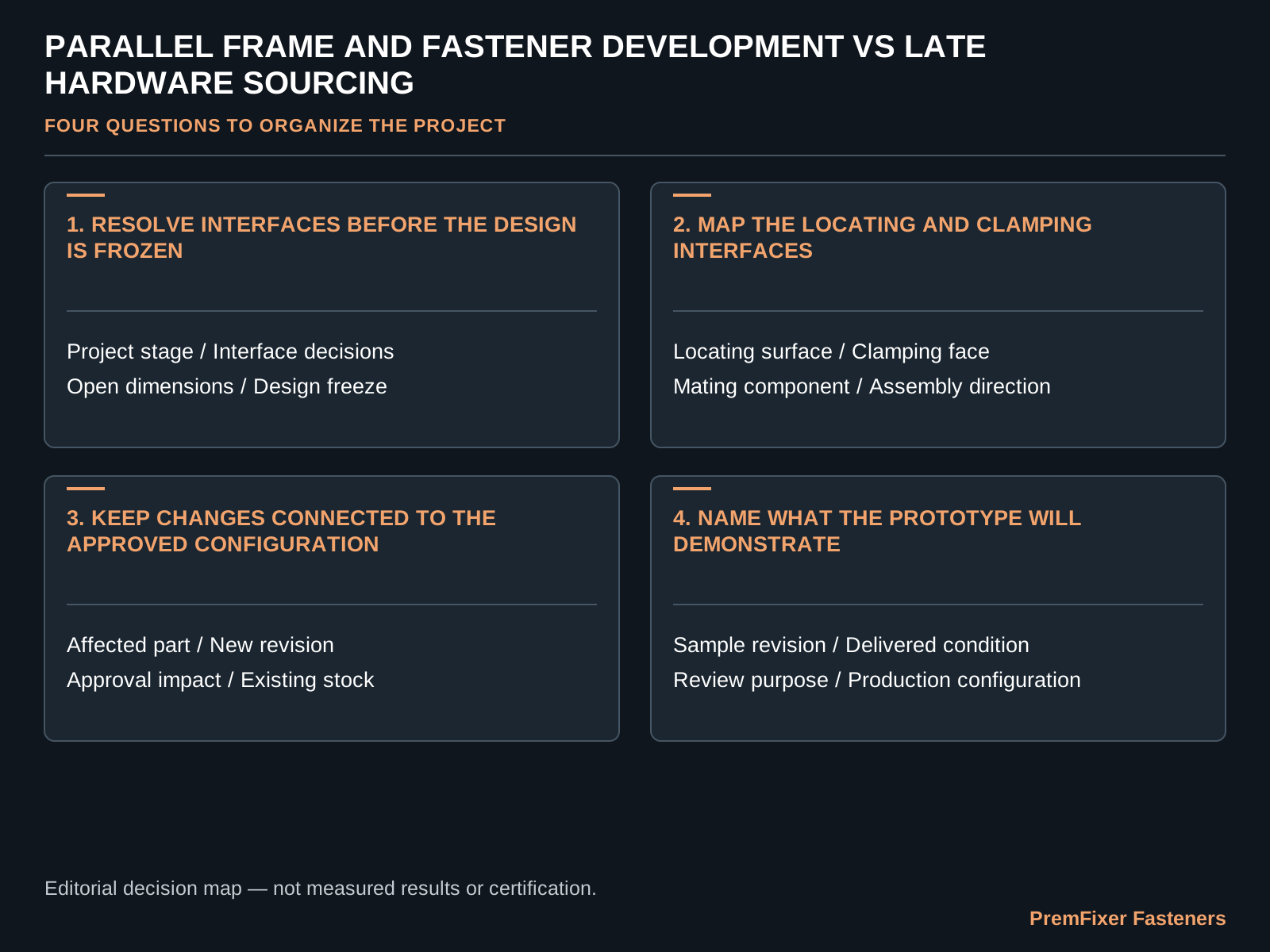
Map the locating and clamping interfaces
A pivot or structural joint contains surfaces with different jobs. A shoulder may locate against a bearing inner ring or sleeve. End faces establish the clamped stack. A thread or receiver creates closing force, while the intended rotation occurs at another interface. A component drawing alone may not explain all of those relationships.
Use an assembly section, a mating-part sketch or a controlled interface table to name the locating surface, clamping face, mating component and assembly direction. The supplier does not need unrelated proprietary frame geometry. It needs enough context to recognize which features are functional and which dimensions can remain manufacturing choices.
In "Map the locating and clamping interfaces," follow parallel bicycle fastener development, early hardware sourcing, bicycle frame fastener design, pivot interface development through the relevant handoff. The output from one operation or team should be a usable input for the next. Missing ownership at that boundary often causes more disruption than the operation itself.
If the assembly information is incomplete, preserve the open question. Do not turn a nominal diameter into an assumed fit or treat a visually similar sample as approval.
| Interface field | Information to provide | Decision protected |
|---|---|---|
| Locating surface | The diameter or face that establishes component position. | Prevents an arbitrary surface from becoming the manufacturing reference. |
| Clamping face | The contact surfaces and intended closing direction. | Clarifies which stack is compressed during assembly. |
| Mating component | Bearing, sleeve, frame feature, nut or threaded receiver. | Connects part geometry to the actual interface. |
| Assembly direction | How the component enters and where tools must reach. | Protects access and serviceability before geometry is frozen. |
Keep changes connected to the approved configuration
Development creates change. A frame interface, surface finish, material, thread or head geometry may be revised after the first sample. The important task is to connect that change to the affected part number, new revision, approval impact and disposition of material or finished stock already in the system.
Do not assume that every change requires a complete restart, and do not assume it has no effect. A cosmetic treatment change can alter a functional diameter or friction condition. A frame-side dimensional change may affect only one spacer or may change the complete clamped stack. Review the actual requirement and record the resulting scope.
Use parallel bicycle fastener development, early hardware sourcing, bicycle frame fastener design, pivot interface development to define the sample question for "Keep changes connected to the approved configuration." The sample record should state what represents production, what is temporary and which decision follows the review. A conforming sample without that context can still leave the production route unsettled.
The same revision should appear on the drawing, BOM, sample identification, inspection record and purchase release. This continuity is particularly valuable when hardware and frame work proceed in parallel because it prevents an early concept part from becoming the accidental production reference.
| Change field | Question to resolve | Controlled output |
|---|---|---|
| Affected part | Which component or interface changes? | A precise scope rather than a whole-program assumption. |
| New revision | Which drawing and BOM state supersedes the prior one? | One released identity for quotation, sample and order. |
| Approval impact | Which checks or assembly reviews must be repeated? | A proportionate re-approval plan. |
| Existing stock | Can material, work in progress or finished parts still be used? | A documented disposition before the next release. |
Name what the prototype will demonstrate
A prototype should have a named purpose. A machined unfinished sample may confirm basic geometry and tool access. A finished sample can support appearance and post-process dimensional review. A complete assembly set can help the customer evaluate fit and service access in the intended frame. These outcomes are related but not interchangeable.
Record the sample revision, delivered condition, review purpose and intended production configuration before the parts are made. If temporary material, omitted finishing or hand adjustment is accepted for one learning cycle, identify that boundary. Otherwise a useful development sample can be mistaken for a released manufacturing standard.
After "Name what the prototype will demonstrate," carry parallel bicycle fastener development, early hardware sourcing, bicycle frame fastener design, pivot interface development into repeat orders and service planning. Approved conditions should remain visible in stock, inspection records and packaging so that later lots do not depend on personal memory.
Approval should close the stated questions and retain the remaining open items. A statement that the sample fitted is less useful than a record showing which configuration was assembled, what was evaluated and what must change before production.
| Prototype field | What to define | Why it matters |
|---|---|---|
| Sample revision | The exact drawing and BOM state supplied. | Keeps an earlier concept from becoming the production reference. |
| Delivered condition | Machined, finished, assembled or otherwise qualified state. | Shows what the sample can reasonably demonstrate. |
| Review purpose | Geometry, appearance, interface, assembly or another named question. | Separates learning objectives from full release. |
| Production configuration | The approved state intended for repeat manufacture. | Connects approval to the next purchase and inspection records. |
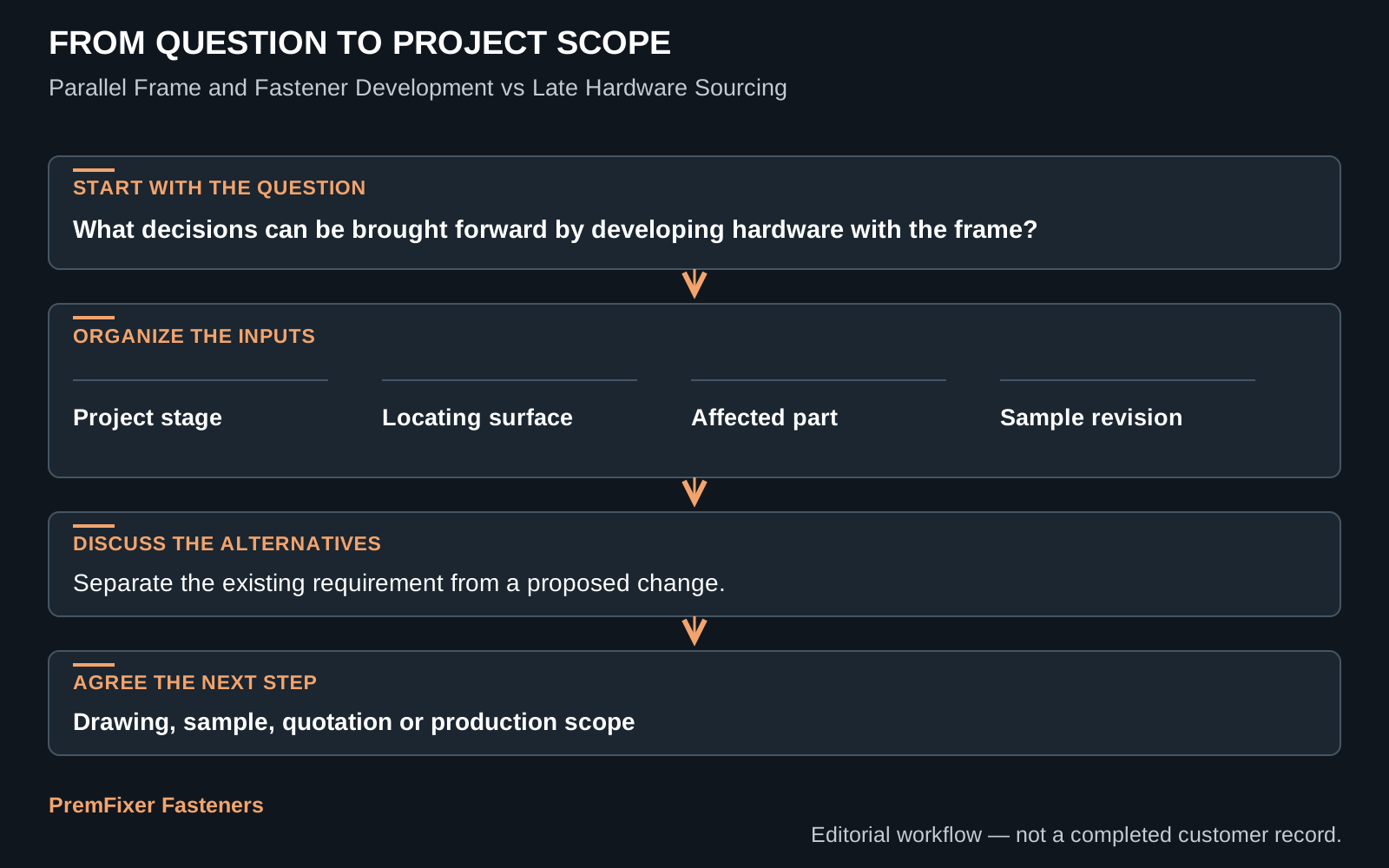
Apply the discussion to a PremFixer Fasteners project
Start with the available assembly view, component drawing, model, BOM or sample description. Add the project stage, expected quantities and the interfaces already fixed. Mark open dimensions and the next freeze or prototype decision so the first review concentrates on issues that can still influence the program.
PremFixer Fasteners can organize manufacturing feedback around locating and clamping surfaces, feasible process routes, revision impacts and the intended sample state. Proposed changes can remain separate from the customer's released requirement, allowing the product team to decide without losing configuration control.
Convert the result of "Apply the discussion to a PremFixer Fasteners project" into a quotation line that identifies parallel bicycle fastener development, early hardware sourcing, bicycle frame fastener design, pivot interface development. Ask the supplier to state included work, customer inputs, open assumptions and release evidence. Alternative offers are easier to compare when scope is not hidden inside one unit price.
Share your available drawings, BOM or project description with PremFixer Fasteners, together with quantities and the project stage, to discuss parallel frame and hardware development.
Turn the comparison into a controlled work package
A frame reaches pilot tooling before the pivot head, tool path and service removal are resolved. Map that case from customer input to accepted delivery, including every point where the part, information or approval changes hands.
For each parallel frame and fastener development vs late hardware sourcing handoff, write the input, responsible person, expected output and rejection condition. This short record makes schedule and responsibility visible without a large process manual.
Late sourcing converts small interface choices into tooling, schedule and assembly changes. Compare the proposed controls with the current route and choose evidence that can reveal the difference during a representative sample or pilot.
Once the result for parallel frame and fastener development vs late hardware sourcing is accepted, update the released files and any stock or service identity affected by the change. Keep superseded material separate whenever interchangeability has not been approved.
Provide the frame model, joint sections, development calendar, open interfaces and prototype quantities. A useful supplier reply links technical questions, commercial scope and release evidence to the same project revision.
Questions buyers ask
How should purchasing frame this decision?
Fix the drawing and project state that frame the decision, then bring fastener interfaces into the project before surrounding geometry and tooling are frozen. A recommendation without that baseline may solve a different configuration.
What should remain linked to the drawing revision?
Provide the frame model, joint sections, development calendar, open interfaces and prototype quantities, including any requirement that is still open to supplier feedback. That distinction prevents assumptions from being priced as approved scope.
Which evidence is useful during sampling?
A frame reaches pilot tooling before the pivot head, tool path and service removal are resolved. Use the pilot to examine that condition rather than treating one conforming part as approval of the complete route.
What should stay visible during repeat orders?
Late sourcing converts small interface choices into tooling, schedule and assembly changes. The review should show where the issue can be detected and who can stop the next release.
What should the first supplier response contain?
For this parallel frame and fastener development vs late hardware sourcing decision, PremFixer can return clarification questions, a proposed route and the records expected at sample or production release.
Start the hardware review earlier
Share the frame model, joint sections, development calendar, open interfaces and prototype quantities. The response will identify the proposed scope, open questions and the evidence needed before release.
Discuss This Project