
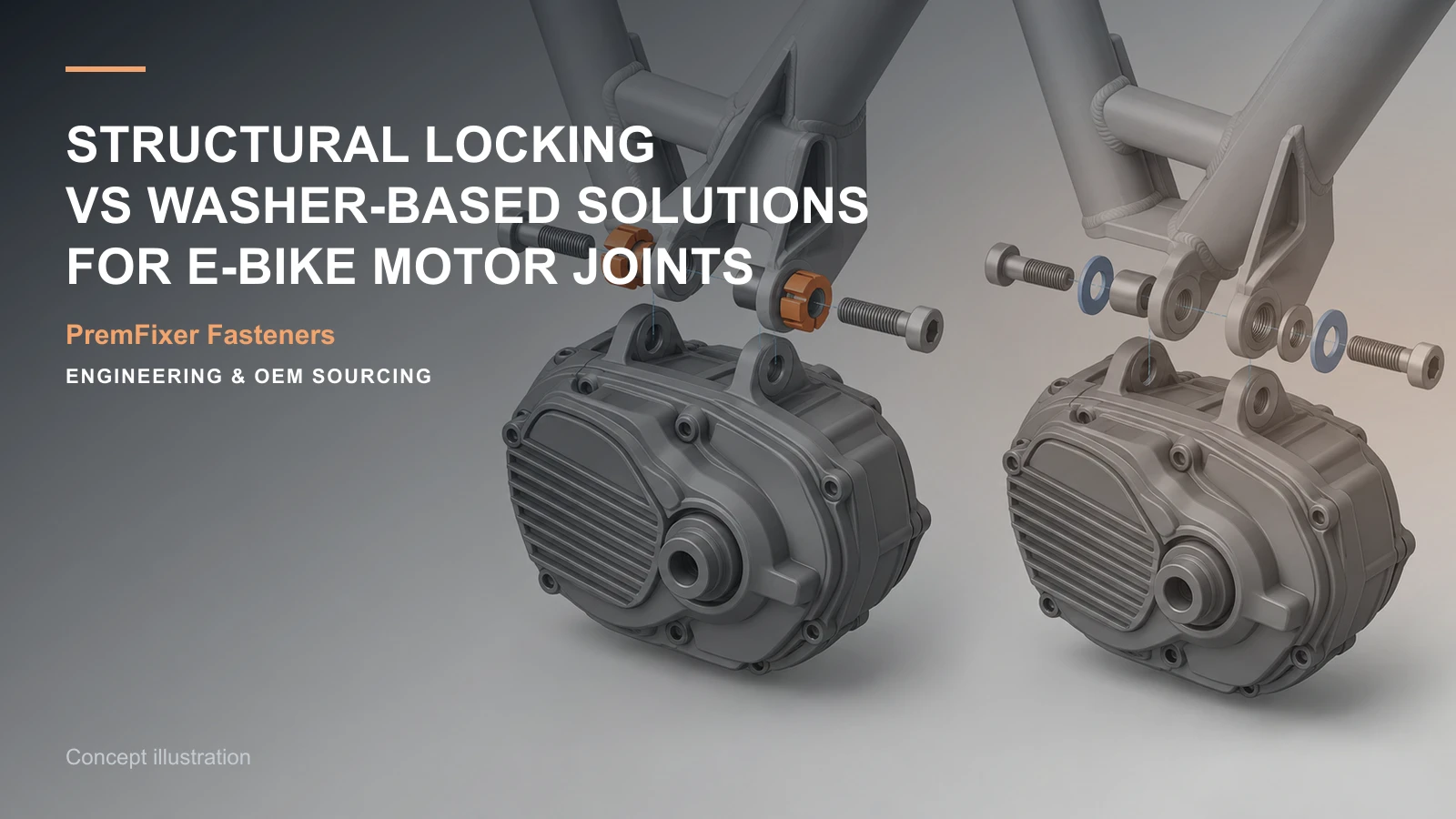
An integrated locking feature can reduce loose components and place a serration, prevailing element or other retention feature directly into a fastener design. A washer-based system can provide load distribution, surface protection or a defined locking function through a separate component. Neither description establishes long-term joint behavior by itself.
For an e-bike motor mount, the locking choice sits inside a larger architecture. The bracket stiffness, contact faces, thread engagement, surface condition, clamp load, service access and loading environment all influence the result. Even washers must be discussed by actual type; a plain load-spreading washer, a spring element and a wedge-locking pair are not one interchangeable category.
A motor-mount joint sees vibration, repeated service and limited access behind the frame. The review needs a defined baseline, named handoffs and a sample or RFQ that closes the next decision.
Define the comparison before comparing the price
Should a motor joint always replace washers with an integrated locking feature? No. Start with the existing joint and the function of each element. A washer may distribute bearing pressure, protect a surface, bridge a slot or provide a specified locking action. An integrated feature may simplify assembly or reduce part count, but its contact surface, orientation and reuse behavior still need to fit the joint.
Compare the same motor interface, fastener size, mating thread, surface state, quantity and delivered locking condition. A pre-applied feature, machined serration or matched washer set adds different manufacturing and assembly scope. A price comparison that ignores installation instructions or replacement policy is not comparing the full delivered solution.
For the "Define the comparison before comparing the price" review, put ebike motor fastener locking comparison, structural locking fastener, washer locking solution, ebike motor mount bolts on the same sheet. Name the current revision, the decision owner and the condition that allows the part or program to move forward. The technical discussion then has a clear purchasing and release action.
Keep alternatives visible. If a supplier proposes a structural change, state which washer or operation it replaces, which mating surface changes and what validation is required.
Specify the locking system and its service rules
Name the locking method and its location in the load path. It may act at the thread, under the head, at a nut face, between mating surfaces or through geometry that prevents rotation. The specification should distinguish a designed feature from incidental friction and identify any separate washer, patch, adhesive or prevailing component that forms part of the approved assembly.
Assembly instruction is part of the configuration. Define orientation, surface preparation and any required single-use material or application step. If a serrated face must contact a particular bracket, adding a decorative washer can defeat the intended contact. If a washer pair has a directional arrangement, receiving and workstation presentation may also matter.
Under "Specify the locking system and its service rules," compare the current and proposed conditions using ebike motor fastener locking comparison, structural locking fastener, washer locking solution, ebike motor mount bolts. Record the evidence source and any item that remains open. The buyer should be able to approve, reject or sample a specific supplier proposal.
Service and reuse rules should reflect the selected system. Some locking elements can be inspected and reused under defined conditions; others are replaced after removal or rely on a refreshed compound.
| Locking field | What to define | Service implication |
|---|---|---|
| Locking method | The actual structural, washer, thread or applied mechanism. | Prevents the generic term anti-loosening from hiding different functions. |
| Application location | Thread, head face, nut face or mating interface. | Shows which surfaces must remain compatible with the feature. |
| Assembly instruction | Orientation, preparation and installation sequence. | Makes the designed mechanism repeatable at the workstation. |
| Reuse rule | Inspection, replacement or renewal after removal. | Keeps service parts aligned with the validated configuration. |
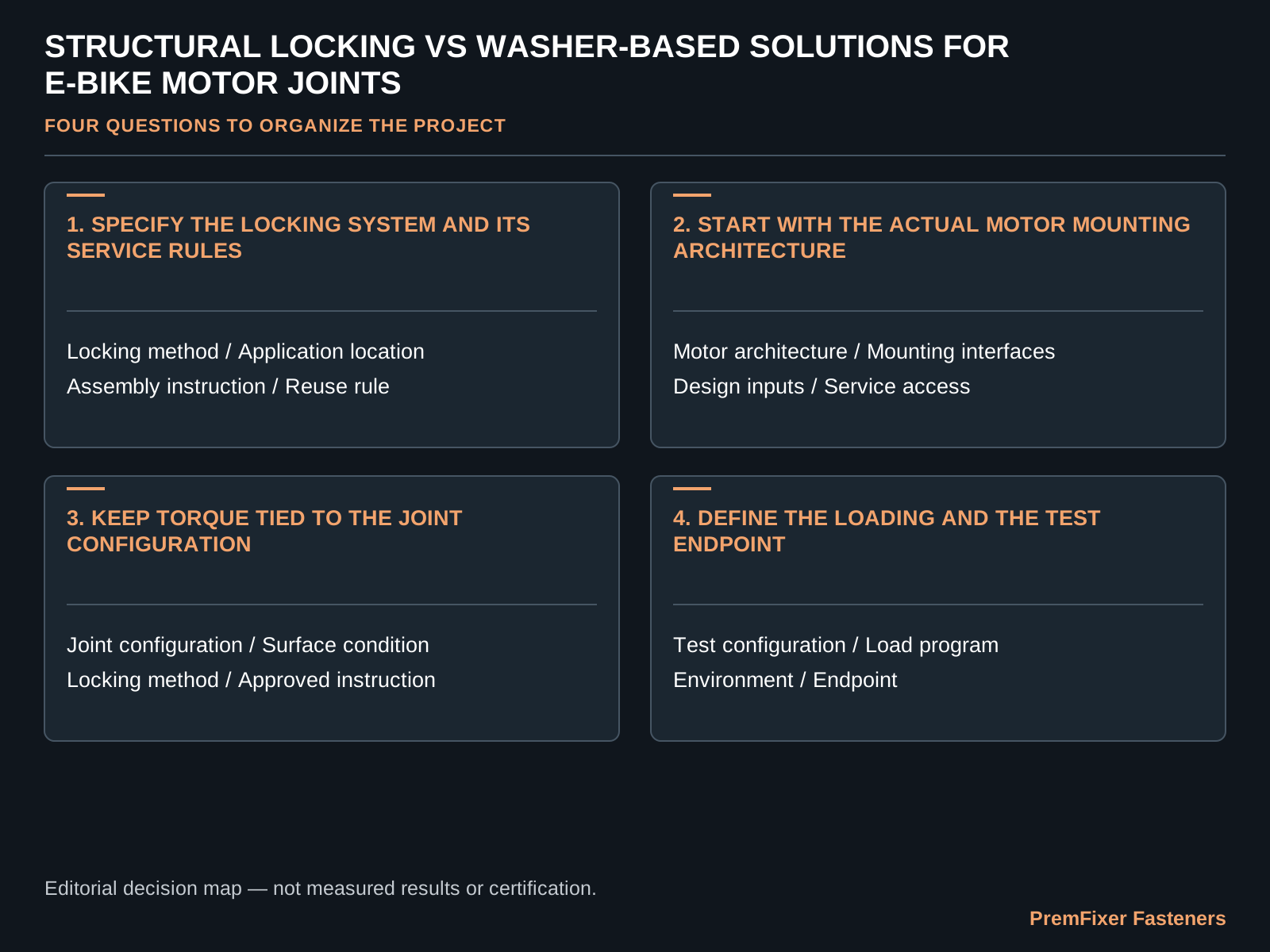
Start with the actual motor mounting architecture
Identify whether the system is a mid-drive, hub-drive or another architecture, then locate the joint under review. A motor's published output is not the torque acting directly on every mounting fastener. Bracket geometry, reaction paths, support points, frame stiffness and external loads determine how the interface is loaded.
Map the mounting faces, through-bolts, threaded receivers, sleeves and any components that locate or clamp the motor. Record access for assembly and service. A locking feature that performs well on an open test plate may be impractical if a frame cavity prevents correct tool alignment or if removal damages a service-sensitive surface.
In "Start with the actual motor mounting architecture," follow ebike motor fastener locking comparison, structural locking fastener, washer locking solution, ebike motor mount bolts through the relevant handoff. The output from one operation or team should be a usable input for the next. Missing ownership at that boundary often causes more disruption than the operation itself.
The design inputs should come from the system owner: interface drawings, expected load information, environmental exposure and maintenance intent. The fastener proposal can then respond to the real architecture instead of applying one motor-bolt pattern to every bicycle platform.
| Architecture field | Question to resolve | Locking relevance |
|---|---|---|
| Motor architecture | Which motor arrangement and support concept are used? | Defines the overall reaction and service context. |
| Mounting interfaces | Which faces, bolts, sleeves and threads locate or clamp the unit? | Shows where the locking feature acts within the joint. |
| Design inputs | Which loads, materials, environments and assembly states are provided? | Prevents motor output from being treated as direct bolt load. |
| Service access | How will the joint be installed, checked and removed? | Tests whether the proposed system can be applied consistently. |
Keep torque tied to the joint configuration
A torque value cannot be selected from fastener material and nominal diameter alone. The relationship between applied torque and clamp load is influenced by thread geometry, mating material, surface condition, lubrication, locking features, bearing surfaces and assembly method. A value approved for one motor mount should not be transferred to another because the thread label matches.
Define the joint configuration and surface state first, then state the locking method included when the instruction was established. If a patch, adhesive, washer or coating changes, review the instruction. The correct output is an approved assembly value or procedure for the actual joint, not a broad material-based chart in a supplier article.
Use ebike motor fastener locking comparison, structural locking fastener, washer locking solution, ebike motor mount bolts to define the sample question for "Keep torque tied to the joint configuration." The sample record should state what represents production, what is temporary and which decision follows the review. A conforming sample without that context can still leave the production route unsettled.
Verification may include controlled assembly trials, clamp-load work or other engineering methods chosen by the system owner. Manufacturing records can confirm the delivered component and specified locking state, while the approved instruction remains part of the bicycle or motor assembly definition.
| Torque input | What to record | Reason for control |
|---|---|---|
| Joint configuration | Fastener, mating thread, clamped parts and contact faces. | Torque belongs to an assembly, not an isolated screw. |
| Surface condition | Finish, cleanliness and lubrication state. | Friction changes the torque-to-clamp relationship. |
| Locking method | The exact feature, washer, patch or applied compound. | A changed locking condition can require renewed validation. |
| Approved instruction | Value or method released for this configuration. | Prevents reuse of a number from a different joint. |
Define the loading and the test endpoint
A meaningful durability comparison identifies the test configuration, loading program, environment and endpoint. The fixture should preserve the relevant contacts and assembly state. The load program should describe what is applied and how. Temperature, moisture, contamination or other environmental conditions should be included only when they belong to the defined question.
The endpoint might be a measured loss of clamp condition, rotation, movement, component damage or another agreed criterion. A vibration duration without an endpoint is difficult to interpret. Likewise, one passing result belongs to the tested configuration and procedure; it does not establish a universal service life for every bicycle, motor bracket or washer type.
After "Define the loading and the test endpoint," carry ebike motor fastener locking comparison, structural locking fastener, washer locking solution, ebike motor mount bolts into repeat orders and service planning. Approved conditions should remain visible in stock, inspection records and packaging so that later lots do not depend on personal memory.
Separate component or joint testing from complete-vehicle validation. Bench work can compare controlled alternatives and reveal an assembly sensitivity, while road, vehicle or regulatory evaluation answers broader questions.
| Test field | What to define | Interpretation boundary |
|---|---|---|
| Test configuration | Geometry, fasteners, locking parts and assembly state. | The result applies to the tested joint configuration. |
| Load program | Applied loading, sequence and monitoring approach. | A generic vibration label does not describe the comparison. |
| Environment | Relevant temperature, moisture or contamination conditions. | Do not infer conditions that were not included. |
| Endpoint | The measured condition that constitutes completion or failure. | Turns duration into an interpretable engineering result. |
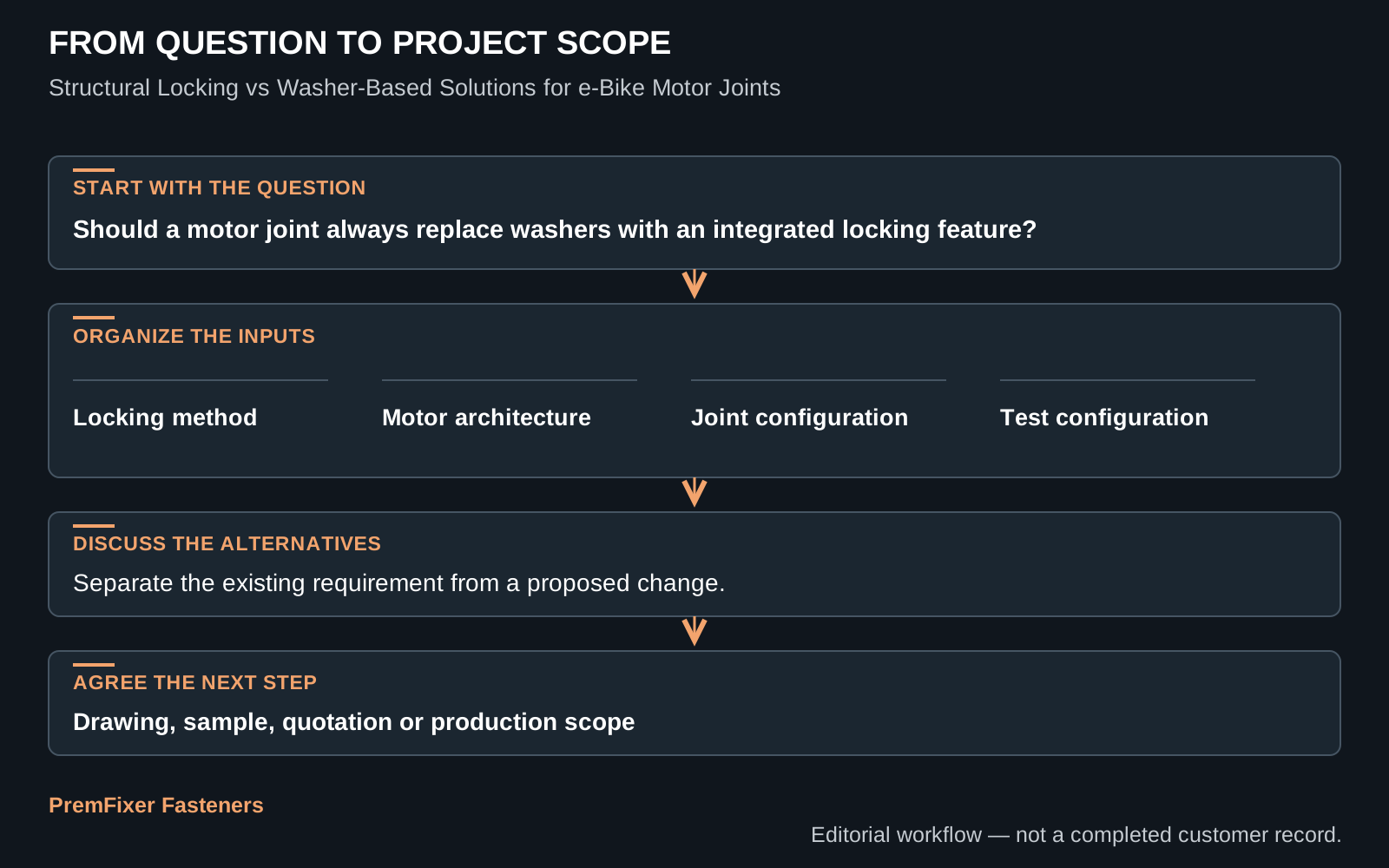
Apply the discussion to a PremFixer Fasteners project
Start with the motor-mount drawing or assembly view, the current fastener and washer arrangement, mating materials, quantity and project stage. Add the approved assembly instruction if one exists, plus service access and any defined durability question. Mark which elements must remain and which are open to an alternative.
PremFixer Fasteners can then organize a proposal around the actual locking location, manufacturable component geometry, delivered surface state and records. A proposed structural feature can be shown separately from the base configuration so the engineering team can decide what changes and what validation belongs to the change.
Convert the result of "Apply the discussion to a PremFixer Fasteners project" into a quotation line that identifies ebike motor fastener locking comparison, structural locking fastener, washer locking solution, ebike motor mount bolts. Ask the supplier to state included work, customer inputs, open assumptions and release evidence. Alternative offers are easier to compare when scope is not hidden inside one unit price.
Share your available drawings, BOM or project description with PremFixer Fasteners, together with quantities and the project stage, to discuss e-bike motor locking hardware.
Apply the decision to a working program
A motor-mount joint sees vibration, repeated service and limited access behind the frame. Identify the exact part numbers and revision involved, then name the teams that approve design, prepare supply, receive the lot and assemble the bicycle.
Place the current condition beside the proposed condition for structural locking vs washer-based solutions for e-bike motor joints. Record the drawing or BOM effect, process change, inspection evidence, schedule consequence and delivered state. Unknown inputs should remain open instead of becoming quoted assumptions.
Adding a washer can change seating or stack height without addressing the loosening mechanism. Use the smallest sample, document check or pilot lot that can expose this issue, and state which production conditions the evidence does not cover.
Carry the accepted result for structural locking vs washer-based solutions for e-bike motor joints into the drawing, order, inspection plan and packaging identity that depend on it. Another model or revision stays outside the approval until its interfaces are shown to be equivalent.
Send the joint drawing, load and vibration context, mating materials, tightening method and service cycle. The supplier response should separate included work, customer approvals, external operations and open assumptions so e-bike joint designers can make the next commitment.
Questions buyers ask
Where should the engineering review begin?
Begin with the current configuration, then select a locking concept from joint behaviour, assembly and service requirements. Name the owner and the output required before price, schedule or supplier preference is treated as final.
What information should the supplier receive?
Send the joint drawing, load and vibration context, mating materials, tightening method and service cycle. Separate fixed requirements from open fields so the supplier can price the confirmed scope and respond to the engineering questions.
What must a prototype demonstrate?
A motor-mount joint sees vibration, repeated service and limited access behind the frame. A sample or pilot should answer named questions and disclose any material, finish, process or quantity that differs from production.
Which handoff deserves extra attention?
Adding a washer can change seating or stack height without addressing the loosening mechanism. Connect the risk to a drawing characteristic, process handoff, approval or delivery record and verify its closure.
What output should the RFQ request?
PremFixer can review the available drawing, model, BOM or sample with the joint drawing, load and vibration context, mating materials, tightening method and service cycle. The response can identify open questions, proposed scope and evidence for the next decision.
Review the locking mechanism
Share the joint drawing, load and vibration context, mating materials, tightening method and service cycle. The response will identify the proposed scope, open questions and the evidence needed before release.
Discuss This Project