
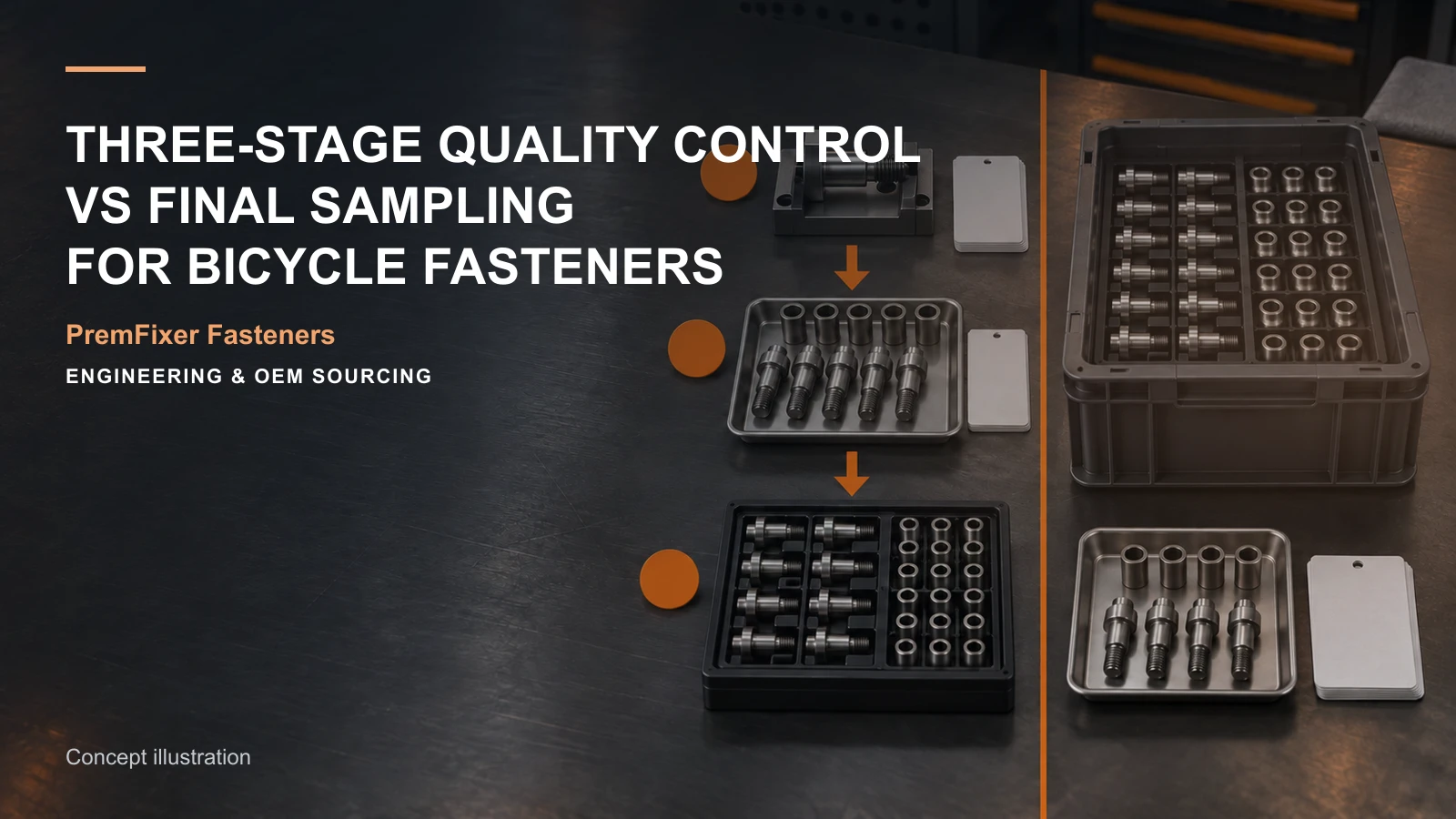
A final sample can show whether selected pieces from a completed bicycle fastener lot meet defined release requirements. It cannot, by itself, show when a process began to drift or what happened after a tool change. First-article, in-process and final inspection are separated because each stage supports a different manufacturing decision.
That does not make a three-stage label a guarantee of zero defects. The value comes from naming the characteristic checked, the method used, the point in the route and the action that follows a result. Final sampling can still be appropriate when its scope matches the component risk and the buyer's acceptance plan.
A shoulder diameter drifts after a tool change even though the final random sample remains within limits. That example provides a practical test for the technical and commercial choices discussed below.
Define the comparison before comparing the price
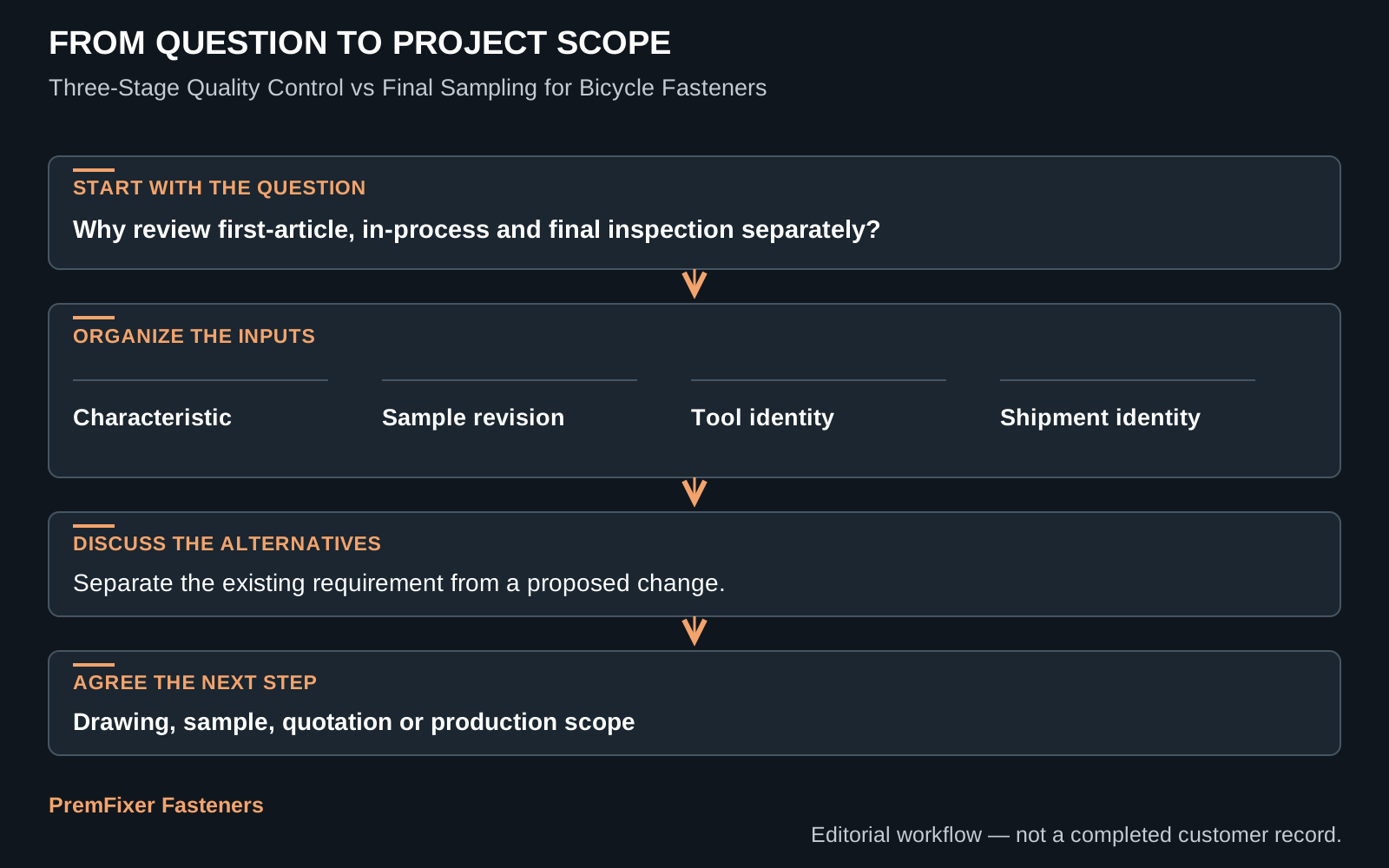
Why review first-article, in-process and final inspection separately? A first-article check asks whether the setup reflects the current drawing and planned route. In-process checks ask whether selected characteristics remain within the agreed conditions while work continues. Final inspection or sampling asks whether the completed lot meets its stated release scope.
Compare the same part revision, quantity, delivered condition and inspection requirements. A quote that includes setup approval, patrol checks and final release is not the same scope as a quote that includes only an end-of-lot sample. The cost discussion becomes useful only after those activities and records are visible.
For the "Define the comparison before comparing the price" review, put bicycle fastener quality control stages, first article inspection, in-process fastener inspection, final sampling on the same sheet. Name the current revision, the decision owner and the condition that allows the part or program to move forward. The technical discussion then has a clear purchasing and release action.
Final sampling is not inherently careless, and a multi-stage plan is not automatically comprehensive. The decision depends on feature criticality, process knowledge, lot structure, measurement practicality and any customer-specific acceptance requirements.
Match inspection to the requirement
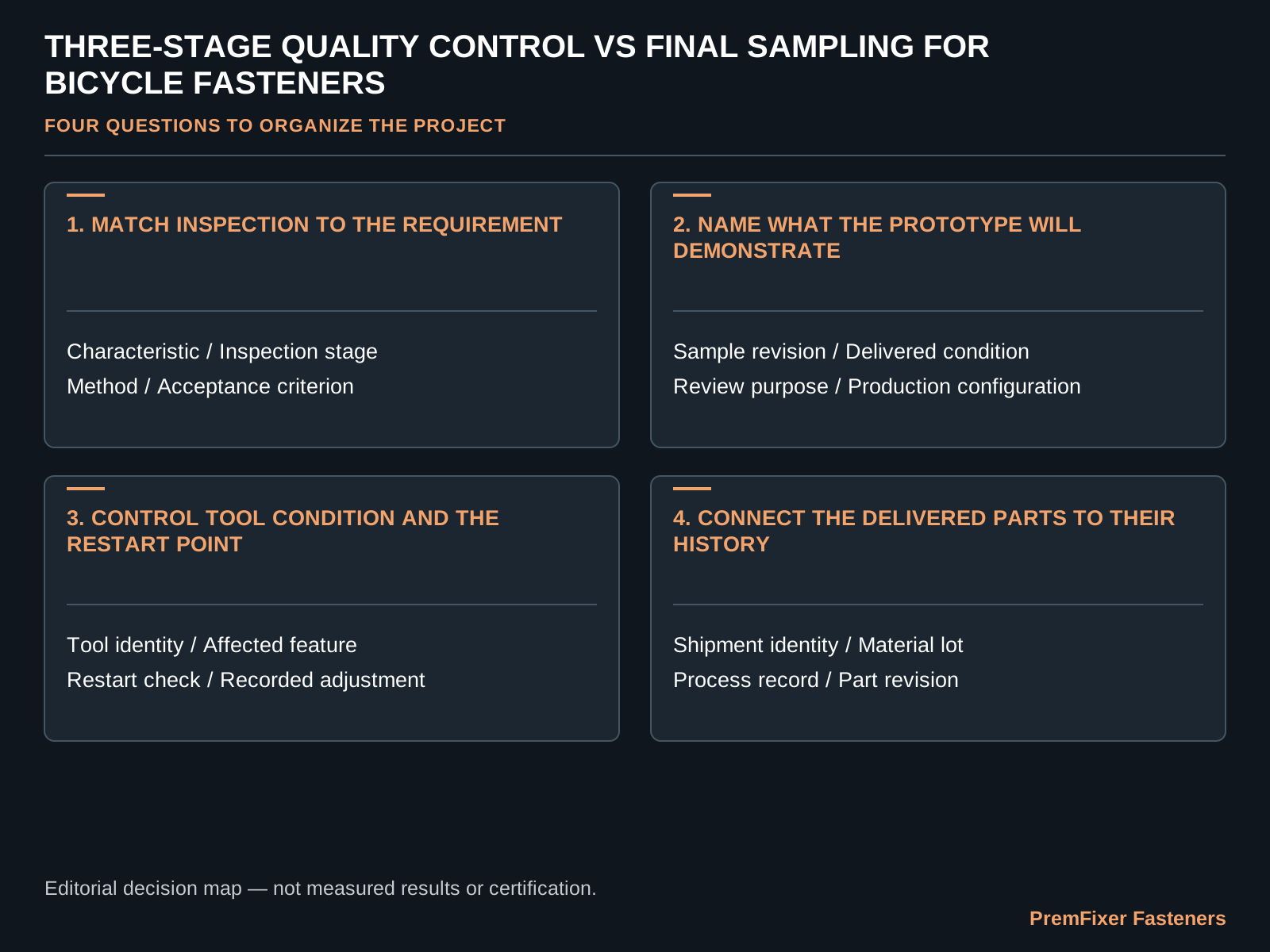
An inspection plan begins with the characteristic, not the stage name. A thread feature, shoulder diameter, contact face, finish condition and packaging identity can require different methods and frequencies. State which drawing or specification provides the acceptance criterion and how the result influences release or correction.
First-article inspection normally addresses the initial setup or a defined restart. In-process inspection provides feedback before the whole lot is completed. Final inspection confirms the stated shipment release conditions. Separately specified material, coating, fatigue or destructive tests should remain separate; a three-stage dimensional plan does not silently include them.
Under "Match inspection to the requirement," compare the current and proposed conditions using bicycle fastener quality control stages, first article inspection, in-process fastener inspection, final sampling. Record the evidence source and any item that remains open. The buyer should be able to approve, reject or sample a specific supplier proposal.
The comparison table below focuses on purpose. It does not assign a universal frequency, sample size or pass rate because those belong to the agreed plan for the actual part and order.
| Plan field | Question to answer | Release connection |
|---|---|---|
| Characteristic | Which dimension, thread, surface or identity is being checked? | Links the result to a stated product requirement. |
| Inspection stage | Is this setup approval, process feedback, final release or a separate test? | Shows which manufacturing decision the result supports. |
| Method | Which suitable gauge, instrument or visual criterion will be used? | Keeps the result interpretable within the agreed scope. |
| Acceptance criterion | Which drawing, specification or approved limit controls the decision? | Prevents a generic pass label from replacing the requirement. |
Name what the prototype will demonstrate
A sample can arrive as a machined part, a finished part, an inspection-supported sample or a set intended for assembly review. Those conditions are not interchangeable. Before approval, record the sample revision, delivered condition and review purpose so the team knows what the part can and cannot establish.
Dimensional review may confirm selected drawing features. An assembly review may expose an interface question. A finish sample may support appearance or handling discussion. None of those automatically releases every aspect of production. Open items should remain visible until the customer and supplier agree on the production configuration.
In "Name what the prototype will demonstrate," follow bicycle fastener quality control stages, first article inspection, in-process fastener inspection, final sampling through the relevant handoff. The output from one operation or team should be a usable input for the next. Missing ownership at that boundary often causes more disruption than the operation itself.
The sample record then becomes the bridge into first-article planning: it shows which configuration is being set up and which characteristics need confirmation when production begins.
| Sample field | What to record | Decision supported |
|---|---|---|
| Sample revision | The drawing or model revision used to make the sample. | Confirms which configuration was reviewed. |
| Delivered condition | Raw, finished, inspected or assembly-review condition. | Prevents a partial sample from being treated as fully representative. |
| Review purpose | The specific dimension, interface, finish or process question under review. | Defines what approval actually means. |
| Production configuration | The released inputs after open items are resolved. | Creates a controlled start point for production and inspection. |
Control tool condition and the restart point
Cutting tools wear, inserts are replaced, offsets may be adjusted and machines can restart after an interruption. A stable program is important for revision control, but it does not remove these physical events. The inspection plan should identify which features a changed tool can influence and what restart check is required before normal production continues.
Record the tool identity or operation, the affected feature, the restart result and any controlled adjustment. The record does not need a fabricated capability index or a decorative trend chart. It needs enough context for manufacturing and quality teams to understand why the check occurred and which parts were produced before and after it.
Use bicycle fastener quality control stages, first article inspection, in-process fastener inspection, final sampling to define the sample question for "Control tool condition and the restart point." The sample record should state what represents production, what is temporary and which decision follows the review. A conforming sample without that context can still leave the production route unsettled.
This is where in-process feedback adds value. It can identify a condition while the relevant lot segment and process state are still known.
| Restart field | Practical question | Record outcome |
|---|---|---|
| Tool identity | Which tool or operation changed? | The event is tied to the relevant process step. |
| Affected feature | Which product characteristic could the change influence? | The check remains focused on the actual risk. |
| Restart check | What must be confirmed before routine work resumes? | A defined decision separates setup from continued production. |
| Recorded adjustment | Was an approved correction made, and to which lot segment? | The production history remains understandable without implying perfect stability. |
Connect the delivered parts to their history
Inspection data becomes more useful when it is connected to the parts that were shipped. Start with a shipment or lot identity, then link it to the part revision, material record and the applicable first-article, in-process and final records. The order should define how much of that information is delivered and how much is retained for later reference.
A certificate stored without a lot connection is difficult to use when a question arises. Conversely, a traceability system does not need to expose every internal screen to the customer. It needs a reliable relationship between the shipment identity and the agreed supporting records.
After "Connect the delivered parts to their history," carry bicycle fastener quality control stages, first article inspection, in-process fastener inspection, final sampling into repeat orders and service planning. Approved conditions should remain visible in stock, inspection records and packaging so that later lots do not depend on personal memory.
For a repeated order, that chain also helps the team recognize whether the same configuration and inspection plan still apply. If the drawing, material, process or acceptance scope changes, update the record path instead of treating the new order as an identical repeat.
Apply the discussion to a PremFixer Fasteners project
PremFixer Fasteners can use an available drawing, model, BOM or sample description to organize an inspection discussion around the actual fastener. Include the quantities, project stage, key characteristics, sample revision and any existing customer acceptance requirements. Mark open points rather than filling them with assumptions.
For quote comparison, ask each supplier to state which checks occur at setup, during production and at final release; which features they cover; and what records or lot identity accompany the delivery. That makes final sampling and a three-stage plan comparable without implying that either label alone guarantees quality.
Convert the result of "Apply the discussion to a PremFixer Fasteners project" into a quotation line that identifies bicycle fastener quality control stages, first article inspection, in-process fastener inspection, final sampling. Ask the supplier to state included work, customer inputs, open assumptions and release evidence. Alternative offers are easier to compare when scope is not hidden inside one unit price.
Share your available drawings, BOM or project description with PremFixer Fasteners, together with quantities and the project stage, to discuss three-stage fastener quality control.
Apply the decision to a working program
A shoulder diameter drifts after a tool change even though the final random sample remains within limits. Identify the exact part numbers and revision involved, then name the teams that approve design, prepare supply, receive the lot and assemble the bicycle.
Place the current condition beside the proposed condition for three-stage quality control vs final sampling for bicycle fasteners. Record the drawing or BOM effect, process change, inspection evidence, schedule consequence and delivered state. Unknown inputs should remain open instead of becoming quoted assumptions.
Final sampling alone may miss a short-lived process shift or the source of a mixed lot. Use the smallest sample, document check or pilot lot that can expose this issue, and state which production conditions the evidence does not cover.
Carry the accepted result for three-stage quality control vs final sampling for bicycle fasteners into the drawing, order, inspection plan and packaging identity that depend on it. Another model or revision stays outside the approval until its interfaces are shown to be equivalent.
Send the critical characteristics, process stages, batch size, sampling plan and nonconformance response. The supplier response should separate included work, customer approvals, external operations and open assumptions so quality engineers and OEM buyers can make the next commitment.
Questions buyers ask
How should purchasing frame this decision?
Decide where first-article, in-process and final checks should sit for a precision fastener. The comparison is credible only when every option uses the same part revision, quantity and delivered condition.
What should remain linked to the drawing revision?
The first package should contain the critical characteristics, process stages, batch size, sampling plan and nonconformance response. It should also state the immediate decision the customer needs from the supplier response.
Which evidence is useful during sampling?
Base the pilot on this situation: a shoulder diameter drifts after a tool change even though the final random sample remains within limits. Record the representative operations and the approval that follows the result.
What should stay visible during repeat orders?
The main risk is that final sampling alone may miss a short-lived process shift or the source of a mixed lot. Put one person in charge of the related drawing, handoff or release action.
What should the first supplier response contain?
For three-stage quality control vs final sampling for bicycle fasteners, PremFixer can organize the files and open points into a manufacturing, sample and quotation response for the defined component or hardware set.
Build a stage-based control plan
Share the critical characteristics, process stages, batch size, sampling plan and nonconformance response. The response will identify the proposed scope, open questions and the evidence needed before release.
Discuss This Project