
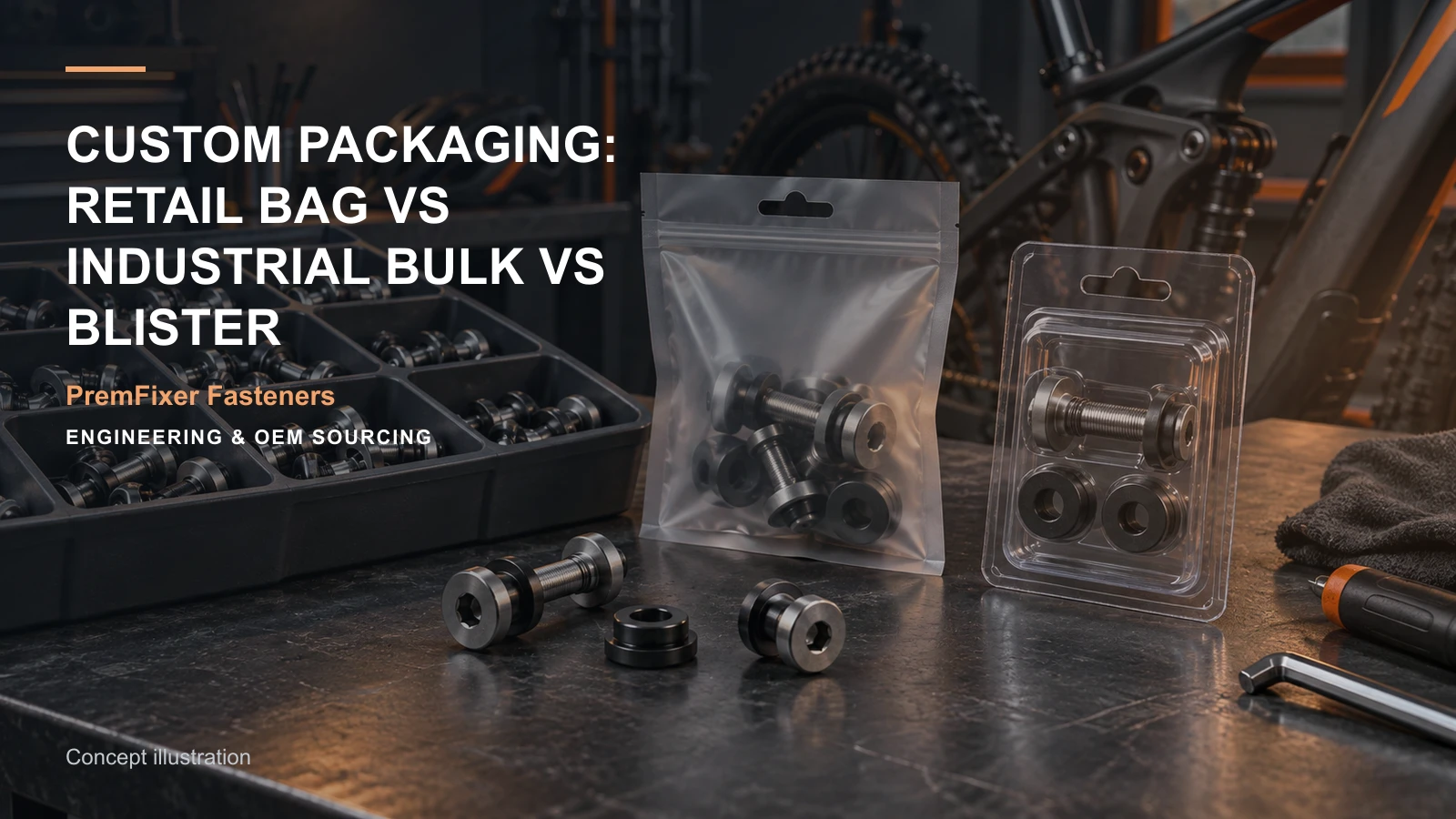
Industrial bulk, a retail bag and a blister pack can contain the same pivot hardware, but they serve different receiving tasks. Bulk suits a controlled assembly line that already identifies parts and counts usage; a sealed bag keeps a small service set together; a blister can improve retail presentation when a market and labeling plan support it. The OEM should first define whether the package holds one bolt, a counted kit or multiple frame variants. Then specify protection, part and revision identity, lot mapping and who supplies label artwork. Packaging alone does not prove that the hardware fits every bicycle model or is ready for direct consumer sale.
Choose for the receiving and use point
At a factory line, a compartmented or separated bulk pack can reduce repeated opening, provided the line controls part number and revision. For service, a sealed counted bag can keep washers and sleeves with the correct bolt. A retail blister adds display and tamper-evidence considerations but also increases pack material and artwork work.
Define who opens the package, how often, and whether the parts are consumed together. The best format follows that task rather than a generic premium label.
Control the item and variant inside
A package should identify the supplied item or kit, quantity, revision and any frame-application restriction. A retail trade item may need a channel-specific product identifier; GS1 describes GTIN as a way to identify trade items, but an OEM should define its own market and labeling requirements before assigning codes.
Do not mix visually similar spacer lengths without a separator or clear identity. Count and verify contents against an item-level BOM before sealing a service kit.
GS1 trade item identification · Kit versus bolt scope
| Use context | Format | Main risk | Verification |
|---|---|---|---|
| Controlled OEM assembly line | Separated industrial bulk | Variant or lot mixed in bins | Line receiving and count check |
| Service replacement set | Sealed counted bag | Washer or spacer missing | BOM count and seal check |
| Retail shelf presentation | Blister-style pack | Unapproved fit or label claim | Artwork and application review |
| Export transit | Inner protection plus outer carton | Surface damage or lost small parts | Pack trial with actual route |
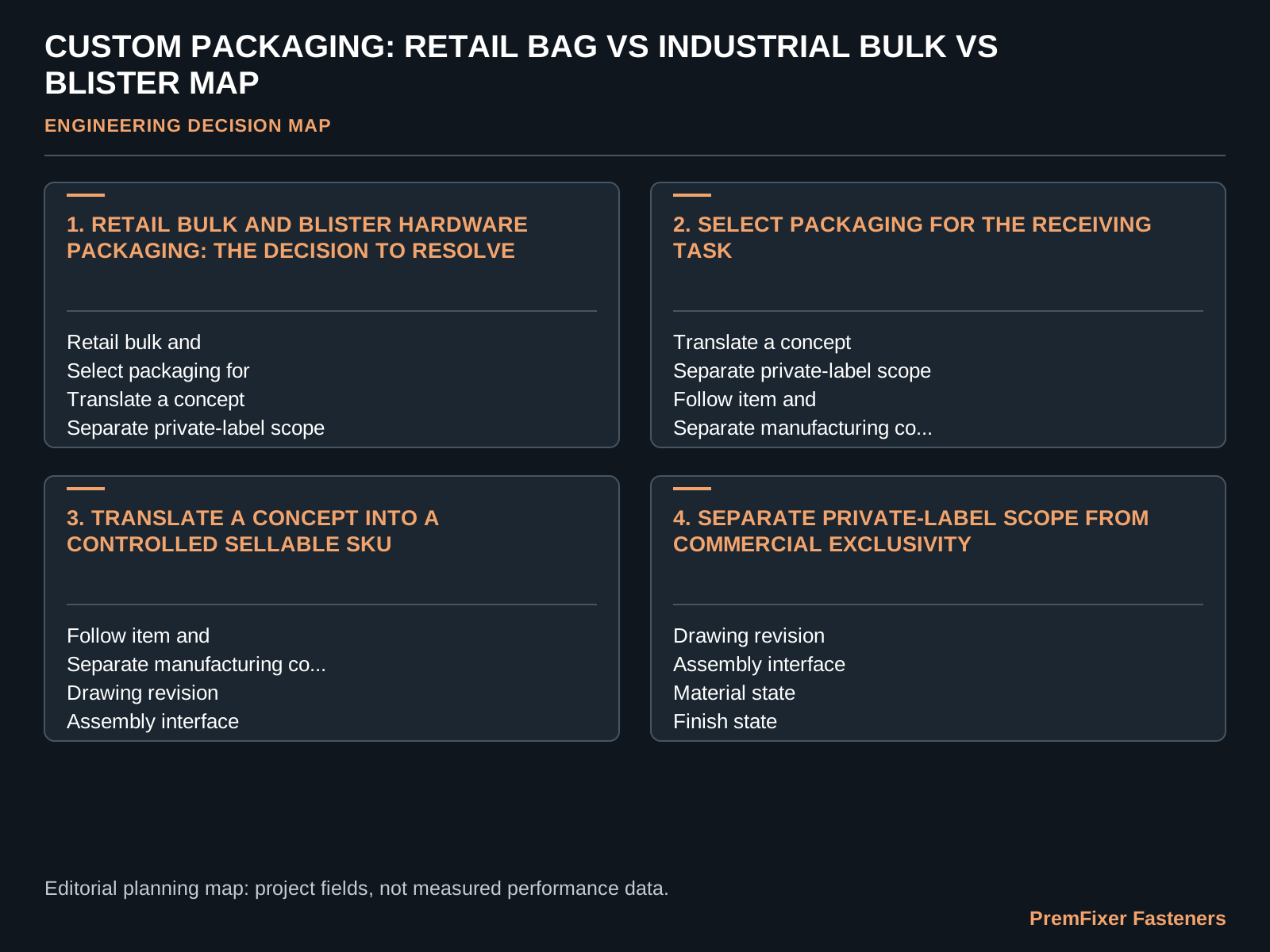
Specify protection and presentation separately
Machined and finished heads can mark each other in transit, and small washers can escape a poorly sealed compartment. Define separation, cushioning, corrosion protection where relevant and the shipping-unit quantity. Then decide whether consumer-facing visibility, opening experience or private-label art is needed.
Do not imply that a blister automatically improves protection or that bulk is always damaging. Test the proposed pack with the actual part mix and distribution route.
Illustrative engineering example: assume an OEM receives the same bolt for factory build and a two-spacer service set for dealers. Factory consumption is controlled by separate bins, so bulk bolt packs are reasonable. The service set needs a counted, sealed bag with a frame-revision identifier. A blister is considered only if the dealer needs shelf display and the OEM approves the fit statement. The example compares receiving tasks; it does not report a PremFixer shipment result.
Clarify artwork, claims and responsibility
Retail artwork may include fit statements, instructions, identifiers and market-required information. The OEM should approve all customer-facing compatibility and safety claims; a manufacturer should not infer them from the part sample. Private-label printing is a packaging service, not a transfer of brand or design ownership.
For an industrial order, a simple outer label may be enough. For retail, define the sales market and who controls graphics, barcode data and translations before the quote includes print work.

Quote the hardware and package as one scope
PremFixer Fasteners can review the drawing-defined hardware and agreed finished-pack requirement. The quotation should state whether it covers loose parts, counted kits, packaging materials, artwork setup, labels and shipping cartons. Manufacturing completion and transport performance are different acceptance events.
Send the part drawings, item BOM, variant matrix, quantities per pack, target channel, packaging concept, label data and distribution conditions. The supplier can then compare formats on the same delivered scope.
Questions buyers need to resolve
Is bulk packing suitable for finished pivot bolts?
Yes when parts are separated and protected as needed for the actual finish and route. Define part and lot identification, container quantity and a receiving check to prevent mixing.
When is a counted retail bag preferable?
When the customer or mechanic needs a small set of matching parts kept together. Specify the kit BOM, seal, label, frame revision and replacement policy.
Does a blister pack prove retail readiness?
No. The OEM still needs approved artwork, market labeling, fit claims and distribution checks. A blister is a presentation and handling choice, not a product certification.
Who supplies the barcode and compatibility text?
The OEM or brand owner should define and approve product identity and market-facing claims. The packaging supplier can implement the agreed data and format after the scope is fixed.
What should a packaging RFQ include?
Provide part drawings, item BOM, variants, quantity per pack, finish-protection needs, sales channel, label artwork and shipping conditions. These fields determine format, material and verification work.
Choose Packaging from the Receiving Task
Share the hardware drawings, item BOM, variants, quantities, receiving or retail channel and label requirements. PremFixer can quote the defined part and pack scope and identify the checks needed before shipment.
Discuss the drawing and BOM