

ARTICLE HERO — CONCEPT. Illustrative component roles; actual content follows the approved model/revision BOM. Appearance does not establish inclusion, material, dimensions, compatibility or application.
Most pivot-hardware RFQs begin with sensible line items: pivot bolts, axles, shock-mount hardware and perhaps a few spacers. Every listed component may be described correctly, yet the package can still be incomplete.
The missing object is often not another bolt. It is the controlled relationship between each physical suspension interface and the parts, assembly state, validation requirements and packing identity assigned to it.
That distinction matters because a full suspension bicycle pivot hardware kit is not universal. Architecture names do not establish the kit. Neither do visual similarity, a model-family name or a bag label. “Complete” only has meaning for an exact frame configuration and an approved inclusion schedule.
1. Define “complete” against one configuration
A release-safe kit identity begins with the exact frame model, year or generation, variant and controlling BOM/drawing revision. Size and frame material should also be treated as required configuration inputs where relevant, but their presence does not prove that the pivot hardware changes. The controlling records must make that decision.
The same discipline applies to architecture. A one-piece rocker arrangement, a dual-short-link layout, a physical four-bar/Horst-family system and a flex-stay system can name, split or omit hardware roles differently. Even when two models share an architecture—or one service subkit—their complete hardware BOMs are not automatically interchangeable.
So the first review question is not “Do we have all the bolts?” It is:
Which named frame configuration and revision does this set release?
Without that answer, “complete MTB pivot bolt kit” remains a search phrase, not an engineering definition.
2. Separate the pivot kit from the broader frame fastener BOM
The strict suspension-pivot kit sits inside a broader frame-hardware scope.
The strict kit covers parts whose approved function is to create, support, clamp, retain, seal or service a suspension-articulation axis or rear-shock attachment. Depending on the design and commercial BOM, that scope may include axles or bolts, locking screws or receivers, bearings or bushings, sleeves or inner spacers, interface washers, conditional nuts or retainers, seals and shock-mount hardware.
The broader full-frame fastener BOM may also contain cable-routing, guard, storage, bottle, hanger, chain-guide, brake, insert, accessory or e-bike hardware. Those items do not become pivot hardware simply because they sit near a linkage. If one fastener serves more than one documented function, the BOM should record that multifunction interface rather than count it silently in two places.
This nested-scope distinction prevents two opposite errors:
- treating non-pivot accessory hardware as part of every suspension kit; and
- omitting broader frame hardware when the purchasing scope is meant to cover the full frame.
The purchasing BOM must state what is included, excluded or customer-supplied. A word such as “complete” cannot make that decision by itself.
3. Eight possible roles to check—not a universal recipe
The following classes are useful review prompts. A real frame may split, combine, relocate or omit them.
Main-pivot axle and locking element
Where a physical main pivot exists, identify the axle or bolt, its receiver or locking element, the joined frame members, side and service direction, and the bearing or bushing stack. One official service example includes an axle, bearings, a sleeve, washers and screws, but that part split belongs to the named model and cannot be copied into a generic BOM.
Rocker or link hardware
“Upper link” and “lower link” are valid only when the selected architecture contains those distinct links. A one-piece rocker and a dual-short-link system need different axis names and different kit decomposition. Every line should identify the actual member pair and location.
Chainstay-related pivot hardware
Confirm that a physical chainstay-related joint exists before assigning bolts, bearings or retainers to it. A compliant flex region can substitute for one physical bearing pivot. That does not remove every other physical pivot, and it does not justify inventing a hidden axis.
Seatstay-related pivot hardware
Tie any seatstay hardware to the exact seatstay-to-link, seatstay-to-chainstay or rear-axle-region articulation named by the model evidence. Architecture families place these relationships differently; a generic silhouette is not proof.
Upper and lower shock-mount hardware
Rear-shock attachment is a defined interface of its own. Standard eyelet, trunnion and bearing-mount arrangements do not use one universal pin, bolt, spacer, bushing or housing set. The frame/shock combination and both mount stacks must control the RFQ.
Sleeves, pins and inner spacers
These parts support or locate different elements of a joint. A sleeve, pin, bearing spacer, reducer, hat washer and flange bushing are not interchangeable labels. Record the installed order, supported surfaces and parent interface rather than grouping them as anonymous spacers.
Flange nuts, washers and retainers
Nuts, concave or hat washers, collet elements and retaining rings can serve receiver, seating, spacing, anti-rotation or retention functions. They are conditional parts tied to a specific joint—not automatic members of every kit and not an unassigned “miscellaneous” bag.
Cable-guide and frame-accessory fasteners
These normally belong to the broader frame fastener BOM. Their location, route, receiver and assembly requirements still need control, but proximity to a pivot does not give them a suspension function.
4. Build the Pivot Point Map and interface stacks before release
A Pivot Point Map assigns a unique identity to each verified physical suspension axis or shock attachment. For every location, it should identify the joined members, left/right side where relevant, assembly direction and whether the interface is a bearing joint, bushing joint, compliant flex region or absent.
The local stack record then answers what the map cannot show by itself:
- axle, bolt, pin and receiver identity;
- bearing or bushing identity and supported surfaces;
- sleeve, inner spacer, washer, nut, retainer and seal roles;
- installed order, orientation and service direction;
- drawing/model/sample and controlling revision;
- project-specific material, finish, locking/lubrication state and acceptance requirements.
Those values must come from the approved project records. Manufacturer service torques, dimensions and part numbers apply to their named configurations and must not be republished as universal kit values.
5. Connect the records into one release chain
A useful configuration chain starts with model identity and ends with the physical packed set. The middle steps must agree:
- model, architecture, variant and revision;
- Pivot Point Map and interface stacks;
- itemized strict pivot kit and broader frame BOM scope;
- assembly instruction and project-specific validation plan;
- packed configuration and release evidence.
This is configuration-management logic, not a claim that one standard prescribes a bicycle-specific form. The exact documents and approval route remain project-specific.
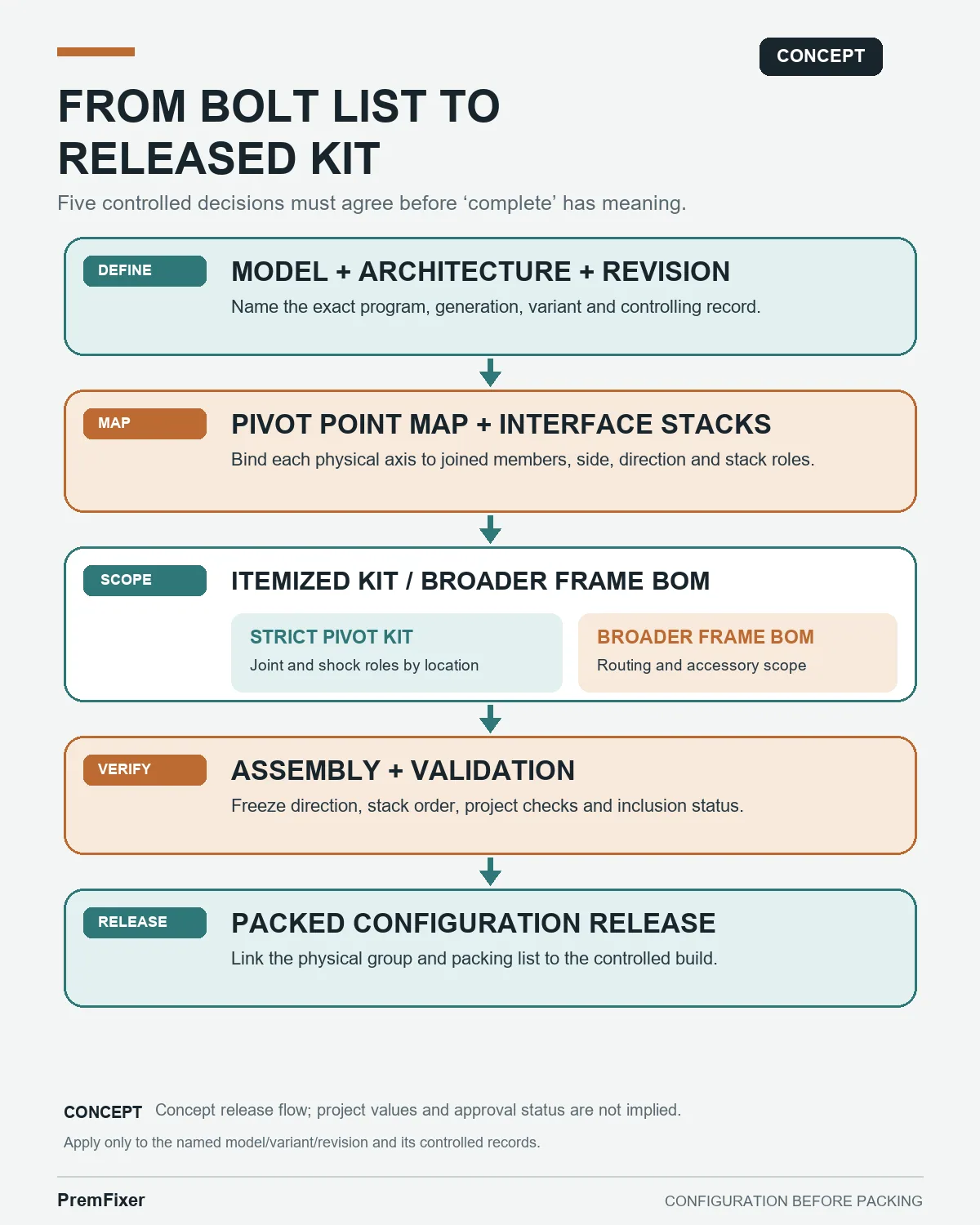
Part identity answers what an item is. Lot or inspection status helps identify the physical production group. The packed-kit record answers whether the selected group matches the released configuration. None of those records substitutes for the others.
6. Architecture changes the questions, not the need for evidence
Architecture examples help teams ask better questions, but they should not be turned into a universal compatibility chart.
On the verified 2023 Trek Fuel EX Gen 6 example, the rear-axle region is part of an ABP suspension assembly. That narrow example shows why location and function matter: it does not convert every bicycle thru-axle into pivot hardware.
Santa Cruz's current VPP material describes two counter-rotating links, while its Superlight description removes a lower link and an additional rear pivot through seatstay flex. Cannondale's FlexPivot material likewise shows how a compliant region can replace a bearing pivot at that region. Specialized's FSR overview provides a physical four-bar contrast in which the arrangement of links, pivots and rear axle is central to the architecture.
These examples support only a qualitative conclusion: the model/service record must establish which axes and roles are physically present. They do not rank architectures, prove hidden joints or make complete BOMs transferable.
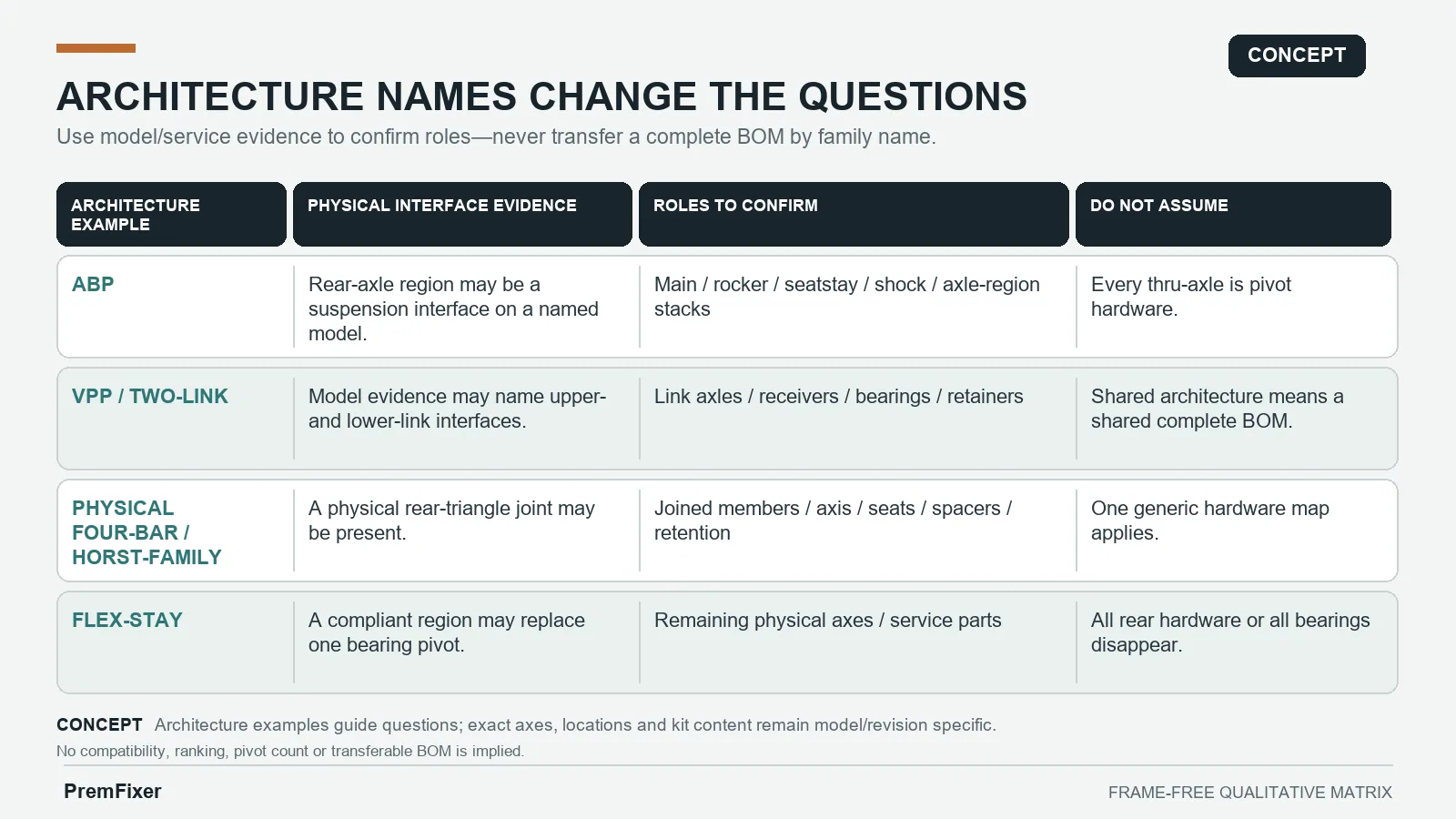
The frame-free matrix is intentional. A complete-frame location map would be a physical claim requiring source-cleared geometry and accurate leaders at every marked interface. When that gate cannot be guaranteed, a question matrix is more honest than a plausible-looking pseudo-frame.
7. Assembly and validation are part of kit identity
Left/right side, installation direction, stack order, quantity by location, locking or lubrication state and service access are not merely packing notes. They are part of the configuration that the assembly team receives.
The validation plan should therefore remain tied to the actual frame and joint. It may need project-defined checks for component conformity, fit and alignment, clamp and retention, movement, corrosion exposure, service access or packed configuration. This article does not prescribe those methods or their acceptance criteria.
The release review should instead expose the open fields:
- Who owns the authoritative assembly instruction?
- Which revision controls stack order and installation state?
- Are bearings, seals, compounds and service spares included, excluded or customer-supplied?
- What evidence links the physical lot and packing list to the released build?
- Which changes require the map, BOM, drawing, assembly instruction or validation plan to be revised together?
A generic torque table or visual parts count cannot answer these questions.
8. A bounded RFQ input set
For a new full-suspension frame, the most useful RFQ package identifies:
- exact frame model, generation/version, variant, size/material where relevant and current BOM/drawing revision;
- authoritative architecture and complete-frame/interface reference;
- Pivot Point Map with unique location or axis IDs;
- local axle/bolt/pin/receiver/bearing/bushing/sleeve/spacer/washer/nut/retainer/seal stacks;
- rear-shock make/model and upper/lower interface configuration;
- released drawings, 3D models or approved samples for custom parts;
- authoritative assembly state, direction, sequence and service requirements;
- project-defined inspection/validation criteria;
- installed versus service-spare scope, inclusion/exclusion status, substitution rules and packing map;
- quantity, commercial terms and requested delivery target as project inputs, not public claims.
PremFixer's current website supports a bounded path from a drawing, sample or OEM BOM into project-specific manufacturability, critical-interface, material/finish, inspection, packing, traceability and quotation review.
It does not establish a universal ready-made kit, compatibility with a named architecture, a completed customer program, a validation result or a guaranteed performance outcome.
Conclusion
A complete pivot-hardware kit is not defined by how many parts are in the tray.
It is defined by agreement: the same model and revision, the same physical Pivot Point Map, the same interface stacks, the same itemized inclusion scope, the same assembly state, the same validation requirements and the same packed configuration.
The bolts remain important. So do the sleeves, receivers, bearings or bushings, shock interfaces, conditional washers and retainers—and the broader frame fasteners when the purchasing scope includes them.
“Complete” is a controlled release decision, not a product-family assumption.
Developing a new full-suspension frame? Send us your exact model/variant/revision, frame BOM or assembly drawing, Pivot Point Map, interface-stack records and inclusion/packing requirements for a complete pivot-hardware review.
Author & Contact
Kang Wang
PremFixer
https://premfixercnc.com/
References
Research verified the live sources below on 2026-09-03. Manufacturer service data are cited for topology, role and configuration boundaries only; no service value is transferred.
- Trek Bicycle Corporation, 2023 Fuel EX — Service Manual, Rev 2.
- Trek Bikes, Fuel EX 8 Gen 6.
- Trek Bikes, Trek MTB architecture context.
- Trek Bikes, Fuel EX Gen 6 vs Fuel Gen 7.
- Trek Bikes, 2023 Fuel EX 29 Rocker Pivot Axle.
- Santa Cruz Bicycles, Suspension — The Santa Cruz Way.
- Santa Cruz Bicycles, Megatower 2 Product Support.
- Santa Cruz Bicycles, Nomad 6 Product Support.
- Cannondale, Scalpel 3.
- Specialized Bicycle Components, FSR Suspension Technology.
- FOX Bike Tech Help Center, Eyelet Hardware Maintenance.
- SRAM, RockShox Rear Suspension Fitment.
- ISO, ISO 10007:2017 — Guidelines for configuration management.
- PremFixer, official website.
Start With the Actual Interface
Send the drawing or sample and the application context so the discussion stays tied to the approved part and its joint.
Send a Drawing or Sample