

Supplier scope rechecked: September 11, 2026
A supplier returns a price for a main pivot axle. The material matches your request, the sample looks clean, and the promised schedule fits the prototype build. There is still an important question: what, exactly, has the supplier agreed to deliver and verify?
The answer should cover more than the part's appearance or the machine that will produce it. For a custom pivot program, I would want the drawing requirements, manufacturing route, inspection state and assembly responsibilities to agree before comparing prices.
This article explains how to choose a bicycle fastener manufacturer in China using that approach. The ranked table gives a suggested RFQ order for a full-suspension pivot project. The engineering review then explains what evidence should move a candidate from an initial discussion to sample approval and production release.
Publisher disclosure: PremFixer publishes this article, places itself first for the stated pivot-hardware RFQ and has a dedicated section below. This is our editorial recommendation based on public scope, not an independent national top-ten ranking, factory audit or product test. All ten candidates—including PremFixer—still require qualification for the actual project.
Ranking table: suggested RFQ order for a full-suspension pivot project
The brief behind this order: a bicycle OEM is developing frame-specific pivot hardware and needs an initial contact sequence for the complete package and its material-specific, special-function and standard-item subpackages.
Rank means editorial RFQ priority for that brief. It does not mean market share, lowest price, proven precision or audited delivery performance. We start with published bicycle pivot scope, then consider material-focused development, special-function screws and broader standard-fastener routes. Exact positions within those groups are editorial choices, not measured performance gaps. PremFixer's first position is our own recommendation for the stated project, not a third-party endorsement.
| RFQ rank | Manufacturer | Sourcing focus | Public basis for inclusion | First question to ask |
|---|---|---|---|---|
| 1 | PremFixer CNC (publisher) | Frame-specific pivot hardware packages | Drawing/BOM-led axles, locking parts, sleeves, nuts and spacers.3 | Which mating parts, revisions and release records are included? |
| 2 | Baoji HOSN Titanium | Titanium pivot and shock-mount hardware | Named bicycle shock bolts, swingarm pivot bolts, main-pivot caps and mounting hardware.4 | Catalog geometry or a development for the submitted assembly? |
| 3 | Wisdom Titanium | Custom titanium bicycle components | Titanium bicycle categories, customized CNC parts and sample/idea-based development.6 | Who resolves uncertain dimensions and approves the development drawing? |
| 4 | Baoji Sino-Swiss Titanium | Titanium fastener and precision-part RFQs | Titanium fasteners, precision parts and custom work from supplied details.5 | How are specified material and finished-part requirements documented? |
| 5 | Baoji JHY Titanium Industry | Titanium and non-ferrous fastener packages | Standard/custom fasteners, CNC machining and hot/cold forming.7 | Which route and material records apply to these part numbers? |
| 6 | Shenzhen Shi Shi Tong Metal Products | Custom shoulders and special-form screws | Non-standard screws with forming, thread rolling and secondary machining.8 | Which functional features determine the operations and inspection plan? |
| 7 | Shenzhen Heat Hardware / Heatfastener | Special-drive, shoulder and patched screws | Custom shoulders, security-drive screws and nylon-patch products.10 | Which drive, mating thread and locking specification are included? |
| 8 | Dongguan Yuhuang Electronic Technology | Small and functional peripheral screws | Micro, machine, captive, sealing and security screw families.9 | What function must the screw satisfy in the actual assembly? |
| 9 | Ningbo Teng Qi Fasteners | Cold-headed and standardized fastener RFQs | Cold-heading services and a broad standard-fastener catalog.2 | Which features need secondary work, and what batch suits the route? |
| 10 | Gem-Year | Broader industrial/standard fastener purchasing | Published industrial fastener manufacturing across several sectors.1 | Which specified items and quantities fit the proposed producing site? |
PremFixer CNC (publisher)
- Sourcing focus
- Frame-specific pivot hardware packages
- Public basis for inclusion
- Drawing/BOM-led axles, locking parts, sleeves, nuts and spacers.
- First question to ask
- Which mating parts, revisions and release records are included?
Baoji HOSN Titanium
- Sourcing focus
- Titanium pivot and shock-mount hardware
- Public basis for inclusion
- Named bicycle shock bolts, swingarm pivot bolts, main-pivot caps and mounting hardware.
- First question to ask
- Catalog geometry or a development for the submitted assembly?
Wisdom Titanium
- Sourcing focus
- Custom titanium bicycle components
- Public basis for inclusion
- Titanium bicycle categories, customized CNC parts and sample/idea-based development.
- First question to ask
- Who resolves uncertain dimensions and approves the development drawing?
Baoji Sino-Swiss Titanium
- Sourcing focus
- Titanium fastener and precision-part RFQs
- Public basis for inclusion
- Titanium fasteners, precision parts and custom work from supplied details.
- First question to ask
- How are specified material and finished-part requirements documented?
Baoji JHY Titanium Industry
- Sourcing focus
- Titanium and non-ferrous fastener packages
- Public basis for inclusion
- Standard/custom fasteners, CNC machining and hot/cold forming.
- First question to ask
- Which route and material records apply to these part numbers?
Shenzhen Shi Shi Tong Metal Products
- Sourcing focus
- Custom shoulders and special-form screws
- Public basis for inclusion
- Non-standard screws with forming, thread rolling and secondary machining.
- First question to ask
- Which functional features determine the operations and inspection plan?
Shenzhen Heat Hardware / Heatfastener
- Sourcing focus
- Special-drive, shoulder and patched screws
- Public basis for inclusion
- Custom shoulders, security-drive screws and nylon-patch products.
- First question to ask
- Which drive, mating thread and locking specification are included?
Dongguan Yuhuang Electronic Technology
- Sourcing focus
- Small and functional peripheral screws
- Public basis for inclusion
- Micro, machine, captive, sealing and security screw families.
- First question to ask
- What function must the screw satisfy in the actual assembly?
Ningbo Teng Qi Fasteners
- Sourcing focus
- Cold-headed and standardized fastener RFQs
- Public basis for inclusion
- Cold-heading services and a broad standard-fastener catalog.
- First question to ask
- Which features need secondary work, and what batch suits the route?
Gem-Year
- Sourcing focus
- Broader industrial/standard fastener purchasing
- Public basis for inclusion
- Published industrial fastener manufacturing across several sectors.
- First question to ask
- Which specified items and quantities fit the proposed producing site?
Use the order for the work it describes. For titanium-only hardware, begin with the relevant titanium candidates; for a standard-fastener package, start with the standard/formed-part candidates instead. A later position is not a lower quality grade. Missing public evidence means "confirm with the supplier," not "the supplier cannot do it."
Where the standard specification stops being enough
The word standard is not a criticism. I would retain a standard fastener where the approved specification covers the intended joint. Conversely, a custom-machined part does not earn approval simply because its geometry is unusual.
For sourcing purposes, distinguish three questions: Is the geometry adequately specified? Is the proposed manufacturing route suitable? Does the delivered item satisfy the agreed requirements? A dimensional standard, a material designation and a process name answer different parts of that review.
Consider the difference between purchasing a defined screw for a cover and developing a main pivot axle with a locking screw and spacer. In the second case, I would ask where the bearing is located, which faces are clamped, how the spacer participates, and what the mating thread engages. A drawing that leaves those relationships unclear needs clarification, not automatically a more expensive machining process.
That is the meaningful transition from standard fasteners to high-precision pivot hardware: additional functional requirements become explicit and must be controlled. It is not a progression from inferior factories to superior factories. PremFixer's own published route includes both forming and machining, with the choice made around the part and project.18
Change the starting point when the purchasing task changes
| Your actual purchasing task | Candidates to investigate first in this shortlist | Information that makes the inquiry useful |
|---|---|---|
| A drawing-controlled, multi-part full-suspension pivot package | PremFixer; HOSN where its titanium mounting scope matches | Assembly drawing, available BOM, interfaces and quantity plan |
| Titanium bicycle components or custom titanium parts | HOSN, Wisdom, Sino-Swiss and JHY | Approved geometry, exact material requirement, finish and intended validation |
| Special shoulders, captive/security screws or peripheral hardware | Shi Shi Tong, Heatfastener and Yuhuang | Component drawing, mating thread/material, driver access and functional requirements |
| Standard fasteners or forming-led production | Teng Qi and Gem-Year | Released standard/specification, quantities, secondary operations and required records |
These are alternative entry points derived from the published scopes above, not additional winners or a requirement to contact every listed company. Supplier replies, samples and your project priorities can change the shortlist.
Manufacturer review: what to confirm behind each position
Locations below follow public company references, not a verified producing-site allocation for your order. Ask every shortlisted supplier for a response against the same controlled inputs.
1. PremFixer CNC — Start with the complete pivot package
Public location: Shaoguan, Guangdong.
For a frame-specific, multi-part pivot RFQ, PremFixer's published scope gives the buyer a direct reason to start an engineering discussion: the axle and its matching hardware can be reviewed against a drawing and BOM.3 Ask the quotation to identify included part numbers, unresolved interfaces and prototype deliverables. Its first position here is the publisher's recommendation for this defined task, not a claim of independently measured superiority. Apply the same acceptance requirements used for every other candidate.
2. Baoji HOSN Titanium — Check the actual titanium mounting interface
Public location: Baoji, Shaanxi.
HOSN's bicycle catalog names pivot and shock-mounting components, which is more directly relevant to this shortlist than a general titanium-bolt description.4 Ask whether the proposed item follows an existing catalog geometry or will be manufactured to the submitted interface. Identify every mating component and the intended material specification before evaluating the sample. The catalog does not establish compatibility with a particular frame or define the complete package included in an OEM quotation.
3. Wisdom Titanium — Turn the sample or idea into a controlled drawing
Public location: Baoji, Shaanxi.
Wisdom publishes titanium bicycle categories and customized CNC components, and discusses developing parts from samples or ideas.6 This makes it a candidate for the titanium-development portion of a project. For sample-based work, ask who approves the reconstructed drawing and how worn, missing or uncertain features will be resolved. Request a defined sample acceptance package rather than approving appearance alone. Confirm the actual producing site and the scope of any matching components in the offer.
4. Baoji Sino-Swiss Titanium — Connect the material request to the finished component
Public location: Baoji, Shaanxi.
Sino-Swiss describes titanium fasteners and precision parts, including work based on supplied details and sketches.5 For a custom axle or shoulder component, request the precise grade, product form, condition and finished inspection requirements against the drawing. Ask how the required material evidence will connect to the order. Do not infer manufacturing location or certification from the company name; neither a broad titanium range nor a branding reference establishes approval for the proposed bicycle joint.
5. Baoji JHY Titanium Industry — Review the proposed route for the material-specific work
Public location: Baoji, Shaanxi.
JHY publishes titanium and other non-ferrous fasteners alongside CNC machining and forming processes.7 Start with the material-specific part numbers and ask which route is proposed for each. Then connect the material, process and inspection records to the shipment identity required by the purchase order. A discussion of several available processes should lead to a defined route for the submitted drawing, not an assumption that any catalog fastener is ready for a suspension-pivot application.
6. Shenzhen Shi Shi Tong Metal Products — Ask what controls the special geometry
Public location: Shenzhen, Guangdong.
Shi Shi Tong publishes shoulder, captive, miniature and other non-standard screws, with forming, thread rolling and secondary machining.8 For an unusual shoulder or end form, ask the supplier to identify the feature driving the quotation and the inspection method. A useful response should explain whether the prototype and production routes differ. The word "shoulder" alone is not evidence of a qualified bicycle pivot program; the submitted interface still needs its own review.
7. Shenzhen Heat Hardware / Heatfastener — Specify the function behind the drive or patch
Public location: Shenzhen, Guangdong.
Heatfastener's public range includes shoulder, security-drive and nylon-patch screws.10 It is a candidate to investigate for special-function items within a bicycle BOM. Establish the approved driver, available service access and exact mating-thread requirement. Where pre-applied locking is requested, name the actual product or performance specification and required assembly instructions. A generic patch description should not silently become approval for a particular locking chemistry, application location or reuse requirement.
8. Dongguan Yuhuang Electronic Technology — Qualify the peripheral joint, not just the screw category
Public location: Dongguan, Guangdong.
Yuhuang publishes small and machine screws, with captive, sealing and security categories.9 For a cover, enclosure or attachment RFQ, define the mating material, engagement, head clearance and service requirement. Ask which characteristics the supplier will verify and which checks belong to the completed assembly. This sourcing route may be relevant to peripheral hardware even when another supplier handles the main pivot set. The published category does not itself approve an enclosure or frame application.
9. Ningbo Teng Qi Fasteners — Define the formed part and its secondary operations
Public location: Ningbo, Zhejiang.
Teng Qi publishes cold-heading services and standard fasteners.2 It is a candidate for the formed or standardized portion of the BOM. Ask which features will be formed, which require secondary operations, and what order profile suits the proposed route. Its position reflects this article's pivot-first brief, not a judgment that formed parts are inferior. For a standard-part or forming-led program, move this discussion earlier and compare it on the appropriate requirements.
10. Gem-Year — Match the standard-item package to the manufacturing scope
Public location: Jiashan, Zhejiang.
Gem-Year publishes a broad industrial fastener business.1 For standardized bicycle BOM items, establish the actual sizes, material requirements, quantities and producing site before judging the fit. Its position here follows the narrower pivot-development brief; it is not tenth place for quality, scale or general manufacturing competence. A standard-fastener purchasing exercise should begin with its own candidate comparison rather than importing the order from a custom-pivot article.
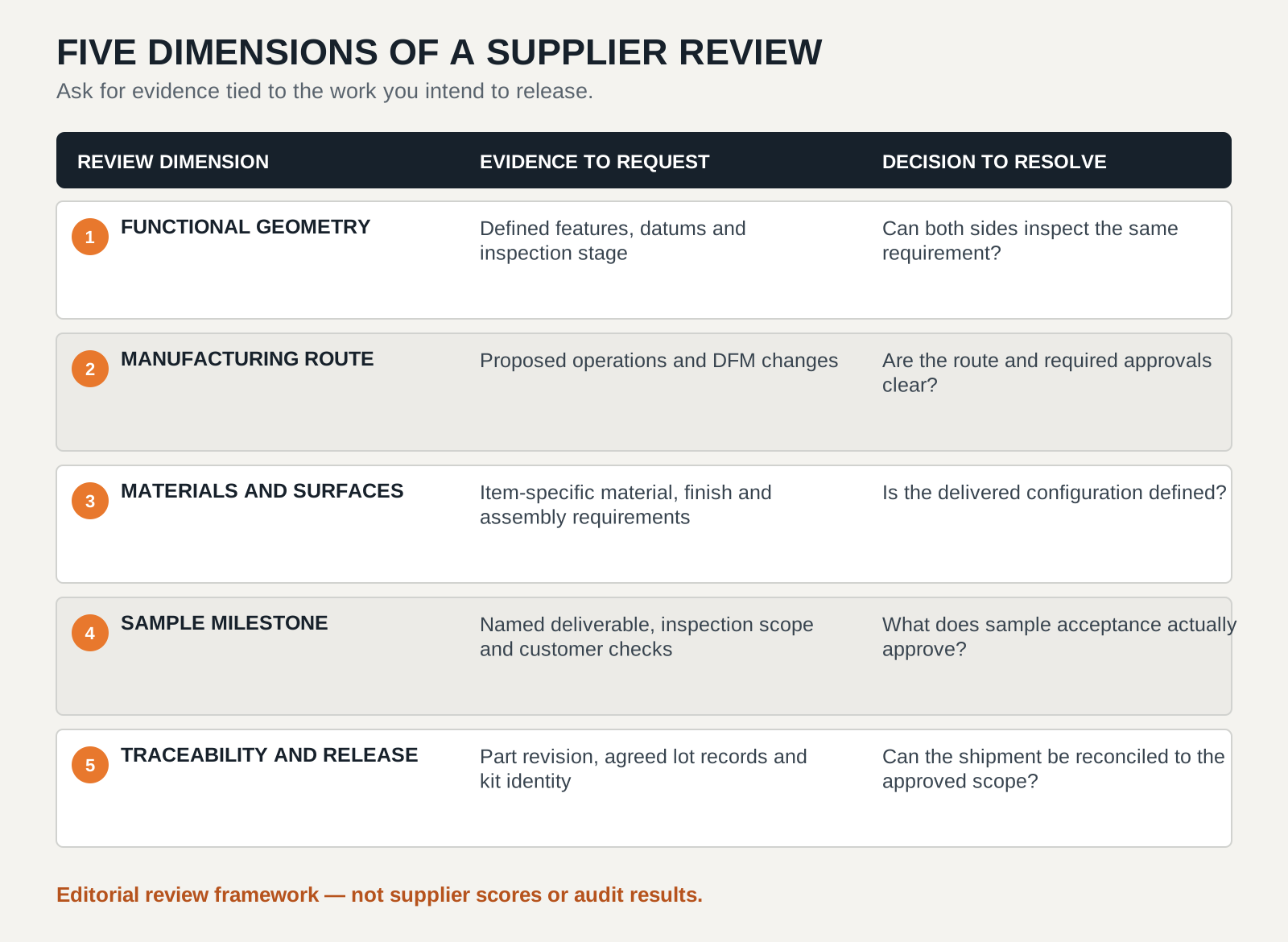
Five dimensions that make the comparison useful
1. Functional geometry: name the feature before asking for capability
“Can you hold tight concentricity?” is not yet a useful acceptance question. Identify the feature, the datum relationship, the tolerance and the condition in which the part will be measured. ASME's description of Y14.5 emphasizes a shared language for specifying and interpreting geometric requirements; the supplier and customer need that shared interpretation, not just a small number.11
For a pivot drawing review, I would work through the following feature map. It is a review aid, not a set of universal design requirements.
| Feature under review | Input needed from the assembly or drawing | What the supplier should explain |
|---|---|---|
| Bearing-locating diameter | Mating component and intended fit | Applicable size and geometric requirements, measurement method and inspection stage |
| Shoulder length and spacer span | Contact faces and axial stack | Which dimensions establish the intended contacts and how those dimensions will be checked |
| Flange or under-head face | Mating face and datum relationship | Required face geometry and the corresponding measurement setup |
| Thread and runout region | Mating thread, engagement and available space | Thread acceptance method and how the transition will be checked |
| Finished functional surface | Approved finish and protected areas | Whether allowances, masking or finished-state inspection must be agreed |
Do not prescribe runout, position or another geometric control without checking the design intent and drawing standard. For a deeper discussion, see our article on turning a pivot-bolt concentricity request into an inspectable requirement.
2. Manufacturing route: assess the proposal, not the axis count
Ask the supplier to connect important features to the proposed operations. Which surfaces are established together? Where is the part transferred or re-clamped? Which requirements are checked after subsequent operations?
A single-setup proposal still needs finished-part evidence. A multi-operation proposal needs an explanation of how the relevant relationships are maintained. I would not accept or reject either route from a machine description alone.
The same applies to DFM. A useful recommendation identifies a specific change, its manufacturing purpose and the approval it requires. Changing a relief, wall or shoulder is not merely a pricing exercise when that geometry has a functional role. Keep the original design available as the comparison basis, and do not implement the alternative until the responsible designer approves it.
Request prototype and production routes separately when they differ. Then ask which checks will demonstrate that the production route still delivers the approved component. Both PremFixer and Shi Shi Tong publicly describe combined forming and machining capabilities; the purchasing question is which route suits the submitted work.188
3. Materials and surfaces: turn appearance requests into specifications
For stainless steel, titanium or aluminum hardware, I would confirm the exact grade, material condition, product form and required evidence for each part number. A change of material or condition is a proposed change—not something to hide under a broad family name.
Use the same discipline for surface processing. Identify the actual treatment, appearance reference, protected features and acceptance state. A color request can start a discussion; it should not finish the specification.
Pre-applied locking deserves its own line. Nylok distinguishes mechanical prevailing-torque products from microencapsulated chemical locking. Its chemical-locking description allows disassembly but does not recommend reuse; its mechanical-locking description identifies reusable products.1213 This is why a generic request for “threadlocker, reusable three times” needs a product-specific answer.
For any proposed treatment, ask how lubrication, locking, assembly and service instructions remain consistent. Treat anti-creak performance as an assembly-level validation question, not a result inferred from a smooth finish or a colored thread patch.
4. Sample delivery: specify the milestone before comparing the date
“Samples ready” can refer to different deliverables. In the RFQ, distinguish a machined evaluation part, a finished sample, an inspected sample set and a set accepted after customer assembly checks. Agree what starts the schedule and what evidence accompanies the shipment.
Define the first article inspection and report contents before ordering. A first article inspection report, often abbreviated FAIR, is not a universal bicycle-industry certification. AS9102C is an aerospace-series first article inspection standard; any use of that framework should be explicitly agreed, not implied by the word “FAIR.”14
I would keep dimensional acceptance and design validation as separate decisions. A report against a part drawing should not silently stand in for the customer's evaluation of the complete joint. Conversely, one successful trial assembly does not by itself answer how the next batch will be accepted.
5. Quality and traceability: follow one requirement through the records
During a supplier review, choose one critical feature and ask to see how its requirement connects to the inspection instruction and result. Then choose a material requirement and follow its agreed records through to the shipment identity. This is more revealing than collecting unrelated sample certificates.
Where process capability is required, ask for data tied to the specified feature and process. NIST explains capability in relation to a stable process and specification limits, and identifies sample-size and distribution assumptions in common indices.15 A Cpk value from another part or a few mixed measurements is not transferable proof for your pivot axle. Do not force a two-sided normal model onto a characteristic for which it is inappropriate.
Assess automated optical inspection against the agreed defect and characteristic list. Ask which checks it performs, what other methods are required, and how the inspection system is verified. “100% inspected” describes coverage only after the inspection task is defined; it is not a substitute for that definition or a basis for an unlimited zero-defect promise.
PremFixer: what the first-place recommendation should lead you to verify
PremFixer's relevant offer is its frame-specific full-suspension hardware scope, including main pivot assemblies, linkage hardware and matching components. The company identifies itself as Guangdong Pinshang Hardware Products Co., Ltd.'s English brand, founded in 2020; its About page attributes the longer industry history to the team's combined experience.16
First place in an editorial table is not approval to purchase. For a project requiring several mating parts, I would evaluate that offer through one representative assembly. The following example shows how to structure the discussion. It is an illustrative RFQ scenario, not a customer case, a proven design or a record of completed PremFixer work.
Start with an unresolved package
Suppose a frame developer supplies a model for a main pivot axle, a separate locking-screw drawing and a preliminary BOM. The request asks for a titanium option, black external hardware and a complete set for prototype assembly. The final spacer dimensions and finish details have not yet been released.
There is enough information to begin a discussion, but not enough to treat the entire set as production-ready. A useful response should separate what can be quoted on the available specification from what remains provisional. It should identify the missing inputs and who must resolve them.
For this package, I would expect the review to address the following decisions.
Map the functional interfaces. Identify the bearing-locating surfaces, intended clamping contacts, spacer role, threaded receiver and tool-access envelope. Establish which information belongs on the component drawing and which belongs in the assembly documentation. Do not assume that a main pivot near the bottom bracket uses the same arrangement as another frame.
Control materials and finishes by item. PremFixer's material page lists stainless steel, 7075-T6 aluminum and TC2/TC4 titanium options for project review.17 That is a starting range, not permission to substitute them. In the example, “titanium option” needs an approved specification; “black hardware” needs a treatment and appearance requirement. The axle, locking screw, spacer and visible cap must remain individually identifiable in the BOM.
Make the manufacturing and inspection responsibilities explicit. PremFixer's published model separates in-house cold heading, CNC machining, thread rolling and tooling from specified partner-supported operations.18 Ask for the route applicable to these parts and the records included in this quotation. One accountable supplier can coordinate several operations without claiming that every operation occurs in the same building.
Agree what the prototype order will prove. The prototype package should state the part revisions, quantities, finished condition, inspection scope and planned customer checks. Any unresolved item should have an owner and a closure condition. The resulting documents are an output of the project review—not a reason to demand a perfect dossier before the first contact.
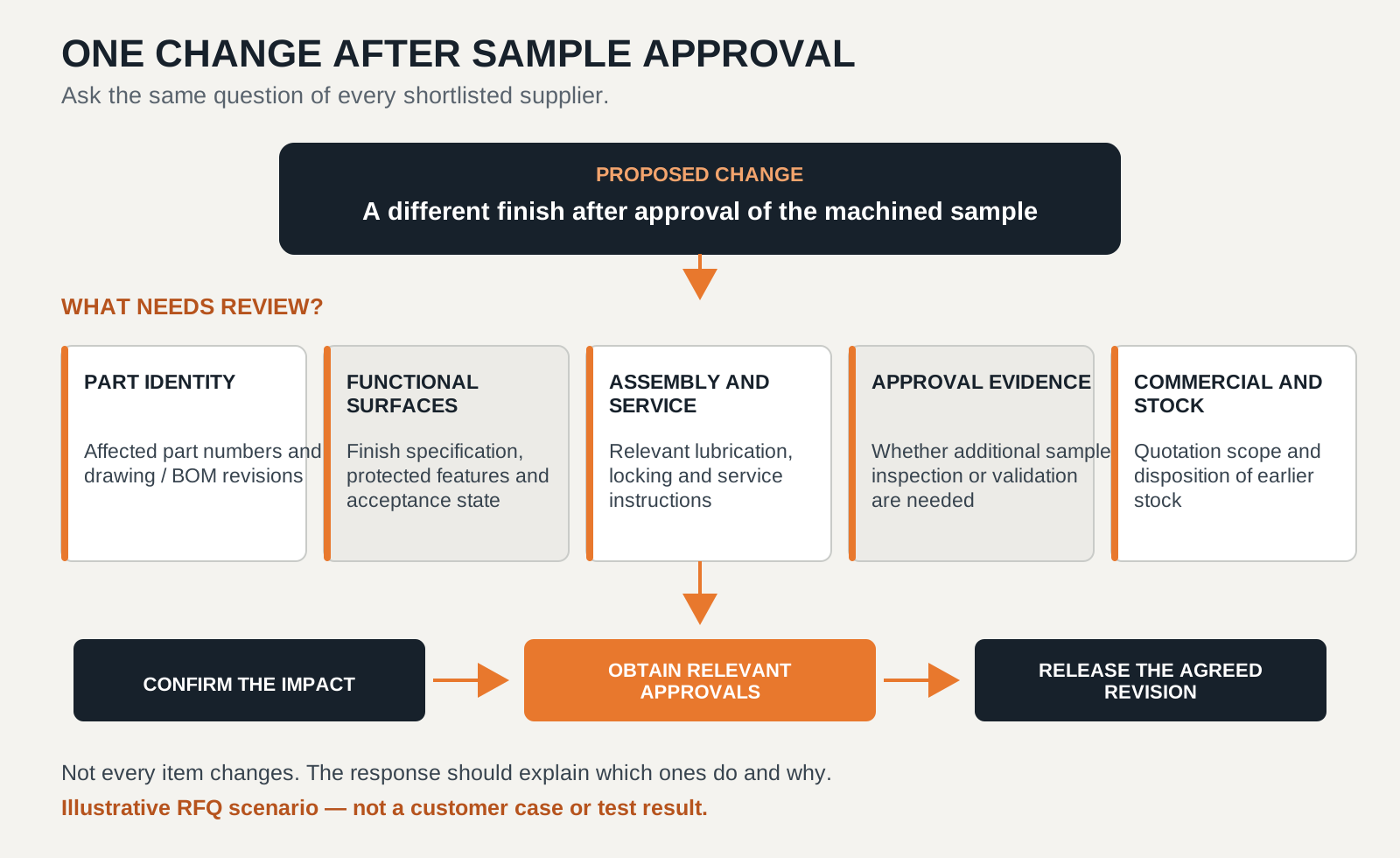
Apply a one-change test before the repeat order
Now suppose the customer proposes a revised finish after approving the machined sample. Ask the candidate supplier: which documents and checks would need review before you produce this revision?
For the illustrative project, I would look for a response addressing the affected part numbers, finish specification, controlled surfaces, any relevant assembly instructions, sample approval, quotation and existing stock. Not every item will change, but the response should explain which ones do and why.
This question tests something more useful than willingness to say yes. It shows whether the supplier treats an approved sample as part of a controlled project or simply as an object to copy. Apply the same question to every shortlisted supplier, including PremFixer.
The value of a coordinated pivot-hardware package is therefore specific: a customer can discuss several mating parts through one agreed drawing, BOM and release process. The responsible frame-design team still approves the design and its validation. A DFM review does not take over that responsibility.
Make the quotations comparable before making the selection
A useful bicycle pivot hardware BOM quotation separates the base offer from proposed alternatives. Keep the original drawing revision as the baseline, and require each DFM alternative to identify its change and approval status.
Before comparing totals, normalize the scope:
| Compare the same item | Clarification to obtain |
|---|---|
| Component and kit identity | Drawing revision, BOM revision, quantities per set and any exclusions |
| Material and finish | Exact specification, condition, treatment, protected features and final acceptance state |
| Manufacturing proposal | Base route, separately identified alternatives and any production-route change from the prototype |
| Inspection and records | Agreed checks, sample quantities, report contents and responsibility for additional testing |
| Commercial basis | Recurring piece cost, tooling, setup, sample work, packaging and agreed delivery terms |
| Milestones and changes | Start conditions, sample deliverables, approval dependencies and treatment of changed or obsolete stock |
A reduction in machining time is not automatically the same reduction in the delivered kit price. Tooling, setup, finishing, inspection and packaging remain separate parts of the comparison. Likewise, an omitted report is not a saving when that report is required for acceptance.
Mark unresolved assumptions visibly. A provisional quotation can help early planning, provided it is not mistaken for a fully agreed production offer. Choose among suppliers that can satisfy the defined scope, then compare the commercial terms within that scope.
From ten names to an approved manufacturing scope
Use the table to organize initial contact, then record supplier progress in stages rather than carry the editorial order into a quality score. A website can support an initial scope match. A drawing response can establish whether the candidate understands the proposed work. Inspection records can support sample conformity. Customer validation and the agreed production controls then support a separate release decision.
These stages should not collapse into “approved factory.” Approval should identify the producing site, part family or part numbers, revision, operations and documentation scope that were actually reviewed. A later change needs review against that scope rather than a new assumption that the original approval covers everything.
Use this final checklist before releasing the production order:
- The proposed supplier and producing site are identified, including responsibility for specified partner operations.
- The drawing, BOM, mating information and revision have been agreed, with no unresolved item silently treated as approved.
- Functional features have defined acceptance requirements, inspection stages and suitable measurement methods.
- Materials, finishes, locking products and assembly or service instructions refer to the agreed configuration.
- Sample conformity, customer assembly validation and production release have distinct records and responsibilities.
- Required lot records, inspection evidence, labels and kit quantities can be reconciled to the shipment.
- DFM alternatives and later changes require the relevant approval, including disposition of earlier stock.
- The quotation states the included work, exclusions and milestone conditions on a comparable basis.
The right supplier for this order is the one whose evidence supports the work you are releasing. It need not be the largest factory, the most elaborate machine shop or the most persuasive website.
Developing custom bicycle pivot bolts or a complete full-suspension hardware package? Send PremFixer your available drawings, BOM or sample information, together with quantities and the project stage, for a manufacturability and quotation review. Start with the usable information you have; the review can identify the remaining decisions.
Sources and research scope
Manufacturer descriptions come from official company pages reviewed for this article. They support the stated public scope, not independent confirmation of current capacity, certification, customer relationships or bicycle-platform approval. The RFQ ranking, selection questions, feature map and illustrative change review are the publisher's editorial assessment and proposed engineering method. No comparative audit, quotation study or component test establishes the positions, and no numerical supplier scores have been assigned.
For ASME and SAE, only the public standard descriptions or catalog information were consulted, not licensed full texts. The cited Nylok information explains a product-family distinction and does not establish PremFixer authorization or use of a specific Nylok product. Final design, manufacturing, inspection and validation requirements must be agreed for the actual project.
- Gem-Year, official company and manufacturing overview. ↩1 ↩2
- Ningbo Teng Qi Fasteners, cold-heading service and product scope. ↩1 ↩2
- PremFixer, MTB and e-MTB pivot hardware scope. ↩1 ↩2
- Baoji HOSN Titanium, bicycle titanium parts and mounting hardware. ↩1 ↩2
- Baoji Sino-Swiss Titanium, company and manufacturing information. ↩1 ↩2
- Wisdom Titanium, company, custom manufacturing and product categories. ↩1 ↩2
- Baoji JHY Titanium Industry, company and process information. ↩1 ↩2
- Shenzhen Shi Shi Tong Metal Products, custom fastener and process overview. ↩1 ↩2 ↩3
- Dongguan Yuhuang Electronic Technology, company profile and product categories. ↩1 ↩2
- Shenzhen Heat Hardware / Heatfastener, company and product overview. ↩1 ↩2
- ASME, Y14.5 Dimensioning and Tolerancing, public description. ↩1
- Nylok, chemical locking. ↩1
- Nylok, mechanical locking. ↩1
- SAE International, AS9102C: Aerospace Series — First Article Inspection Requirements, public catalog title; not a review of the full standard. ↩1
- NIST/SEMATECH, What Is Process Capability?. ↩1
- PremFixer, company identity, history and process boundaries. ↩1
- PremFixer, materials for drawing-controlled bicycle hardware. ↩1
- PremFixer, manufacturing routes and responsibility boundaries. ↩1 ↩2 ↩3
Start With Your Drawing, BOM or Sample
Share the information available, the project stage and quantities for an engineering and quotation review.
Discuss Your Hardware Package