
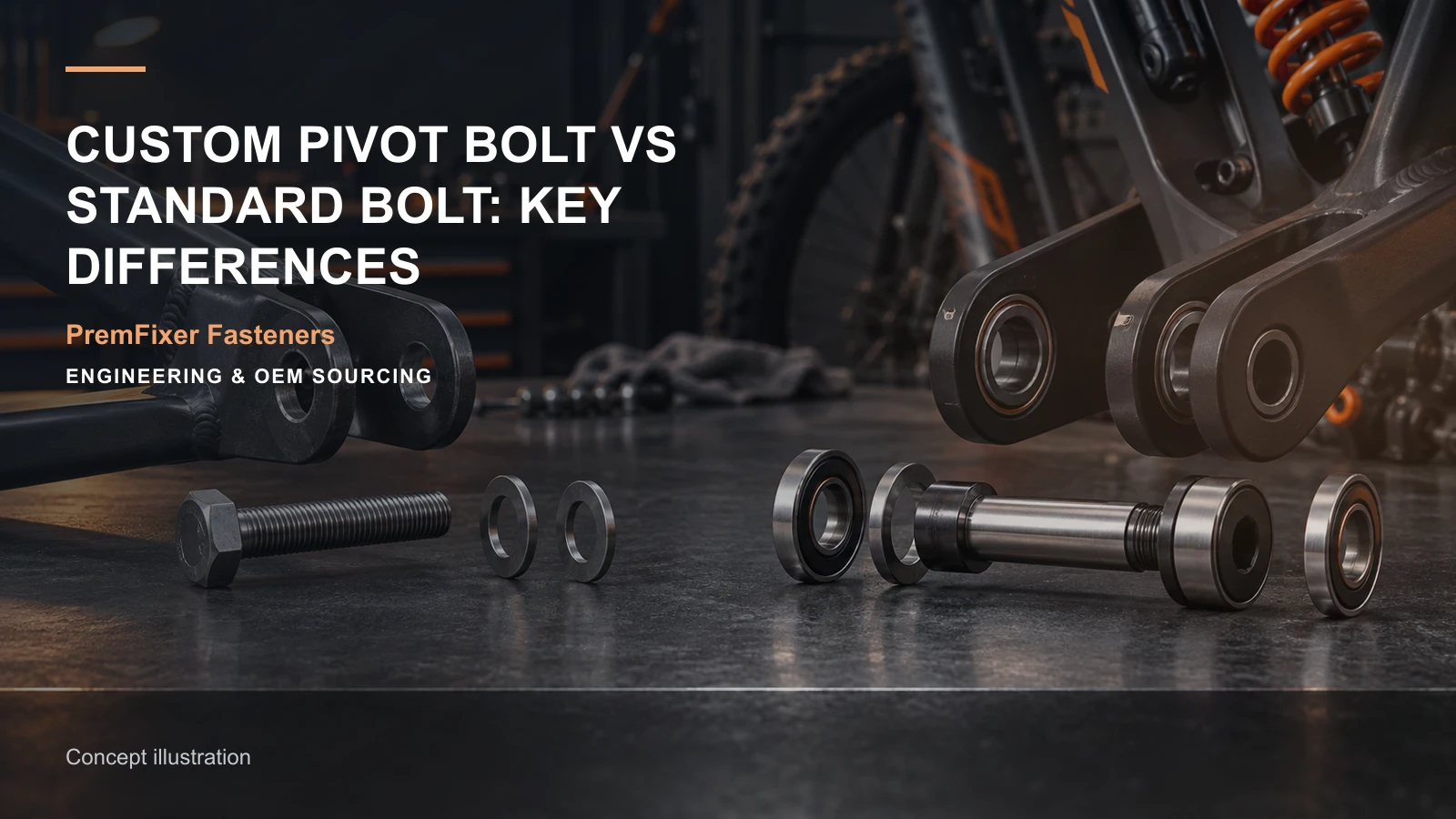
A standard bolt or shoulder screw can be the right pivot component when its published geometry and material satisfy the bicycle joint. A custom pivot bolt is appropriate when a controlled requirement—such as shoulder span, bearing-seat diameter, head access or supplied spacer stack—cannot be met by the selected catalog part. Compare both on the same assembly and acceptance criteria, not on whether one is called precision hardware. For an OEM buyer, the decision also affects tooling effort, sample timing, replacement availability and whether the supplier delivers one bolt or a matched kit. Separate those commercial differences from the mechanical fit decision.
Compare real specifications, not product labels
Start with a named catalog part and its published drawing. A general M8 or M10 callout is not a complete pivot specification because the shoulder, under-head face and thread transition can affect the assembly independently of nominal thread size. ISO 7379 covers a defined shoulder-screw family, while many bicycle joints require features outside that family.
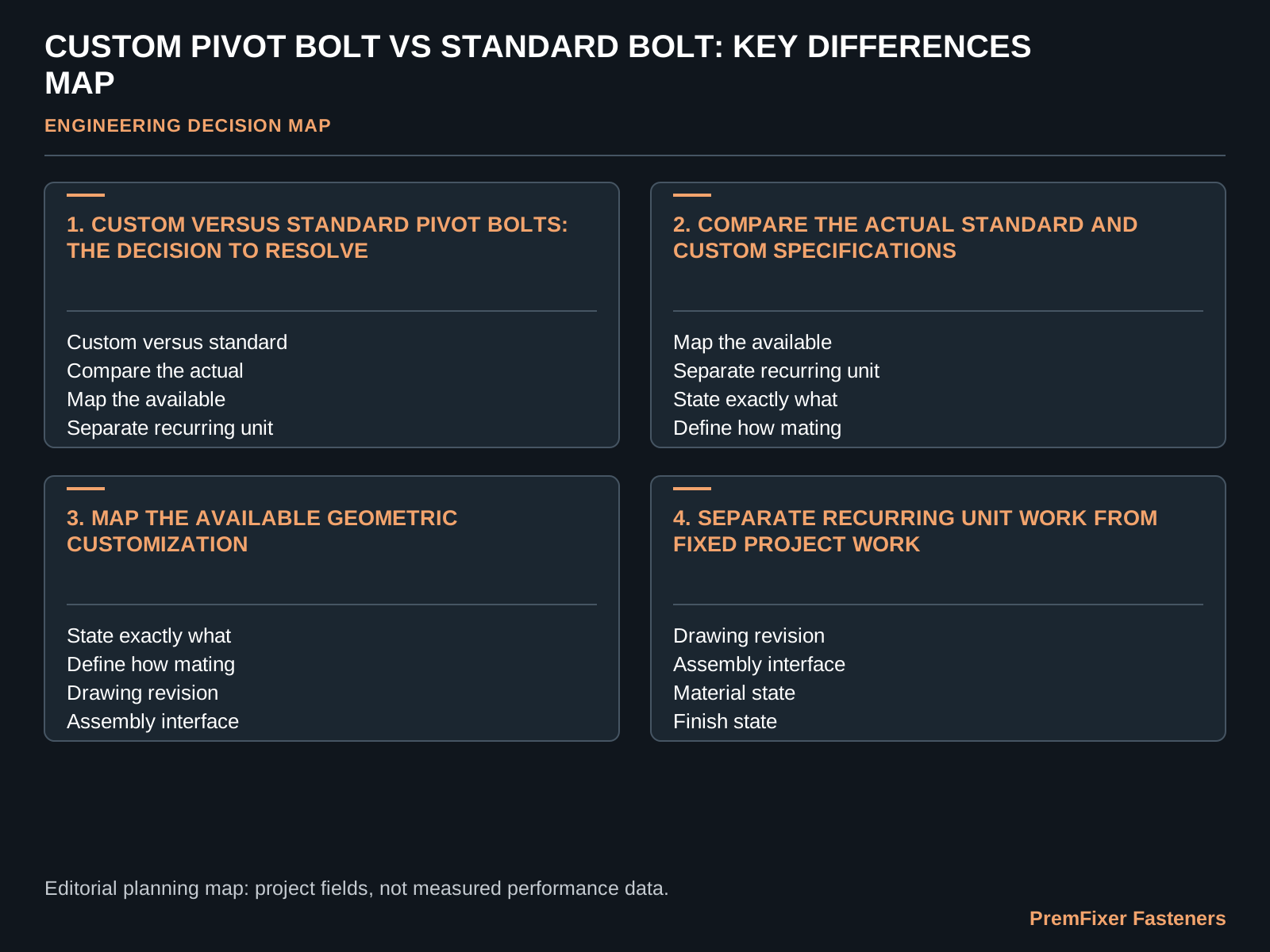
List the joint's functional dimensions beside the catalog values and a proposed custom drawing. If all requirements are met, the catalog option remains viable. If a changed feature is needed, state which requirement it solves and how it will be checked.
Separate locating, clamping and service duties
A standard fastener may clamp the frame tabs while a separate sleeve locates a bearing. A custom bolt may combine those roles, but combination is not automatically advantageous: it can make one worn feature require replacement of the entire part. Determine which surface carries radial support, which face transmits clamp force and what a mechanic must remove during service.
Use an assembly drawing to evaluate head access, thread engagement, washer clearance and sleeve span. The same bolt can look acceptable in isolation yet bind a moving link after the stack is tightened.
Define a custom pivot bolt · ISO 7379 product scope
| Requirement state | More suitable route | Trade-off or risk | Check before release |
|---|---|---|---|
| Published shoulder and head match the joint | Catalog shoulder screw | Part designation may omit assembly-stack information | Review catalog drawing and assembled clearance |
| Shoulder length or seat is unique to the frame | Custom drawing | New feature must be toleranced and inspected | First-article dimensions and assembled fit |
| Several loose spacers are required | Either route with controlled kit BOM | Missing or mixed spacer at assembly | BOM, packing and receiving check |
| Service replacement must remain easy | Compare both supply plans | Custom part availability or catalog change | Revision and spare-part plan |
Compare buying cost with the correct scope
A catalog choice normally avoids new part tooling and drawing control, but it may require separate spacers, modified assembly instructions or a stocking policy. A custom choice adds drawing review and first-article work, yet may reduce assembly variants when several functions are integrated. Neither route should be described as cheaper without the same quantity, finish, inspection and kit assumptions.
Ask suppliers to identify one-time engineering or tooling items separately from repeat unit work. For both routes, include replacement supply and revision handling in the comparison; an unavailable service part can outweigh a small initial unit-price difference.
Illustrative engineering example: suppose an OEM uses a catalog shoulder screw that fits a bearing sleeve but leaves insufficient tool clearance behind the frame tab. A custom lower-profile head could solve access, while a revised tool path and head strength still need review. The team compares the catalog part plus an assembly change against a new bolt drawing, then tests tool access and clamp stack on the same frame revision. The example shows why one changed feature, rather than a broad custom-versus-standard claim, should drive the decision.
Use samples to test the unresolved interface
A sample should answer a named question: does the shoulder seat correctly, does the head clear the moving link, and does clamp load pass through the intended stack? A dimensional report alone does not show whether the assembled pivot moves freely after tightening. Conversely, a hand-fit check without a drawing cannot establish repeatable acceptance.
If the catalog route is selected, validate it in the intended frame revision. If the custom route is selected, check the proposed changes and retain the drawing revision used for the sample.
Prototype route · Material options
Select the route on evidence
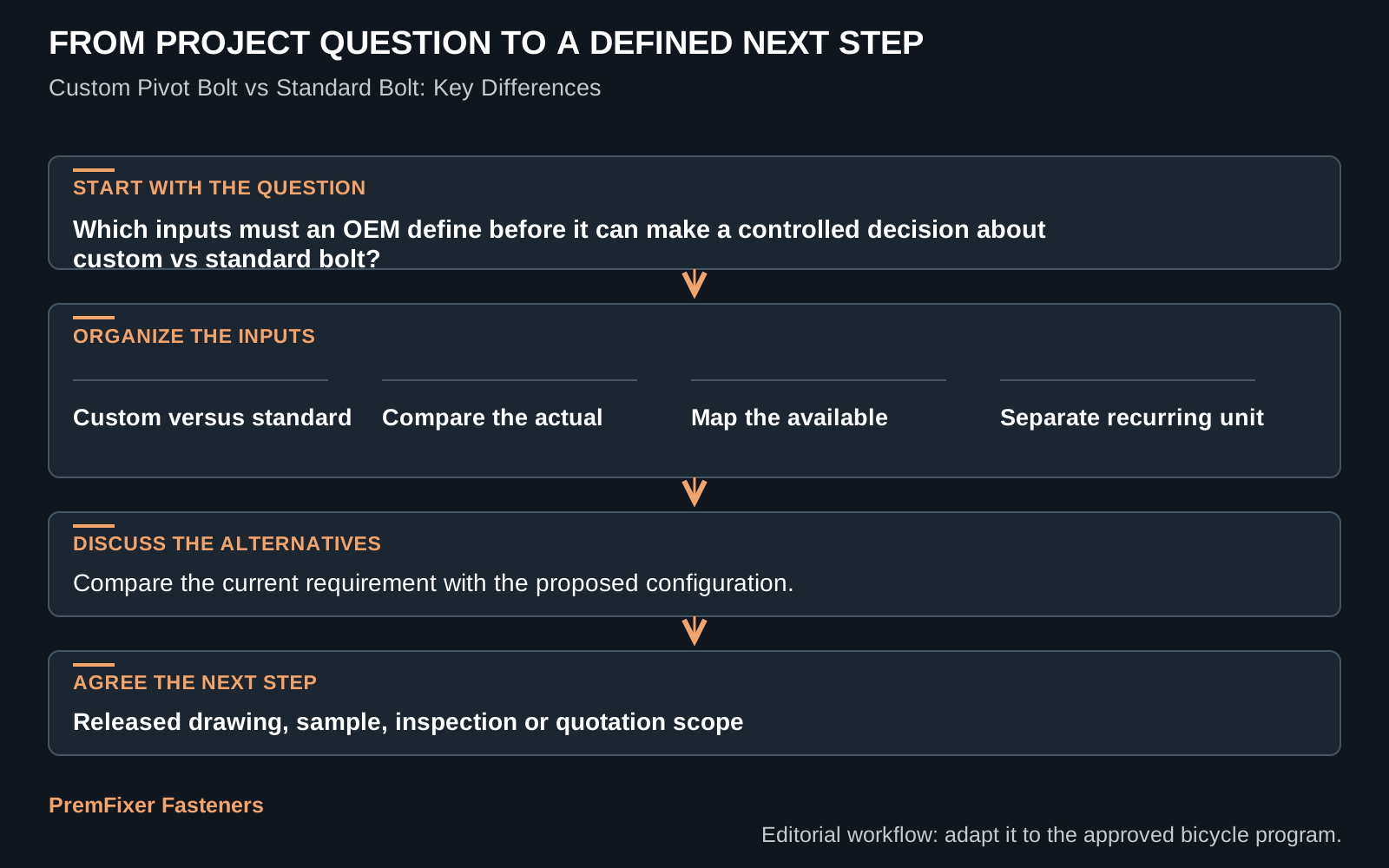
PremFixer Fasteners can review a drawing-specific option and quote the defined manufacturing scope. The OEM still owns the joint requirements and application validation. An honest supplier comparison makes the acceptance conditions explicit rather than assuming that a custom-machined part automatically outperforms a standard one.
Provide both the current catalog reference and the proposed drawing if you are weighing alternatives. Include the assembly view, volume forecast, finish, inspection needs and service strategy so the quote compares like with like.
Questions buyers need to resolve
Is a custom pivot bolt stronger than a standard bolt?
Not by definition. Strength depends on material condition, geometry, thread engagement and the loaded joint. Compare those fields and the required validation; the word custom states a specification route, not a performance class.
Can a standard ISO shoulder screw fit a bicycle pivot?
Yes, when its actual dimensions and material satisfy the assembly. Verify shoulder diameter and length, head clearance, thread transition and clamp stack against the frame and bearing or sleeve.
What cost belongs in a fair comparison?
Include repeat part price, tooling or engineering charges, spacers, finishing, inspection, packaging and service stock. Quantity and revision frequency can shift the balance between catalog and custom routes.
Should an OEM request a sample before switching?
Yes when the revised interface is unproven. Specify whether the sample must demonstrate dimensional conformity, assembled clearance, tightening behavior or service access; each calls for a different check.
What documents allow a supplier to compare both routes?
Provide the catalog designation and drawing, current assembly model, proposed part drawing, bearing or sleeve details, expected quantities and acceptance plan. These identify the changed requirement and avoid comparing unequal scopes.
Compare Two Pivot Bolt Supply Routes
Send the current catalog designation, proposed drawing or STEP assembly, mating parts, quantity and service requirements. PremFixer can identify the feature that drives customization and quote the drawing-defined alternative.
Discuss the drawing and BOM