
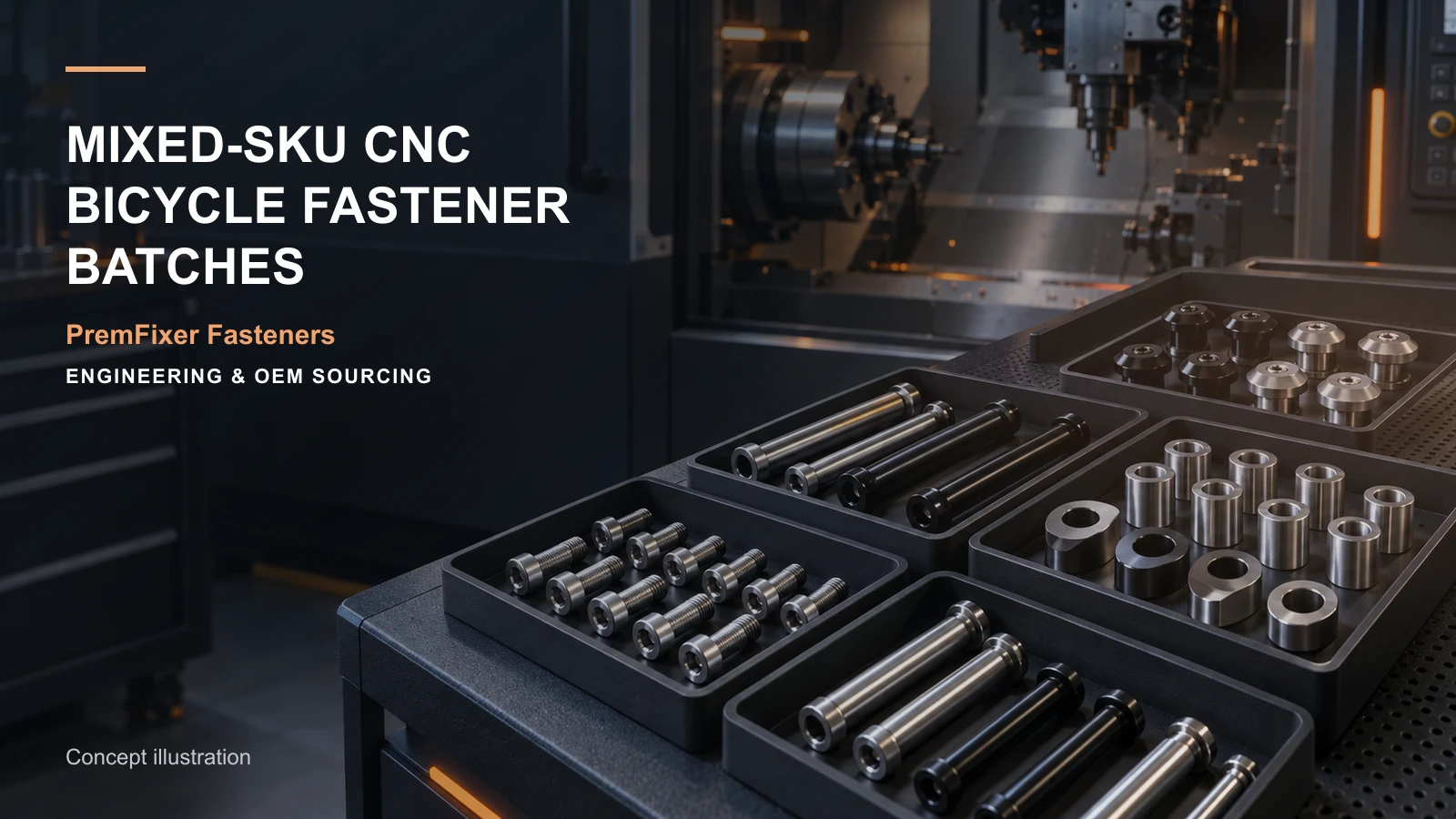
A mixed order may contain axles, sleeves, shoulder bolts, caps and small screws in different quantities. The production opportunity is to group compatible work, while the control challenge is to keep every revision, finish and kit position identifiable.
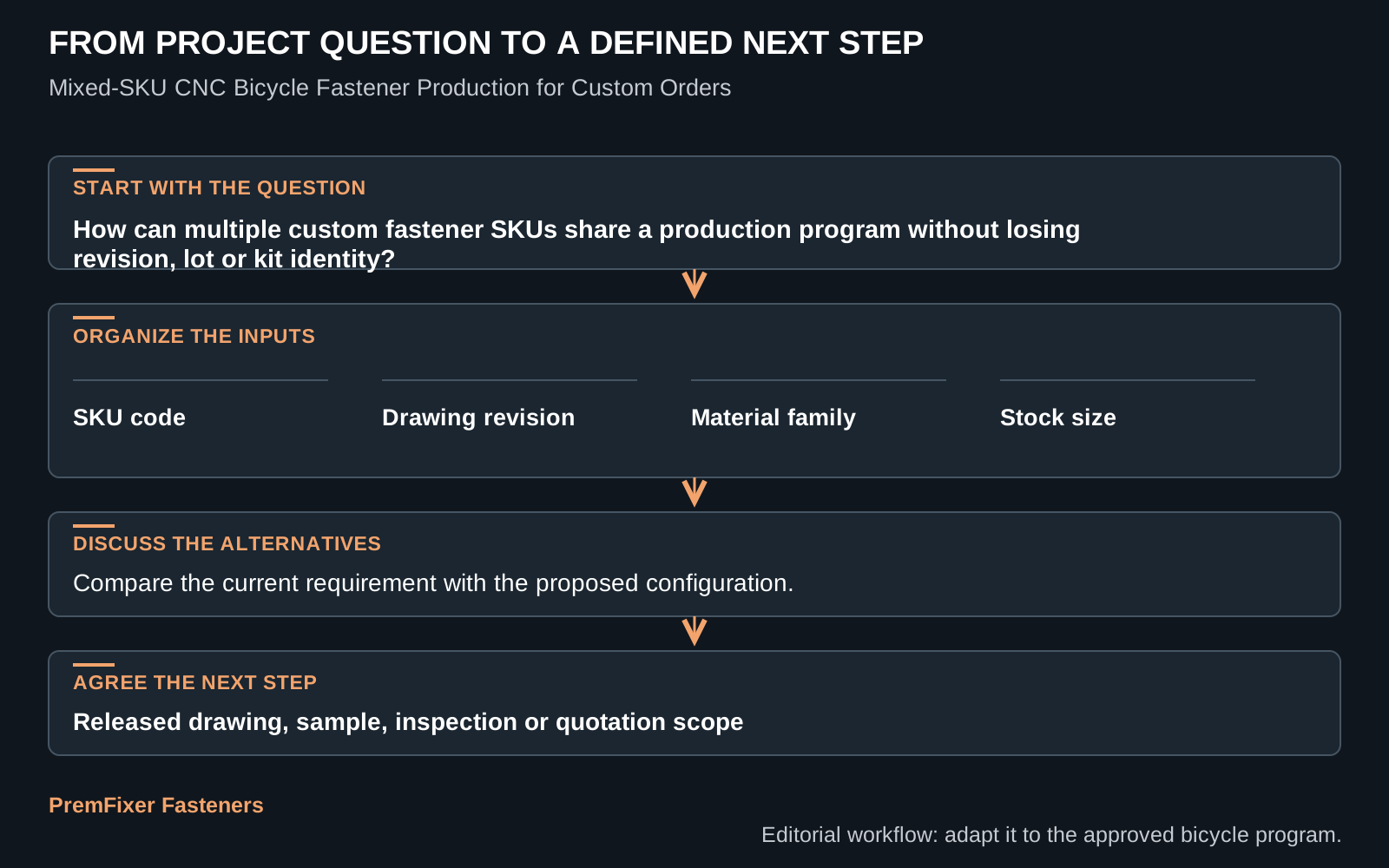
Bicycle OEM buyers, production planners and contract manufacturers should begin with one practical question: How can multiple custom fastener SKUs share a production program without losing revision, lot or kit identity? The answer depends on SKU family, setup sequence, revision identity and kit quantity, not on a single headline property. This guide turns that question into six review stages that can support a drawing update, sample plan or comparable RFQ.
The mixed-SKU bicycle fastener production examples below are specification tools rather than universal pass or fail rules. Use them to expose interfaces, process assumptions and delivery responsibilities, then confirm the final requirement against the actual bicycle platform and approved component definition.
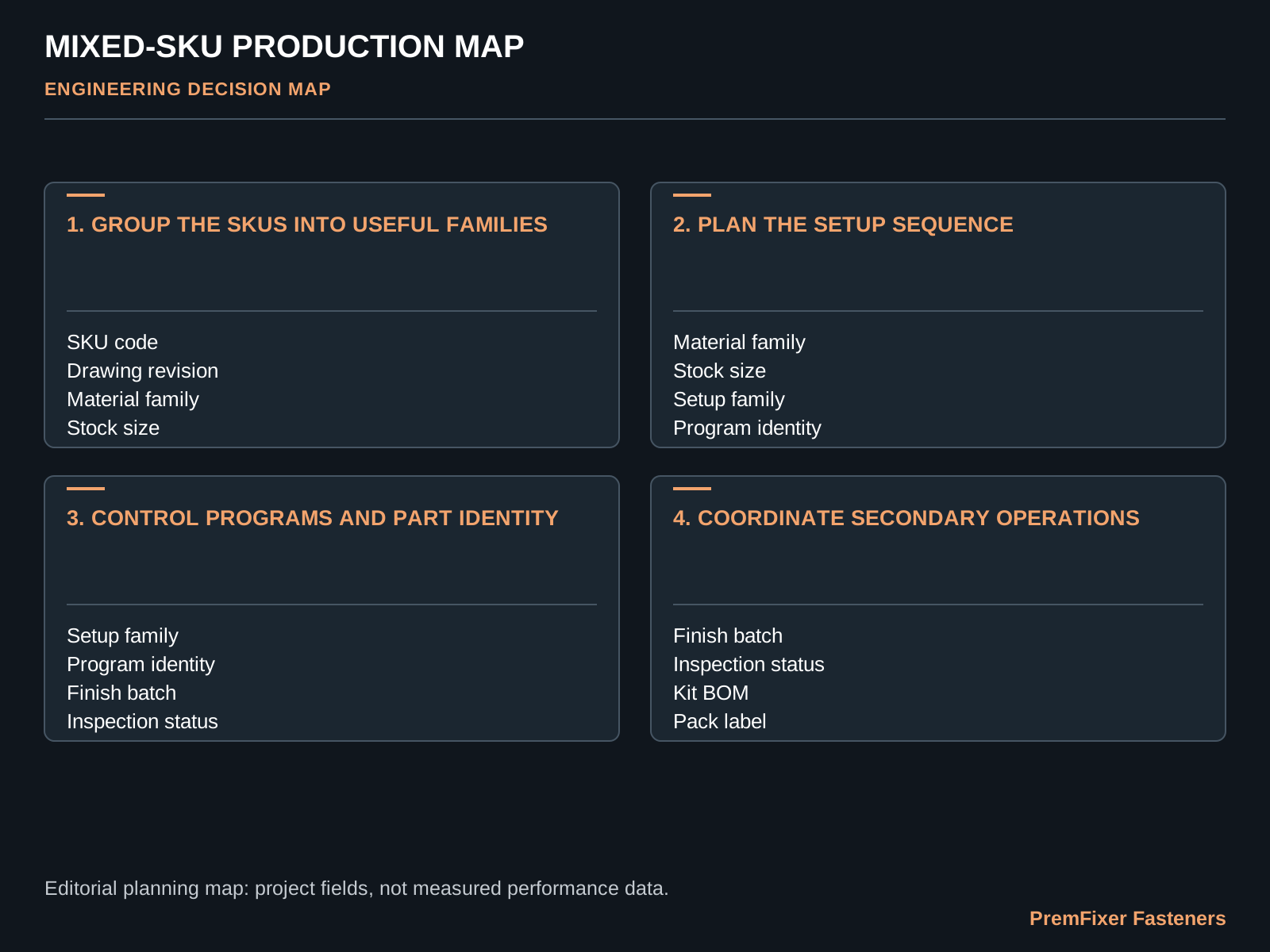
Group the SKUs into useful families
Compare geometry, stock size, material, tolerances, finish and likely operation routes. Group parts by geometry, stock, material and route while retaining each SKU code. This part of the review belongs to a mixed-SKU custom bicycle hardware purchase order, so the requirement should be written around the component and joint rather than around a material or machine label.
Build the working record around SKU code, Drawing revision, Material family and Stock size. Read those fields together: one value can change the meaning of the others, especially after machining, finishing or assembly. The useful output is a mixed-SKU family matrix, with the current condition, proposed condition and unresolved points visible on the same page.
During concept review, apply group the skus into useful families to a real part revision and one representative assembly condition. The design engineer needs the functional reason, while purchasing needs the supplied scope and revision identity. For mixed-SKU bicycle fastener production, define the sample question before parts are made, then keep the observation with the drawing, material state and inspection record instead of turning it into a general claim.
Do not combine parts solely because they look similar or use the same material; drawing and assembly identity must remain explicit. To close group the skus into useful families, name the responsible owner and the evidence needed for the next release. That may be an updated drawing, mating-part check, process trial, finish coupon, dimensional report, packaging sample or revised quotation, depending on this mixed-sku production decision.
Plan the setup sequence
Arrange shared turning, milling and inspection steps without losing part-specific references. Sequence setups to manage changeover, tool access and common references. This part of the review belongs to a mixed-SKU custom bicycle hardware purchase order, so the requirement should be written around the component and joint rather than around a material or machine label.
Build the working record around Material family, Stock size, Setup family and Program identity. Read those fields together: one value can change the meaning of the others, especially after machining, finishing or assembly. The useful output is a family-based setup plan, with the current condition, proposed condition and unresolved points visible on the same page.
At drawing release, apply plan the setup sequence to a real part revision and one representative assembly condition. Manufacturing needs an achievable route, and quality needs a measurement or acceptance method tied to the same feature. For mixed-SKU bicycle fastener production, define the sample question before parts are made, then keep the observation with the drawing, material state and inspection record instead of turning it into a general claim.
Do not combine parts solely because they look similar or use the same material; drawing and assembly identity must remain explicit. To close plan the setup sequence, name the responsible owner and the evidence needed for the next release. That may be an updated drawing, mating-part check, process trial, finish coupon, dimensional report, packaging sample or revised quotation, depending on this mixed-sku production decision.
| Review stage | Decision | Inputs to connect | Controlled output |
|---|---|---|---|
| 01 | Group the SKUs into useful families | SKU code / Drawing revision / Material family / Stock size | a mixed-SKU family matrix |
| 02 | Plan the setup sequence | Material family / Stock size / Setup family / Program identity | a family-based setup plan |
| 03 | Control programs and part identity | Setup family / Program identity / Finish batch / Inspection status | a revision-to-program register |
| 04 | Coordinate secondary operations | Finish batch / Inspection status / Kit BOM / Pack label | a secondary-process routing map |
| 05 | Reassemble the purchase-order scope | Kit BOM / Pack label / SKU code / Drawing revision | a complete-order reconciliation |
| 06 | Explain tooling and batch cost honestly | SKU code / Drawing revision / Material family / Stock size | a transparent mixed-SKU quotation |
Control programs and part identity
Link each released drawing to its program, setup sheet, tool list, lot and label. Keep CNC programs, revisions and inspection records tied to the correct part. This part of the review belongs to a mixed-SKU custom bicycle hardware purchase order, so the requirement should be written around the component and joint rather than around a material or machine label.
Build the working record around Setup family, Program identity, Finish batch and Inspection status. Read those fields together: one value can change the meaning of the others, especially after machining, finishing or assembly. The useful output is a revision-to-program register, with the current condition, proposed condition and unresolved points visible on the same page.
When the first sample is inspected, apply control programs and part identity to a real part revision and one representative assembly condition. A sample is useful when the team states what it is meant to confirm and records the result against the released definition. For mixed-SKU bicycle fastener production, define the sample question before parts are made, then keep the observation with the drawing, material state and inspection record instead of turning it into a general claim.
Do not combine parts solely because they look similar or use the same material; drawing and assembly identity must remain explicit. To close control programs and part identity, name the responsible owner and the evidence needed for the next release. That may be an updated drawing, mating-part check, process trial, finish coupon, dimensional report, packaging sample or revised quotation, depending on this mixed-sku production decision.
Coordinate secondary operations
Route deburring, heat treatment, surface finishing, marking and cleaning by SKU and required state. Plan heat treatment, finishing, cleaning and marking as controlled branch routes. This part of the review belongs to a mixed-SKU custom bicycle hardware purchase order, so the requirement should be written around the component and joint rather than around a material or machine label.
Build the working record around Finish batch, Inspection status, Kit BOM and Pack label. Read those fields together: one value can change the meaning of the others, especially after machining, finishing or assembly. The useful output is a secondary-process routing map, with the current condition, proposed condition and unresolved points visible on the same page.
Before a pilot lot is approved, apply coordinate secondary operations to a real part revision and one representative assembly condition. The buyer should distinguish a proposal from an approved requirement so that cost and lead-time assumptions remain visible. For mixed-SKU bicycle fastener production, define the sample question before parts are made, then keep the observation with the drawing, material state and inspection record instead of turning it into a general claim.
Do not combine parts solely because they look similar or use the same material; drawing and assembly identity must remain explicit. To close coordinate secondary operations, name the responsible owner and the evidence needed for the next release. That may be an updated drawing, mating-part check, process trial, finish coupon, dimensional report, packaging sample or revised quotation, depending on this mixed-sku production decision.
Reassemble the purchase-order scope
Reconcile accepted quantities, required spares, kit positions, documents and packaging before release. Reconcile completed quantities back to the purchase order and kit BOM. This part of the review belongs to a mixed-SKU custom bicycle hardware purchase order, so the requirement should be written around the component and joint rather than around a material or machine label.
Build the working record around Kit BOM, Pack label, SKU code and Drawing revision. Read those fields together: one value can change the meaning of the others, especially after machining, finishing or assembly. The useful output is a complete-order reconciliation, with the current condition, proposed condition and unresolved points visible on the same page.
When repeat production is planned, apply reassemble the purchase-order scope to a real part revision and one representative assembly condition. Production planning becomes clearer when change points, owners and required records are named before the order is released. For mixed-SKU bicycle fastener production, define the sample question before parts are made, then keep the observation with the drawing, material state and inspection record instead of turning it into a general claim.
Do not combine parts solely because they look similar or use the same material; drawing and assembly identity must remain explicit. To close reassemble the purchase-order scope, name the responsible owner and the evidence needed for the next release. That may be an updated drawing, mating-part check, process trial, finish coupon, dimensional report, packaging sample or revised quotation, depending on this mixed-sku production decision.
Explain tooling and batch cost honestly
Separate family setup, dedicated tooling, outside-process minimums and recurring unit work. Explain tooling and one-time work by family rather than hiding it inside a blended piece price. This part of the review belongs to a mixed-SKU custom bicycle hardware purchase order, so the requirement should be written around the component and joint rather than around a material or machine label.
Build the working record around SKU code, Drawing revision, Material family and Stock size. Read those fields together: one value can change the meaning of the others, especially after machining, finishing or assembly. The useful output is a transparent mixed-SKU quotation, with the current condition, proposed condition and unresolved points visible on the same page.
At the RFQ and supplier handover, apply explain tooling and batch cost honestly to a real part revision and one representative assembly condition. A quotation is comparable only when each supplier is working from the same geometry, material, finish, quantity and delivery boundary. For mixed-SKU bicycle fastener production, define the sample question before parts are made, then keep the observation with the drawing, material state and inspection record instead of turning it into a general claim.
Do not combine parts solely because they look similar or use the same material; drawing and assembly identity must remain explicit. To close explain tooling and batch cost honestly, name the responsible owner and the evidence needed for the next release. That may be an updated drawing, mating-part check, process trial, finish coupon, dimensional report, packaging sample or revised quotation, depending on this mixed-sku production decision.
Questions buyers ask
When should a team review mixed-SKU bicycle fastener production?
Start before the drawing, material, finish or supply plan is locked. Bring the current revision and the decision that must be made next. Early review is most useful when the team can still adjust the part definition without disrupting released production.
What should be included in the first RFQ?
Provide the released BOM, individual drawings, quantities by SKU, shared materials and finishes, kit structure, labeling and delivery requirements. Mark any item that is provisional, and state who will approve the final configuration. A supplier can then separate confirmed requirements from questions that need engineering review.
Can a sample approve the full production program?
A sample can answer defined questions about fit, appearance, machining or documentation. Production release still needs the agreed configuration, process controls, inspection scope and change rules for the intended quantity.
Which details usually change the quotation most?
For mixed-SKU bicycle fastener production, the strongest cost and schedule drivers are normally the geometry, material condition, finishing route, inspection depth, order quantity and delivered scope. Compare quotations only after those items are aligned.
What can PremFixer prepare after the review?
The review can produce a part-family map, setup sequence, identity controls, secondary-process plan and reconciled kit delivery. The handover should identify the revision reviewed, what is included in the manufacturing scope and which decisions remain with the bicycle OEM.
Turn the Mixed-SKU Production Question into a Controlled RFQ
The review can produce a part-family map, setup sequence, identity controls, secondary-process plan and reconciled kit delivery. Start with the information already available; open fields can remain clearly marked for review.
Discuss the RFQ