

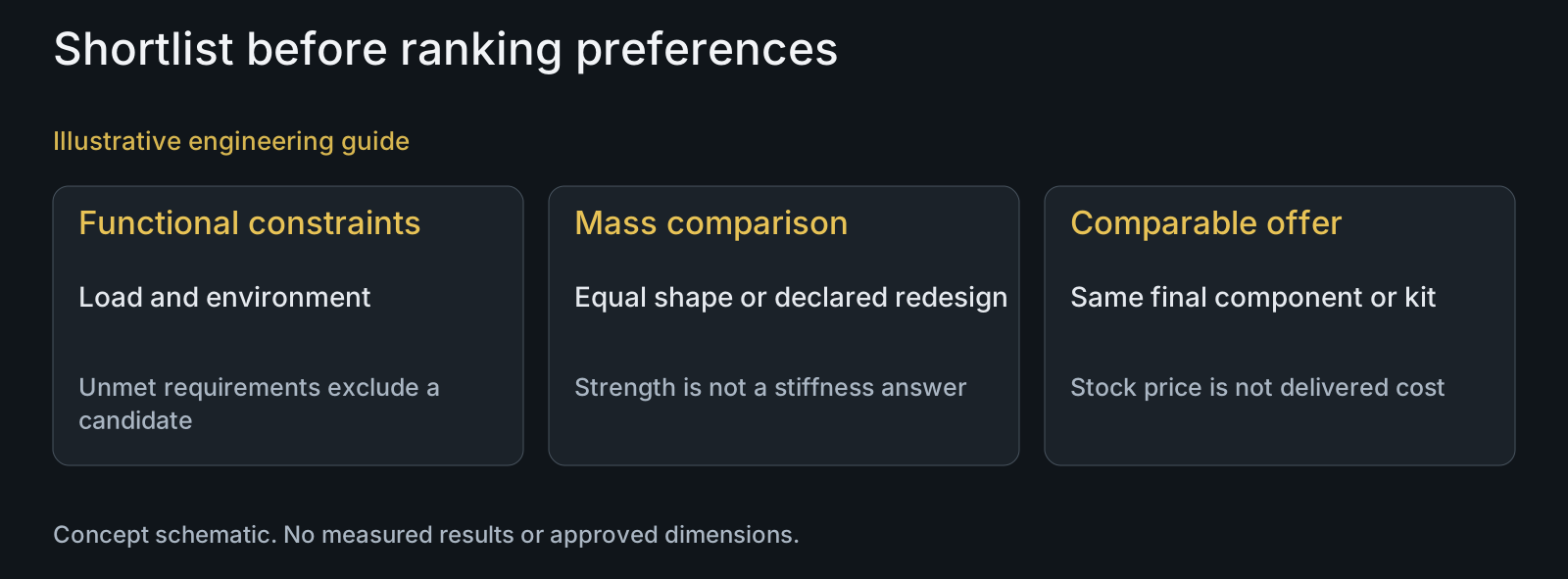
Choose a custom bicycle pivot-bolt material by screening four constraints in order: the actual load and interfaces, service environment, mass requirement and comparable supply cost. A candidate that cannot meet the functional requirement should not remain in consideration because it is light or inexpensive. Neither 304 stainless nor TC4 is an automatic answer to the word pivot. Define the bolt's role, bearing or spacer contacts and threaded receiver before comparing materials. The decision tree below produces a shortlist and identifies missing evidence; it does not certify a material substitution or prescribe a universal alloy for a bicycle category.
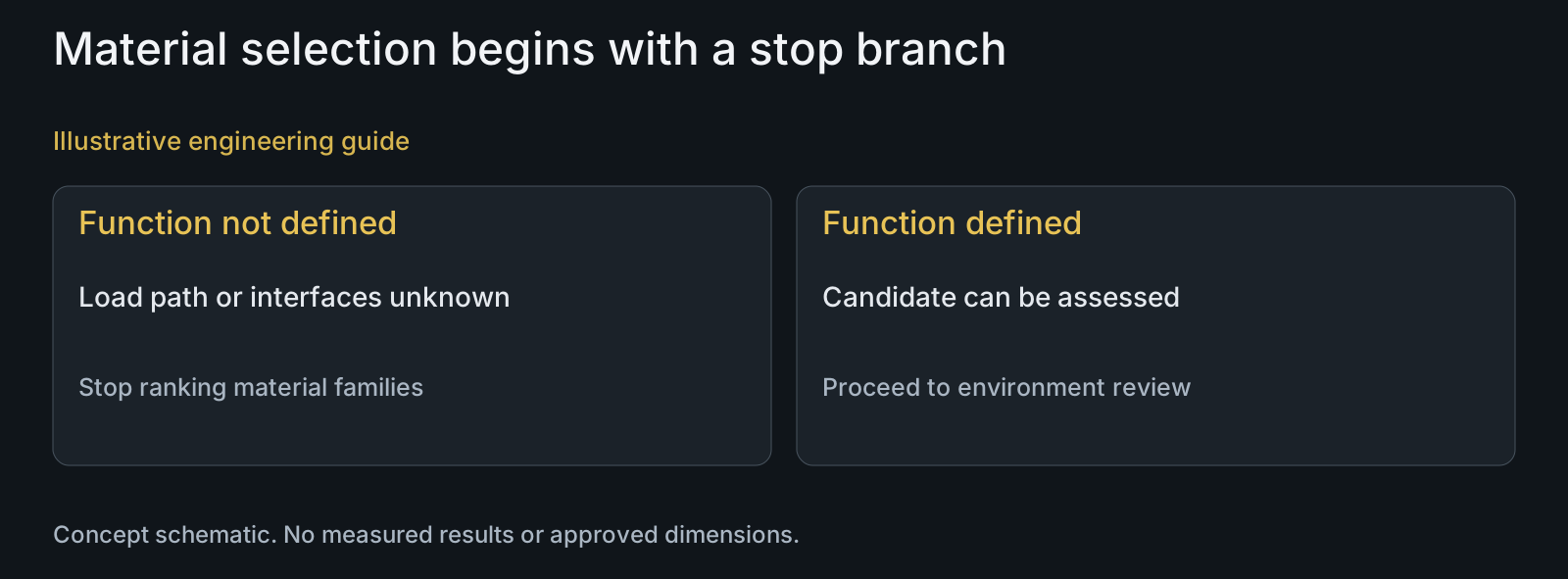
Branch 1: is the load and interface task defined?
If the task is unknown, stop the material ranking and define it. Identify whether the component clamps the stack, locates a bearing, supports a loaded span or serves another role. Describe support geometry, load cases, receiver engagement and the required structural or contact assessments. A spacer and a threaded structural bolt can need different materials even within one kit.
If the task is defined, screen the exact candidate in that geometry. Strength, stiffness, contact response and fatigue are different concerns. A change in density or tensile strength does not answer all of them. The shoulder, transition, thread runout and supported span remain part of the design, not inconveniences a premium material automatically resolves.
Separate raw-material information from finished-fastener requirements. ISO 3506-1:2020 and ISO 898-1:2013 address specified stainless and carbon/alloy-steel fasteners respectively; their public scopes do not establish every shear, fatigue or torque/clamp-force requirement of a custom pivot assembly.
Branch 2: does the interface survive the specified environment?
Identify water, salt, trapped contamination, cleaning agents and contact with dissimilar materials. Review the contact geometry, drainage, seals, treatment continuity and possible service damage. A corrosion-resistant bolt material does not independently protect every neighboring component or contact in the pivot.
For aluminum, condition remains part of the branch. Kaiser Aluminum's 7075 rod-and-bar data distinguish the strength and stress-corrosion behavior of T6/T651 and T73/T7351. That comparison supports evaluating temper, not choosing an alternative temper from a corrosion label alone. The application still needs the relevant strength, contact and finishing assessment.
For stainless or titanium candidates, keep the mating interface and assembly surface state visible. The wet and coastal pivot review addresses exposure; the titanium surface and anti-seize discussion addresses a separate contact concern. No material name is used here as a corrosion-proof or seizure-proof guarantee.
| Branch | Proceed when | Stop or investigate when | Evidence needed |
|---|---|---|---|
| Load and interfaces | The exact candidate can be assessed against defined functions | Only a family name or tensile ranking is available | Geometry, load cases, receiver, supports and relevant validation |
| Environment | Exposure and mating-interface risks have an evaluated response | Protection, condition or neighboring materials remain unspecified | Exposure history, material condition and surface/interface definition |
| Mass | The comparison states equal geometry or an explicit redesign | Density savings are treated as proof of acceptable stiffness | Applicable density and elastic data plus the proposed geometry |
| Supply cost | Offers describe the same delivered configuration | Stock price or unlike sample/production scopes are compared | Quantities, route, finish, inspection, documentation and packing |
Branch 3: compare mass without silently assuming equal stiffness
If mass is not a defined constraint, do not invent a savings target. If it is, distinguish an equal-geometry substitution from a redesigned component. Density affects mass at a fixed volume; a redesigned section changes the volume and may change the assembly envelope or interfaces.
Producer data for 7075, TIMETAL 6-4 and Custom 630 describe density and elastic properties separately from strength. Use properties appropriate to the chosen form and condition. A lighter candidate's finished response must be evaluated with its section, support and contact geometry rather than inferred from a strength-to-weight slogan.
Keep the mass of the relevant supply unit clear. Replacing only one bolt is not the same as redesigning an entire pivot kit. Do not present hypothetical density arithmetic as an observed bicycle weight reduction, and do not transfer a producer's specimen fatigue result to the finished pivot.
Branch 4: compare supply cost after technical screening
Ask for comparable offers covering the same geometry, quantities, delivered condition, inspection and packing. Stock form, machining route, finishing, specialist work and reporting can change the offer. A generic raw-material price ranking cannot determine the cost of the same finished assembly.
PremFixer reviews drawing-led CNC manufacturing and coordinates agreed specialist operations. A proposed substitution should name the original and alternative specifications and explain the changed process or evidence requirements. Material availability is a reason to discuss a change, not authority to make it silently.
Use the pivot RFQ template to preserve the comparison basis. Identify whether an offer concerns a finished component, a preliminary sample or a complete kit. If the technical definition changes, compare the revised supply rather than carry forward an obsolete price assumption.
Turn the shortlist into exact material descriptions
A 304 stainless callout needs its product specification and condition; it is not the same description as an A4-80 finished fastener. Similarly, a property class such as 10.9 is not one alloy chemistry or heat-treatment recipe. Keep stock identity, processing condition and required finished-fastener evidence distinct.
Keep 17-4 PH / UNS S17400 as a separate condition-sensitive branch. Carpenter's Custom 630 data show properties for different aged conditions, so H900 is not an automatic pivot default. Aluminum 7075-T651 and 7075 in another temper likewise are not interchangeable purchasing descriptions.
For titanium, TIMET's Ti-6Al-4V information distinguishes Grade 5 and other variants and relates properties to processing history. A bare TC4 description does not independently establish compliance with a requested ASTM Grade 5 product specification. Confirm the governing specification, form, condition and required evidence before approving the substitution.
Review example: shortlist titanium without declaring a winner
Illustrative engineering example: assume an OEM is considering a titanium alternative to a stainless pivot bolt because the project has a mass constraint. The receiver, support span and bearing interface are unchanged initially. No dimensions, loads, costs or test outcomes are assumed.
The first branch asks whether the alternative can meet the defined structural and contact requirements in that geometry. The next asks about the actual wet interface and assembly surface state. Only candidates that remain credible proceed to the mass comparison and equivalent-scope manufacturing offer.
If a larger section is proposed to address a functional requirement, it is a redesign rather than an equal-shape substitution. Check the envelope and mating contacts, then update the material-and-geometry comparison. The decision tree prevents an attractive family name from concealing a changed design.
Questions buyers need to confirm
Should I choose 304 or TC4 for a suspension pivot?
Neither name alone supplies the answer. Define the structural role, support geometry, receiver, contact surfaces, exposure and required material condition. Compare exact candidates against those requirements, then assess mass and equivalent-scope cost. No suspension-pivot alloy is universally prescribed here.
Can all parts in the pivot kit use the same material?
Only if each component's requirements support that choice. A spacer, locating shaft and clamping screw have different functions and contacts. Preserve item-level material descriptions even when the design owner approves a common material for several BOM lines.
Is 10.9 a complete alloy-steel material specification?
No. It describes a specified finished-fastener property class, not one chemistry or processing recipe. Identify the selected material, required treatment, surface system and evidence. Separate the class requirements from assembly fatigue, corrosion and torque/clamp-force validation.
Does changing 7075 temper leave the design unchanged?
Not automatically. Temper can change strength and stress-corrosion behavior and may affect the supply route. Compare the original and proposed condition against the application requirements rather than accept a substitution solely because both descriptions contain 7075.
Can titanium reduce mass without a geometry review?
An equal-volume comparison can address density, but it does not independently establish acceptable structural or contact response. Assess elastic properties, section and supports. If geometry changes, evaluate the new envelope and interfaces before claiming a useful finished-part mass benefit.
What defines an acceptable material substitution request?
Name the original and proposed grade, specification, product form and condition; identify affected parts and changes to processing, finishing and evidence. State why the change is proposed and what functional assessment remains. The responsible design team approves it, not stock availability alone.
Technical references and scope
Kaiser Aluminum 7075 rod-and-bar data. Producer-specific temper and property distinctions; its specimen data are not finished-pivot validation.
TIMET TIMETAL 6-4 data. Historical producer description of Ti-6Al-4V variants and processing-dependent properties; no table value is adopted as a current pivot allowable.
Carpenter Custom 630 data. Condition-specific PH stainless information; no aged condition is prescribed for all pivots.
ISO 3506-1:2020 public scope. Specified stainless-fastener properties and excluded functional properties, not raw-bar equivalence or complete assembly approval.
ISO 898-1:2013 public scope. Specified carbon/alloy-steel fastener properties; corrosion, shear, fatigue and torque/clamp-force performance require separate consideration.
Explore related component, material and sourcing decisions in the customer decision knowledge center. For a drawing review, use the Drawing/BOM RFQ path.
Build a material shortlist for your actual pivot
Send the component drawing, relevant assembly section, receiver and mating materials, exposure description, mass constraint and quantities. Include candidate grade and condition if known. The review can separate functional gaps from manufacturing and purchasing tradeoffs for your design decision.
Discuss the drawing and BOM