
For a useful custom bicycle pivot-bolt quotation, send the available drawing or STEP model, its revision, material and finish requirements, mating-interface notes, quantities and required delivery state. Also identify inspection deliverables and what remains unresolved. The most easily missed input is the unit of supply: a bolt, a part-number line and a complete pivot kit are not interchangeable quantities. A preliminary estimate can start before every field is closed, but a firm production offer needs a defined scope. Use the RFQ template below to make engineering requirements and purchasing assumptions visible in the same request.
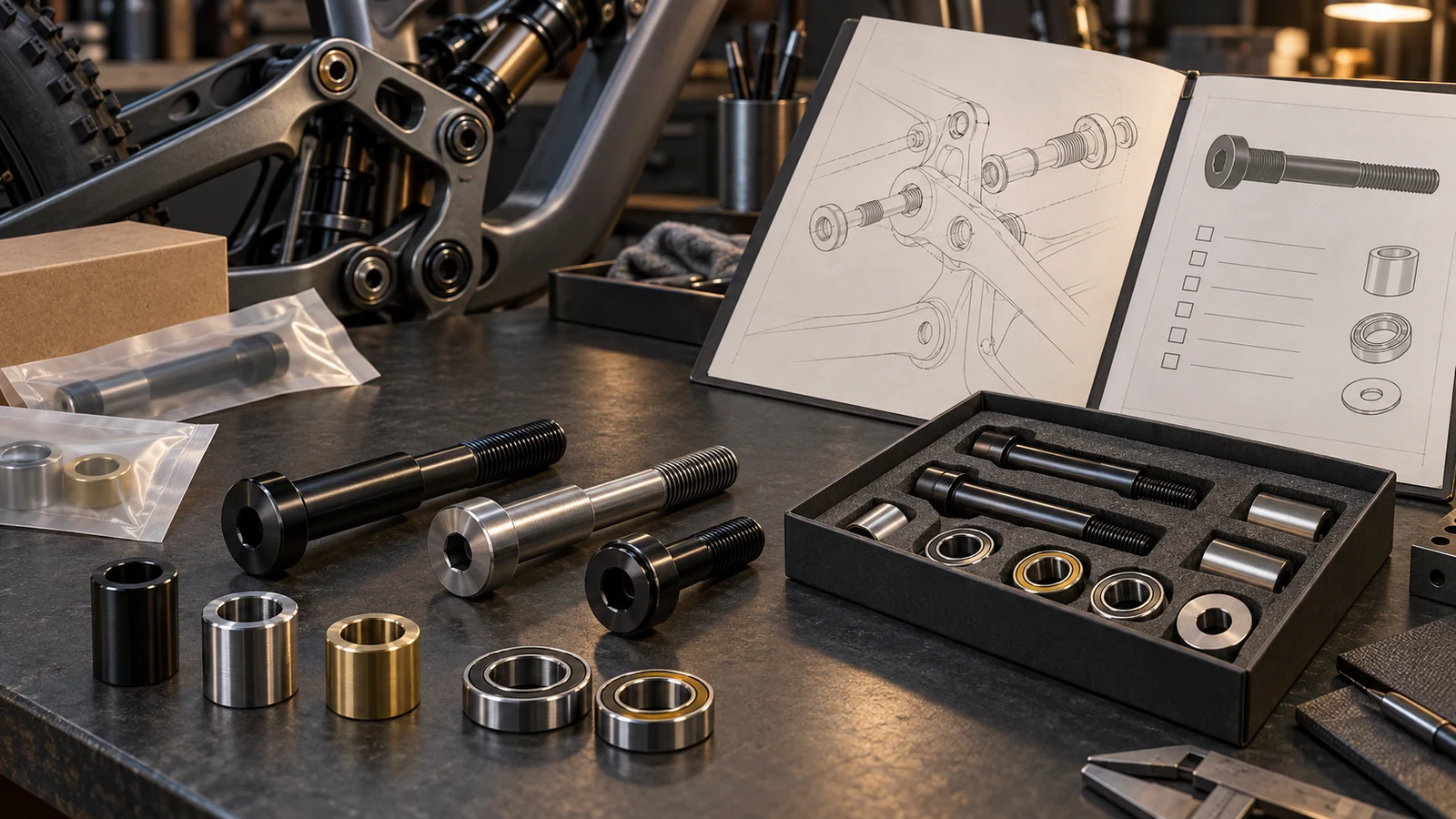
Hero: concept illustration of example hardware and its application. It is not a factory photograph, tested component or approved production geometry.
Define the item being purchased before asking its price
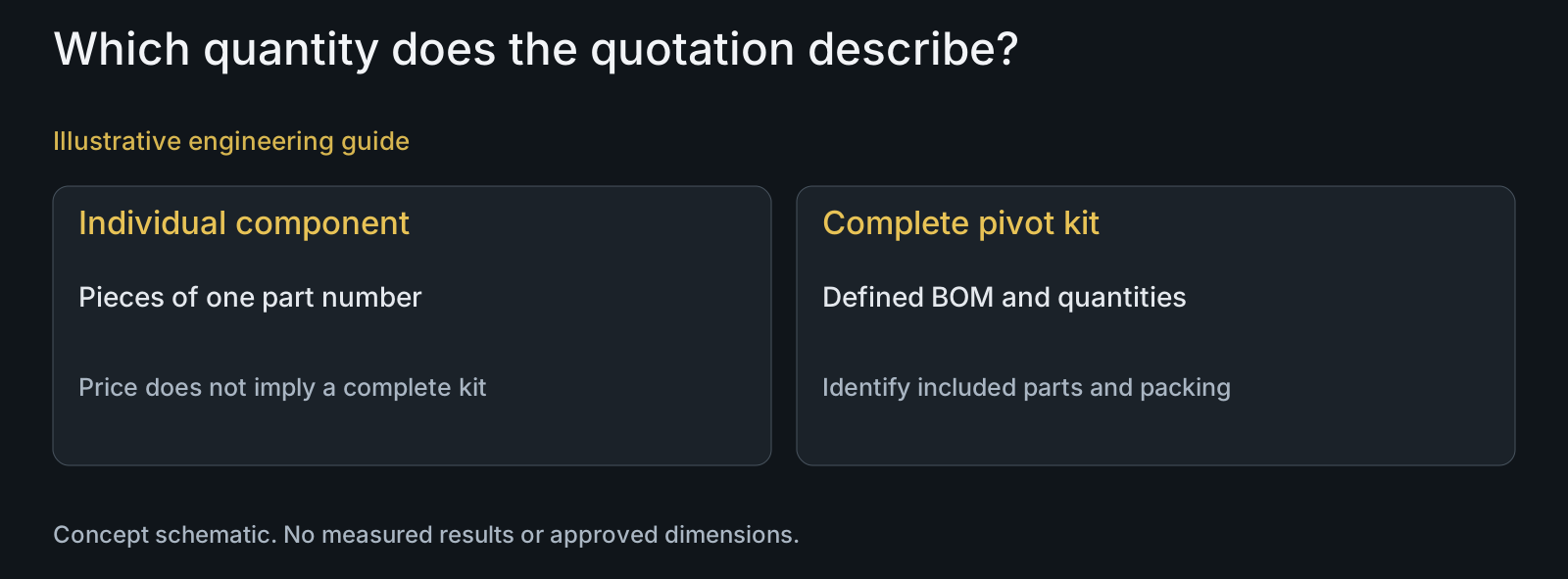
Name each component and its part number. A pivot assembly can contain several bolt lengths, spacers and other hardware whose quantities differ. State whether the supplier is quoting individual components, a complete kit or selected items from the BOM. Identify which mating parts are supplied by the customer rather than included in the offer.
For each BOM line, distinguish pieces per kit from the number of kits requested. State prototype quantities separately from production quantities, and distinguish an order from a forecast. A forecast can support planning without being represented as a released purchase commitment.
Avoid a quantity heading that says only units. Ask the offer to repeat the unit of price and unit of delivery. This exposes a comparison error before an apparently lower bolt price is treated as a lower cost for the complete assembly.
Fill the technical fields without inventing missing values
Send the controlling geometry, material grade and condition, critical dimensions or relationships, thread definition and finish. Identify which dimensions apply to the final delivered state. Provide bearing, receiver and spacer details where they affect fit; the supplier does not necessarily need the entire bicycle model to understand those local interfaces.
Protolabs' published quoting workflow separates uploaded geometry from material, secondary-operation, finish, quantity and shipping selections. That is an external example of quote configuration, not evidence that PremFixer uses its platform, automation or response times. The practical point is that shape alone does not describe the whole supply request.
Use the template as a request form, not as an acceptance standard. If a field is unknown, name the specific open decision and ask whether the offer is conditional on it. Discuss drawing-led CNC turning, material options and finishing scope with those requirements visible.
| RFQ field | What to enter | Why it changes the offer | If unresolved |
|---|---|---|---|
| Geometry and revision | Part number, drawing/model revision, controlling document | Defines which shape and requirements are priced | Identify available files and conflicts |
| Material | Grade, specification and delivered condition | Changes stock, processing and required evidence | State the intended function and request options |
| Fit and tolerances | Critical seats, thread definition, datums and mating details | Changes manufacturing and feature-specific inspection | Name the unconfirmed interface |
| Surface requirements | Treatment, zones, masking and final dimensional state | Changes finishing work and final-fit evaluation | Separate cosmetic preference from functional need |
| Quantity | Pieces by part number, pieces per kit, sample and production quantities | Defines the real unit of price and delivery | Separate forecast from released demand |
| Inspection and documentation | Characteristics, coverage and required reports | Changes inspection, specialist work and deliverables | Ask which evidence is included |
| Packing and schedule | Loose parts or kits, identification, destination and required date | Changes handling and shipment assumptions | Identify the decision or event controlling timing |
Make inspection and documentation part of the quoted scope
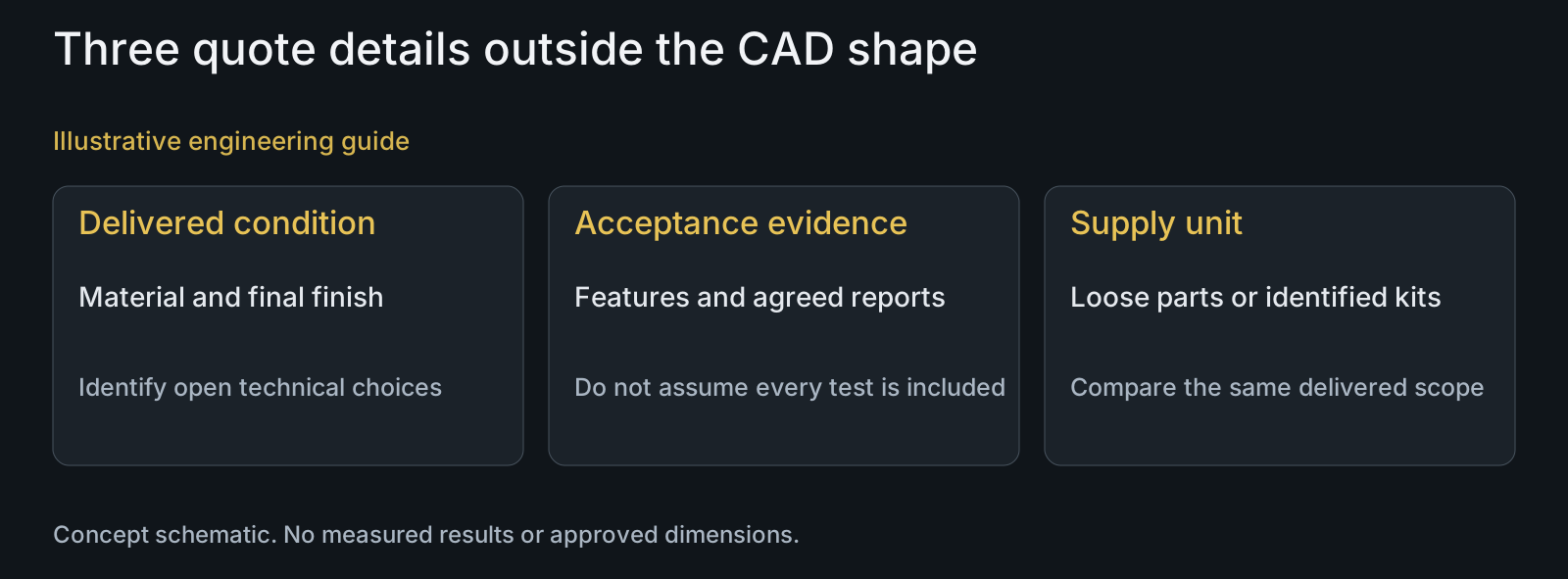
Separate required characteristics from required documents. Measuring a feature, reporting its value and supplying a particular report format are different requests. State the features, final component state, sampling or coverage expectation and documentation needed for the buyer's acceptance decision.
Identify material evidence, agreed specialist tests or first-article deliverables when they are required. Do not assume that every quotation includes every possible certificate or destructive test. PremFixer coordinates drawing-led manufacturing and agreed partner operations; the actual order defines the evidence supplied.
Include marking and identification requirements where they affect traceability or packing. A request for mixed loose parts is different from identified kits, even if the machining geometry is identical. Ask the quotation to list included work and any exclusions explicitly.
Specify delivery state and schedule assumptions
State whether the delivered parts are unfinished samples, finished components, loose identified items or packed kits. Include destination and any required shipment documentation in the commercial discussion. Keep the requested arrival date distinct from a manufacturing completion or dispatch date.
Ask what technical approvals, material availability or specialist operations the proposed schedule depends on. An unresolved treatment or mating interface can affect the route after a preliminary price has been discussed. No universal sample lead time, production duration or minimum quantity is promised here.
Specify whether tooling or setup work is included, separately charged or still to be defined. This article organizes what the buyer sends; the pivot quotation breakdown addresses how an offer's cost elements should be understood. Compare offers only after their assumptions and deliverables are aligned.
Keep an early estimate useful without treating it as release
A model, sample or incomplete drawing can start a technical discussion. Label the request as preliminary when material, interfaces or delivery requirements remain open. Ask which fields prevent a firm offer and which can be estimated under stated assumptions.
A physical sample can help communicate geometry, but wear or undocumented material may prevent it from defining the intended new part. Agree how the proposed specification will be established. Do not let an existing sample's appearance silently define tolerances, treatment or assembly acceptance.
If the review produces a geometry alternative, compare it with the original request and obtain the responsible design decision. The five-issue pivot DFM review explains functional changes; the RFQ should identify which version the price actually covers.
Review example: compare the same kit rather than unlike prices
Illustrative engineering example: assume a project needs a pivot kit containing two different bolts and a spacer. One proposed offer prices the bolts individually, while another describes a packed kit. No prices, production results or order quantities are assumed. The buyer maps each offer to the same BOM, finishing state, inspection deliverables and packing requirement.
The individual-component offer may exclude the spacer or kit identification; the kit offer may include them. Those are scope differences, not proof that either supplier is cheaper or better. Resolve the missing line items and compare a common delivered configuration before making the purchasing decision.
Return the clarified BOM and requirements with the RFQ revision so the updated offer can be understood without reconstructing an email chain. The useful outcome is a comparable supply definition and visible open items, not an artificially complete brief filled with guessed values.
Questions buyers need to confirm
Can I request a quotation before the drawing is final?
Yes, request a preliminary discussion or estimate and identify the open fields. Material condition, critical mating dimensions, finishing state or inspection scope can prevent a firm production offer. Ask which assumptions the estimate uses rather than present those assumptions as approved requirements.
Should the quantity be the number of bicycles or the number of bolts?
Provide both the requested kit or vehicle quantity and the pieces of each part number per kit. State which BOM lines are included. This lets the quotation distinguish complete supply from selected components and prevents a per-bolt price from being mistaken for a per-kit price.
Which tolerances belong in the RFQ?
Include the controlling drawing requirements and identify function-critical seats, stack dimensions and geometric relationships. Supply relevant bearing, receiver or spacer information where it changes the fit assessment. Do not substitute a generic machining tolerance for a specified interface requirement.
Do material certificates and inspection reports come automatically?
Not every possible document is implied. State the evidence you require, its relationship to the delivered parts and any coverage or format expectation. Ask the offer to confirm included reports, specialist tests and exclusions before the acceptance scope is agreed.
Can a sample replace all the drawing information?
No. It can help establish geometry for discussion, but wear, unknown material and missing tolerances can leave the intended design undefined. Identify whether the sample is a reference or an approved design input, and agree how the production specification will be established.
How do I compare quotations with different included work?
Normalize them to the same BOM, quantities, material condition, finish, inspection deliverables and packing state. Identify tooling, omitted components and schedule assumptions separately. A lower headline unit price is not independently evidence of a lower price for the same delivered scope.
Technical references and scope
Protolabs ProDesk quoting workflow. An external manufacturer example of geometry, material, finishing, quantity and shipment configuration. Its platform, timing and service conditions are not PremFixer promises.
Explore related component, material and sourcing decisions in the customer decision knowledge center. For a drawing review, use the Drawing/BOM RFQ path.
Send an RFQ with a clear unit of supply
Share your drawing or STEP file, BOM and sample information with part and kit quantities, material condition, finished interfaces, inspection deliverables and required delivery state. Mark open fields so the review can separate an initial estimate from a defined manufacturing offer.
Discuss the drawing and BOM