
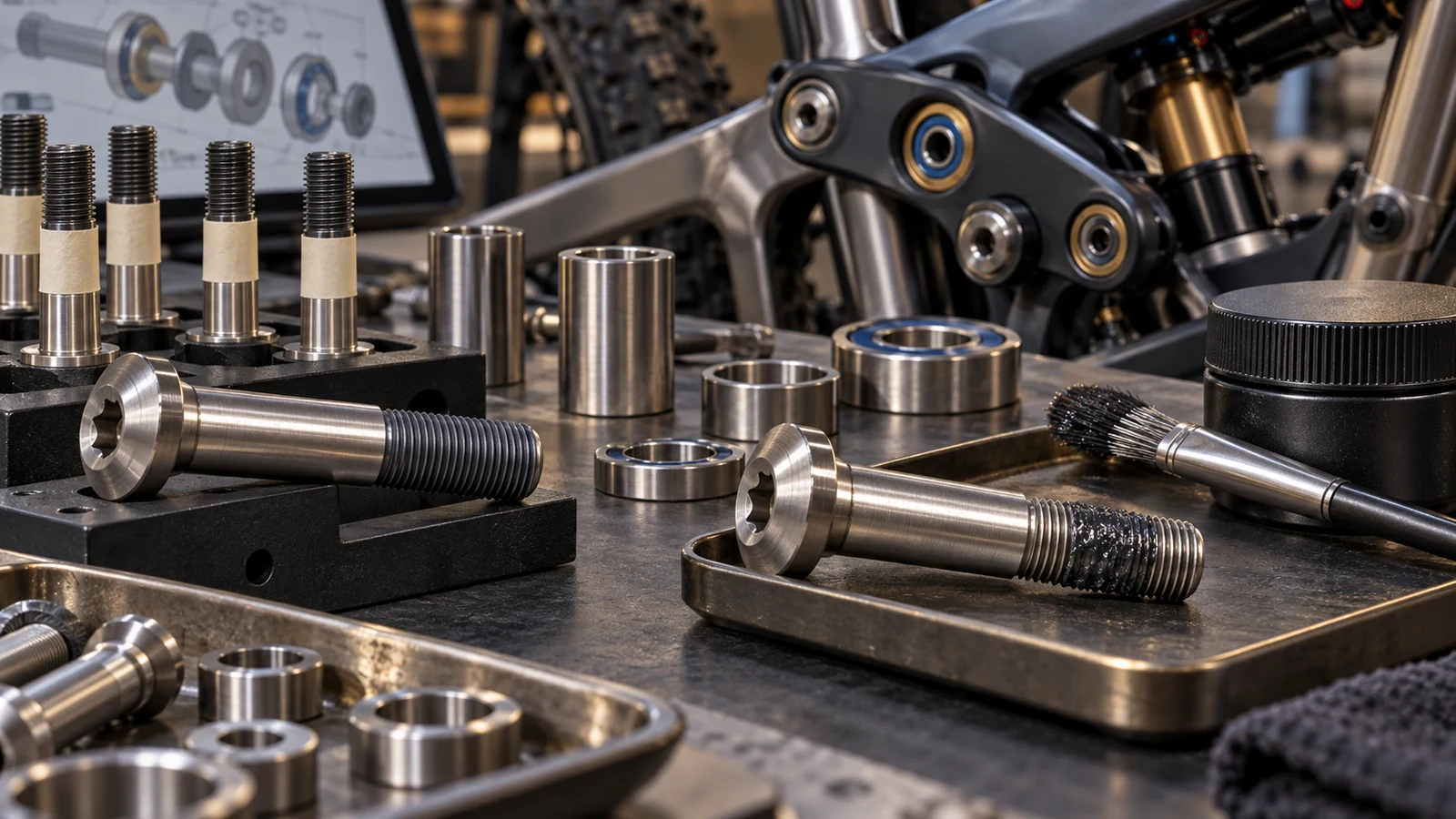
A custom titanium pivot can use a specified dry-film lubricant or an approved anti-seize paste, but the two routes create different manufacturing and assembly responsibilities. A pre-applied film needs defined preparation, coverage and readiness for use; a paste needs a controlled application at installation. Neither permits an arbitrary torque reduction or an unreviewed change to threadlocking. For an OEM choosing between them, compare the actual contacting surfaces, finished thread fit, assembly conditions and maintenance procedure. A dry-looking pre-coated bolt is not an unlubricated bolt, and its appearance cannot establish that every contact or later service installation has the intended friction condition.
Hero: concept illustration of example hardware and its application. It is not a factory photograph, tested component or approved production geometry.
Specify a product and application state, not just a coating color
Dry-film lubricant is not a synonym for every dark finish. A hard protective coating, an appearance treatment and a lubricant may have different purposes. Specify the actual product or controlled process, the substrate and the intended contact. If a proposed coating has no identified lubrication function, do not assign it one from a photograph.
DuPont's MOLYKOTE D-321 R technical sheet illustrates a binder-containing dry-film product and distinguishes touch-dry from fully cured readiness. Henkel's LOCTITE LB 8009 sheet describes a non-curing anti-seize paste. These are terminology examples, not recommendations or proof that either is approved for a particular bicycle joint.
A substitution needs more than a shared lubricant ingredient. Compare the complete formulation, application condition and allowed use with the released assembly requirements. Keep product documents current for the supplied item; a familiar trade name without a specification or revision can leave purchasing and assembly describing different conditions.
Separate the thread from the other pivot contacts
Mark the zones intended to receive the product. Thread flanks, the head bearing surface, shoulder and sleeve contact are not one undifferentiated surface. A thread-only film does not establish under-head lubrication, and an instruction to lubricate threads does not authorize spreading paste into every nearby bearing or seal.
Identify the mating material and finish for each relevant contact. A bolt treatment may be proposed to address assembly seizure, while the rotating or clamped interface has a separate functional requirement. Avoid combining those functions into one blanket instruction. The pivot galling guide covers the related seizure diagnosis rather than product-route selection.
Keep exclusions explicit where adhesive locking, cleanliness, sealing or an interference interface depends on another surface state. Compatibility should be reviewed for the actual product combination and location. A drawing with separate zones is more useful than an instruction to coat the entire assembled pivot.
| Decision | Pre-applied dry film | Assembly-applied anti-seize | Risk and verification |
|---|---|---|---|
| Where application occurs | Controlled before delivery if agreed | Controlled during installation | Confirm who establishes the specified surface state |
| Readiness for assembly | Product-specific film and readiness requirements | Example paste is non-curing | Do not substitute touch-dry appearance for product readiness |
| Coverage | Defined coated and excluded features | Defined application zones at the joint | Review threads and head contact separately |
| Finished thread fit | Assess after the specified treatment | Assess supplied threads and approved assembly state | Do not assume a color or lubricant corrects dimensional mismatch |
| Tightening instructions | Represent the named film and contacts | Represent the named paste and contacts | Evaluate the actual joint; no universal correction factor |
| Maintenance | Define retained-film inspection and restoration | Define permitted cleaning and renewed application | Service substitution needs its own compatibility and assembly review |
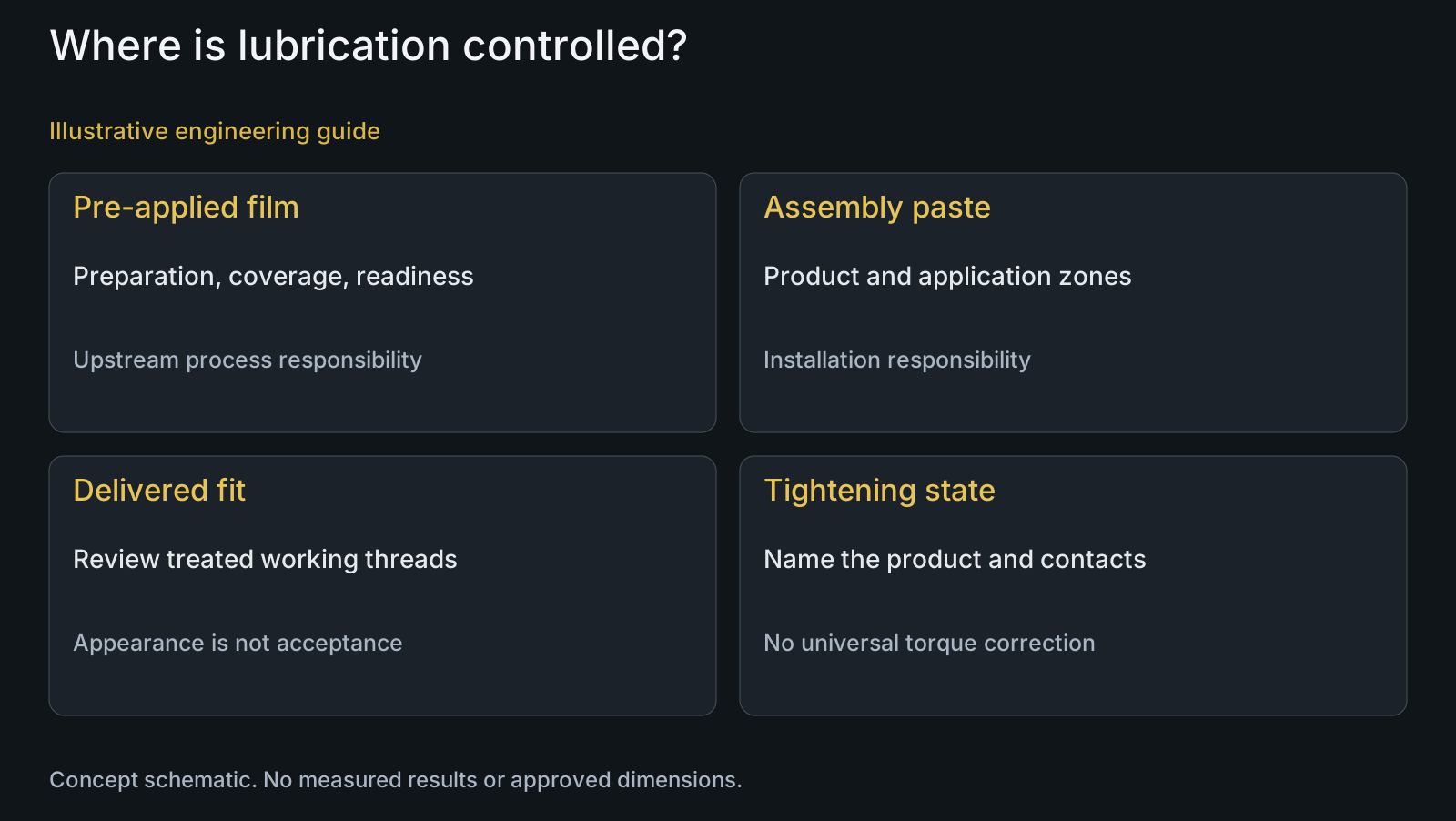
Compare upstream film control with assembly paste control
For a production-applied film, specify the approved preparation and application route, coverage and ready-for-use condition. Confirm that the selected treatment can be provided before quoting it as a supplied feature. PremFixer coordinates drawing-defined manufacturing and qualified finishing routes; this article does not claim that every titanium bolt is pre-coated or that an in-house dry-film line is established.
Evaluate specified thread fit in the delivered state, not only before treatment. A layer on working surfaces belongs in the fit review, including coverage consistency and any affected mating features. The thread-class guide separates dimensional fit from the assembly conditions that accompany it. No universal film thickness is prescribed here.
For assembly-applied paste, define the selected product, contact zones and application instruction for the actual joint. The control question moves to the assembly station: can it establish the approved condition without substitution or contamination? Do not infer that a brush, an aerosol or a different container gives the same result simply because all are called lubricant.
Match tightening and later service to the selected route
Keep tightening instructions attached to the represented lubrication state. Henkel's cited sheet identifies its example torque coefficient with a stated steel fastener test configuration and says the coefficient is determined experimentally. That value does not establish a coefficient for a custom titanium pivot or a percentage adjustment to another joint's setting.
The torque and clamp-force discussion explains why changing friction changes the interpretation of applied torque. Review the named product, covered contacts and assembly procedure together. Do not add anti-seize on top of a pre-applied film as an undocumented precaution, particularly where the original assembly also uses a locking product.
First installation and later maintenance need separate instructions when the relevant surface state can change. Define inspection, permitted cleaning and restoration or replacement with the responsible designer and product supplier. Neither a dry film nor a non-curing paste establishes unlimited reuse. A maintenance instruction must not silently replace a production film with a different paste and retain the earlier tightening assumption.
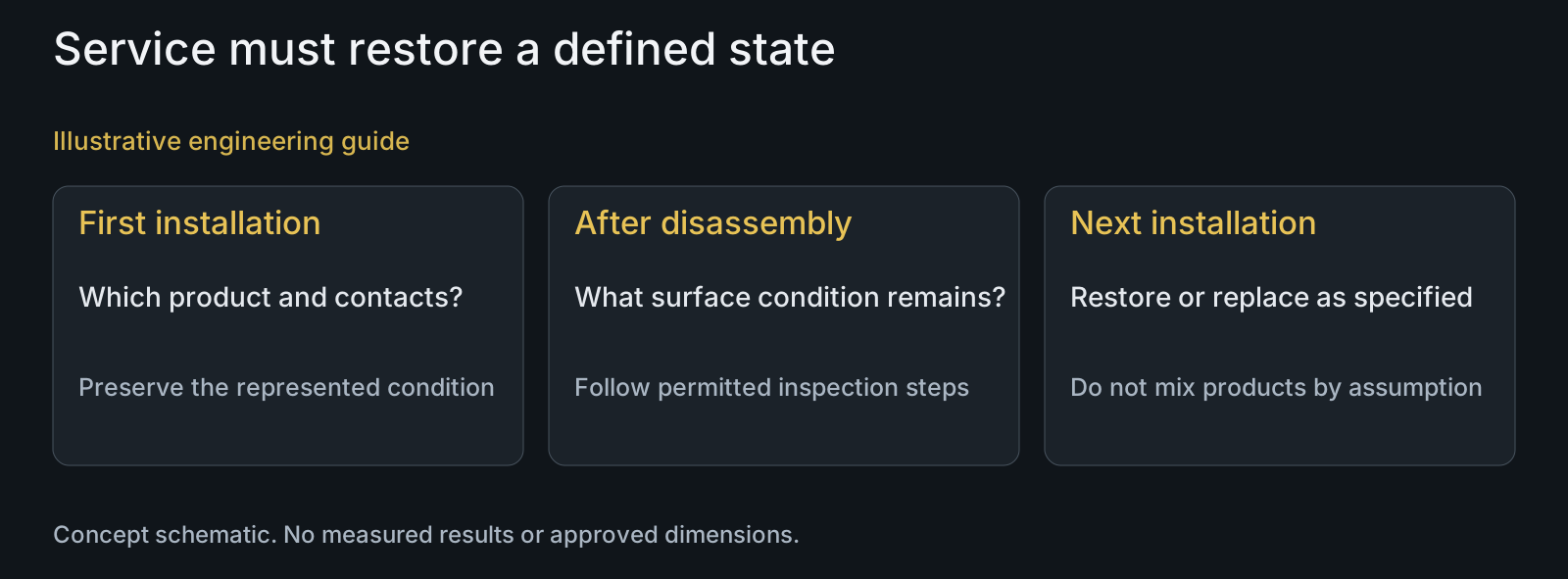
Illustrative review: a pre-coated bolt and a service paste are two configurations
Illustrative engineering example: assume an OEM proposes a thread-only production dry film for a titanium pivot, while its draft service sheet tells technicians to add a generic anti-seize to threads and the head contact. The bolt and receiver dimensions are unchanged. No assembly tests or service results are available.
The review finds a configuration mismatch rather than an automatic benefit from more lubrication. Production and service differ in product identity and covered surfaces, so the first-installation tightening definition cannot simply be carried across. The team specifies the desired service condition and requests the relevant compatibility and assembly evaluation before releasing that alternative.
Purchasing can then distinguish a finished pre-coated component from a bare component plus an assembly consumable. The surface-treatment route should be discussed against the actual drawing and supplied scope. This assumed example demonstrates a review decision, not measured friction improvement, a passed coating process or an approved customer installation.
Questions buyers need to confirm
Is a dry-film-coated titanium bolt an unlubricated bolt?
No. A specified dry-film lubricant supplies lubrication even though the ready surface may look dry. Identify its actual product and coverage instead of applying an unlubricated tightening assumption from appearance.
Does every anti-seize paste behave like a pre-applied film?
No. Product form, readiness and application control can differ. The cited examples distinguish a curing film from a non-curing paste; shared terminology or an ingredient does not approve their substitution in a pivot.
Should lubricant cover the head as well as the thread?
Only where the approved assembly specifies it. Identify thread and head-bearing contacts separately, along with the shoulder and adjacent interfaces. Changing coverage can create a different tightening condition even without changing the bolt dimensions.
Can the supplier inspect threads before dry-film application only?
Not if the requirement concerns finished coated fit. Specify the delivered state and affected features so the treatment is included in the acceptance review. Do not prescribe one universal coating allowance without the actual product and drawing.
Can service technicians add paste over the existing film?
Not as an automatic precaution. Review the product combination, covered contacts, locking compatibility and represented assembly condition. Use a defined restoration or replacement procedure rather than assuming the first-installation instruction still applies.
What should an RFQ say about pre-coated titanium pivots?
Provide thread and mating drawings, materials and finishes, designated product or process, coverage and excluded zones, finished-fit requirements and delivery condition. Include first-assembly and proposed service instructions so supplied treatment and application responsibility can be reviewed together.
Technical references and scope
DuPont: MOLYKOTE D-321 R technical sheet. Example dry-film product form and distinction between touch-dry and fully cured readiness. No product recommendation, numeric recipe, bicycle approval or PremFixer process adoption.
Henkel: LOCTITE LB 8009 technical sheet. Example non-curing paste and configuration-bound experimentally determined torque coefficient. No coefficient, temperature rating or steel test result transferred to titanium pivots.
Explore related component, material and sourcing decisions in the customer decision knowledge center. For a drawing review, use the Drawing/BOM RFQ path.
Define the supplied lubrication state for your titanium pivot
Send controlled drawings or STEP files and the mating BOM, intended lubricant or treatment, coverage map, finished-fit requirement and assembly instructions. Include the maintenance condition you need to restore. PremFixer will review the manufacturing and finishing scope and identify application or compatibility questions that remain with the responsible engineering team.
Discuss the drawing and BOM