
304 and 316 pivot bolts do not share one automatically approved machining recipe, and 316 does not require a universal percentage reduction from a 304 cutting speed. Start with the exact stock condition, operation, cutting diameter, tool and support arrangement. Use the relevant tooling guidance as a starting point, then assess the resulting dimensions, surface, chips and tool condition for the specified axle. A grade name alone cannot define that process window. Also distinguish spindle revolutions from cutting speed: two cuts at the same rpm can have different surface speeds when their diameters differ. No operating settings or comparative production results are supplied here.
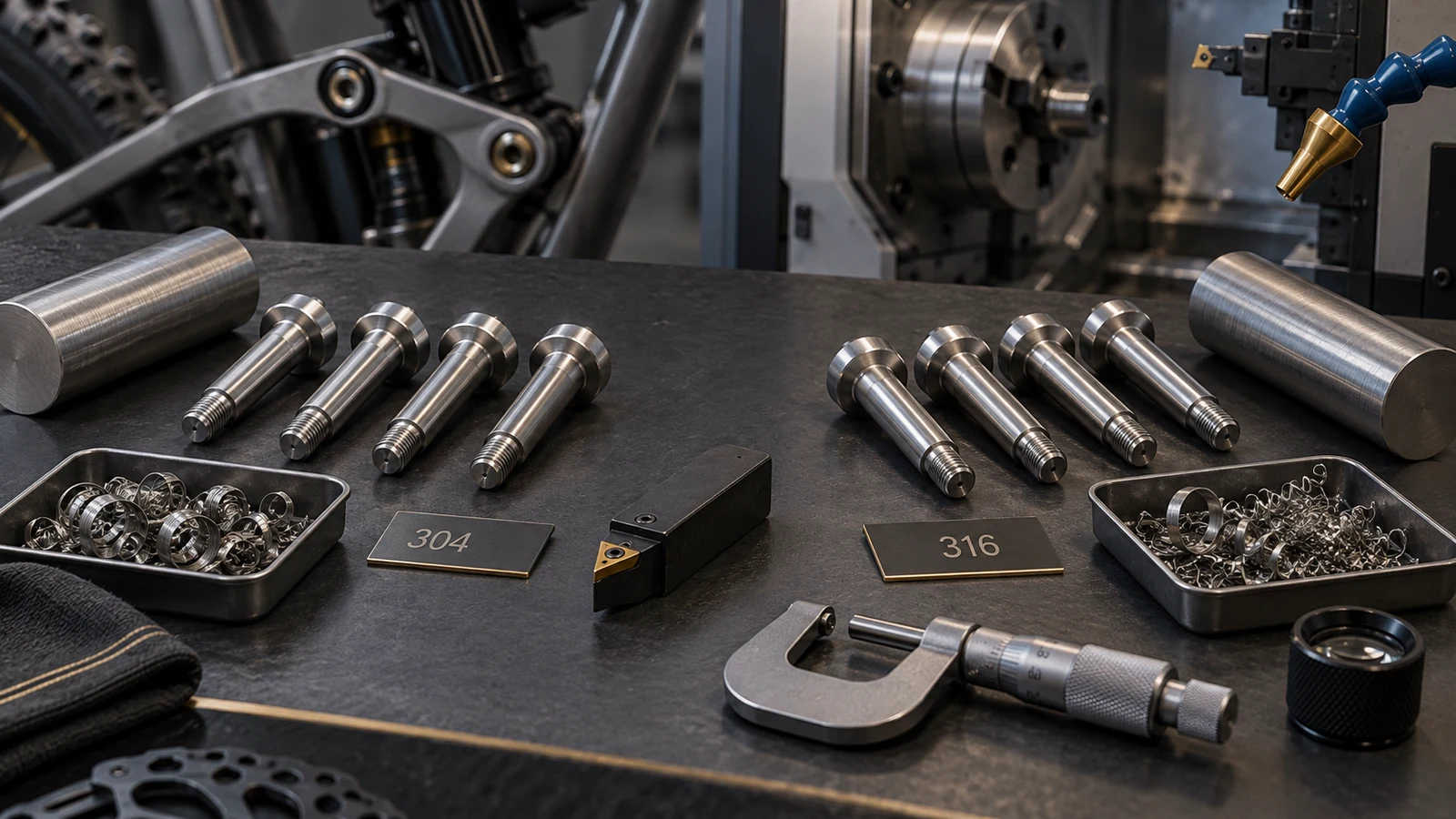
Hero: concept illustration of example hardware and its application. It is not a factory photograph, tested component or approved production geometry.
A stainless grade is not a complete cutting situation
Specify the exact alloy designation, product form and supplied condition. A comparison between a cold-worked bar and a differently conditioned bar cannot isolate the effect of changing 304 to 316. Keep the represented stock and operation visible when reviewing a supplier's parameter explanation.
Sandvik Coromant's workpiece-material guide discusses the effects of composition and material history on machinability. Its austenitic-stainless section describes work hardening, demanding chip behavior and cutting-edge issues. These are useful mechanisms, not a universal numerical conversion between the two grades.
Material selection for exposure remains a separate design question. The wet and coastal 304/316 review concerns corrosion location and assembled contacts. A machining convenience does not authorize an alloy substitution that changes the released material requirement.
Separate cutting speed, rpm and feed units
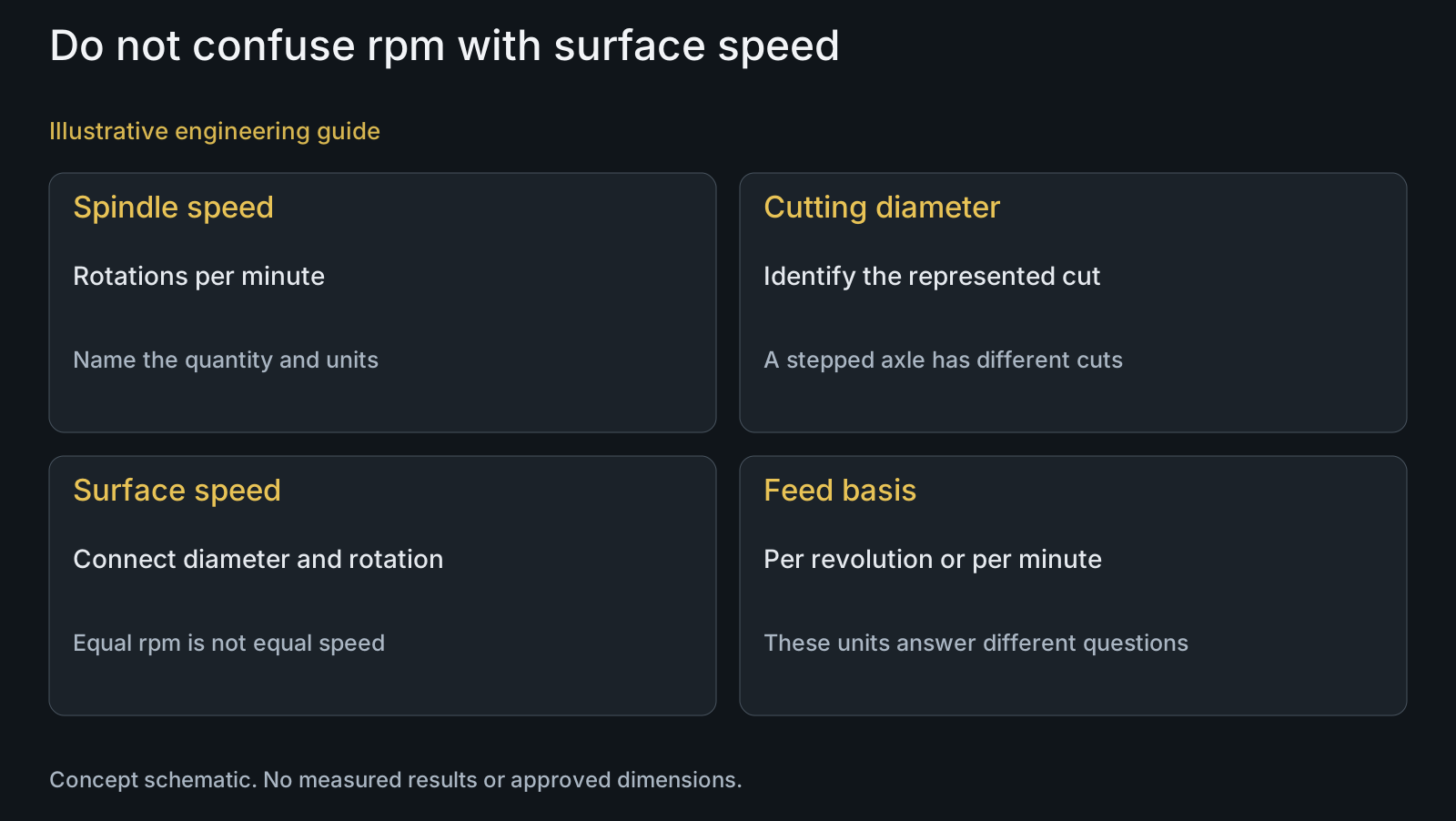
Cutting speed describes surface movement at the cut; spindle rpm counts rotations per minute. Diameter connects the two. At equal rpm, a larger cutting diameter has greater surface speed. At equal selected surface speed, different diameters require different rpm. State which quantity a proposed speed change refers to.
Sandvik's general-turning definitions distinguish cutting speed, spindle speed, feed per revolution and cutting depth. Record the units with each value. A feed expressed as travel per minute is not the same quantity as travel per revolution.
For a stepped axle, identify the diameter and operation being compared rather than quoting one rpm for the whole component. Review the actual control strategy and its limits with the responsible manufacturing team. This explanation is not a program, a machine setup instruction or permission to exceed equipment limits.
| Comparison item | Keep explicit | Misleading shortcut | Useful assessment |
|---|---|---|---|
| Material | Exact designation, form and condition | Treating all stock with a grade name alike | Represented stock specification |
| Speed | Surface speed, rpm, diameter and units | Comparing rpm as if it were cutting speed | Identify the actual cut diameter |
| Feed and tool | Feed basis, edge geometry and task | Attributing a changed tool's result to alloy alone | Matched comparison or disclosed complete routes |
| Cooling and support | Delivery and real cutting arrangement | Assuming a nozzle or machine name proves the setup | Operation-specific proposal and observations |
| Outcome | Dimensions, surface and agreed supply scope | Calling shorter machining time a delivered saving | Conforming output and comparable quoted costs |
Compare the tool, support and cut together
Identify the tool grade and geometry, the roughing or finishing task, tool reach and workpiece support. A parameter set from a short, well-supported external cut is not automatically relevant to an extended shoulder, a narrow groove or a different interrupted operation on the same material.
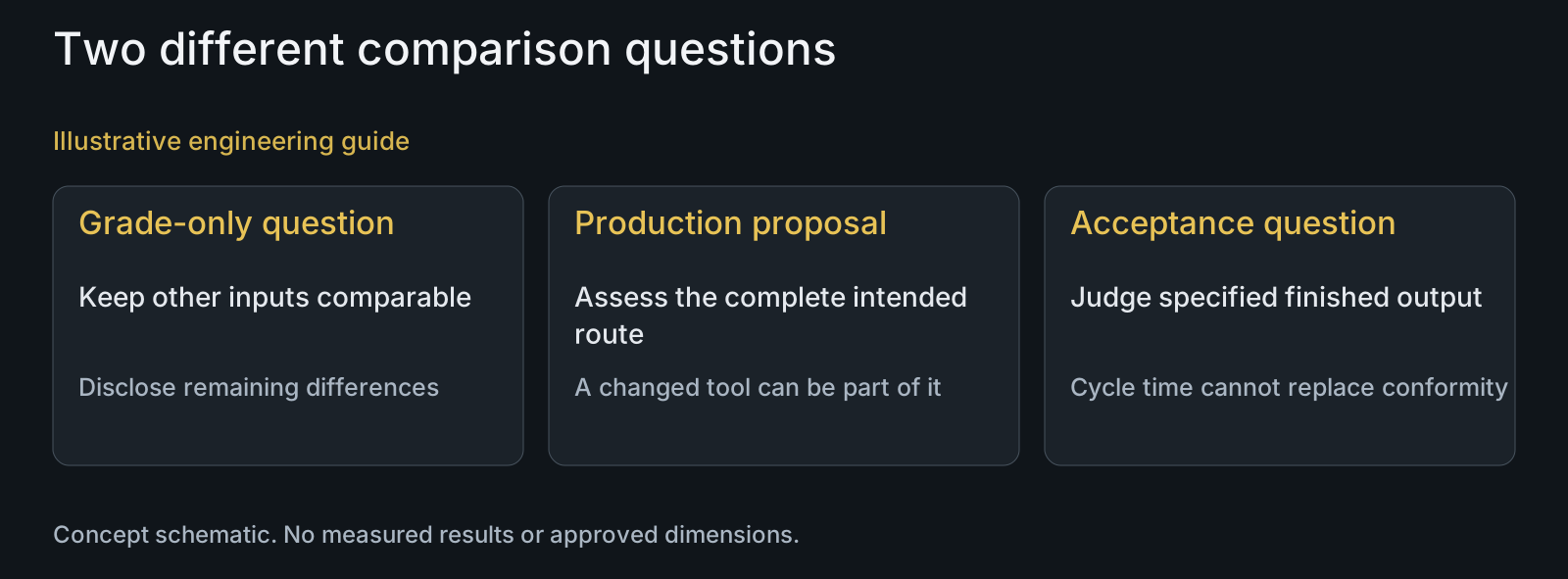
Ask which variables remained constant in a claimed 304/316 comparison. If the insert, support, cut depth and coolant delivery changed with the alloy, the observation represents two complete process proposals. It may still be useful, but it is not evidence that the grade alone caused the difference.
The CNC turning scope connects those questions to the requested part. Avoid demanding the most impressive machine description in place of an explanation of how the critical feature will be produced. Manufacturing feasibility should follow the drawing, not a ranking of axis counts.
Use more than cycle time to judge the response
Review the locating diameter, shoulder relationship and specified surface in the state represented by the trial. These are different acceptance tasks. A faster cut that leaves an unacceptable functional surface has not produced a conforming alternative, even if the diameter reading is inside its limits.
Compare chip handling and edge condition as process observations, alongside the required part results. They help explain whether the proposed route is behaving consistently, but they are not substitutes for acceptance. The tool-life review explains why a counter and a dimensional offset cannot answer every output question.
Treat cooling as part of the cutting arrangement. Identify delivery to the relevant operation and the fluid requirement applicable to that setup. No universal concentration, pressure, flow or change interval is prescribed here. A photographed nozzle or the word flood does not establish what the cutting edge experienced.
A grade change can be confused with a diameter change
Illustrative engineering example: assume a team compares a 304 axle operation with a proposed 316 variant. Both descriptions report the same spindle rpm, but the represented cutting diameters differ. The proposals also use different finishing inserts. There are no actual cutting records, chip observations or dimensional results in this example.
The first review separates the quantities. Equal rpm does not mean equal cutting speed at the two diameters. The second identifies the insert difference. The team can compare the complete proposals against the same finished requirements, but it cannot attribute any future difference exclusively to the stainless grade.
To answer a grade-only question, establish a suitable matched comparison and state the remaining differences. To answer the production question, assess the complete intended route. Those are different objectives; either can be valid when its boundary is clear. Neither produces a fixed speed-reduction rule without supporting job-specific evidence.
Translate an improved process into a comparable quotation
Keep stock specification, geometry, final finish, quantities and inspection scope aligned across offers. If a supplier proposes an easier-machining stock variant, request the exact specification and design-owner review. A commercial description such as improved machinability is not permission to change the material silently.
Separate machining time from delivered-component cost. Include setup, tool consumption, secondary operations and required checks in the agreed scope. No savings figure is justified by a faster spindle setting alone. For the delivered state, connect the machining proposal to surface-treatment requirements and the final acceptance definition.
PremFixer can review the customer's stainless pivot drawing, BOM and intended manufacturing scope. The useful outcome is a feasible feature-specific proposal and clear comparison basis, not a universal recipe, an unverified production-speed advantage or a claim that either alloy is always easier to supply.
Questions buyers need to confirm
Should 316 always run a fixed percentage slower than 304?
No universal percentage is established. Identify material condition, operation, cutting diameter, tooling and cooling, then assess the proposed output. A grade name cannot define the complete cutting window.
Does using the same rpm make two stainless trials comparable?
Not by itself. Cutting diameter affects surface speed, while tooling and support can also differ. State the represented operation and units before interpreting the comparison.
Can an improved-machinability stock variant replace the specified grade?
Only after the responsible design team accepts its exact specification and relevant requirements. Request the full material designation and condition; a commercial stock description is not an approved BOM change.
What should a supplier show besides a faster cycle?
Show how the required dimensions and surface are satisfied and identify relevant tool and chip observations. Compare the complete quoted scope, including setup, secondary operations and inspection, before claiming delivered cost improvement.
Is one coolant setting suitable for every 304 and 316 operation?
Do not assume that. Identify the fluid and delivery arrangement for the actual cut and follow applicable supplier and machine requirements. No universal pressure, concentration or replacement interval is supplied here.
What should accompany a stainless pivot machining RFQ?
Provide drawings and STEP, exact alloy and stock condition, critical surfaces and dimensions, final finish and quantities. State whether you want a matched grade comparison or feasible complete-route proposals for the intended part.
Technical references and scope
Sandvik Coromant: Workpiece materials. General material and austenitic stainless sections read. Condition and machining mechanisms only; composition percentages and numerical machinability/cutting data not adopted.
Sandvik Coromant: General turning formulas and definitions. Public parameter designations and units read. No tool-data values, force rules or machine settings transferred.
Explore related component, material and sourcing decisions in the customer decision knowledge center. For a drawing review, use the Drawing/BOM RFQ path.
Review the actual stainless pivot cutting situation
Send the drawing, STEP file, stainless designation and condition, critical-feature notes, final finish and planned quantities. PremFixer will review the manufacturing scope and evidence needed to compare feasible routes without assuming a fixed 304-to-316 parameter conversion.
Discuss the drawing and BOM