
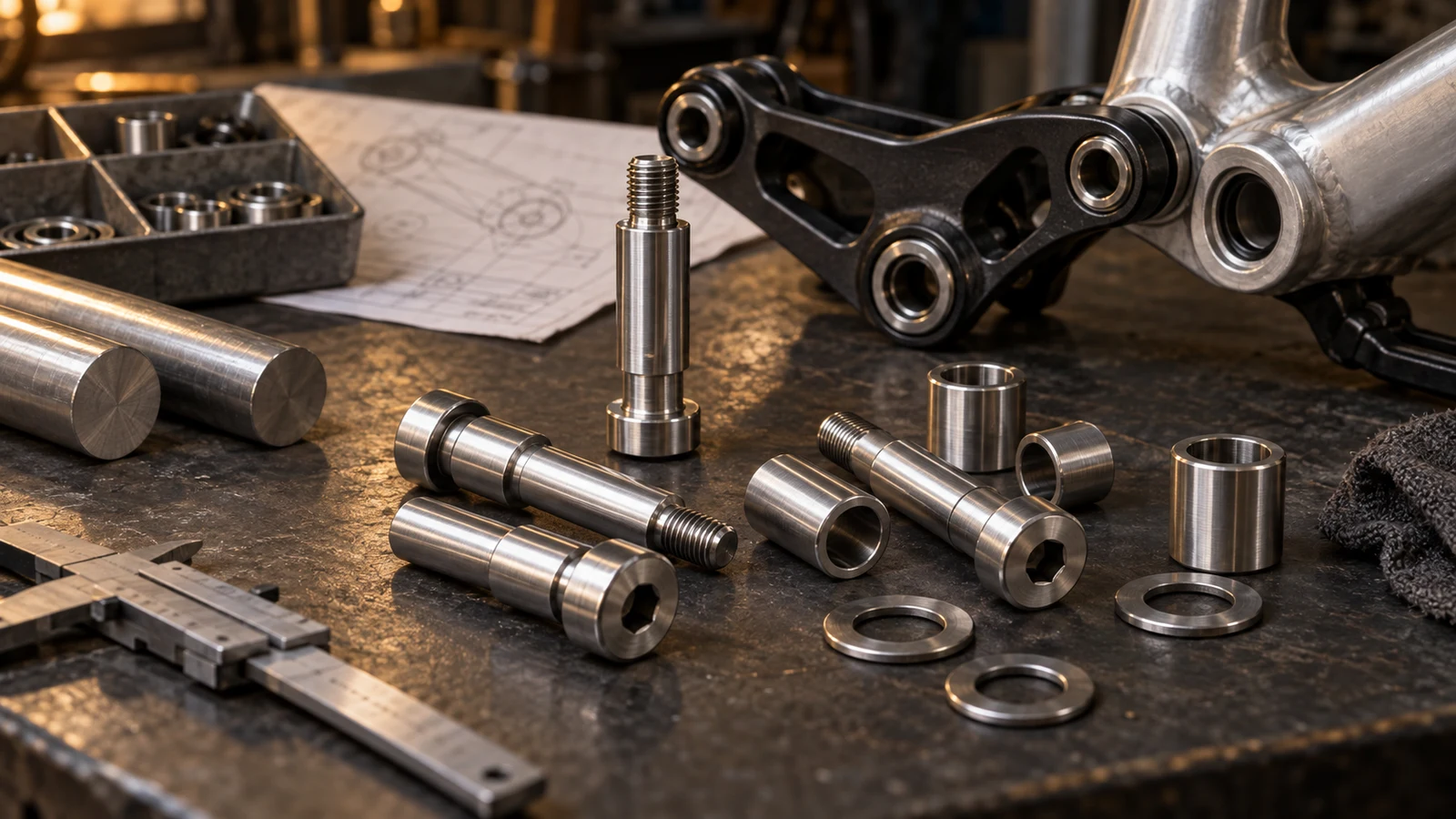
A custom 304 stainless pivot bolt needs more than a material name or an A2-70 label. Specify the governing material standard and permitted grade, the stock form and condition, and the properties required of the finished fastener. Then define the shoulder, bearing seat, receiving thread and surface condition on the component drawing. These fields answer different questions. A chemical certificate can identify purchased stock without proving the strength of the finished geometry, while a fastener property class does not completely define a precision pivot interface. Keep both requirements visible when engineering and purchasing prepare the RFQ.
Hero: concept illustration of example hardware and its application. It is not a factory photograph, tested component or approved production geometry.
Separate alloy identity from the fastener designation
Write the exact material requirement in the material field. If the design requires a specific 304 grade under a named specification, include that requirement rather than relying on a supplier's general stainless description. State whether alternative grades are permitted and who can approve them. A proposal to use another stainless steel should be assessed before it becomes a purchase-order substitution.
A2 describes a stainless fastener material group; 70 denotes a property class. BSSA's designation guidance explains that fastener chemistry ranges are broader than the feedstock ranges it compares. Use that designation background alongside the applicable current specification, not as a substitute for an exact required 304 stock identity or a universal suspension-joint recommendation.
The source of a requirement matters. A frame team may have selected 304 for environmental compatibility, while a purchasing system has copied A2-70 from a standard screw catalogue. Reconcile the two descriptions against the actual custom part instead of assuming the more familiar label takes precedence. For acceptance of markings and documents, use material certificates for pivot orders.
Identify the stock and the condition being purchased
State whether the machining route starts with bar, a heading blank or another product form. Include its applicable supply condition. Austenitic stainless properties depend on processing history, so identical chemistry does not establish identical mechanical properties for annealed and cold-worked stock. The supplier needs to know which condition is required, which is proposed and which features are subsequently formed or cut.
Keep raw-material evidence attached to the stock lot. A mill document describes the material covered by that document; its results do not automatically describe every feature after machining, thread forming or a later treatment. Ask the manufacturer to identify which finished-component requirements are demonstrated separately and how the stock-to-part association will be maintained.
For an order with several pivot sizes, avoid a blanket condition statement that is ambiguous about the covered items. List the relevant part numbers and any different material conditions or finished requirements. This gives purchasing a comparison basis without forcing the manufacturer to infer that every component in the BOM has the same property class.
| Requirement | What it describes | What it leaves unresolved | Useful RFQ evidence |
|---|---|---|---|
| Specified 304 grade and material standard | Permitted material identity | Finished bolt strength and precision fit | Stock document tied to the named grade and lot |
| Bar or blank condition | Starting product form and processing state | Properties after subsequent operations | Supply condition and proposed manufacturing route |
| Applicable fastener grade / property class | Finished-fastener requirements within the standard scope | Custom geometry loadability and assembly suitability | Applicable standard, component review and agreed verification |
| Component drawing and finished state | Functional interfaces and acceptance condition | Permission for silent material or finish substitution | Drawing revision, BOM and clearly identified open items |
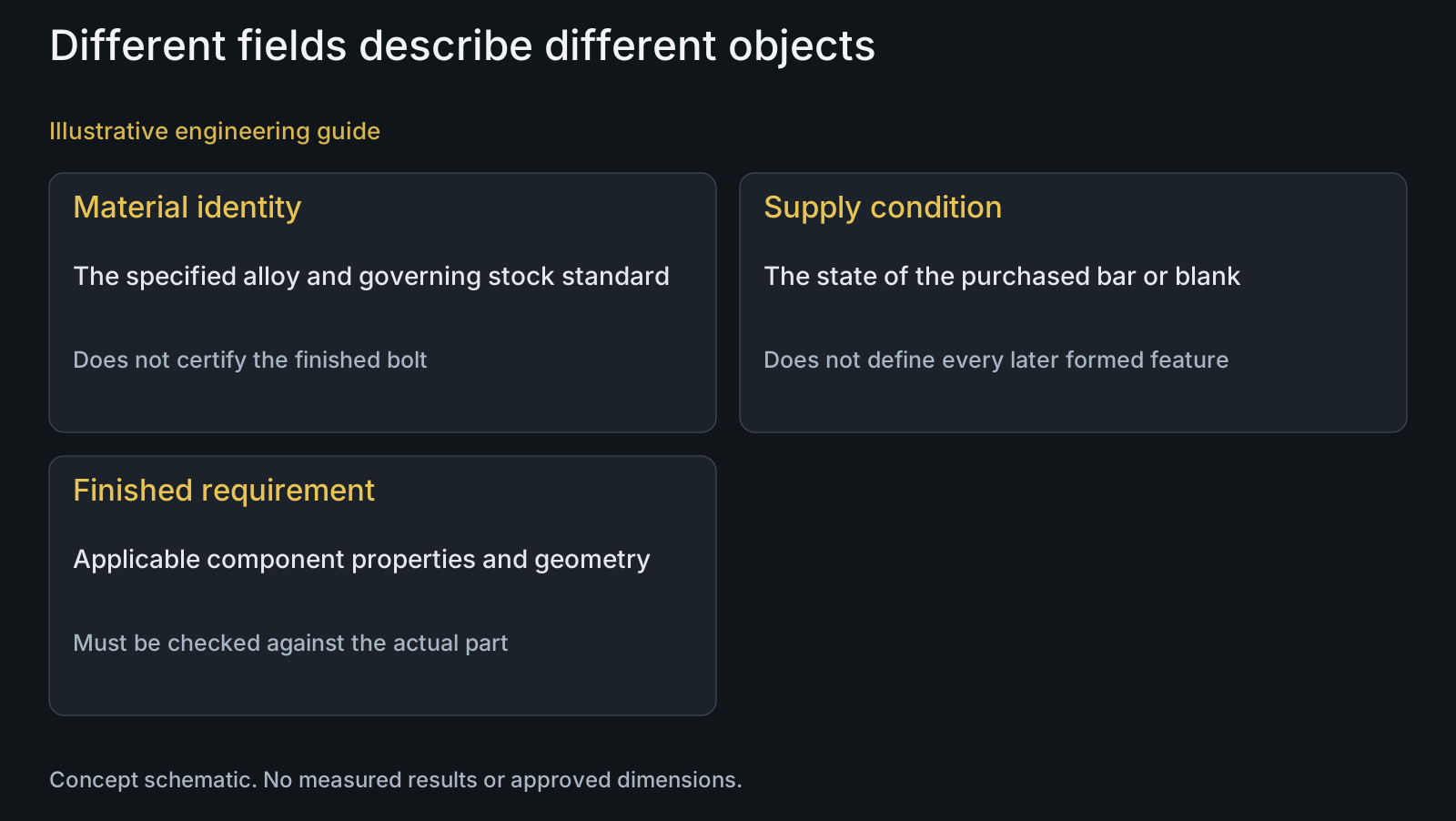
Check whether the finished geometry fits the property claim
The public abstract of ISO 3506-1:2020 identifies its stainless bolt, screw and stud scope and notes reduced loadability associated with some head or unthreaded-shank geometries. Review the actual pivot geometry before applying a property designation without qualification. The abstract is not a conformity certificate or a substitute for the applicable full requirements.
The important question is which feature transfers load in the actual assembly. A component may clamp a sleeve stack while its shoulder locates a bearing ring, or it may perform a different drawing-defined function. Identify the intended clamp and contact path so the property requirement can be assessed at the part level. Do not select a class solely from bicycle category or a general claim that a higher number must be safer.
Where the custom geometry changes how a standard test is performed or interpreted, agree the appropriate method and evidence with the design owner and qualified testing provider. PremFixer's confirmed route includes manufacturing in-house with partner testing as specified for the project. It does not make a material label into a component certification. See manufacturing capabilities for the route boundary.
Specify the delivered state at each functional surface
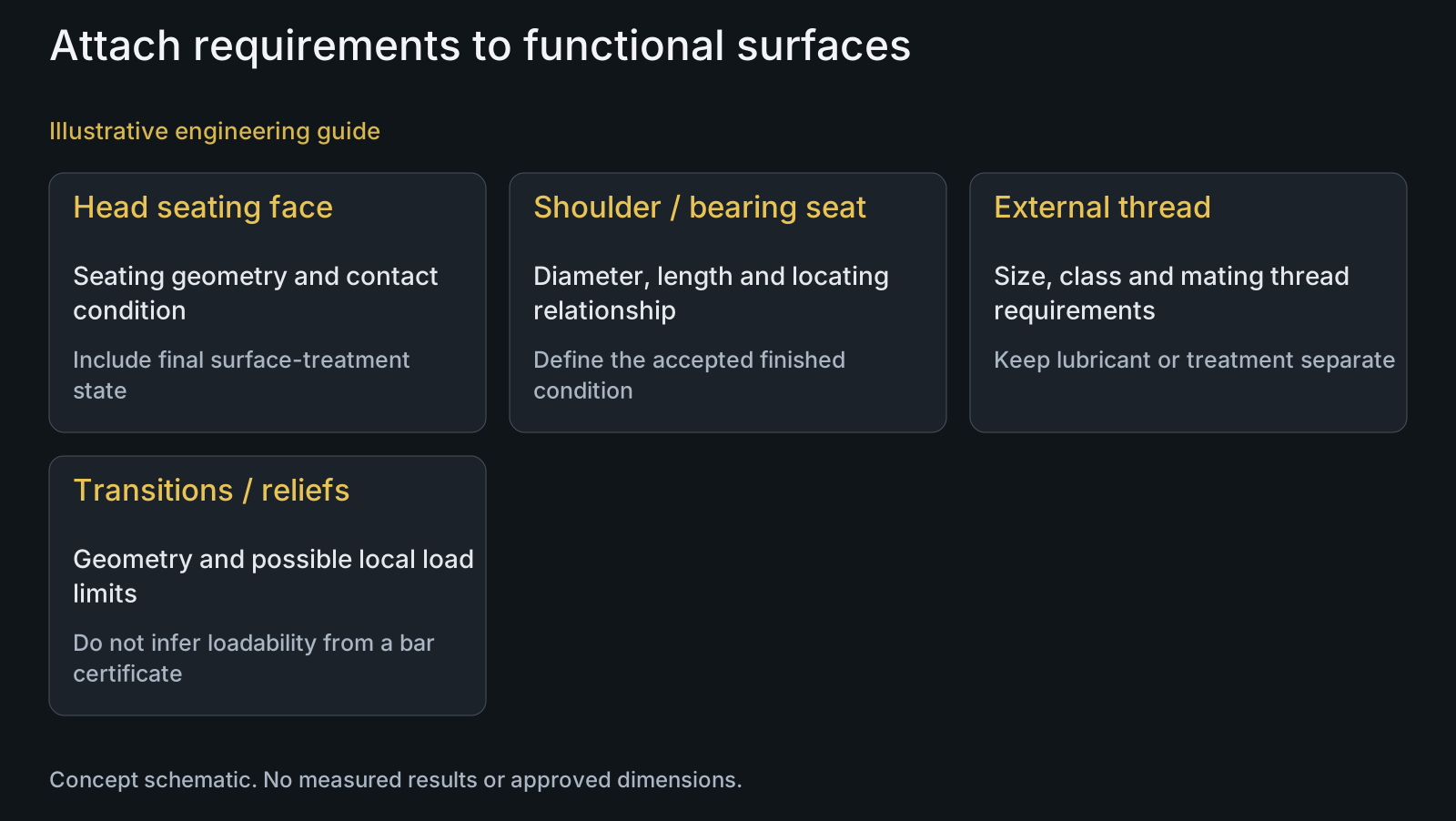
The material callout and the dimensional drawing should work together. Define shoulder diameter and length, bearing-seat requirements, thread size and class, head seating face, transitions and any protected surfaces. Make clear whether dimensions are accepted before or after the specified surface operation. A fit intended for the final part should not depend on an unstated finishing allowance.
Surface finish and processing requirements need their own fields. If passivation is requested, identify the governing treatment and verification requirements rather than placing the word stainless in the finish column. If a lubricant or thread treatment is part of the assembly specification, keep it visible as a separate controlled condition. It can affect assembly behavior even though the alloy has not changed.
A prototype request can leave genuine unknowns open, but name them. For example, a drawing can define the interface while the final property requirement remains under engineering review. Marking the requirement unresolved is preferable to copying a familiar class into the RFQ and having competing suppliers quote different interpretations. The knowledge center provides adjacent drawing, material and sample decisions.
An illustrative correction to an incomplete RFQ
Illustrative engineering example: assume an OEM supplies a shoulder-bolt drawing whose material field says 304 and a purchasing line that says A2-70. The intended starting stock, permitted substitutions and finished property verification are unspecified. The supplier cannot tell whether the second label is a deliberate finished-part requirement or a catalogue description inherited from another screw.
A useful review retains the drawing geometry and separates the unresolved requirements: named material specification and grade; proposed stock form and condition; applicable finished-fastener requirement; and final dimensional/surface acceptance. Engineering decides the required properties and approves any geometry-related qualification. Purchasing then compares quotations using those same fields.
No strength, test result or approved class is invented in this example. The improvement is a clearer specification: a quote for identified stock and machining can be distinguished from one that also includes the agreed finished-part testing and documentation. This prevents a lower apparent price from hiding a different supplied scope.
Questions buyers need to confirm
Is A2-70 another name for 304?
No. It combines a stainless fastener material designation with a property class. A named 304 stock grade may sit within a relevant chemistry family, but the purchasing descriptions do not resolve the same requirements. Specify exact material identity separately when it is required.
Does 304 tell the supplier the bolt's strength?
No. The stock condition, manufacturing history, finished requirements and geometry matter. Identify the applicable material and fastener specifications and the condition in which the component is accepted. A chemistry document alone is insufficient evidence of finished loadability.
Can I request a higher class without revising anything else?
Do not assume the same stock or manufacturing route will meet it. Ask for the proposed condition, feasibility for the geometry and verification method. Engineering should review the complete component requirement before purchasing changes the order description.
Which dimensions should be called out after finishing?
Identify the shoulder, bearing seat, thread and seating surfaces whose delivered dimensions matter. State the required finish and acceptance stage on the drawing. Discuss masking or allowances where relevant instead of assigning one universal adjustment to all features.
What is enough to start a specification review?
Send the current drawing or STEP, mating parts or assembly sketch, material and property descriptions from the BOM, quantity and required finish. Flag conflicting labels and unresolved values. PremFixer can review manufacturing scope while the design owner retains application and requirement approval.
Technical references and scope
ISO 3506-1:2020: scope and reduced-loadability geometry. Public abstract; it does not certify a custom component.
BSSA: stainless fastener designations and chemistry ranges. Designation background; the applicable order specification controls acceptance.
Outokumpu: cold work and stainless product condition. General material behavior, not a measured pivot-bolt property.
Explore related component, material and sourcing decisions in the customer decision knowledge center. For a drawing review, use the Drawing/BOM RFQ path.
Turn the material label into a usable pivot-bolt specification
Share the shoulder-bolt drawing or STEP, mating-part BOM, proposed grade and stock condition, and any property-class or finish requirement. PremFixer can review the manufacturing route and identify which material, geometry and finished-state fields need clarification before quotation.
Discuss the drawing and BOM