
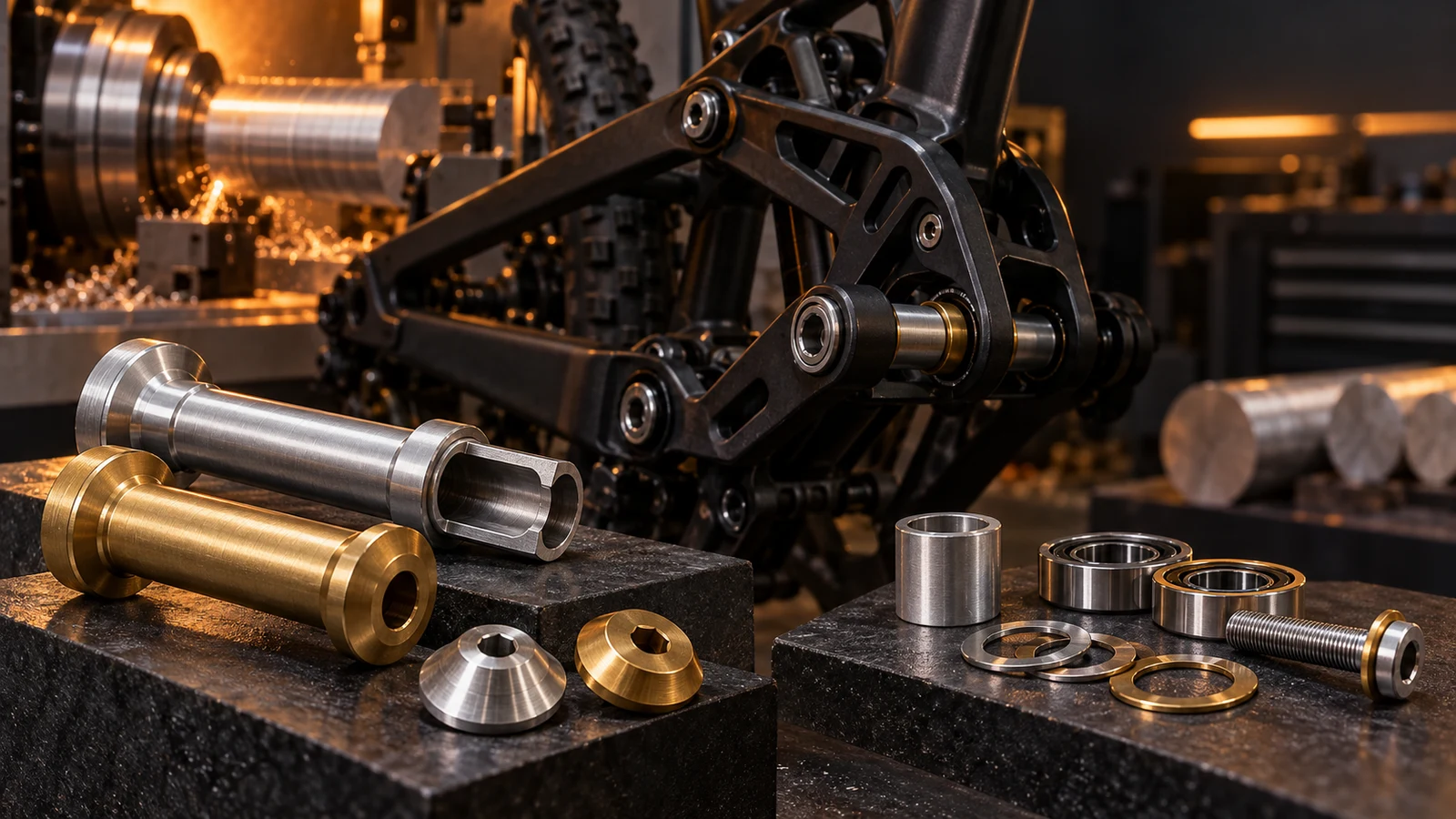
For an OEM comparing 7075 vs 6061 pivot bolts, 7075 in a specified high-strength condition offers a stronger material option, but it is not automatically the better choice for every axle, clamp screw or end cap. First compare the same product form and stated temper; then determine which part requirement controls the decision. Material tensile strength does not establish joint stiffness, thread retention or completed-bicycle acceptance. A strength-driven axle proposal and a lightly loaded cover can therefore justify different choices within one kit. Keep surface condition, mating contacts and the finished-part acceptance requirements in the comparison.
Hero: concept illustration of example hardware and its application. It is not a factory photograph, tested component or approved production geometry.
What the published strength comparison actually says
Kaiser's rod-and-bar sheets list typical ultimate tensile strengths of 572 MPa for 7075-T6/T651 and 310 MPa for 6061-T6/T651, with typical yield strengths of 503 and 276 MPa respectively. These are manufacturer reference values for the listed material conditions, not minimum requirements for an arbitrary machined pivot bolt.
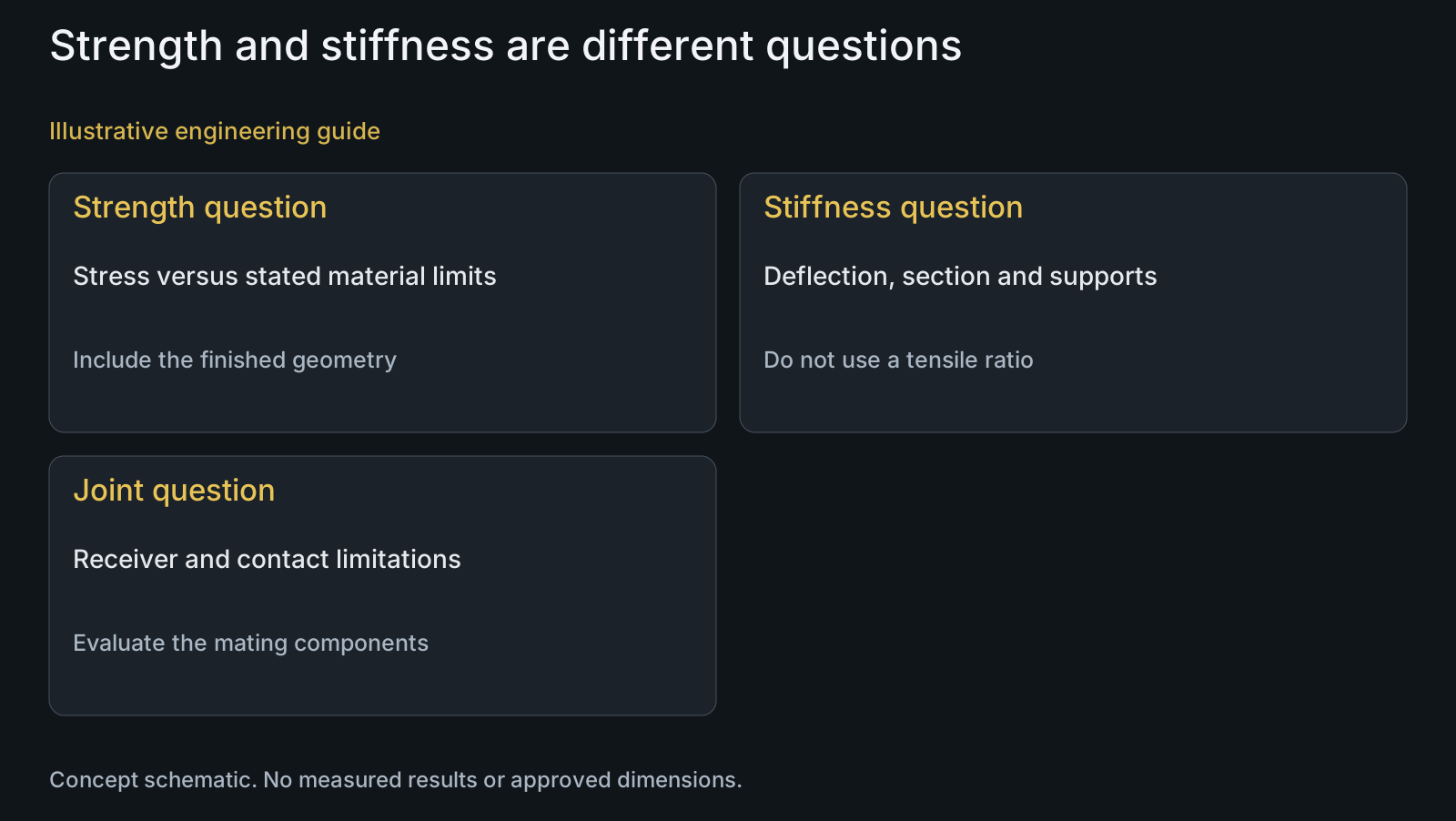
The approximately 1.85 ultimate-strength ratio calculated from those two typical values describes that comparison only. It does not mean a 7075 bolt in an unchanged joint can carry 1.85 times the load. The governing purchase specification, stock size and supplied condition must establish the actual material requirements; the finished geometry introduces separate limits.
Compare yield with yield and ultimate with ultimate. Do not combine a guaranteed minimum for one product with a typical value for another and present the result as an equivalent comparison. The materials overview is a starting point for defining the requested stock, not a substitute for its governing specification.
A stronger alloy is not a proportionally stiffer part
The same sheets list elastic moduli of 71.0 GPa for 7075 and 68.3 GPa for 6061. The much smaller modulus difference is important: elastic deflection does not follow the tensile-strength ratio. Strength concerns the stress a material can sustain; stiffness concerns how far the component deforms under a particular load and support arrangement.
For a simplified beam-like axle, elastic bending depends on modulus, section geometry, support span and boundary conditions. MIT's beam solutions illustrate these dependencies, but a complete pivot can also involve contact compliance and clearance. Treat a beam model as a stated approximation, not a measured bearing-alignment result.
If excessive axle deflection controls the design, choosing a stronger alloy while retaining a long span and thin section may not solve the problem. Investigate support and geometry alongside the alloy. Conversely, a strength-limited section may benefit from a material option that provides more strength while other requirements remain satisfied.
| Controlling condition | Meaning for the alternatives | Risk of a strength-only choice | Useful comparison or verification |
|---|---|---|---|
| Material-strength limit | Compare specified properties in matched form and temper | Typical data mistaken for guaranteed part capacity | Applicable purchase specification and component strength analysis |
| Axle deflection or alignment | Compare section and supports as well as elastic modulus | Higher tensile strength presented as much higher stiffness | Stated elastic model and relevant assembly response |
| Threaded retention | Review both screw and receiver materials | Receiver fails before the stronger screw | Engagement, complete threads and joint-specific checks |
| Spacer or contact function | Review axial faces, area and mating stack | All kit items assigned the axle's requirement | Delivered dimensions and contact evaluation |
| Appearance or protection cover | Meet the cover's own duty and finish target | Unnecessary strength cost or assumed interchangeability | Retention, fit and defined surface condition |
| Supply-cost decision | Price the same released scope | Bar price hides finish or geometry changes | Itemized comparable quotations |
Make the comparison item by item
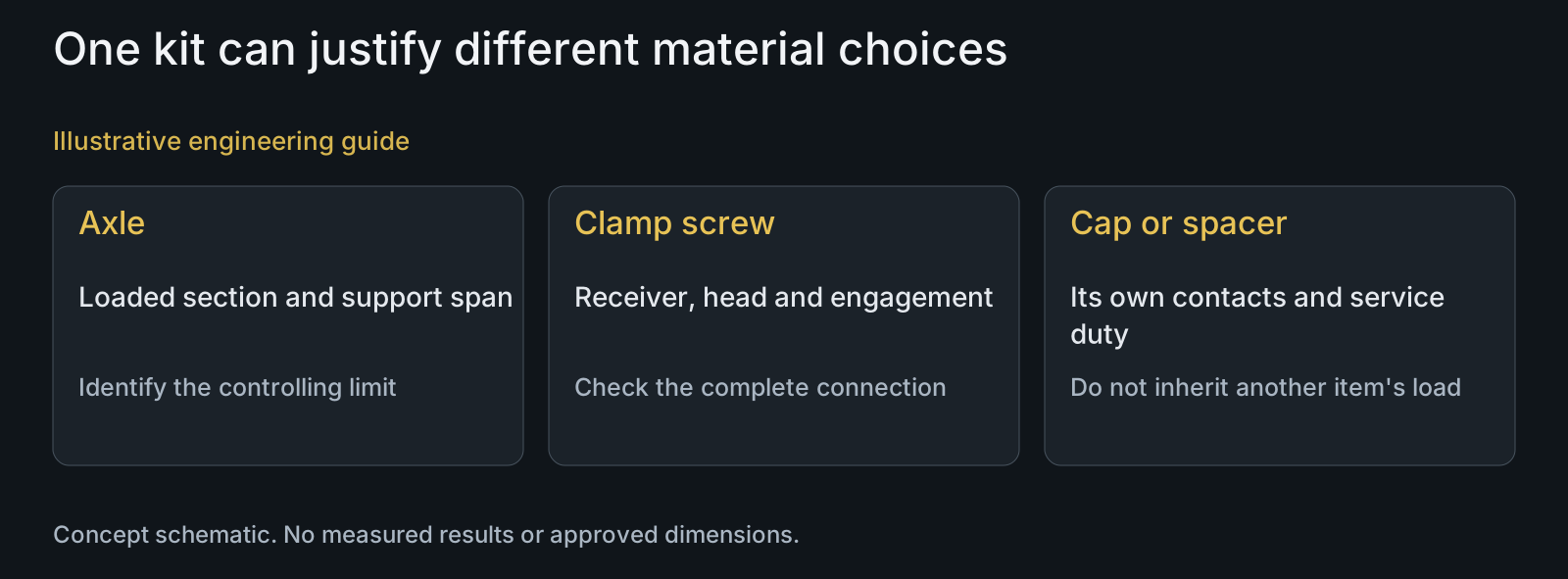
A locating axle, clamp screw, spacer and cover share a kit but not necessarily a failure mode. An axle review addresses its loaded section and supports. A screw review must include the receiver and head contact as well as the screw itself. A spacer review concerns axial contacts and dimensional stability; an appearance cover may have a very different load duty.
Higher bolt strength cannot fix a receiver that strips first or a small contact land that damages its mating surface. Identify which component limits the connection before paying for a different alloy. Review the torque and clamp-force relationship separately rather than copying an installation torque between material options.
Surface and environment also remain part-specific. Specify the required anodized condition, protected contacts, mating metals and exposure. A decorative color match does not demonstrate equal fit or corrosion performance, and the uncoated material data do not certify the proposed finished assembly.
Compare finished cost, not just the price of bar
Request both alternatives against defined geometry, quantities and acceptance scope. Stock availability, removal volume, machining features, surface processing and requested reports can alter the delivered cost. A design revision that removes weight may also change tool access, wall sections and inspection effort.
Weldability matters only if welding is actually part of the proposed route or repair. Kaiser's comparative ratings distinguish gas/arc from spot welding, so an absolute claim that every 7075 joining method is impossible would be too broad. A separate machined axle does not gain value merely because a different alloy is easier to weld.
PremFixer can review the drawing-led CNC turning scope and specified surface-treatment scope. The quotation should identify the exact alloy condition and supplied item definition. Do not silently substitute a more readily available condition under the same familiar alloy name.
Illustrative review: one alloy comparison, two different decisions
Illustrative engineering example: assume a team is comparing an existing 6061 axle concept with a 7075 alternative and also buying a separate protective end cap. The axle has a fixed support span, while the cap is assumed not to carry the suspension load. No dimensions, loads or test results are supplied.
The axle reviewer separates two questions: whether the specified material gives sufficient strength and whether the geometry keeps the mating bearings aligned under the intended loads. A favorable strength comparison cannot close the second question. The cap reviewer instead checks its own retention, finish and service requirements; it does not inherit the axle's strength demand.
The resulting RFQ can compare two axle options while retaining a separately specified cap. That is an engineering reasoning example, not an approval of either alloy. The missing load cases and assembly evidence must be resolved by the responsible design team before a material change becomes a released product definition.
Questions buyers need to confirm
How much stronger is 7075-T6 than 6061-T6?
Kaiser's listed rod-and-bar typical ultimate values are 572 and 310 MPa, about a 1.85 ratio. That is a reference-material comparison, not a finished-bolt load rating; use the specified form, condition and governing requirements for the actual order.
Will changing to 7075 reduce axle deflection by the same ratio?
No. Elastic deflection depends on modulus, section, support span and boundary conditions, not ultimate strength alone. Compare the actual axle geometry and mating support arrangement before claiming improved alignment.
Should the whole kit use 7075?
Not automatically. Identify each item's locating, clamping, spacing or cover function. A low-load cap and a load-carrying axle can have different requirements even when they are supplied together.
Can 6061 be substituted because it has the same dimensions?
Only after the responsible design team accepts the material change. Equal dimensions do not establish equal material strength, surface behavior or finished-part requirements. Identify the original and proposed specifications and affected part numbers.
Does anodized color prove which alloy was supplied?
No. Specify material identity and the required surface condition separately. Color is an appearance characteristic, not proof of alloy, temper, lot connection or mechanical properties.
What should a two-alloy RFQ contain?
Provide the component drawing, assembly section, exact candidate material conditions, mating parts, exposure, finish and quantities. State whether the alternatives retain geometry or propose a revision, and request comparable acceptance and delivery scopes.
Technical references and scope
Kaiser Aluminum: 7075 rod and bar technical data. Manufacturer typical material values and process ratings, not a finished-pivot acceptance specification.
Kaiser Aluminum: 6061 rod and bar technical data. Matched-form reference for the explicitly listed typical strength and modulus comparison.
MIT Unified Engineering: standard beam-deflection solutions. Educational elastic-beam relationships; applying them to an axle requires stated model assumptions.
Explore related component, material and sourcing decisions in the customer decision knowledge center. For a drawing review, use the Drawing/BOM RFQ path.
Compare two alloy options against the actual pivot drawing
Send the axle and kit drawings, STEP model or sample, assembly section, candidate material specifications, finish and quantities. PremFixer can review manufacturing differences and prepare a comparable scope while identifying interface and validation decisions that remain with the product team.
Discuss the drawing and BOM