
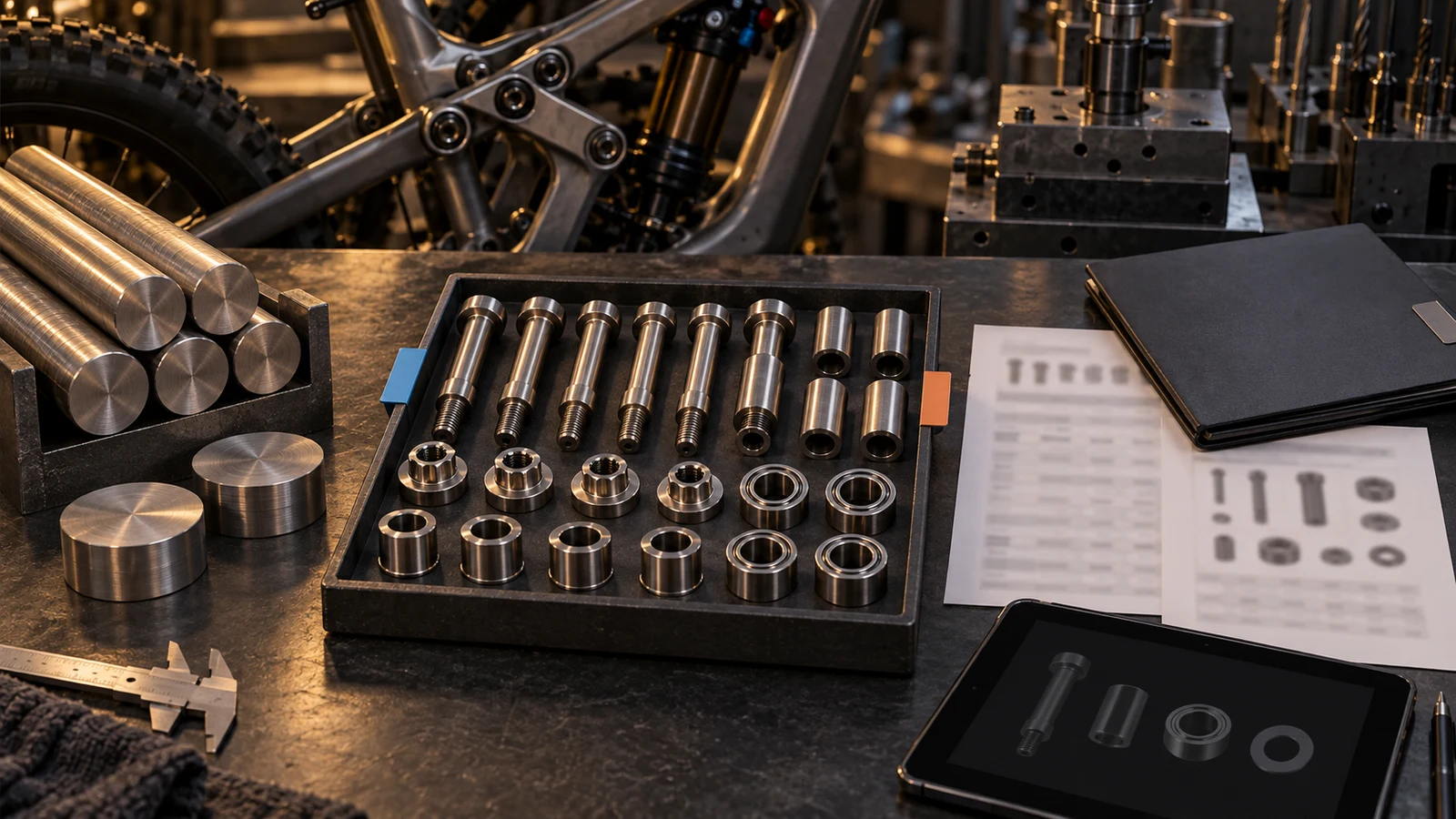
AMS 4928 and ASTM B348 can be relevant to titanium stock used for custom pivot hardware, but neither name automatically certifies the finished bolt or its bicycle application. The useful purchasing decision is which specified alloy, product form, condition and document scope the drawing requires. AMS 4928 identifies an annealed 6Al-4V material specification; ASTM B348 covers multiple titanium grades in annealed bars and billets. Similar alloy wording does not establish interchangeable requirements or automatic dual conformity. For engineering, purchasing and SQE teams, connect the ordered specification to actual supply evidence, then retain separate requirements for finished dimensions, processing and the supported pivot assembly.
Hero: concept illustration of example hardware and its application. It is not a factory photograph, tested component or approved production geometry.
Read the published material scope before using an aerospace label
SAE's public listing for AMS4928X identifies annealed 6Al-4V bars, wire, forgings, flash-welded rings and drawn shapes, with specified dimensional scope. The listing identifies revision X dated October 2025. Do not treat the familiar unsuffixed number as a complete order requirement when a revision matters.
ASTM's public B348/B348M-25 scope covers annealed titanium and titanium-alloy bars and billets, including Grade 5, UNS R56400, described as 6 percent aluminum and 4 percent vanadium. B348 alone therefore does not select Grade 5: the order needs the required grade as well as the relevant form and condition.
Those public descriptions establish an important scope difference without proving full equivalence. This article does not reproduce paid acceptance clauses, test frequencies or numerical chemistry limits. Determine detailed conformity against the specified edition and purchase requirements; a stock label or catalog description cannot replace that review.
Compare a proposed alternative requirement by requirement
An AMS4928 proposal is not automatically better for every pivot than a B348 Grade 5 proposal. Ask why the alternative is being offered: availability, the customer's specified material route or another defined requirement. Keep that reason separate from an unqualified aerospace-grade sales description.
Compare alloy designation, product form, supplied condition, dimensional scope and the ordered testing and documentation. Where a field differs or is unresolved, identify it rather than silently declaring equivalence. A familiar TC4 designation also needs its governing specification; the Grade 2 versus Grade 5 discussion distinguishes material families from cross-standard acceptance.
Dual conformity needs evidence that the supplied material meets both ordered specifications, not just a broadly similar composition description. If the available report names only one requirement, do not add the other on a shipment summary without the relevant supporting basis. The responsible customer team should approve a changed material requirement before it becomes the manufacturing baseline.
| Question | AMS4928 context | ASTM B348 context | Buyer decision or boundary |
|---|---|---|---|
| Which alloy? | Published title identifies annealed 6Al-4V | Multiple grades; Grade 5 must be selected explicitly | Name the actual ordered alloy or grade |
| Which product form? | Listed bars, wire, forgings, rings and drawn shapes | Listed annealed bars and billets | Match the supplied form to applicable scope |
| Which revision? | Public listing identifies AMS4928X | Public listing identifies B348/B348M-25 | Use the contracted requirement, not an unsuffixed sales label |
| Can one replace the other? | Needs a requirement comparison | Needs a requirement comparison | Similar alloy wording is not automatic substitution approval |
| What does a material report cover? | Its identified stock and reported scope | Its identified stock and reported scope | Connect the actual material to the delivered parts |
| Is the finished pivot approved? | Material designation alone does not establish it | Material designation alone does not establish it | Retain separate drawing, process and application requirements |
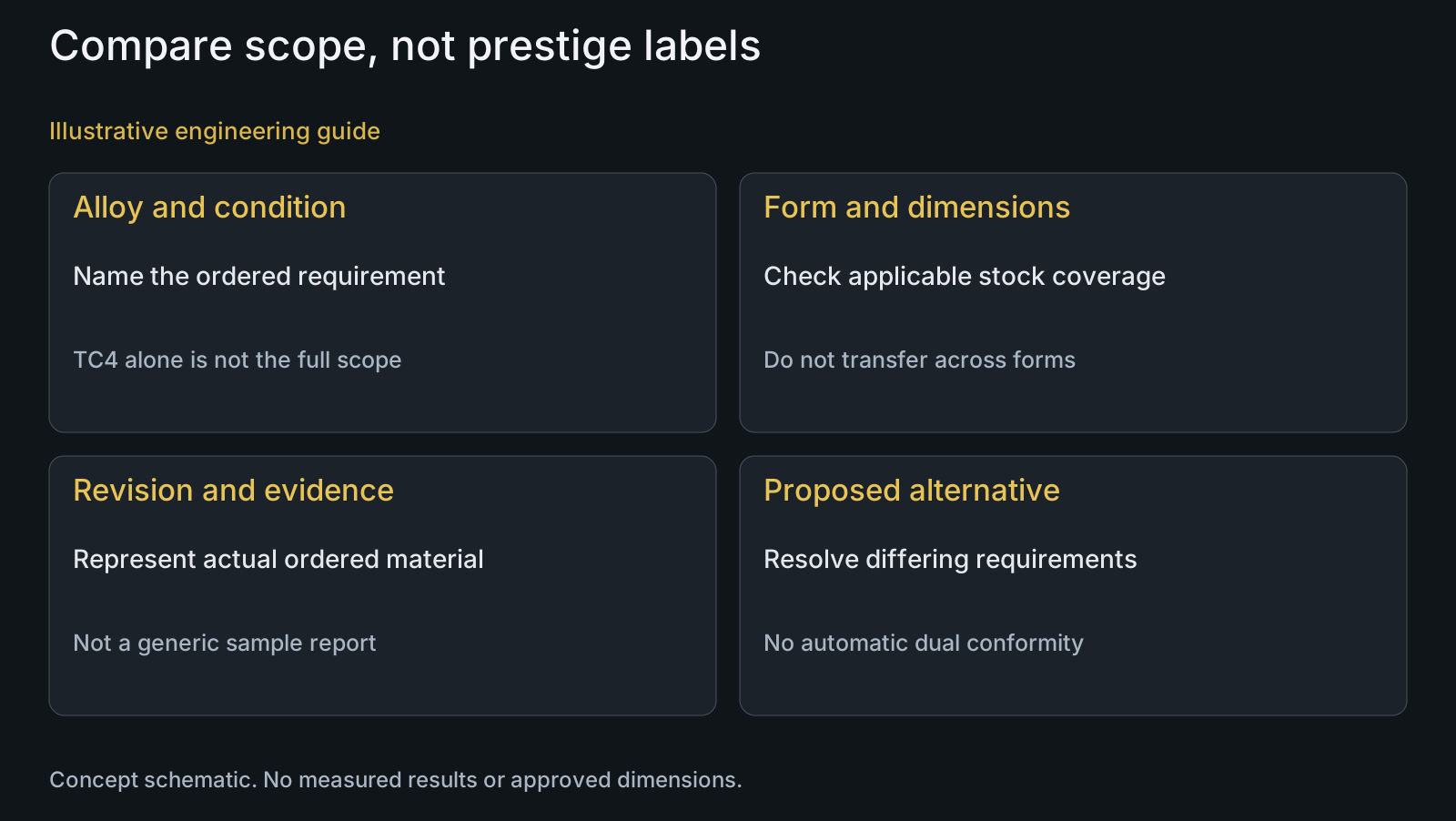
Define what the material document must establish
Ask for documentation against the actual ordered stock and its identity. The request should identify the material specification and revision, alloy or grade, form, condition and required results. A generic sample report may illustrate the supplier's document format, but it is not a report for the material allocated to your parts.
If chemical results are needed, state the required analysis scope. Do not relabel a separate finished-part spot check as an original mill heat analysis or assume a chemical result alone establishes every ordered material property. Keep the report's issuer, represented material and test scope clear.
Agree the required document type and availability before confirming the supply scope. An EN 10204 document request is a separate question from choosing AMS4928 or B348. The material-document guide explains that distinction. This page does not promise a default 3.1 document, heat analysis or AMS stock availability for every PremFixer order.
Connect stock conformity to the actual manufactured pivot
The stock-to-part connection needs an identified path from allocated material to the manufacturing batch and delivered part numbers. A folder containing a correct report cannot establish that connection if it represents a different heat or if the actual material allocation is unknown.
When material is cut, split between orders or combined into a shipment, retain the relationship needed to identify which parts the report covers. A kit containing bolts and sleeves should not inherit one document automatically for all items. Item-level material requirements still matter even when multiple items use a common approved alloy.
Material conformity remains distinct from the finished drawing. Machining, thread formation, specified surface treatment and accepted dimensions need their own relevant records and requirements. The CNC turning route should be discussed against the controlled part definition. Neither a stock certificate nor a titanium specification demonstrates that the finished receiver interface or complete bicycle has passed its required validation.
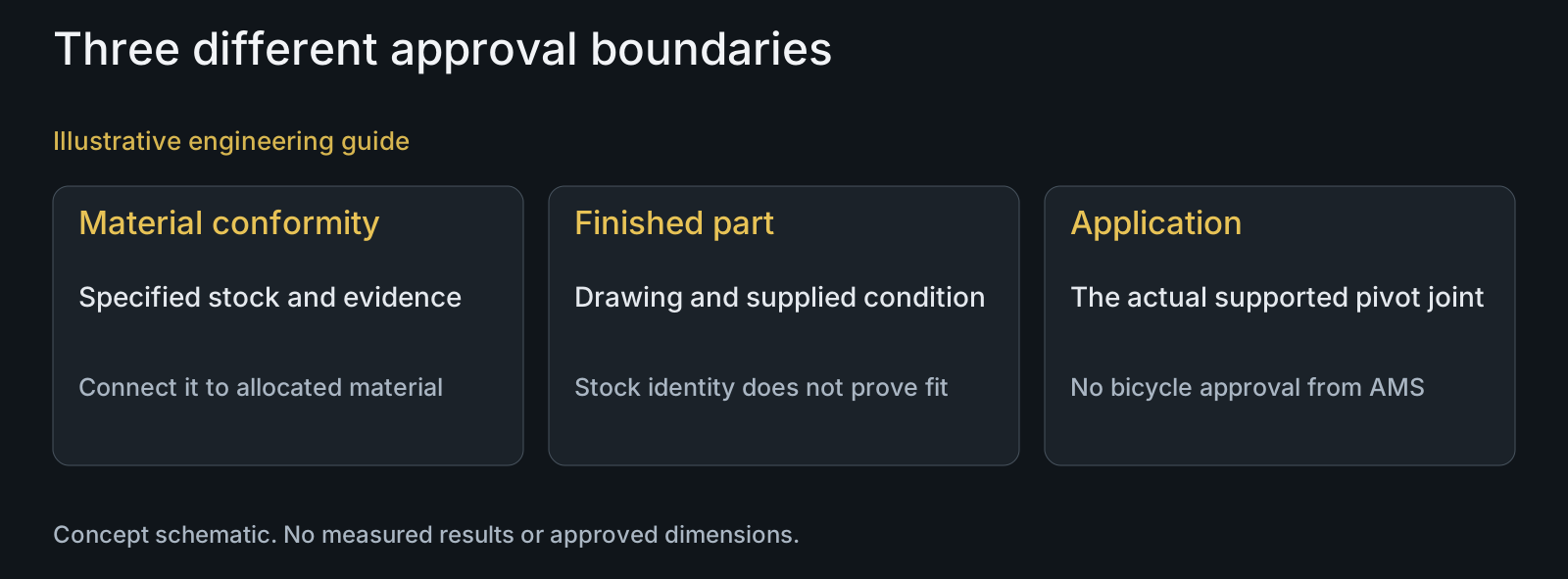
Illustrative review: a Grade 5 stock offer is not an AMS substitution approval
Illustrative engineering example: assume an OEM drawing calls for an identified AMS4928 revision, while a supplier proposes available annealed B348 Grade 5 bar. The proposed stock report names B348 and a material identity; the finished pivot geometry would stay unchanged. No actual report or supplied material is represented here.
The review does not accept or reject the alternative from the two names alone. It compares the actual ordered requirements, identifies missing evidence and asks the responsible engineering and quality team to decide whether the proposal is acceptable. It does not rewrite the report to imply AMS conformity or label the stock dual-certified.
If an alternative is approved, the changed requirement and represented material identity must follow the affected parts. The original finished-drawing and application requirements remain in force unless separately changed. This assumed example demonstrates substitution reasoning, not a verified certificate, accepted batch, purchasing saving or aerospace approval.
Questions buyers need to confirm
Does AMS4928 certify a finished titanium pivot bolt?
No. It is a material specification with defined stock scope. The finished component still needs its drawing and manufacturing requirements, and the bicycle application needs the relevant separate assessment.
Does ASTM B348 automatically mean Grade 5 titanium?
No. Its scope includes multiple grades. Identify the required grade, form, condition and revision; a B348 label without the grade does not complete a pivot material order.
Can B348 Grade 5 be substituted for AMS4928 without approval?
Not automatically. Compare the actual contracted requirements and supplied evidence, then obtain the responsible customer's decision on differences. Similar alloy descriptions do not establish full equivalence.
Can one material report support both specifications?
Only where relevant evidence establishes conformity to both required scopes. Do not add a second designation solely because the material has a familiar alloy name. Identify the actual supplied material and the basis for each claimed conformity.
Does PremFixer provide a 3.1 certificate and heat analysis for every titanium order?
No blanket promise is made here. State the document type, results and stock specification required in the RFQ, and confirm availability and supplied scope. A generic example certificate is not evidence for your allocated material.
What should accompany an AMS4928 or B348 pivot RFQ?
Provide the drawing, ordered material designation and revision, grade, form and condition, required analysis and document scope, quantities and part numbers. Mark any proposed alternative explicitly so material approval and finished-part requirements are not silently combined.
Technical references and scope
SAE International: AMS4928X public scope. October 2025 revision, annealed 6Al-4V title and listed material forms. Public scope only; paid requirements, numerical limits and equivalence not asserted.
ASTM International: B348/B348M-25 public scope. Annealed bars and billets, multiple grades and identified Grade 5 alloy description. Public listing does not prove actual stock conformity or finished-part approval.
Explore related component, material and sourcing decisions in the customer decision knowledge center. For a drawing review, use the Drawing/BOM RFQ path.
Define titanium material and document scope for your pivot order
Send the controlled drawing and BOM, specified material revision, grade, stock form and condition, plus the required document and test-result scope. Identify any proposed substitution and the approval owner. PremFixer will review supply and manufacturing feasibility without treating a material designation as finished-pivot or bicycle certification.
Discuss the drawing and BOM