
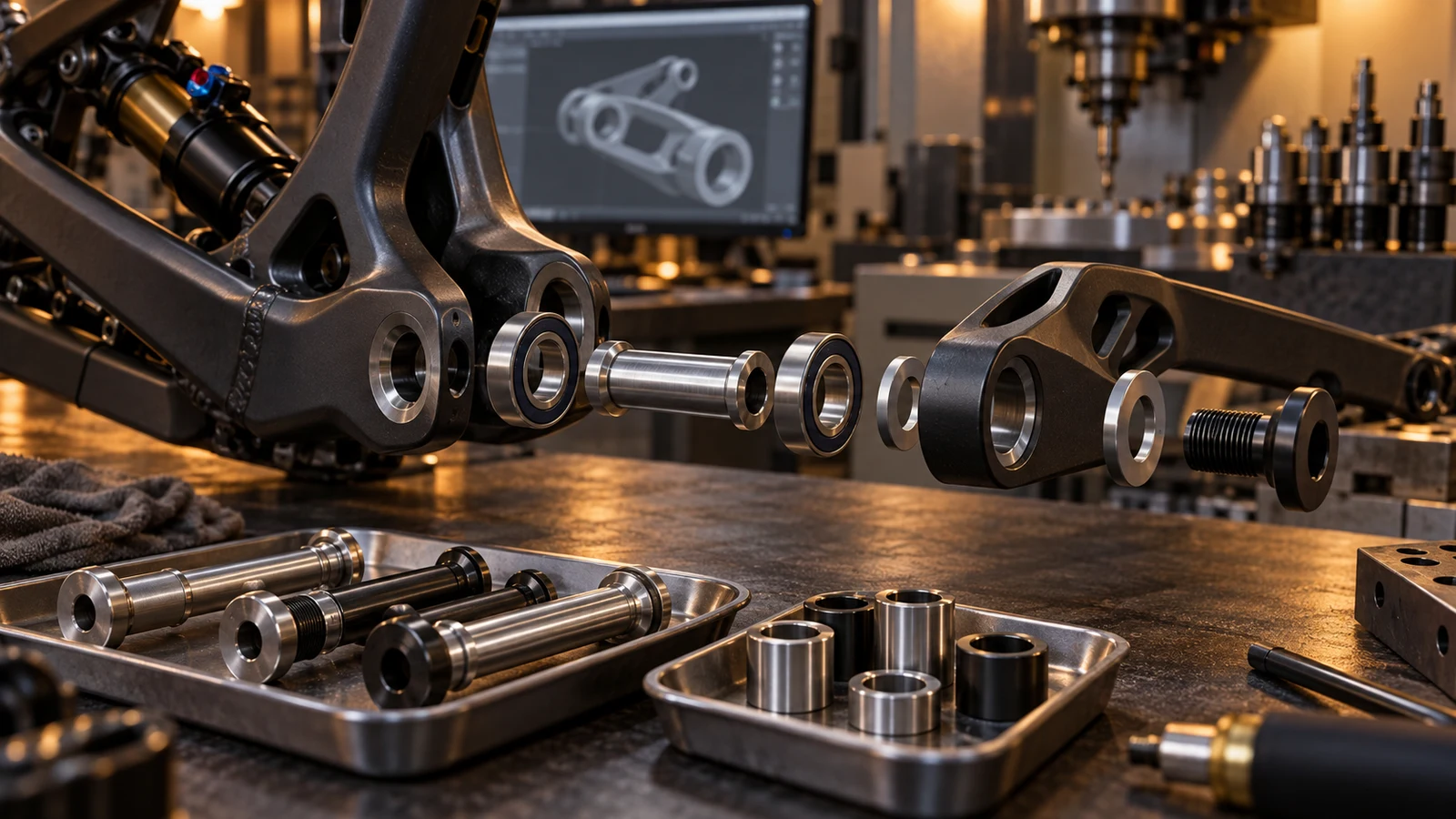
A custom bicycle frame pivot axle order may need much more than a thread size and bolt length. Depending on the architecture, the axle locates bearing or bushing contacts while a separate screw, shoulder or other retention arrangement closes the joint. Define which surfaces establish the pivot axis, which carry clamp force and which permit relative movement. An OEM selecting hardware should supply those relationships with the component drawing and BOM. Ordinary screws are not automatically unsuitable, but their catalog definition may not cover a custom locating surface or spacer stack. Material and tolerance choices follow the actual interface rather than a universal titanium or stainless recommendation.
Hero: concept illustration of example hardware and its application. It is not a factory photograph, tested component or approved production geometry.
Identify the axle function separately from the screw function
Begin with an assembly section and the ordered part numbers. Identify the pivot axis and the surfaces that locate it. Then identify the threaded connection or other mechanism that retains the assembly. One component can perform several tasks, but separate components may also divide them.
The 2023 Trek Fuel EX service manual lists its main pivot axle, sleeve, bearings, screw and shaped washers separately. This is a concrete example of a coordinated hardware architecture, not a universal parts list or approval to reproduce that design for another frame.
Specify the actual interface rather than ordering an unspecified pivot bolt and expecting the supplier to infer the missing members. The full-suspension solution provides the application context; the drawing and BOM must identify exactly what PremFixer is asked to manufacture.
Show the clamp path without confusing it with bearing adjustment
Trace contact from the fastening head or mating shoulder through the represented parts to the receiver. Identify where the contact stack closes and which members it includes. A spacer that transmits clamp load is not necessarily interchangeable with an exterior washer that provides another contact.
Engineering analysis: bolt tension and bearing preload describe different relationships. Depending on the arrangement, clamp force may pass through a defined ring-and-spacer stack; in another design, an adjustment feature may control a bearing condition. The term preload alone leaves those distinctions unresolved.
Do not change a spacer length simply to make the joint feel tighter. First determine whether the complaint concerns axial clearance, relative movement or another contact condition. The stack-up guide explains why individual part conformity does not automatically establish the intended assembly relationship.
| Function or supply choice | Required relationship | Risk of an incomplete order | Useful verification |
|---|---|---|---|
| Axis location | Axle seat and mating bearing or bushing | Thread specification omits locating surface | Size and geometry against named mating features |
| Axial location | Shoulders, sleeves and stack contacts | Parts pass individually but contacts remain undefined | Assembly relationship and component limits |
| Threaded retention | Head contact, receiver and engagement | Visible screw is mistaken for complete pivot | Receiver and clamp-path review |
| Permitted movement | Bearing or bushing arrangement | Tighter feel is treated as universal acceptance | Defined moving and stationary contacts |
| Component-only supply | One drawing and explicit exclusions | Quote is compared with a complete kit | Line-item scope and reference-only parts |
| Coordinated hardware kit | Members, quantities and common revision | Compatible-looking parts are mixed | BOM and explicit compatibility boundary |
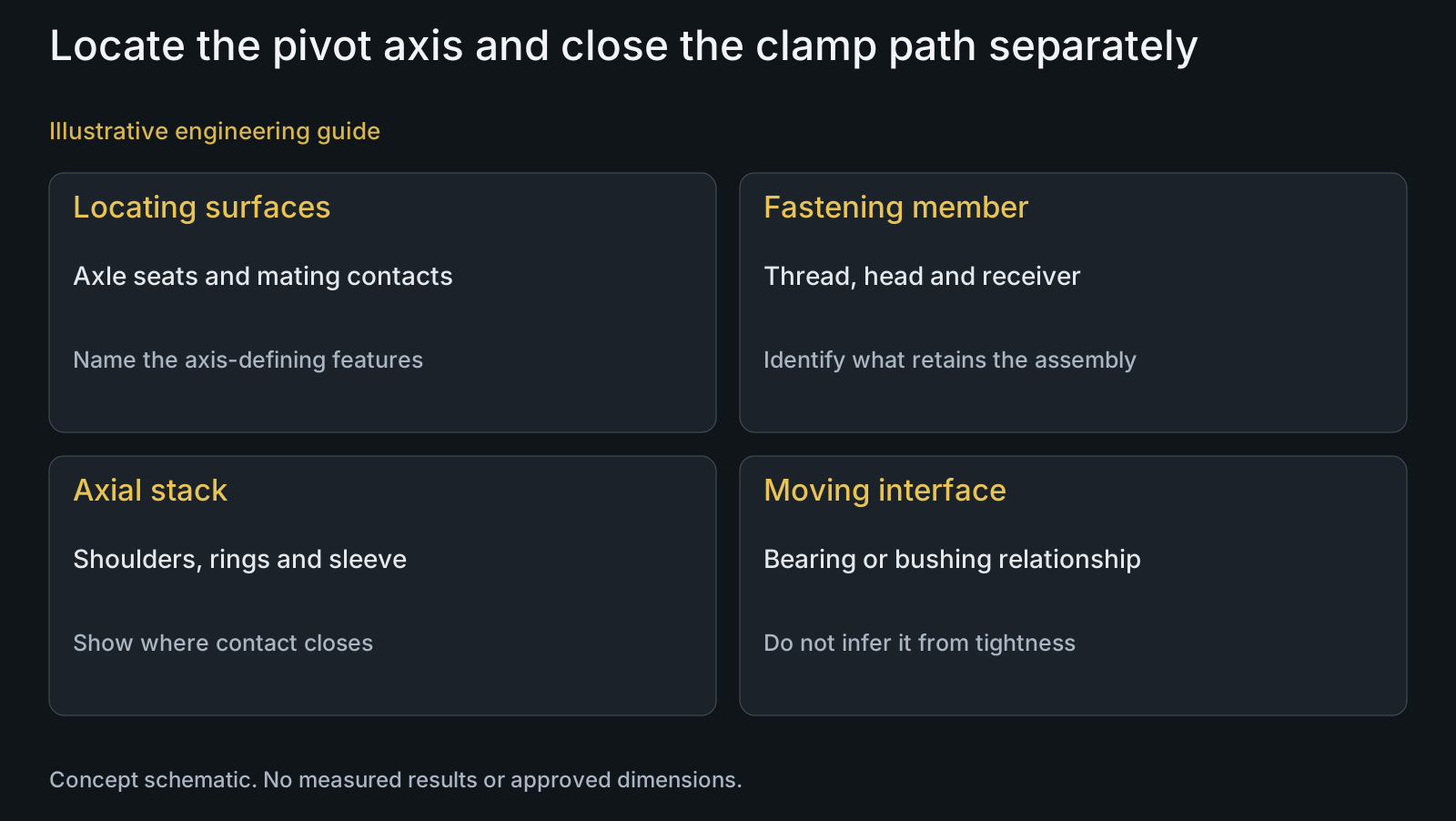
Connect each locating feature to its mating definition
For each axle seat or shoulder, identify the corresponding bearing, bushing, sleeve or frame contact. Include the mating dimensions and applicable fit requirements. A tight tolerance with no identified mating feature gives purchasing a number but leaves its functional purpose unclear.
Distinguish size limits from geometric relationships. Two individually acceptable diameters do not by themselves describe the intended alignment of separated seats or the location of a shoulder face. The fit and datum guide supports that drawing-level review without assigning a universal pivot fit.
State the final material and surface condition in which the feature must conform. Discuss the affected process through CNC turning and surface treatment. If a finish is excluded from a contact or controlled there, make that boundary readable on the part definition.
Compare material candidates after the structural interface is clear
A frame category or the label structural pivot does not specify the force carried by every member. Identify the load path, component geometry, intended environment and acceptance requirements before choosing a material. Do not describe one bolt as carrying the whole frame load without an actual model of that connection.
Titanium, stainless and other materials can be considered against the defined function, but an alloy name is not a finished-component specification. Include required condition, relevant properties, receiver relationship and supplied surface. The material-selection guide addresses that comparison separately from defining the architecture.
Keep a proposed material substitution separate from an approved configuration. A different material may require review of the geometry, assembly condition or evaluation basis; it is not automatically acceptable because the original shape can be machined in it. No fatigue life or frame-system approval is implied by a manufacturability discussion.
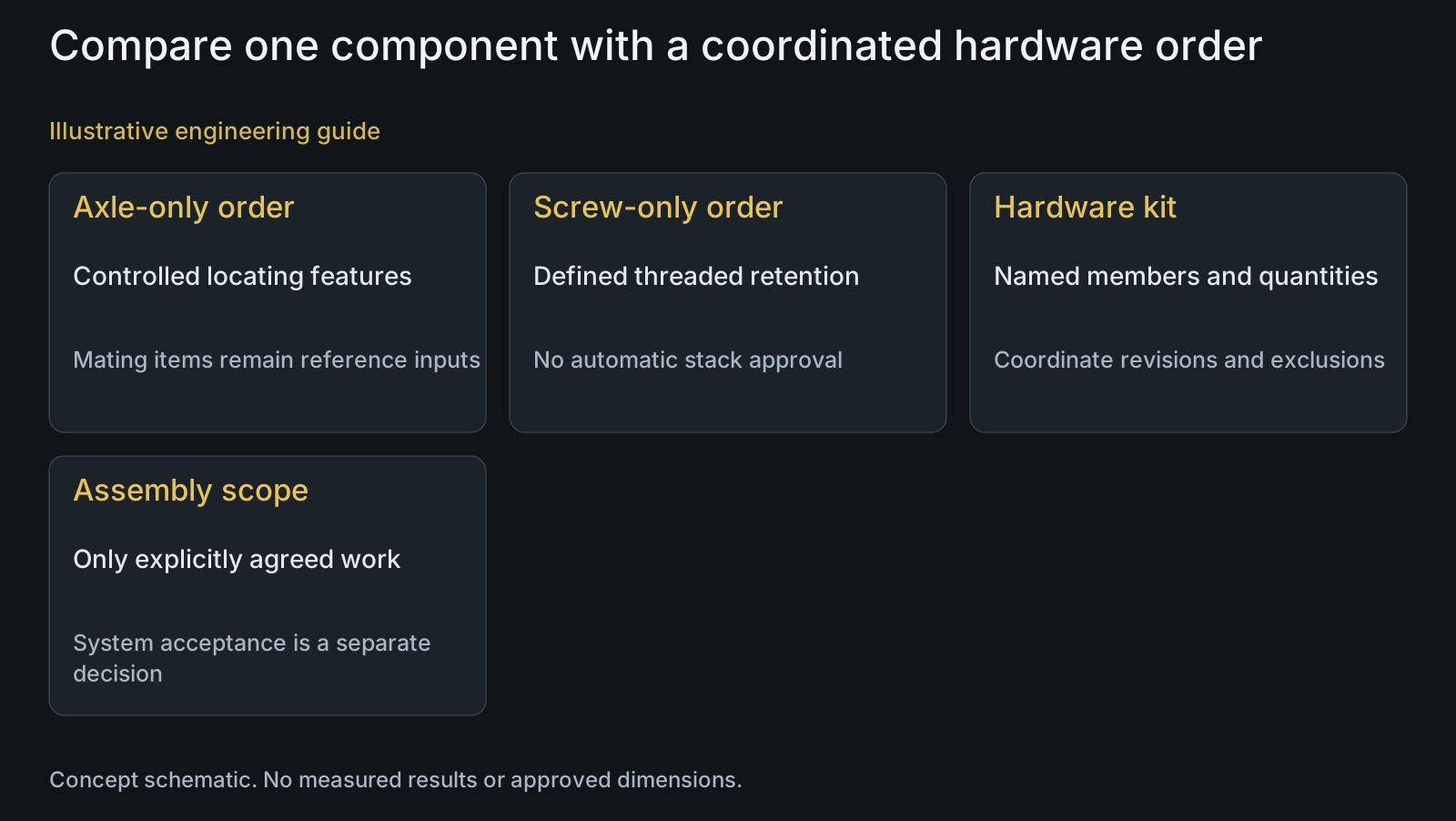
Make a coordinated quote comparable with a component-only quote
List each supplied axle, locking member, sleeve, spacer and washer with its drawing revision and quantity. Also identify bearings or other mating parts that are reference-only or supplied elsewhere. A lower quotation for one screw is not directly comparable with a defined multi-item kit.
State whether parts are supplied individually, grouped by joint, or assembled within an agreed scope. Identify the final characteristics and any represented assembly checks requested. Use manufacturing to discuss the route without turning component inspection into a guarantee of the whole frame's behavior.
For parts shared by more than one frame revision, retain the explicit compatibility boundary. The hardware revision guide separates a common item from an assumed common interface. Equal nominal lengths or a common thread do not approve mixing the surrounding kit members.
Review example: one screw quotation leaves a spacer decision open
Illustrative engineering example: assume an OEM sends a drawing for a retaining screw while its assembly uses a separate axle, two bearing contacts and an internal sleeve. A revision changes the distance between the locating shoulders, but the screw's thread remains unchanged. No dimensions or test outcome are assumed.
The reviewer identifies that the screw drawing does not answer the changed axial-stack question. It requests the axle and sleeve relationship, the mating contacts and the intended assembled state. The quote can still cover only the screw, provided that limited scope is explicit and the unresolved interface is not presented as approved.
If the OEM instead requests coordinated hardware, the RFQ lists the relevant members and their common revision. This makes the compared supply scopes clear while leaving structural design and application acceptance with the responsible product team. The example does not claim a real customer kit or a validated redesign.
Questions buyers need to confirm
Can an ordinary screw be used in a frame pivot?
Possibly, if its complete definition satisfies the specific fastening task. Do not assume every screw is unsuitable or that its thread size defines the axle. Check locating surfaces, head contact, receiver, engagement and the surrounding stack against the actual architecture.
Are bolt preload and bearing preload interchangeable terms?
No. Identify the clamp path and bearing or bushing arrangement. The drawing must show which surfaces transmit force and which permit motion. A specified screw instruction does not by itself define every bearing's preload condition.
Does tighter tolerance always produce a better pivot?
No. Specify limits for named mating features and their required relationships. Size, geometric alignment, final finish and axial stack serve different functions. Tightening an isolated limit without understanding those functions can leave the assembly question unanswered.
Can the spacer be shortened to remove apparent play?
Not as an automatic remedy. Establish where movement occurs and how the spacer participates in the clamp and contact stack. Review the proposed change against the released assembly and required movement before deciding whether any component revision is appropriate.
Must every structural pivot use TC4 or stainless steel?
No universal material rule is established. Compare the actual component geometry, loads, contacts, environment and required final condition. The label structural pivot does not provide an application-specific material approval.
What is needed for a comparable pivot hardware quotation?
Send the part and assembly drawings, STEP or represented samples, bearing or bushing interfaces and receiver definition. List supplied and reference-only parts, BOM revisions, quantities, material condition, finish and requested checks. Distinguish component-only manufacture from a coordinated kit.
Technical references and scope
Trek 2023 Fuel EX service manual, Rev2 October 2023. Main-pivot example lists axle, sleeve, bearings, screw and shaped washers separately. Not a universal architecture, copied part specification or instruction for another frame.
Explore related component, material and sourcing decisions in the customer decision knowledge center. For a drawing review, use the Drawing/BOM RFQ path.
Define the frame pivot interface before quoting the hardware
Share the axle and fastening drawings, assembly section, STEP or represented samples, mating bearing or bushing data and spacer stack. Include the BOM, supplied-item boundary, quantities, final material and finish and relevant instructions. PremFixer can review the locating features and coordinated manufacturing scope without assuming complete-frame design approval.
Discuss the drawing and BOM