

A custom pivot order needs a document package matched to its material, finished-part and receiving requirements. An EN 10204 material document, a certificate of conformity, a first-article inspection report and a chemical declaration describe different subjects. Specify which parts or material lots each covers, who issues it and what information must be reported. Do this in the RFQ so additional testing, witness inspection or special formats are visible in the supply scope. A supplier's quality-system certificate does not accept a particular shipment. The direct question is whether each required claim about the delivered hardware has relevant, identifiable evidence, not how many certificates accompany the box.
Hero: concept illustration of example hardware and its application. It is not a factory photograph, tested component or approved production geometry.
Start from the requirement, then select the document
For material identity, name the specified alloy, condition and product standard. For finished geometry, identify the drawing revision and reported characteristics. For a treatment, state the process and acceptance evidence needed. These are distinct questions even when one supplier coordinates the complete hardware order.
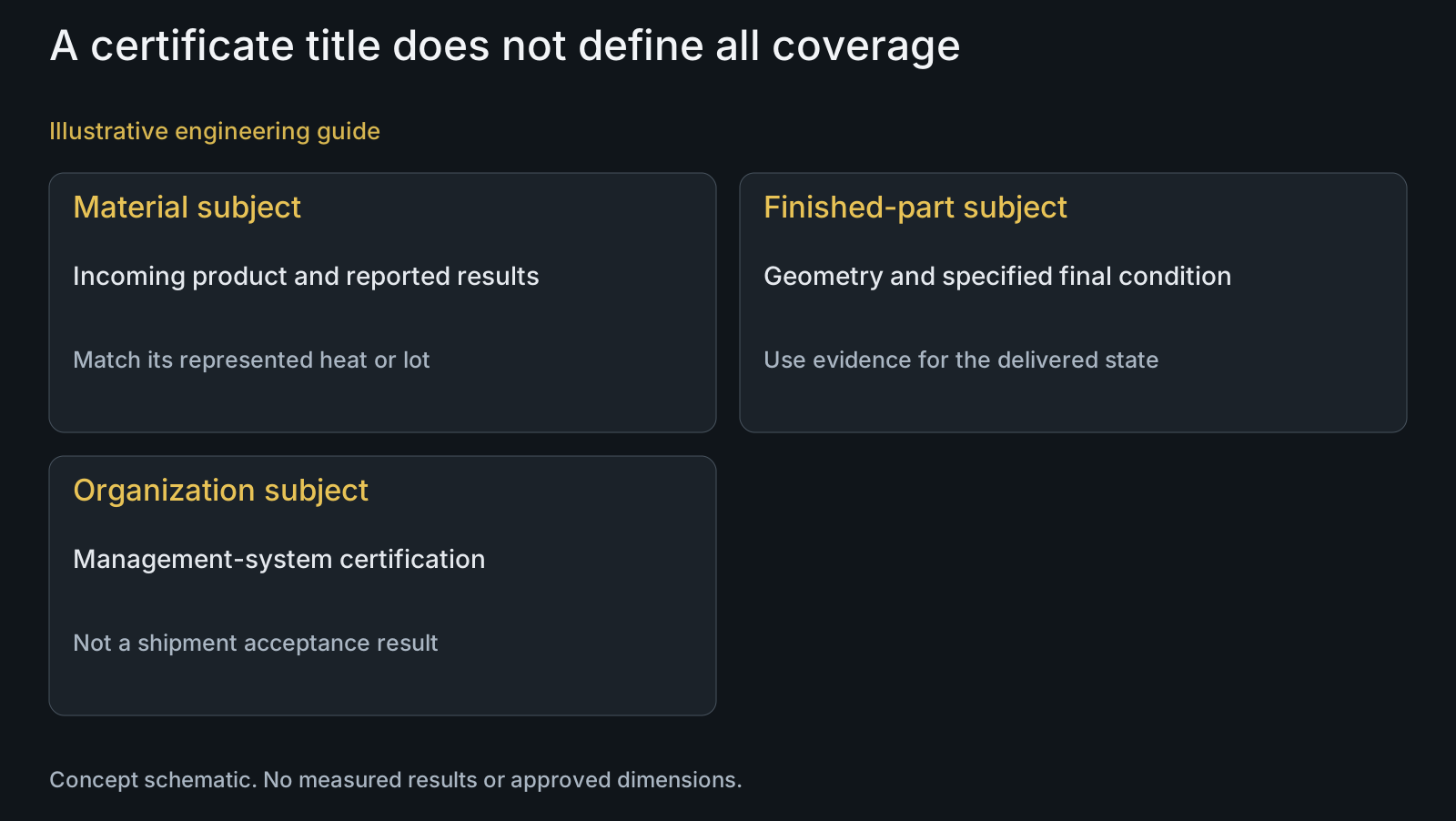
Write the intended subject of each document: incoming bar, heat-treated part, finished pivot, assembled kit or shipping quantity. A report can be genuine yet irrelevant to the supplied state. Check that its specification and represented material or product match the order before treating its results as evidence.
Separate required results from a general statement of conformity. Also state any witness or independent inspection need before production. Such arrangements can affect material sourcing, specimen planning and the schedule; an undefined request for all certificates cannot resolve that scope.
Understand what an EN 10204 material document represents
BSI identifies EN 10204 as a system of inspection-document types used with the product's technical delivery conditions. Select the required type and material scope explicitly instead of using mill test report as a complete specification. Read the applicable grade, condition and reported inspection information, not only the document heading.
Type 3.1 includes specific inspection results with validation by the manufacturer's authorized inspection representative independent of manufacturing. TÜV NORD's explanation distinguishes this from added third-party involvement in type 3.2. A 3.1 heading does not automatically mean an external laboratory certified the finished pivot.
Link the represented material heat or lot to the supplied components through the agreed production records. A material certificate is not a dimensional report, fatigue result or approval of the complete bicycle. The EN 10204 scope guide addresses document-type differences in more detail.
| Document | Question it supports | Do not infer | Identity or scope to check |
|---|---|---|---|
| Material inspection certificate | Specified material and reported inspection results | Finished geometry or bicycle approval | Product standard, condition and represented heat or lot |
| Certificate of conformity | Issuer's declaration against named supply requirements | Every measured result without its stated scope | Item, revision, order and declared requirements |
| First-article report | Evaluation of identified sample characteristics | All later batches or automatic aerospace conformity | Sample, drawing, coverage and process state |
| Batch inspection report | Specified checks on identified supply specimens | Unstated full-population testing | Lot, sampling scope, method and acceptance criteria |
| Process or treatment record | Evidence for a specified manufacturing state | Unrelated final-part performance | Affected parts, process requirement and linked results |
| Chemical declaration or report | Named substance or regulatory information | Every market-access obligation | Article, finish, date and assessment basis |
| Management-system certificate | Defined organizational system certification | Acceptance of a particular hardware shipment | Organization, scope and certificate record |
Keep CoC, first-article and batch inspection evidence distinct
A requested certificate of conformity should identify the supplied item, revision, order or lot, and requirements being declared. Agree its issuer and wording. If measured results are required, specify them separately; do not infer a complete dimensional dataset or every test result from the title CoC.
A first-article report should connect the identified sample and drawing characteristics to the reported evaluation. Define whether all or selected features are included and what processing state is represented. A project-specific first-article report is not automatically compliance with an aerospace FAI standard or approval of every subsequent lot.
For batch acceptance, state the inspection scope, sample identity, selected characteristics and applicable criteria. A sample measurement and a shipment-wide declaration support different conclusions. The final inspection guide helps define coverage without assuming every method is performed on every part.
Define chemical information for the actual material and application
The European Commission describes RoHS in relation to electrical and electronic equipment. Establish the customer's actual application and requested component evidence rather than claim that every bicycle bolt requires one identical standalone RoHS certificate. Legal applicability and any exemption decision belong to the responsible product-compliance assessment.
ECHA explains that Candidate List substances in articles can trigger obligations for relevant supply-chain actors. For a requested REACH-related declaration, identify the article, material and finish, the assessment date and the requirements addressed. A statement without that basis should not be promoted as unrestricted compliance with every provision of REACH.
Include specified surface systems and other supplied materials where they affect the declared scope. A base-alloy analysis does not necessarily describe a later coating or compound. Require a declaration, analytical report or other evidence appropriate to the question; one selected test cannot establish every chemical requirement.
Reconcile the document package with the delivered kit
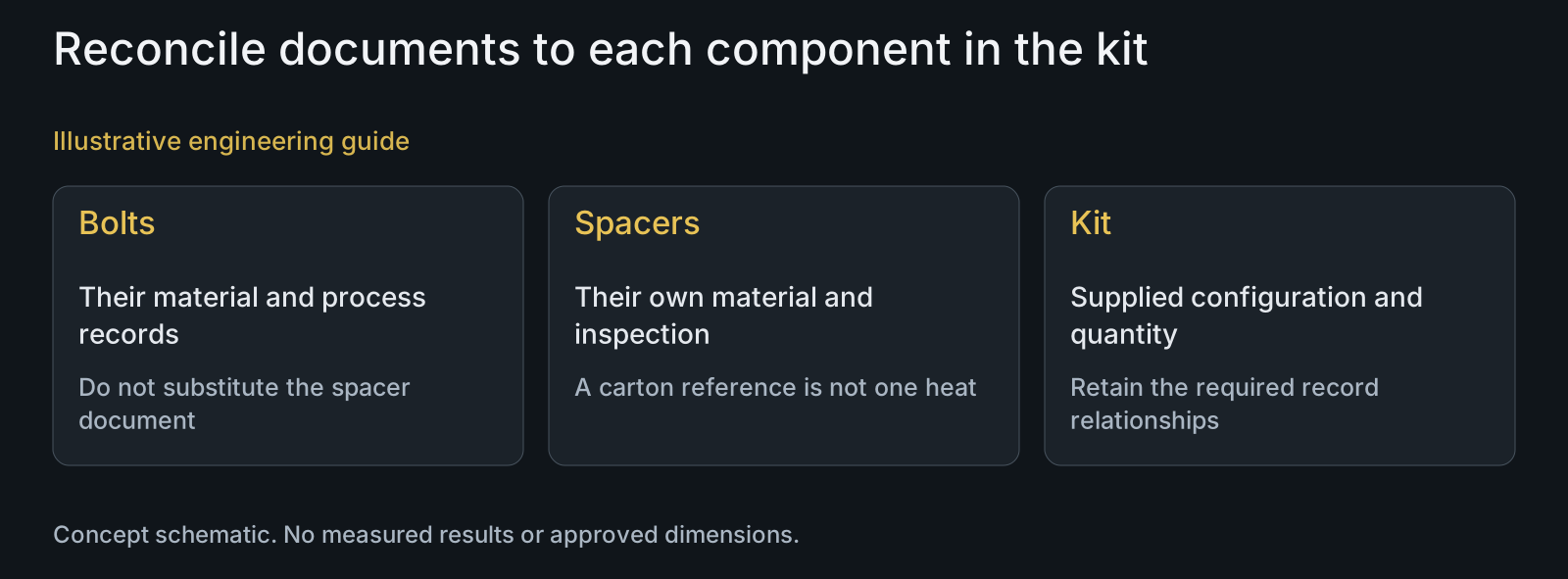
Create a concise relationship between kit identity, constituent part numbers and the relevant material, manufacturing or inspection lots. If bolts and spacers use different materials, their material documents must remain distinguishable. Do not let a common carton reference imply one common material heat.
State the delivery stage, language, file format and required report identifiers in the quotation. When a record is unavailable, identify the missing evidence and its consequence rather than substitute an unrelated document. Special reports or additional tests need an agreed provider, scope and timing.
Use the quality-system certificate page for its organization and management-system scope, not as a shipment release record. PremFixer coordinates material, manufacturing and qualified partner services against the agreed order. No universal availability of every certificate or test is asserted here.
Review example: material evidence does not cover a later treatment
Illustrative engineering example: assume an order contains steel pivot bolts and aluminum spacers. The buyer receives a material document for the bolt stock and a dimensional report for a sample. The final bolts also require a specified heat treatment and surface finish. No real certificate, chemistry value or project outcome is assumed.
The reviewer asks which evidence describes the required final bolt condition and which document covers the spacer material. The sample report is checked for drawing revision and process state. Neither the stock certificate nor a supplier's system certificate closes those separate gaps automatically.
The order's document matrix is revised to show the appropriate treatment, final inspection and material relationships. The useful outcome is a clear coverage decision and explicit missing evidence, not a larger folder of documents that do not represent the supplied kit.
Questions buyers need to confirm
Is EN 10204 type 3.1 always third-party certification?
No. It concerns specific inspection results validated by an authorized manufacturer representative independent of manufacturing. Identify the actual represented product and order requirements. Do not relabel it as an external certification of every finished-component property.
Does a stock certificate prove the final pivot condition?
Not every final requirement. Check later heat treatment, surface processing and finished-part acceptance. The stock document can support its represented material scope, while the specified delivered condition may require separate linked evidence.
Does a CoC replace a dimensional report?
Not when measured results are required. Agree what the declaration covers and specify the dimensional characteristics, sample or lot and process state separately. The document title alone does not establish measurement coverage.
Is a first-article report a certificate for every batch?
No. It represents a defined sample and evaluation scope. Specify subsequent batch acceptance separately. If a named FAI standard is required, agree that requirement and provider rather than assume any sample report complies.
Can we request RoHS and REACH information for a coated part?
Yes, as a clearly defined document requirement. Identify the article, substrate, finish, intended application, relevant requirements and assessment date. The responsible compliance team determines applicability; a bare-metal report does not automatically cover every added material.
What should the RFQ document list contain?
Name each document, issuer or validation role, represented item or material lot, required results, format and delivery stage. Connect it to the drawing and purchase requirement. Make extra tests or witness arrangements visible before assuming they are included.
Technical references and scope
BSI EN 10204 public document scope. Inspection-document types and technical delivery conditions; no blanket legal obligation for every pivot inferred.
TÜV NORD explanation of EN 10204 document types. Manufacturer inspection role for type 3.1 and distinction from added third-party involvement. Marketing guarantees and universal trade acceptance not adopted.
European Commission RoHS overview. Electrical and electronic equipment scope; no case-specific exemption, legal determination or universal bolt certificate asserted.
ECHA Candidate List substances in articles. Primary indexed overview of possible article and supply-chain obligations. No current substance count, threshold calculation or full regulatory conformity inferred.
Explore related component, material and sourcing decisions in the customer decision knowledge center. For a drawing review, use the Drawing/BOM RFQ path.
Request evidence that matches your supplied configuration
Send the drawing and kit BOM with specified alloys, final treatments, required material-document type, CoC wording, inspection coverage and applicable chemical-information request. Identify issuer, lot relationships and delivery stage so the review can distinguish available records from additional agreed evidence.
Discuss the drawing and BOM