
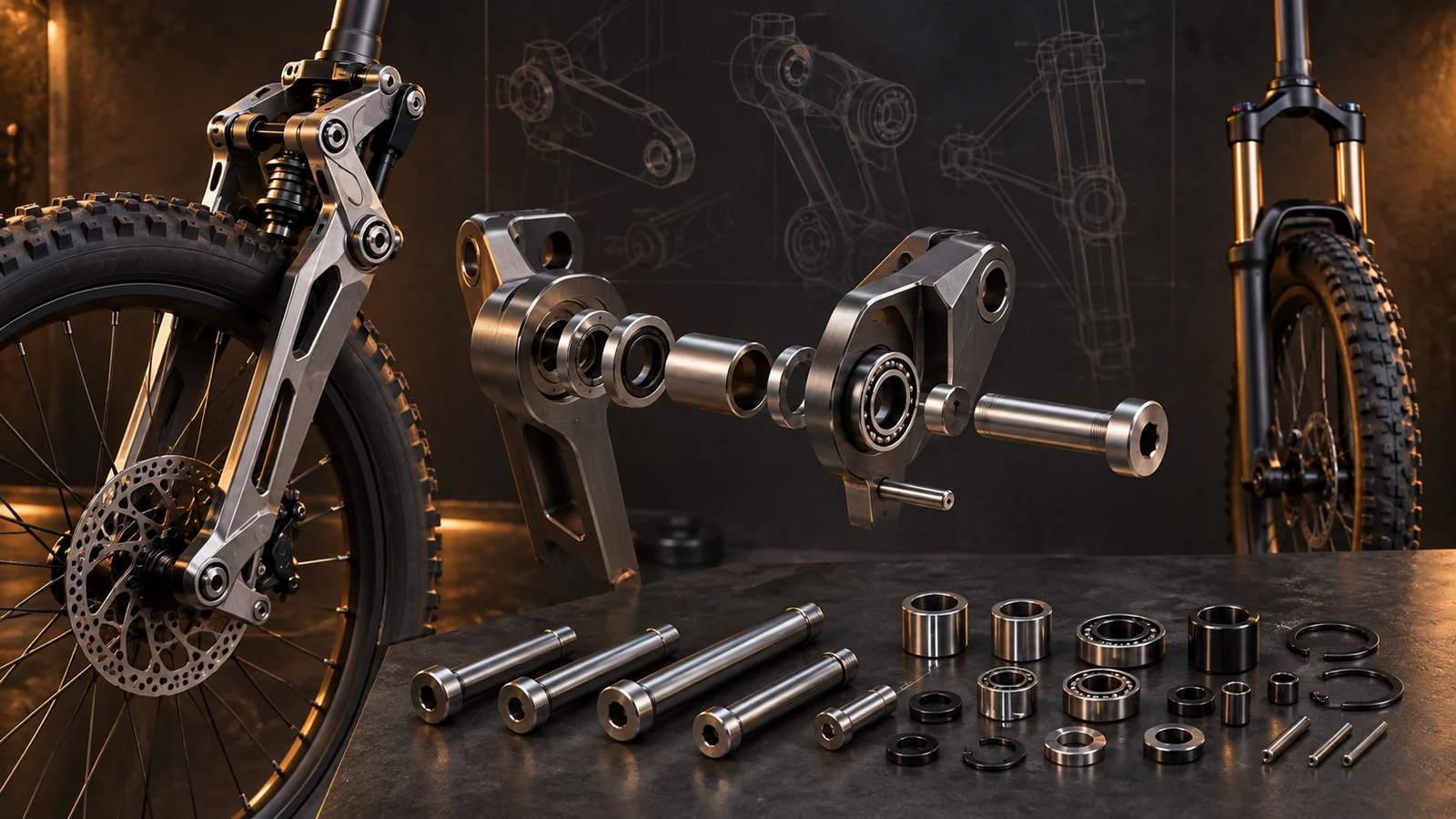
Linkage-fork pivot hardware is not a universal category of bicycle fork bolt. First confirm the front-suspension architecture and identify the moving connection, its bearings or bushes, locating geometry and retention. Keep it distinct from the steerer, headset, wheel axle and other mounting fasteners. Different locations can require different components and instructions even within one fork. Material selection follows the represented interface and relevant load cases, not a blanket recommendation for high-strength steel or titanium. PremFixer can review drawing-defined components; replacement compatibility, installation and complete-fork validation remain controlled by the applicable manufacturer or responsible product team.
Hero: concept illustration of example hardware and its application. It is not a factory photograph, tested component or approved production geometry.
Identify the fork architecture and actual connection
A linkage front-suspension mechanism and a conventional telescopic mechanism do not use the same component map. Show the represented assembly and identify where articulation occurs. Do not label an axle, lower attachment or steering clamp a linkage pivot merely because it belongs to the fork.
Locate the component by function and part identity: a shaft through a linkage, a retaining screw, a suspension-element connection or a separate wheel interface. Include the model or development revision. An isolated sample without its location can leave the supplier reviewing the wrong manufacturing scope.
Use an assembly view or installed photographs to connect the sample to its mating components. A whole-fork photograph can clarify architecture, but it cannot establish hidden dimensions, material condition or interchangeability. Keep visible observation separate from the specified part definition.
Separate movement, location and retention
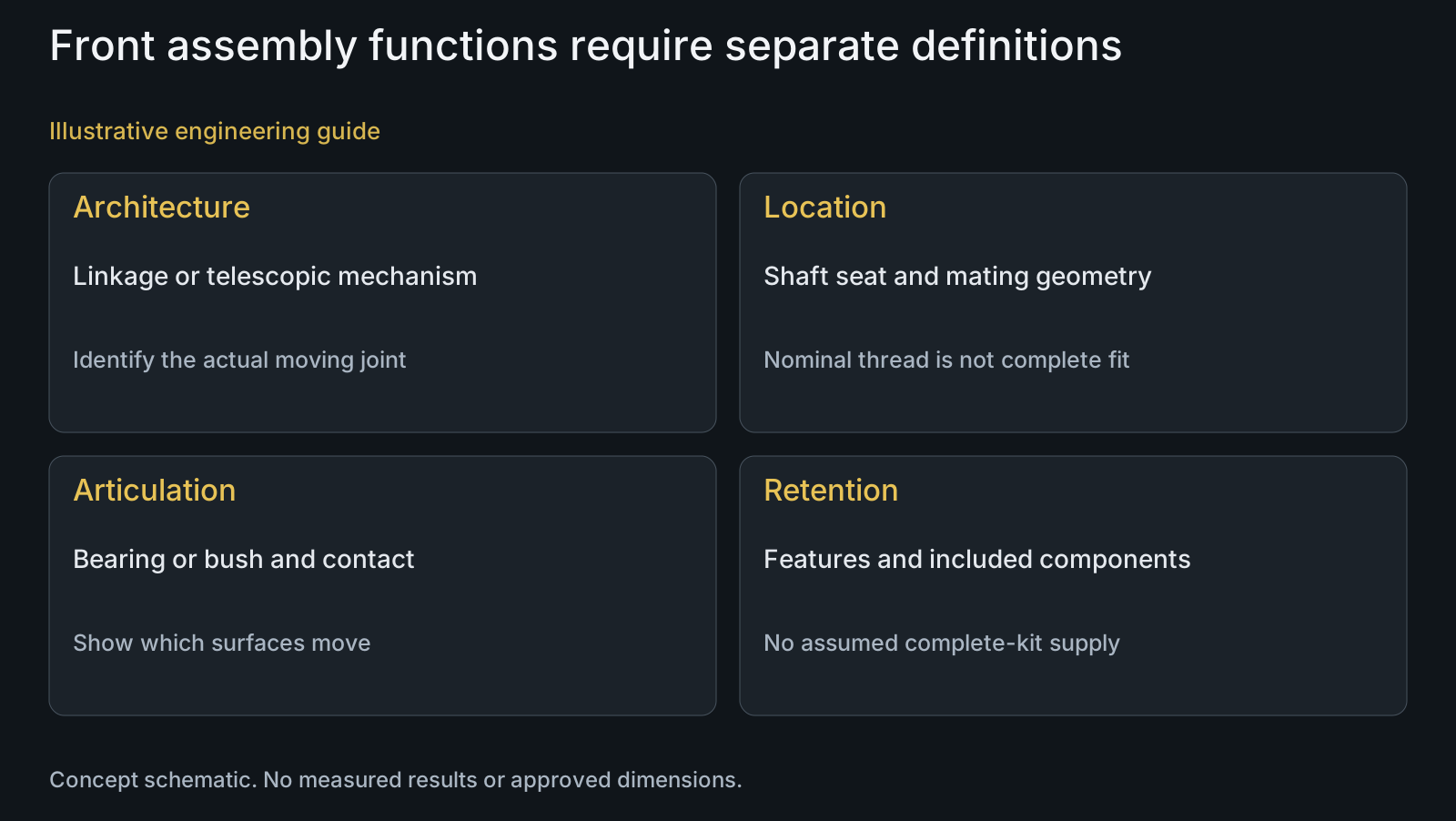
Mark which surfaces move relative to each other and which surfaces locate the shaft or bearing. Then identify how the component is retained. These tasks may involve different features or separate parts; the thread is not automatically the entire retention definition.
The Trust Performance owner's guide, preserved by its distributor, distinguishes suspension and shock/spring pivots and describes separate pivot fixing pins. It is an archival manufacturer-document example of architecture-specific requirements, not evidence that another fork uses the same parts or that a current replacement is available.
Engineering analysis: ensure the supplied BOM covers the function assigned to each component. A quotation for a shaft should not imply that an omitted retainer or mating sleeve is included. Describe complete-kit supply and individual components explicitly through custom manufacturing solutions.
| Identified function | Component question | Risk | Review basis |
|---|---|---|---|
| Linkage articulation | Moving contact and support arrangement | Generic fork bolt used for a proprietary joint | Assembly geometry and component identity |
| Suspension-element attachment | Its own mount and mating parts | Copying a neighboring linkage instruction | Applicable location and manufacturer definition |
| Shaft location | Finished seat, shoulders and stack | Nominal thread treated as complete fit | Feature limits and mating geometry |
| Component retention | Included retaining features and parts | Assuming shaft supply covers the complete kit | Defined BOM and replacement scope |
| Steering or wheel interface | Different connection function | Calling every front fastener a pivot | Actual architecture and instruction |
| Alternative material | Specified condition under represented duty | Category-wide steel or titanium recommendation | Candidate definition and applicable validation |
Connect front-end load cases to the represented pivot
Front-end operation includes different loading situations, but those situations are not automatically the same force at every linkage joint. Ask the responsible product team to identify the applicable braking, suspension and steering-related cases and how the represented structure transmits them.
Record support geometry, offsets, bearing or bush arrangement and relevant moving clearance. Identify the shaft region and adjoining components the assessment covers. Do not convert an application phrase such as steering plus impact into a universal alloy recommendation.
Compare material, section and support candidates against the same defined input. If interface loads or validation requirements are not yet established, preserve that limitation. A manufacturability response can still identify feature and process questions without claiming a completed structural evaluation.
Specify the final geometry and surface at each function
Distinguish the locating shaft region from thread, shoulder transition and clearance features. Show the final surfaces and relevant mating edges. A transition that clears one sleeve may not clear another, so keep any proposed fillet or chamfer with the represented stack.
Material requirements should include the specified condition rather than an alloy label alone. Surface requirements belong to the feature they affect: a bearing seat, moving contact or fastening region can present different questions. Do not describe corrosion resistance as complete evidence of fork suitability.
Connect the enquiry to materials, CNC turning and surface treatment. The fit-drawing guide helps distinguish nominal dimensions from the actual final-interface definition. No universal fit or radius is assigned here.
Treat service replacement as a separate approval question
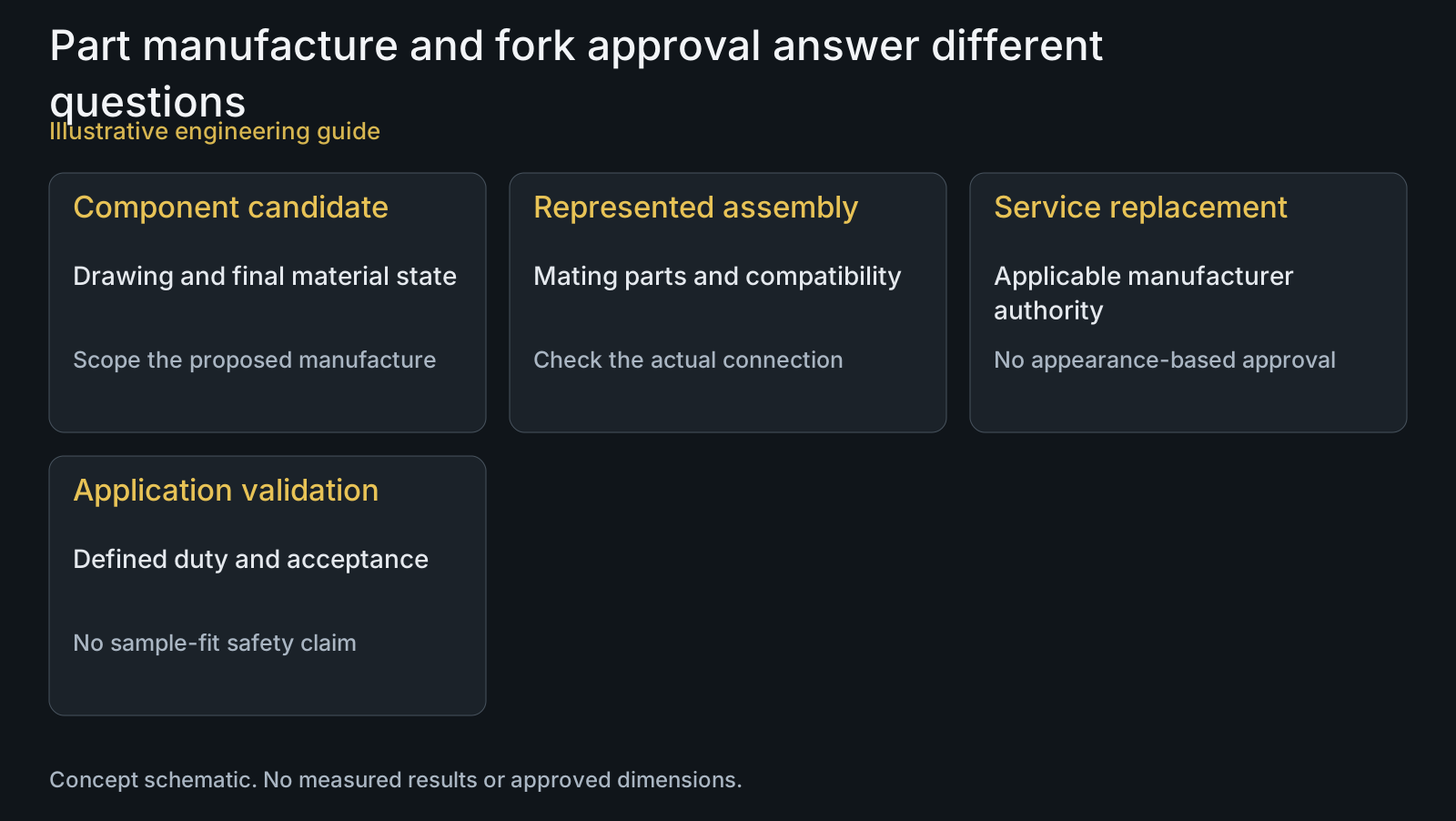
For an existing fork, identify the applicable manufacturer instruction and permitted replacement scope. A custom drawing or dimensional match does not itself authorize altering a proprietary front-suspension assembly. Refer installation and condition concerns to the responsible qualified service or product authority.
For OEM development, identify which components and assembly relationships the sample is intended to evaluate. Feature conformity, assembly movement and application performance need separate conclusions. A sample that fits is not automatically a validated front-fork design.
Keep any revised component's identity and compatibility explicit. The revision guide addresses why similar appearance is insufficient when mating definitions change. Do not borrow rear-linkage torque or service instructions simply because a shaft has the same nominal thread.
Review example: shaft sample without its retaining scope
Illustrative engineering example: assume a development team sends a linkage-fork shaft sample and requests an alternative material. The initial enquiry lacks the assembly view and full mating BOM. No real project, installation or test result is represented.
The reviewer asks where the shaft belongs, which surfaces locate or move and what retains it. The completed description distinguishes the shaft from its mating sleeve and retaining component. It also identifies the applicable material condition and final surfaces rather than choosing an alloy from the fork name.
The quotation can now distinguish individual shaft manufacture from the represented kit, with assembly and validation questions still visible. This does not prove that an alternative material is suitable. It prevents a part-only enquiry from silently claiming a complete and approved fork connection.
Questions buyers need to confirm
Does every bicycle fork use linkage pivot bolts?
No. Identify whether the mechanism uses linkage articulation and locate the actual connection. Steering, wheel attachment and telescopic-fork fasteners are different functions. Do not specify a generic pivot merely from the fork label.
Can one material recommendation cover all linkage-fork pivots?
No. Specify the represented joint, support, mating parts, load cases and material condition. Separate geometry and surface candidates from an alloy-only change. A category-wide steel or titanium preference does not establish application suitability.
Why request the complete mating BOM with a shaft sample?
It identifies what locates, moves and retains the shaft and what the supplied kit includes. A sample alone may not describe separate mating or retention components. Keep individual manufacture and complete-connection supply explicit.
Can rear-suspension torque be reused for a front linkage?
Not by assumption. Use the applicable instruction for the actual fork connection, hardware and preparation. Equal nominal threads do not establish the same receiver, clamp arrangement or installation condition.
Does a sample that fits approve a replacement fork pivot?
No. It can support a defined fit observation, but it does not authorize proprietary assembly changes or establish application performance. Confirm compatibility and permitted service scope with the responsible manufacturer or technical authority.
What should a linkage-fork hardware RFQ include?
Send the architecture and joint location, component and assembly drawings, STEP model or represented samples, complete mating BOM and quantities. Identify locating and moving surfaces, retention, specified material and finish, applicable instructions and available load or validation requirements.
Technical references and scope
Trust Performance Front Suspension Owner's Guide, distributor-preserved copy. Archival manufacturer example distinguishing pivot types and separate retention components. No current availability, universal parts or installation values inferred.
Explore related component, material and sourcing decisions in the customer decision knowledge center. For a drawing review, use the Drawing/BOM RFQ path.
Define the linkage-fork connection before selecting a component
Send the fork architecture, joint location, assembly and component drawings or represented samples, STEP data, mating BOM and quantities. Identify locating, moving and retention functions with material, finish and applicable instructions. PremFixer can review manufacturable hardware and kit scope while compatibility, service authorization and complete-fork validation remain explicit.
Discuss the drawing and BOM