
Choose neutral salt spray or cyclic corrosion for custom pivot hardware according to the exposure question and the requirement the result must support. Continuous fog can provide a controlled comparison under a specified procedure. A defined cyclic method can add environmental stages relevant to a different investigation, but its name does not establish field realism for every bicycle joint. For an OEM comparing finishes, identify the material, delivered surface, test object, sequence and assessed endpoint first. Equal elapsed hours in two methods are not equivalent exposure histories. Neither method automatically determines a riding-life guarantee, a universal test duration or approval of unrepresented mating components.
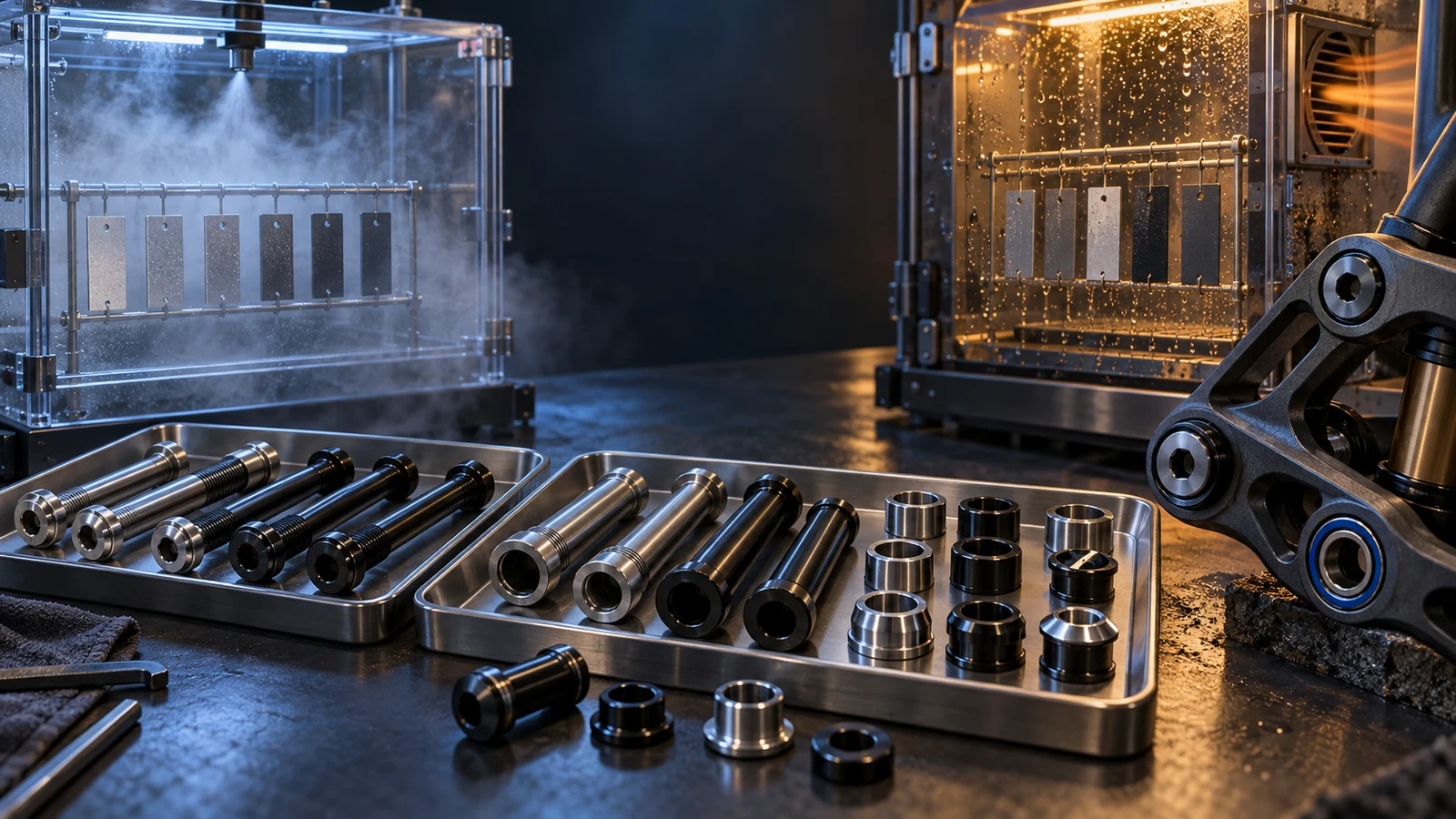
Hero: concept illustration of example hardware and its application. It is not a factory photograph, tested component or approved production geometry.
Identify whether the task is acceptance, comparison or investigation
A shipment acceptance requirement may already name the procedure and criterion. Follow that scope or agree a change; a supplier should not substitute a preferred cyclic test simply because it sounds more realistic. A finish-development comparison instead needs controlled alternatives and an endpoint that distinguishes the proposed systems. A service investigation needs an exposure hypothesis connected to the observed location and conditions.
For a pivot, state whether the question concerns a plated axle surface, an anodized spacer, a threaded receiver contact or an assembled mixed-material joint. These are different subjects. The anti-corrosion solution review can connect the required finish and interface to manufacturing scope without promising that one test represents every bicycle environment.
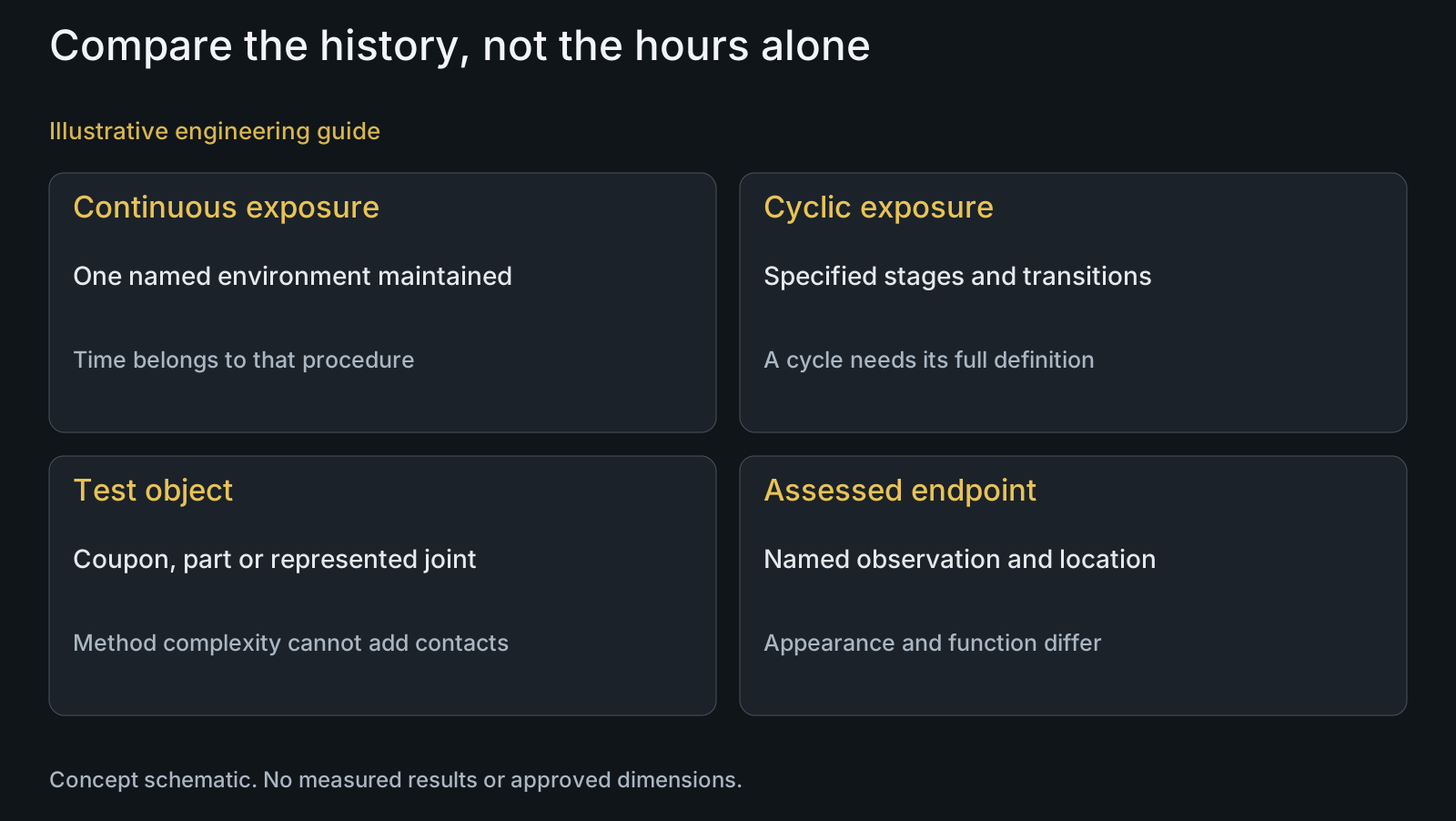
Continuous fog and cyclic exposure have different histories
Q-Lab's corrosion introduction distinguishes continuous salt-fog exposure from methods incorporating drying, humidity and controlled transitions. The important difference is the specified environmental history, not simply a more complicated chamber. An intended dry phase should be identified as part of the method; a pause in spraying is not automatically equivalent to a defined dry-off stage.
When reviewing alternatives, list solution, environmental stages, transition conditions and specimen handling. Changing several of these at once can change the question being tested. Do not attribute a different observed outcome solely to wet/dry cycling when the electrolyte or specimen condition also changed. If the aim is to understand one change, keep other relevant variables controlled or explain why they differ.
| Question | Useful comparison basis | Main interpretation risk | Verification focus |
|---|---|---|---|
| Meet a named order requirement | Required method and endpoint | Substituting another test without agreement | Match edition, specimen and criterion |
| Compare two finishes | Controlled specimen and exposure | Changing electrolyte and geometry as well | Identify held and changed variables |
| Study wet/dry exposure | Defined environmental stages | Treating a spray pause as a dry phase | Specify sequence and transitions |
| Request G85 testing | Selected annex and conditions | Assuming every G85 variant is cyclic | Name the exact modification |
| Investigate receiver contact | Represented assembled interface | Using an isolated axle as the whole joint | Review mating materials and assessed region |
| Interpret elapsed hours | Report tied to its exposure history | Equal hours treated as equal dose or life | Keep method and conclusion explicit |
ASTM G85 does not identify one universal cyclic test
ASTM G85 describes several modified salt-spray methods. Its public scope distinguishes a continuous acidified method from multiple cyclic variants, including dilute-electrolyte fog/dry exposure. Therefore a purchase-order request for G85 cyclic testing is incomplete without the selected annex or otherwise defined method and edition.
The public scope also leaves product-specific method selection, specimens, exposure periods and interpretation to the relevant requirements. Do not assume the acidified seawater variant, a fog/dry variant and a humidity-based OEM cycle are interchangeable. The laboratory and engineering team must identify which sequence is proposed and what decision it is meant to inform.
Likewise, ASTM B117 describes a salt-fog environment rather than setting one exposure period and acceptance interpretation for every product. A method designation needs a separate project criterion. The framework's suggested 500-hour duration is not a demonstrated PremFixer result or an automatic requirement for every pivot.
Match the specimen and observation to the relevant interface
If comparing a finish, identify substrate, coating system, initial surface and any intentionally introduced damage. If investigating a joint contact, define the mating materials, geometry and assembled condition. A coupon omitting a receiver or trapped-moisture region cannot answer every contact question. A more complex exposure cannot restore a missing specimen feature.
Name the observation and its location. Surface appearance, coating deterioration, substrate attack and post-exposure joint function are not one common pass label. Where appropriate, agree assessment of hidden contact regions and a separate functional evaluation. Explain specimen preparation and any cleaning or disassembly used for assessment so observations remain interpretable.
The titanium salt-exposure guide discusses the difference between a requested duration and an actual result. This comparison concerns selection of the exposure history; it does not establish a completed salt-spray test for titanium or any other PremFixer component.
Illustrative review: two finishes, unequal test proposals
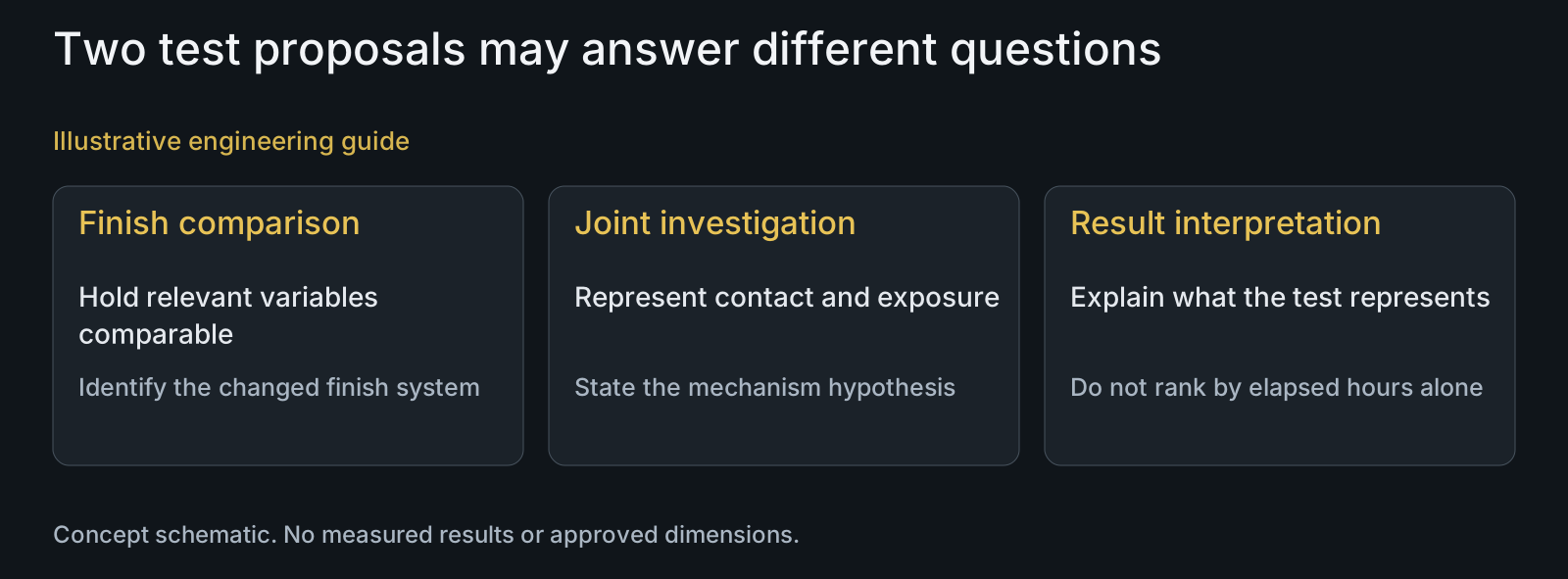
Illustrative engineering example: assume an OEM is considering two finish systems for a pivot axle and its receiver interface. One proposed evaluation uses isolated axles in continuous neutral fog. Another uses assembled specimens in a defined wet/dry sequence. No observations or test outcomes are assumed. The proposals differ in both exposure and specimen, so they cannot isolate a finish-system difference merely by using the same elapsed duration.
For a controlled finish comparison, agree comparable specimen definitions and a common exposure basis. For a joint investigation, choose a represented contact configuration and sequence relevant to the exposure hypothesis, while acknowledging what remains unrepresented. These may be separate tests because they answer separate questions; there is no obligation to force both into one headline ranking.
If later reports differ, first check the assessed region, specimen state and environmental history. Do not conclude that the finish with more recorded hours is universally superior. A meaningful conclusion states the represented comparison and the purchasing or design decision it supports, without inventing a field-life multiplier.
Specify a corrosion review that a supplier can quote
Provide the material and finish callouts, application contacts, proposed procedure and edition, specimen definition and evaluation criterion. If the sequence is still undecided, identify the engineering question and candidate methods. Include required reports, specimen quantities and any post-exposure function in the manufacturing discussion; testing arrangements and availability require project confirmation.
PremFixer's confirmed model includes qualified partners for testing and surface treatment. It does not establish ownership of a corrosion chamber or a universal passed exposure. Agree the actual scope instead of interpreting an equipment illustration or a coating description as completed evidence. Keep any service-life claim separate and supported by the appropriate application evidence.
Questions buyers need to confirm
Is cyclic corrosion always better than neutral salt spray?
No. Select the defined exposure that answers the requirement or investigation. A specified cyclic method can include relevant environmental stages, but additional complexity alone does not validate its relationship to every riding environment. State the purpose, specimen and endpoint before choosing.
Is ASTM G85 a single wet/dry test?
No. It covers several modified salt-spray methods, including a continuous variant and different cyclic variants. Identify the selected annex or method, edition and project interpretation. The designation alone does not settle a test sequence or duration.
Can two methods be compared using equal hours?
Equal elapsed time does not make the environmental histories equivalent. Identify wet, dry and other stages, solution and specimen state. Interpret each result within its procedure or design a justified common comparison; do not rank finishes from elapsed hours alone.
Is 500 hours the required duration for all pivot bolts?
No universal requirement or PremFixer result is established. The applicable product or project requirement must define duration or cycles and the acceptance observations. If no criterion exists, define the intended engineering comparison rather than choosing a familiar number as proof of durability.
Does an isolated axle test cover the aluminum receiver?
Not when that mating component and contact are absent from the specimen. Supply the actual materials, contact geometry and assembled condition if the receiver is part of the question. Identify which regions will be assessed and any post-exposure function separately.
Can cyclic exposure predict a number of years in bicycle use?
Not through a universal conversion. The selected method is still a bounded laboratory exposure, and service includes conditions it may not represent. Support any field-life conclusion with appropriate application evidence rather than a larger hour count or the cyclic label.
Technical references and scope
ASTM B117, Salt spray apparatus practice. Official public exposure-practice and product-interpretation boundaries. Use the edition required by the applicable order; no paid recipe reproduced.
ASTM G85-19, Modified salt spray testing. Official public distinction between modified methods and product-specific selection, duration and interpretation.
Q-Lab, Introduction to corrosion testing. Manufacturer explanation of continuous exposure, environmental stages and transitions. No chamber ownership or universal field correlation attributed to PremFixer.
Explore related component, material and sourcing decisions in the customer decision knowledge center. For a drawing review, use the Drawing/BOM RFQ path.
Choose an exposure that answers your corrosion question
Send the pivot and receiver drawings, BOM materials and finishes, expected wetting and cleaning conditions, quantities and corrosion concern. Include any required method and edition, specimen definition, assessed regions and functional endpoint. PremFixer can review supply and test scope without turning a proposed duration into a completed-result or field-life claim.
Discuss the drawing and BOM