
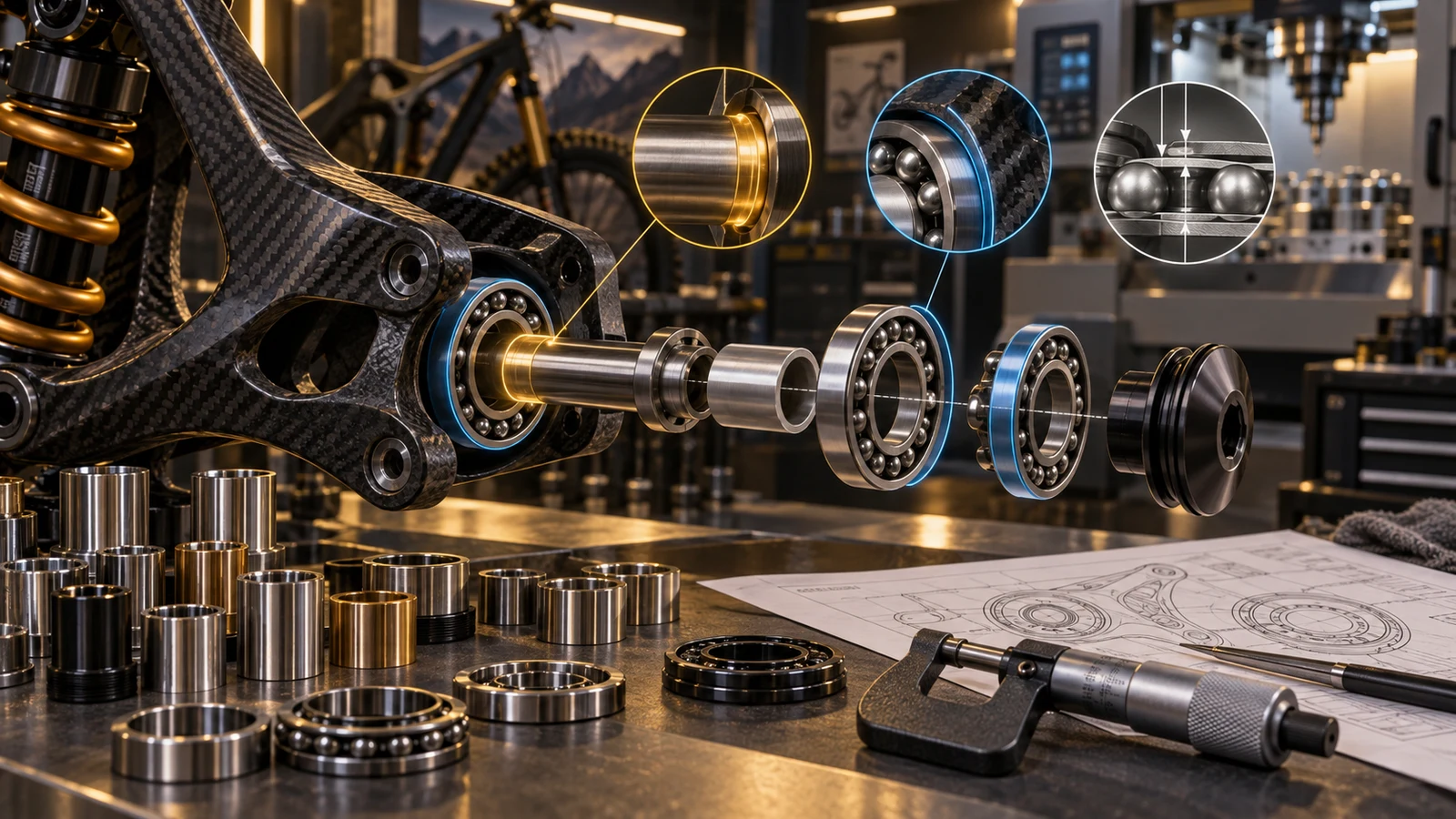
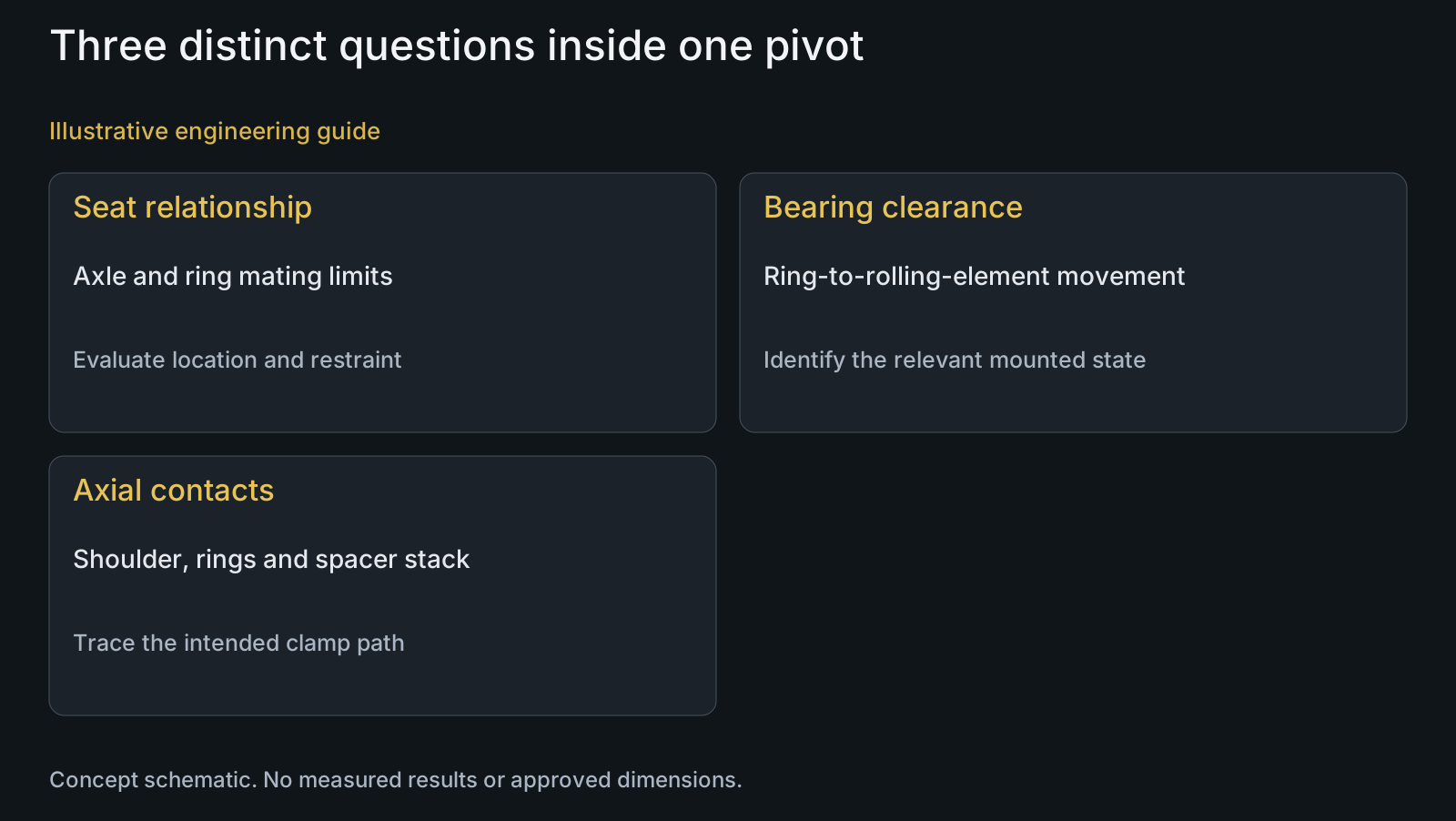
A pivot axle does not automatically need an interference fit in its bearing inner ring. Select that relationship for the actual bearing arrangement, ring restraint, loading and service method, using the bearing manufacturer's application guidance. The OEM is deciding how the joint locates and clamps its components while permitting intended suspension movement. Separate three questions: the axle-to-ring seat relationship, the bearing's internal clearance, and the axial contact stack. A tighter seat does not repair an incorrect spacer or shoulder. Specify the finished mating limits and the mounting condition, then assess the assembled function. A familiar shaft tolerance symbol alone cannot approve this complete interface.
Hero: concept illustration of example hardware and its application. It is not a factory photograph, tested component or approved production geometry.
Map the rings and restraints before selecting the seat
Identify the bearing reference and its actual bore, outside-diameter and relevant clearance information. Show where the inner and outer rings sit, which components restrain them and where movement is intended. Do not describe every cylindrical interface as the same bearing fit.
Name the load relationship for each ring rather than infer it from whether the bicycle linkage visibly rotates. A suspension joint moves over a limited range, and its ring loading must be evaluated for that arrangement. An industrial continuous-rotation example is not automatically a bicycle selection rule.
State the design question separately for each seat: radial location, resistance to unwanted ring movement, required axial freedom or removal access. A removable axle and an outer ring retained in a link bore can have different constraints even though both belong to one pivot.
Distinguish seat clearance from internal bearing clearance
Seat clearance concerns the mating dimensions of a ring and its shaft or housing. Bearing internal clearance concerns relative movement between the rings and rolling elements. These are not two names for the same gap, and an axle diameter measurement cannot report both.
NSK explains that tight mounting fits can expand or contract bearing rings and reduce internal clearance. It distinguishes initial, mounted and operating clearance. Its discussion of creep also ties unwanted ring movement to fit and ring loading; these mechanisms justify reviewing the arrangement, not applying a universal interference value.
Ask which condition the supplied bearing information represents and which assembled condition the design needs to evaluate. Changing the selected bearing clearance category is a separate design choice, not an automatic remedy for an over-tight seat. Obtain application-specific guidance before changing either requirement.
| Requirement | Useful input | Risk of conflating it | Verification focus |
|---|---|---|---|
| Axle-to-inner-ring seat | Bearing bore and finished axle limits | Tighter seat treated as a cure for axial error | Actual mating relationship and restraint |
| Outer-ring-to-link seat | Bearing outside limits and link geometry | Housing seat omitted from the arrangement | Seat condition and ring support |
| Internal bearing clearance | Bearing reference and mounted-state guidance | Seat gap reported as internal clearance | Applicable bearing condition |
| Axial clamp contacts | Shoulder, ring, spacer and end-face stack | Torque used to disguise wrong contact | Intended axial load path |
| Installation and removal | Tool access and supported ring | Force routed through rolling elements | Approved mounting and service method |
Express the actual finished mating relationship
Compare the selected bearing's specified bore limits with the finished axle seat limits. Do not assume the bearing bore is a generic hole tolerance class. If a code is used on the drawing, identify its controlling system, nominal size and corresponding limits.
The drawing-fit guide explains individual size, geometry and inspection callouts. This review adds the bearing arrangement and mounted-state questions that must inform those callouts. No universal j5, k5 or interference range is prescribed here.
Identify treatment state, masking and controlled surfaces. Geometry, finish and inspection condition need their own requirements, rather than being assumed from diameter alone. Coordinate the proposed seat with CNC turning so machining and final acceptance address the same feature.
Review the axial clamp path independently
Trace the intended axial contacts through the shoulder, inner rings, spacer and end component. Identify which surfaces carry clamp force and which must remain free from unintended contact. A correct radial seat can coexist with an incorrect axial stack.
Do not assume tightening the axle is intended to set bearing preload. The arrangement and bearing type determine that question. Explain the role of the inner spacer and end contacts in the actual design before choosing how the stack is accepted.
Use the functional tolerance-stack review for combined axial relationships. Keep that calculation separate from the radial fit comparison. Neither calculation alone establishes acceptable operation under all service conditions.
Include installation and removal in the interface review
A proposed interference seat needs a feasible mounting method and access to the appropriate supporting surfaces. NSK's mounting-tools guidance cautions against routing installation force through rolling elements when mounting an interference-fitted ring. The tooling and force path belong to the arrangement review.
Define how the axle and bearing will be removed without an improvised force path. If a service requirement changes the proposed seat relationship, revisit ring restraint and loading rather than declare any loose fit acceptable simply because it is easier to remove.
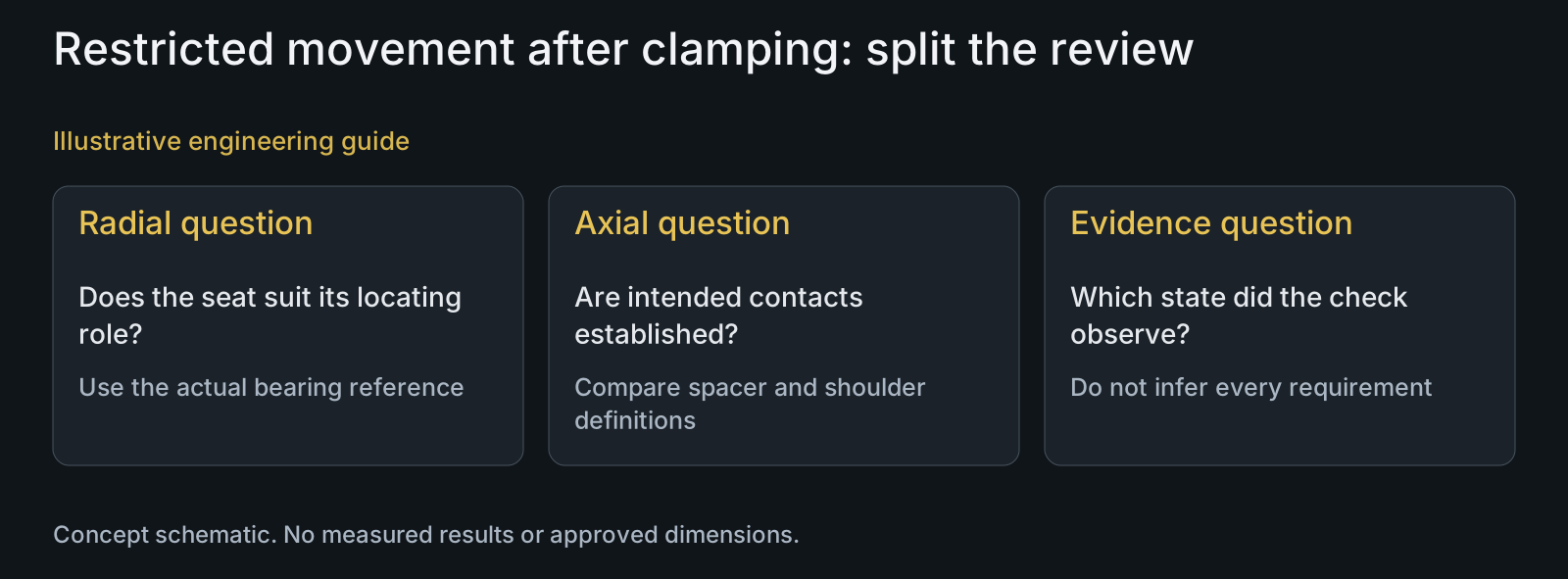
Compare finished feature inspection, mounting observations and assembled movement as distinct evidence. Smooth movement is useful but does not demonstrate every seat or clamp requirement. Unexpected stiffness should trigger a review of contacts and component state, not an unapproved adjustment to the installation instruction.
Review example: improve location without hiding a stack error
Illustrative engineering example: assume an OEM is evaluating an axle through two bearings and an inner spacer. The axle assembles readily, but movement becomes restricted after the specified assembly operation. A proposal is made to tighten the axle's radial seat. No dimensions, torque or test outcome are assumed.
The reviewer separates the observed change during clamping from the radial locating requirement. They inspect the intended inner-ring and spacer contact relationship and compare it with the provided component definitions. They also identify the actual bearing reference and mounted-state guidance.
A different axle fit may address a separate locating concern, but it cannot be accepted as the explanation for the clamp-dependent symptom without evidence. The review produces two defined questions: whether the radial seat suits its role, and whether the axial arrangement creates the intended assembled state.
Questions buyers need to confirm
Should every pivot axle use an interference fit?
No. Provide the bearing reference, ring restraints, loading relationship, axial arrangement and service needs. Those inputs determine the seat decision with manufacturer guidance; a generic interference recommendation cannot approve an unspecified pivot.
Is seat clearance the same as bearing internal clearance?
No. Seat clearance compares mating shaft or housing dimensions with the ring. Internal clearance concerns movement within the bearing. Identify the bearing condition and method when discussing clearance rather than infer it from an axle measurement.
Can we specify j5 or k5 without the bearing data?
Not as a complete interface decision. Obtain the bearing's specified bore limits and the relevant application guidance, then compare the finished axle limits. Also define geometry, treatment state and axial contacts; the code alone cannot establish function.
Does a spacer make bearing clearance irrelevant?
No. The spacer belongs to the axial contact arrangement, while the bearing's mounted internal condition remains a separate requirement. Establish the role and dimensions of the spacer without treating it as proof that every bearing condition is acceptable.
What if the axle fits but movement becomes stiff after tightening?
Review the change in assembled state, including inner-ring contacts, spacer and shoulder relationships. Keep radial fit and axial clamping questions distinct. Do not publish an improvised torque reduction or tighter seat as a validated repair.
What is needed for a bearing-interface RFQ?
Supply the bearing reference and available tolerance data, assembly drawing, axle and mating limits, ring restraints, spacer stack, surface state and mounting/service requirements. State the unresolved interface question so the manufacturing review can address a defined feature.
Technical references and scope
NSK fits and internal clearance guidance. Distinguishes seat relationships and internal clearance, mounting effects and ring-loading considerations. Industrial numerical selections are not adopted as bicycle recommendations.
NSK mounting-tools guidance. Installation force should act on the interference-fitted ring rather than pass through rolling elements. No tooling capability or model compatibility claim inferred.
Explore related component, material and sourcing decisions in the customer decision knowledge center. For a drawing review, use the Drawing/BOM RFQ path.
Review the complete pivot bearing interface
Send the assembly drawing or STEP, bearing references, axle and housing limits, spacer BOM and finished-surface requirements through the Drawing/BOM RFQ path. PremFixer can review the turned-part definitions and manufacturing implications with your team before a generic fit label becomes a production assumption.
Discuss the drawing and BOM