
A lower-cost alloy can be proposed for custom pivot hardware, but identical nominal dimensions do not make it an equivalent replacement. Compare the original and proposed grade, product form and condition against the component's load, contact surfaces, environment and final treatment. A 304-for-316 proposal needs more than a dry-location label; a 6061-for-7075 proposal needs more than a low-load description. Determine which original requirement remains satisfied and which assessment changes. Keep the baseline and alternative quotations separate on the same finished supply basis. No saving or unchanged performance can be promised before the application and manufacturing consequences have been reviewed.
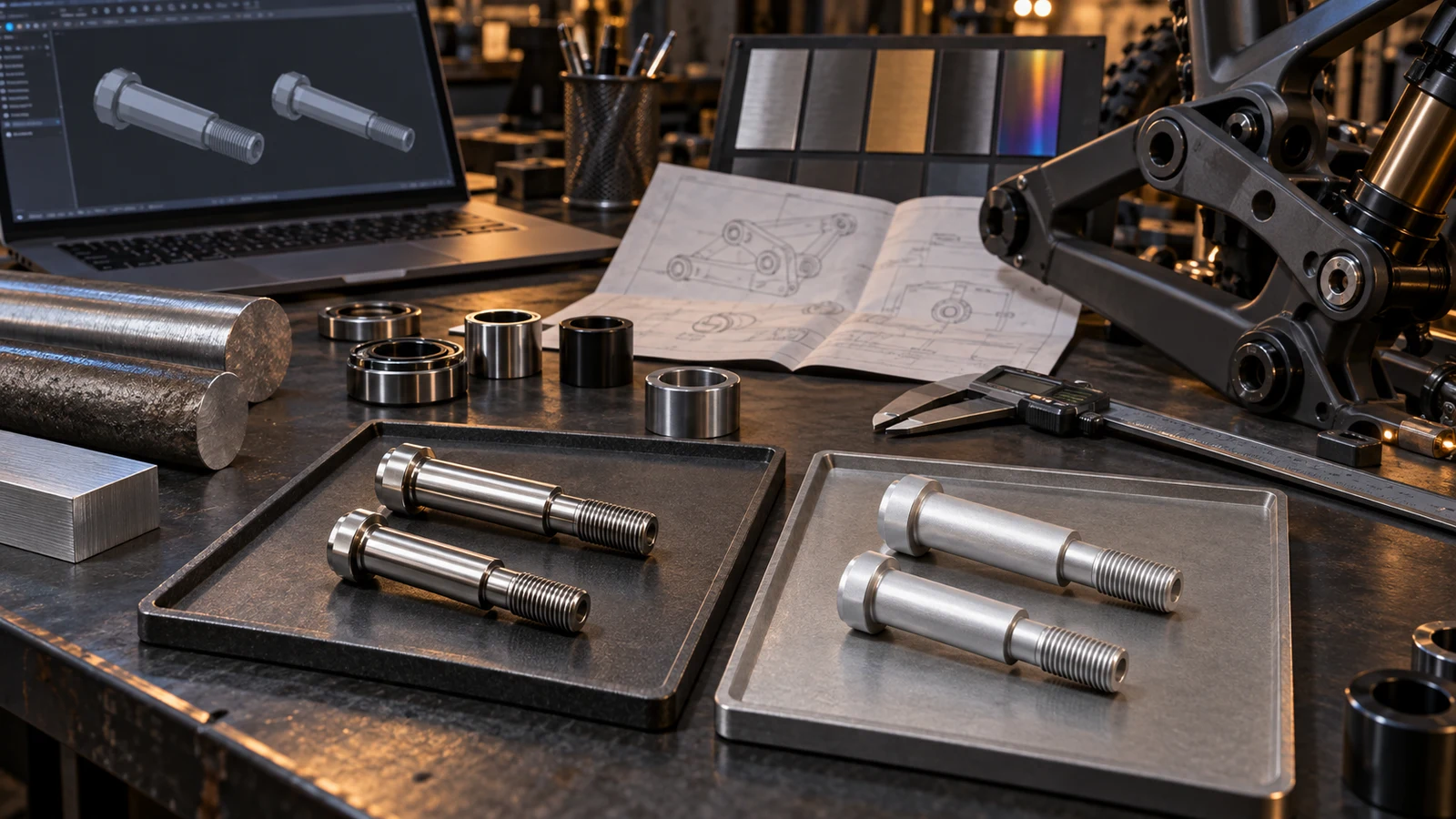
Hero: concept illustration of example hardware and its application. It is not a factory photograph, tested component or approved production geometry.
Find the requirement behind the original material
Ask why the drawing specifies the original grade and condition. It may address structural response, contact behavior, corrosion exposure, mass or an existing platform requirement. If that reason is unavailable, keep it unresolved instead of assuming the material is unnecessarily expensive.
State the real constraint: total finished price, stock availability, an urgent sample requirement or a purchasing preference. These can lead to different proposals. An alternative stocked alloy is not necessarily less expensive after different treatment, reporting or validation work is included.
The material-selection guide screens initial candidates. This article addresses a different decision: whether a specific change from an already specified material can be accepted, and how to compare its consequences without hiding the substitution.
304 instead of 316: evaluate actual exposure, not only the storage label
Outokumpu identifies 316/4401 as a molybdenum-alloyed austenitic grade used where greater corrosion resistance is needed. Its alloying guidance explains molybdenum's contribution to corrosion resistance. That is a reason to investigate what the original selection protects against, not a guarantee that 316 is immune to every environment.
For a proposed 304 substitution, describe operating and cleaning exposure separately from dry storage. Identify salt contamination, trapped moisture, sheltered contacts and maintenance. Outokumpu's corrosion guidance emphasizes the combined effects of environment, surface and design; a dry-location description alone does not establish suitability.
Also preserve the required mechanical condition and receiving-part interface. Changing stainless grades is not permission to change the finished-fastener requirements or assembly surface state. If the service environment truly differs from the original platform, the design owner can assess that defined application, rather than approve unrestricted cross-model use.
| Proposal or claim | Potential reason to consider it | Hidden risk | Evidence before acceptance |
|---|---|---|---|
| 304 replaces 316 | A defined application may not need the original corrosion provision | Dry storage mistaken for dry service | Exposure, contacts, surface and specified condition |
| 6061 replaces 7075 | An exact component may have assessable alternative requirements | Low external load hides clamp or contact demands | Load, thread, contact and condition assessment |
| Same alloy, different temper | Stock or processing option changes | Grade number treated as unchanged properties | Condition-specific requirements and supply evidence |
| Same geometry | Interfaces appear to remain within the envelope | Equal dimensions assumed to mean equal behavior | Structural, contact and final-fit assessment |
| Same finish name | A familiar treatment route is proposed | Response or final surface assumed identical | Treatment scope, appearance and finished interface |
| One alloy for every kit part | Purchasing seeks simpler sourcing | Different component functions ignored | Item-level approval and identified BOM revision |
| Lower quoted unit price | Commercial target may be met | Additional operations or evidence excluded | Comparable finished scope and unresolved assessment work |
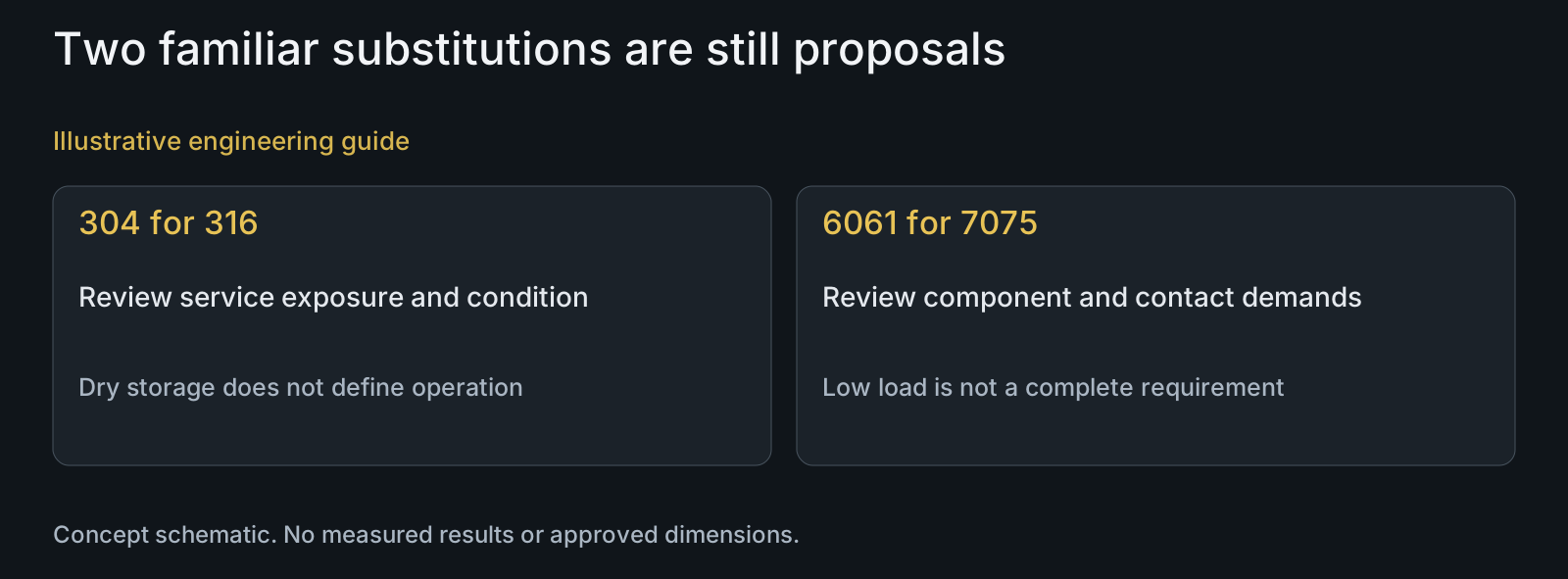
6061 instead of 7075: low external load is not the complete component task
Kaiser Aluminum's rod-and-bar sheets distinguish typical properties by temper for both 6061 and 7075. Their data show different strength levels and condition-sensitive behavior. Use appropriate product and condition information, not the bare alloy number or a table value treated as a finished-pivot allowable.
Identify whether the proposed part carries clamp force, supports a span, receives a thread, contacts a bearing ring or only covers another component. A component with little external service load can still have an important assembly or contact requirement. Do not classify every small bolt or spacer as a suitable substitution candidate from its appearance.
Compare strength, stiffness, local contact, thread behavior and required validation as separate questions. A change that needs a larger section or different engagement is a redesign, even if the first proposal kept the same nominal envelope. Preserve the actual bearing and spacer arrangement when evaluating the proposed material.
Include finishing and manufacture in the alternative definition
State both material specifications with product form, condition and required evidence. For aluminum, an alloy designation without temper leaves the proposal incomplete. For stainless, a grade name alone does not define every required finished component property. The approved drawing must describe what is delivered, not only what stock is initially available.
Check the surface-treatment scope, protected contacts, final fit and appearance acceptance. An existing color reference or treatment arrangement should not be assumed to transfer unchanged to a new alloy and condition. Ask what the proposed route retains and what must be reassessed.
Review machining and any qualified specialist operations for the exact alternative. PremFixer manufactures to the agreed definition; a substitution request is not authority to quietly change the stock. Keep affected BOM lines identifiable even when several components are considered together.
Compare a finished alternative, including its unresolved work
Request the original and proposed offers for the same supplied unit, quantities, inspection and delivery boundary. Use the custom fastener cost breakdown to identify omissions. A lower raw-material charge cannot establish the cost of the finished kit if other operations differ.
Identify one-time assessment or sample work separately from recurring supply where useful. A proposal may reduce a recurring charge while requiring further design or validation effort. Record those assumptions without inventing a payback period, fixed saving percentage or guaranteed discount.
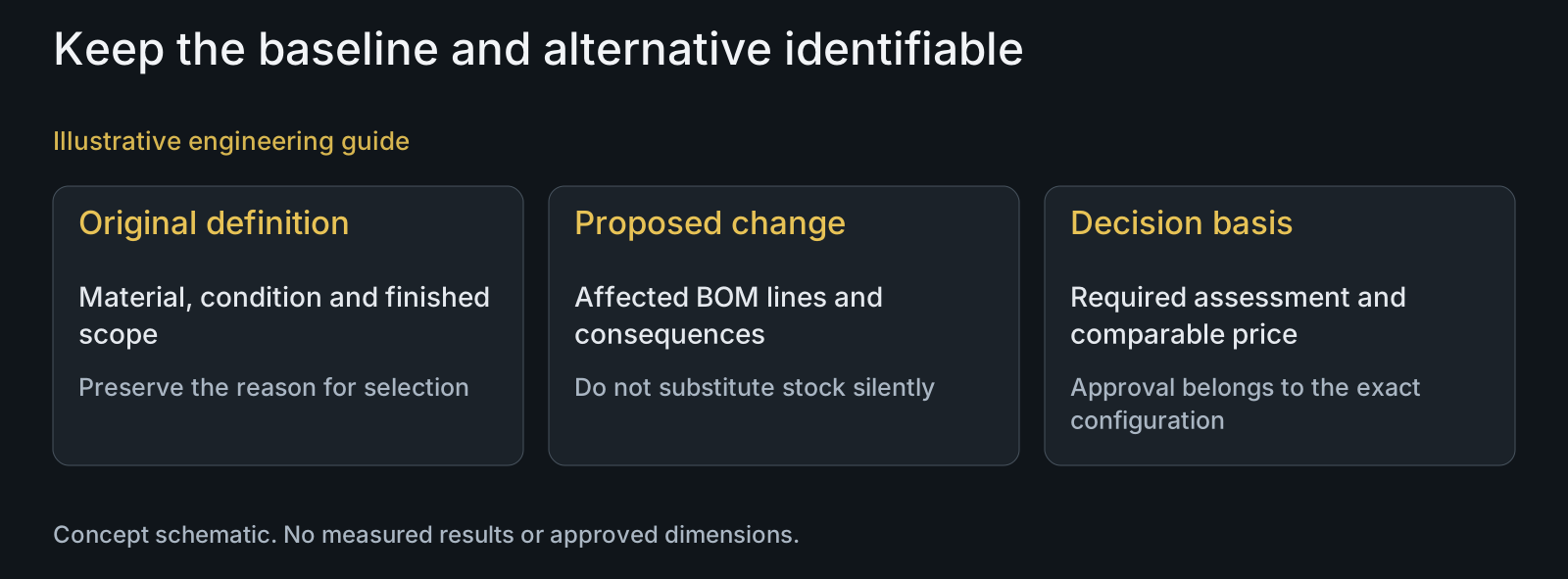
Approval should name the affected component, exact material and condition, applicable revision and required verification. Do not extend it to every part or future model merely because the same grade name appears. Keep original and alternative stock or finished parts distinguishable until the authorized configuration is established.
Review example: a spacer and a threaded bolt need different decisions
Illustrative engineering example: assume an OEM considers changing a 7075 hardware kit to 6061 to meet a cost target. The kit contains a threaded clamping bolt and a spacer that contacts bearing rings. No loads, dimensions, prices or tested performance are assumed.
The reviewer separates the BOM lines. For the bolt, the proposed condition must be assessed against the structural and thread requirements. For the spacer, the axial contact and stack requirements remain relevant even if it is described as lightly loaded. Neither line is approved merely because the external shapes remain unchanged.
A mixed-material proposal may be considered if each component's requirements support it. The buyer then compares that specifically defined kit with the baseline, including finishing and evidence. The example shows how to avoid an all-or-nothing purchasing shortcut; it does not report a successful substitution or quantified saving.
Questions buyers need to confirm
Can 304 replace 316 when the bicycle is stored indoors?
Storage alone is insufficient. Assess operating exposure, cleaning, contamination, trapped moisture, contacts and the required material condition. A defined less demanding application may support a proposal, but the grade change still needs evaluation and approval against the original requirements.
Can 6061 replace 7075 in a low-load location?
Treat it as a candidate, not an automatic substitution. Identify clamp force, contact, thread and structural demands as well as external load. Compare the exact temper and geometry with those requirements; a lightly described application does not establish finished-part suitability.
Does keeping the same diameter avoid a design change?
No. Material and condition affect behavior even when geometry is unchanged. State the original and proposed specifications and assess the affected requirements. If additional section or engagement is needed, the alternative also becomes a geometry change.
Can we keep the existing finish specification?
Possibly, but confirm how it applies to the proposed grade and condition. Check protected surfaces, appearance, treatment response and final interface acceptance. The shared process name does not establish identical delivered surfaces or fit.
Should every kit component change to the cheaper alloy?
Only if each line's requirements support it. Assess bolts, shafts, spacers and nuts by their separate functions and contacts. A mixed-material kit can be evaluated while retaining item-level identification and approval; purchasing convenience is not sufficient design evidence.
How do we confirm that the alternative actually saves money?
Compare the same finished kit, quantity and supply boundary, including changed operations, reporting and any assessment work. Keep the baseline offer visible. No price ranking or percentage saving can be established from the raw alloy names alone.
Technical references and scope
Outokumpu 316 product-range description. 316/4401 molybdenum-alloyed grade context. Flat-product or range data not treated as finished-fastener properties or universal corrosion immunity.
Outokumpu alloying-element effects. Molybdenum and combined composition/condition effects. No grade substitution approved from an individual element.
Outokumpu corrosion-resistance guidance. Environment, surface, design and contamination affect corrosion. Numerical environmental thresholds and service-life predictions not adopted.
Kaiser Aluminum 6061 rod-and-bar data. Historical producer-specific condition and typical-property distinctions. Values are not pivot design allowables or current contract guarantees.
Kaiser Aluminum 7075 rod-and-bar data. Typical strength and temper distinctions for the producer's rod/bar. Specimen fatigue data do not validate a finished pivot or unchanged performance.
Explore related component, material and sourcing decisions in the customer decision knowledge center. For a drawing review, use the Drawing/BOM RFQ path.
Review a specific material change against its original requirement
Send the current drawing and BOM, original material specification and condition, proposed alternative, component functions, mating materials, exposure, final treatment and quantity basis. Include the reason for the cost target and available validation requirements. The review can identify affected decisions and a comparable supply scope without assuming equivalent performance.
Discuss the drawing and BOM