
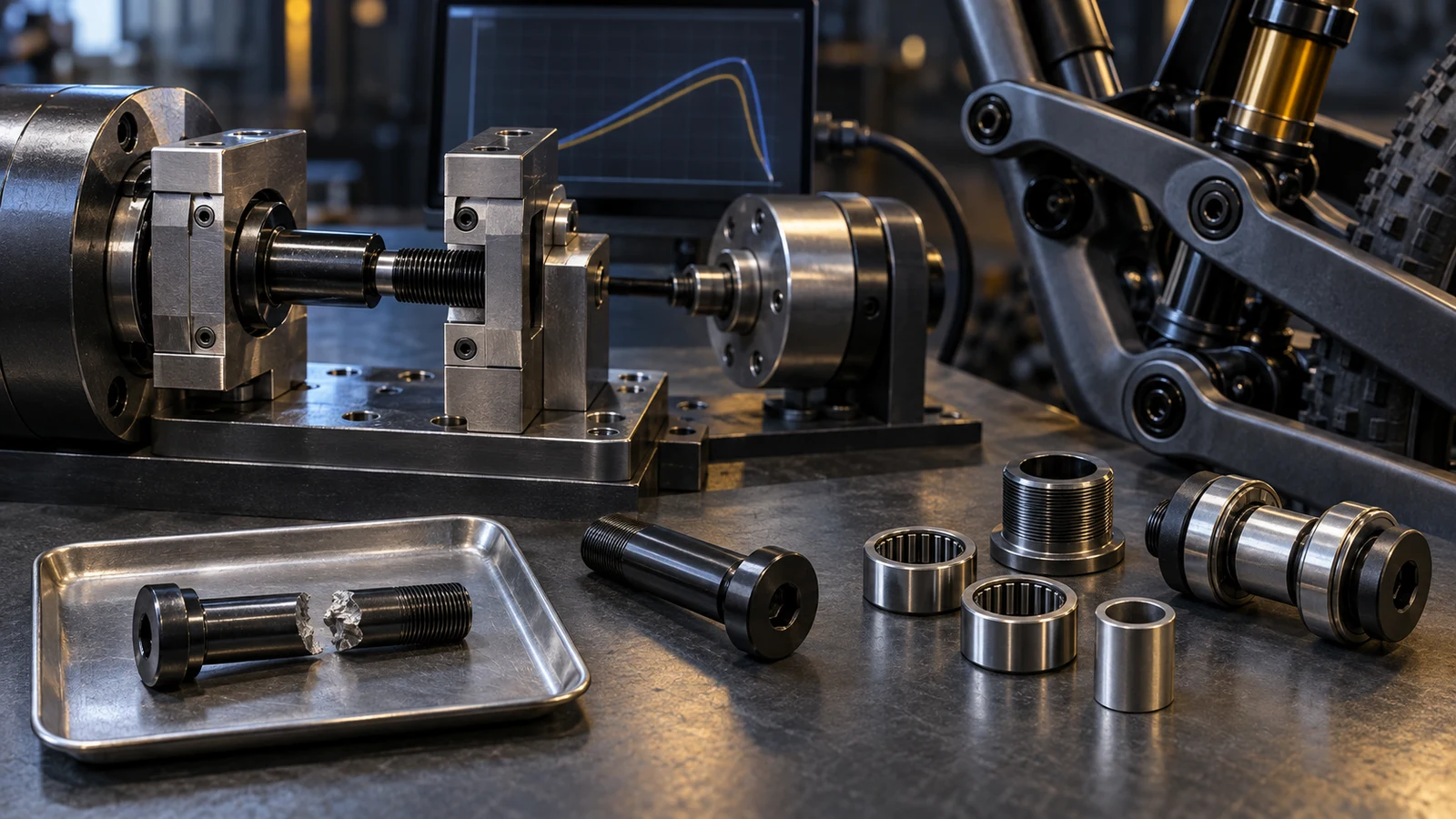
A destructive torque result is not the correct production tightening torque for a custom pivot bolt. First identify whether the test isolates fastener torsion, overloads a representative joint or verifies an intended assembly procedure. The receiver, engagement, bearing-spacer contacts and surface condition can change what limits the setup. Record the actual measured channels and observed endpoint rather than treating every maximum as bolt breaking strength. Installation still needs a joint-specific basis that creates useful clamping without unacceptable damage or restriction. Neither an arbitrary fraction of a failure value nor a material grade alone establishes that basis, and a standards number cannot replace a defined test purpose.
Separate three torque questions
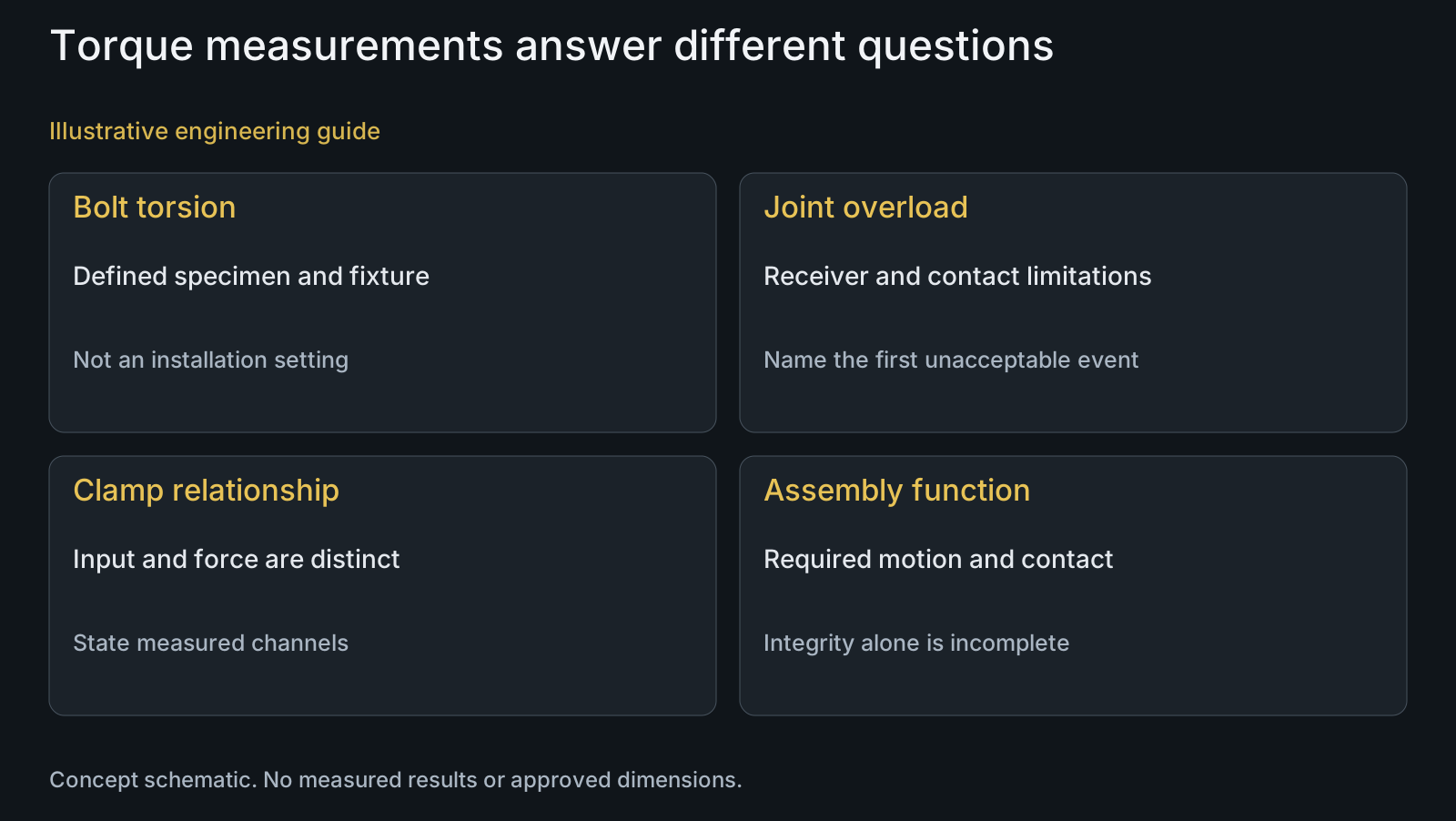
An isolated torsion test examines a fastener under the defined twisting setup. An assembled overload test examines the first unacceptable event in the chosen joint. A torque/clamp-force evaluation investigates the relationship between applied input and clamping in a stated condition. They may all record torque while answering different questions.
Assembly verification should name the intended procedure and functional checks. A pivot can remain intact while its motion is restricted by an incorrect contact stack. Define both integrity and function where relevant; a visually unbroken bolt is not a complete assembly verdict.
Select a method with applicable scope
ISO 898-7's public scope concerns a defined subset of steel-class bolts and screws, including certain small or short fasteners. It is not a universal destructive-torque threshold for stainless, titanium or aluminum pivots. Confirm applicability to the actual part instead of copying a convenient steel minimum.
ISO 16047 identifies torque/clamp-force testing and includes applicability limits and exclusions, including additional self-locking features. A custom adapted investigation may still be useful, but describe it honestly rather than claiming full conformity from a familiar label. The order's applicable standard, edition and customer instructions require explicit review.
| Test or reading | Useful conclusion | Main risk | Verify |
|---|---|---|---|
| Isolated torsion | Terminal response in a defined fixture | Test nut becomes production receiver | Applicability and endpoint |
| Assembled overload | First limiting event in represented joint | Receiver damage called bolt strength | Damage location and contact path |
| Torque and angle | Input and rotation history | Preload claimed without force evidence | Actually measured channels |
| Torque/clamp-force evaluation | Relationship in the stated condition | Changed finish assumed equivalent | Surface and interface representation |
| Assembly verification | Named integrity or functional criterion | No break called complete success | Motion, contacts and approved limits |
| Equipment stop | Supported reached input | Last reading called breaking torque | Whether intended failure occurred |
Make the receiver and contact path part of the definition
Specify receiver material, internal thread, effective engagement, support and supplied state. Identify whether a laboratory nut intentionally isolates bolt response or represents the production interface. Replacing a weak receiver with a stronger test accessory changes the subject of the result.
Provide the intended bearing and spacer contact arrangement. Tightening should load the designed clamping path; unwanted contact can damage a surface or restrict movement before bolt rupture. The full-suspension review helps identify those interfaces. Do not assume an isolated specimen reproduces the complete joint.
Read the measured channel and failure location
Torque and rotation describe tightening input and movement. They are not direct clamp-force readings unless suitable force evidence or a justified relationship is supplied for that configuration. A torque-only chart cannot acquire a preload label merely because a calculation or display looks precise.
Record bolt rupture, receiver stripping, drive damage, contact deformation or fixture slip as distinct observations. If testing stops at equipment capacity without the intended event, state the limitation; the final reading is not an observed breaking value. Preserve relevant prior use, locking system and surface condition when interpreting the result.
A strong test nut can conceal the production limitation
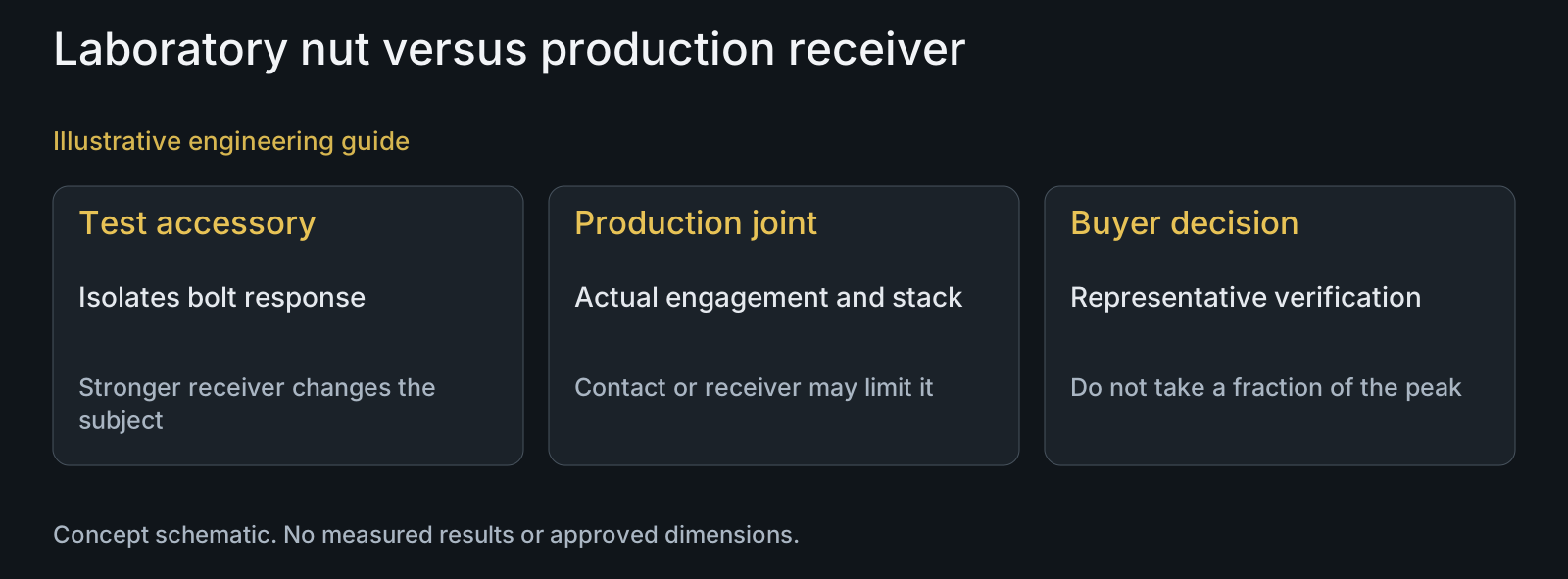
Illustrative engineering example: assume an OEM has a torsion proposal using a strong laboratory nut for a shouldered pivot, while production uses a lightweight receiver and a bearing-spacer stack. No torque values, dimensions or actual failure results are assumed.
The laboratory setup can isolate bolt response. It cannot show that the production receiver or contacts tolerate equivalent input. The buyer defines a separate representative assembly check with relevant integrity and function criteria. If the receiver is the limiting interface, quoting the bolt's higher terminal result does not solve that problem or justify a tightening instruction.
Keep verification specimens and order commitments explicit
Define specimen selection, permitted reuse, tightening direction, tools or sensors, observation method and the agreed decision rule. A destructive specimen is not automatically suitable for later delivery. Even a nominally nondestructive verification may alter the interface, so sample disposition belongs in the test definition.
The torque/preload guide addresses why friction and surface changes affect the installation decision. PremFixer's manufacturing review can address component definition and coordinated testing. No owned torque rig, universally approved setting or bicycle-system compliance is established here; those deliverables require supported project scope.
Questions buyers need to confirm
Can tightening torque be a fixed percentage of breaking torque?
Not from that evidence alone. Installation needs useful clamping and acceptable joint behavior. Provide receiver engagement, contacts, surface condition and locking details so the relevant interface and assembly criteria can be assessed.
What if the receiver strips before the bolt breaks?
Report receiver stripping as the observed joint event. Identify the receiver, thread and engagement. A stronger laboratory nut can support a separate fastener test but cannot erase the production limitation.
Does a torque-angle curve directly measure clamp force?
No. Identify the actual recorded channels and any justified force relationship. If clamping is the decision variable, specify suitable evidence for that quantity and configuration rather than relabelling torque data.
Do steel torsional-test limits apply to every pivot material?
No. ISO 898-7 has a defined steel-fastener scope. Confirm class, geometry and applicability before using its requirements. An adapted custom-part test must distinguish engineering usefulness from standard conformity.
Does a test with no visible break verify assembly?
Only the named observed criteria are supported. Receiver damage, contact deformation or motion restriction may be separate endpoints. State how required function is examined, not just whether the bolt remains in one piece.
Can tested parts return to deliverable stock?
Decide from the actual test and authorized disposition, not the nondestructive label alone. Prior loading, interface alteration or damage may affect suitability. Define specimen identity and disposition before combining them with untested production.
Technical references and scope
ISO 898-7:1992 public scope. Defined steel-fastener torsional-test applicability; no universal pivot minimum or installation value.
ISO 16047:2005 public scope. Torque/clamp-force subject and applicability boundaries; full paid method and contractual requirements not reproduced.
Explore related component, material and sourcing decisions in the customer decision knowledge center. For a drawing review, use the Drawing/BOM RFQ path.
Define the torque question for your pivot assembly
Send bolt and receiver drawings, STEP or stack details, material and finish states, engagement, locking system and required endpoints through the Drawing/BOM RFQ path. PremFixer can review component manufacture and coordinated verification scope while keeping installation approval separate.
Discuss the drawing and BOM