
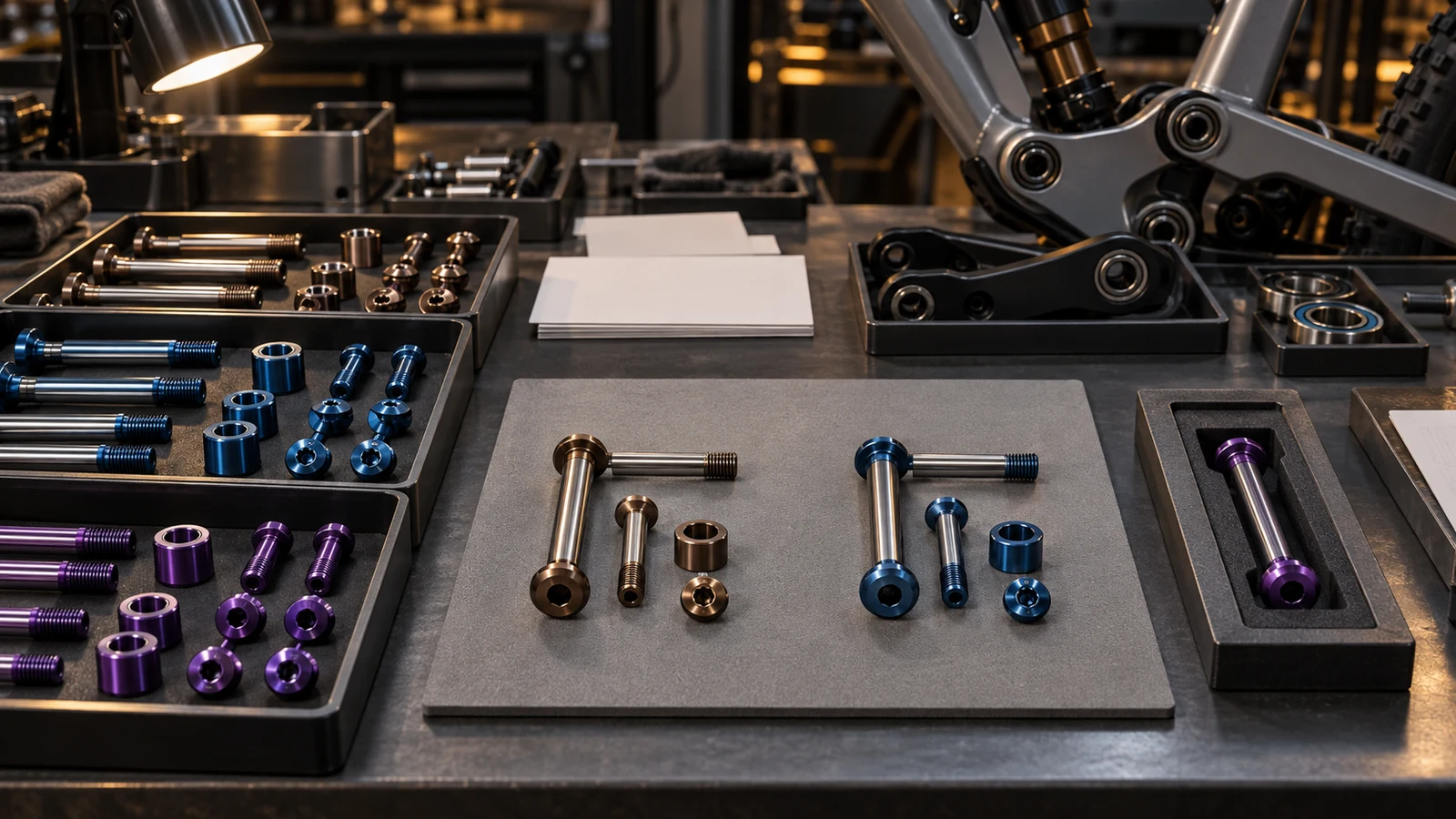
Two batches of colored pivot bolts can each meet an agreed reference requirement without being approved for mixing in one visible assembly. An OEM ordering matching axle heads, caps and spacers needs to define what must match: the retained reference, neighboring parts, complete kits or replacement hardware. The direct purchasing answer is to assess the intended comparison, not assume that separate batch acceptance settles every combination. Lighting, surface texture, viewing geometry and the agreed method remain important, but the overlooked decision is often inventory use. Specify which lots may be combined and what happens when a repeat order meets older hardware.
Hero: concept illustration of example hardware and its application. It is not a factory photograph, tested component or approved production geometry.
Specify the comparison unit before the color limit
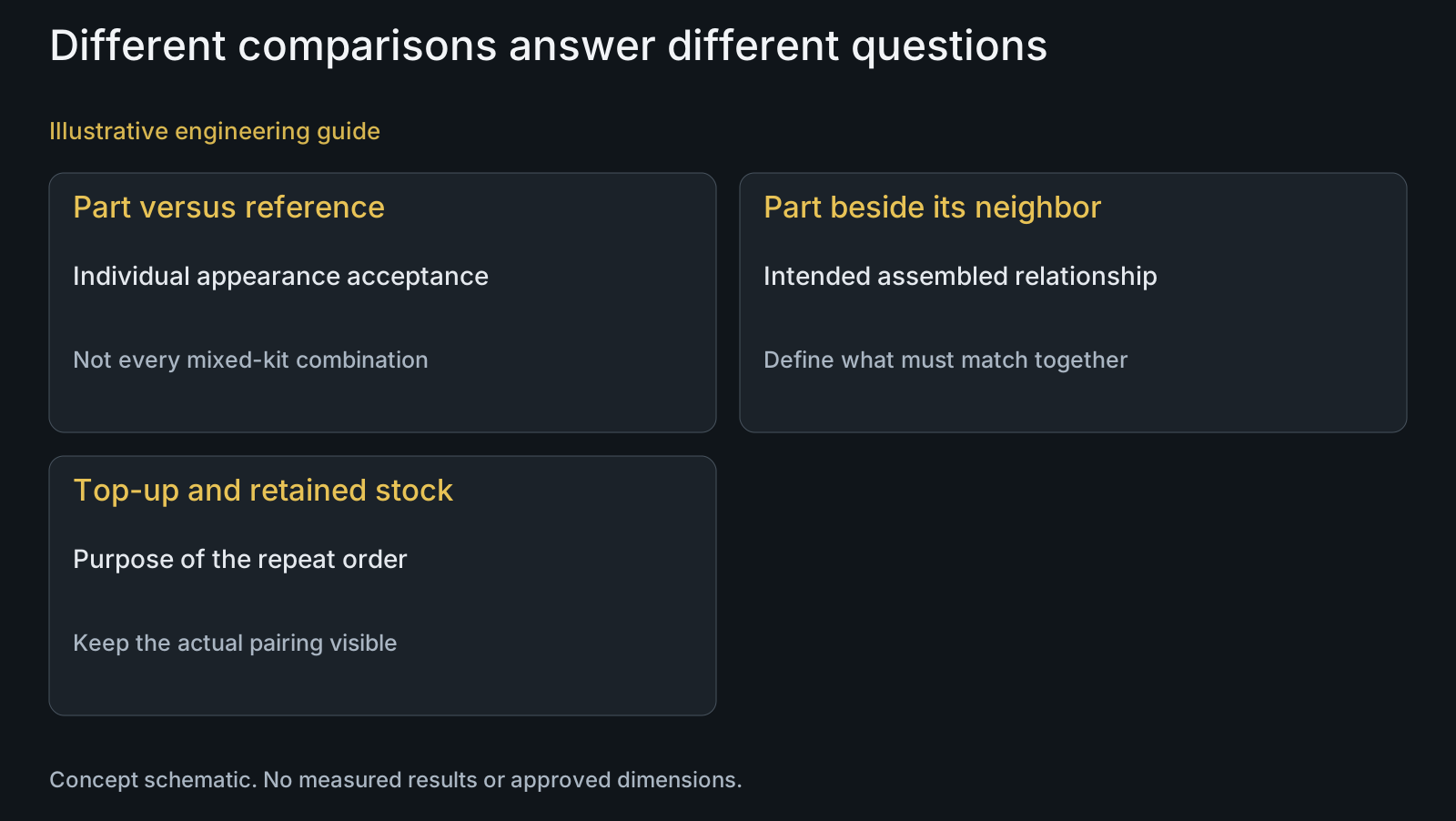
A drawing color callout may describe an individual head, while the customer's appearance concern is the finished bicycle. Identify the parts visible together and the relationship being controlled. Matching two adjacent caps is not the same task as keeping separately installed axles reasonably consistent across a production program.
Distinguish part-to-reference acceptance, within-batch variation, mixed-lot kit harmony and replacement-part appearance. Each has a different comparison subject. A decision on one should not silently authorize the others. This is an engineering purchasing distinction, not a claim that every application needs a separate numerical limit.
Define visible regions on the drawing or assembly view. Hidden threads and bearing seats may have dimensional or functional finish requirements without sharing the same appearance requirement. The titanium color-precision guide covers oxide color and reference conditions; this review addresses how accepted inventory is actually combined.
Two reference comparisons do not prove a matched pair
Treat reference acceptance as the stated decision, not a universal matching certificate. If two parts depart from the reference in different appearance directions, putting them beside each other may expose a distinction that was not evaluated during separate checks. Whether that distinction is acceptable needs the agreed kit requirement.
ASTM D2244-25 describes calculating instrumental color differences and requires purchaser and seller agreement on tolerance and calculation procedure. Its public scope recognizes that proximity, gloss and texture affect commercial acceptability. Different calculation systems also need to be distinguished rather than treated as interchangeable numbers.
Use those principles to define the question being answered; they do not supply a universal pivot-hardware acceptance value. If mixed kits require a separate comparison, specify the relevant regions and arrangement. Do not infer a measured pairwise difference from two pass labels when the underlying coordinates or suitable comparison evidence are unavailable.
| Buying decision | Comparison subject | Shortcut risk | Useful verification |
|---|---|---|---|
| Accept a supplied part | Visible region versus agreed reference | Pass treated as approval of all assemblies | Applicable appearance method and reference revision |
| Control variation within a lot | Representative delivered parts | One sample assumed to describe every part | Agreed lot assessment and relevant regions |
| Build a mixed-lot kit | Neighboring parts in intended arrangement | Two reference passes called a matched pair | Relevant kit comparison and mixing permission |
| Replenish incomplete kits | Top-up parts with retained inventory | New purchase purpose left unstated | Actual pairing requirement and lot relationship |
| Change the master reference | Old and new reference revisions | Revision silently authorizes inventory mixing | Defined disposition for existing and future kits |
| Supply a replacement | New reference and installed appearance separately | Used part assumed unchanged from delivery | Explicit service comparison and limitations |
Make small curved parts comparable without hiding their appearance
An axle head and a spacer can present different textures and curved areas. Identify where an instrumental reading represents the appearance requirement and how the part is positioned. A convenient flat coupon may support process review without representing every visible head, recessed cap or neighboring component.
ASTM D1729-22 addresses visual appraisal of diffusely illuminated opaque materials. Its scope is not a blanket method for every directional metallic or effect appearance. Select a suitable comparison approach for the actual surface instead of attaching the standard designation to any inspection-light setup.
Record the relevant viewing arrangement and compare the intended combination consistently. Where angle-dependent appearance matters, resolve that issue explicitly rather than suppress it with a favorable photograph. The surface-treatment review connects the agreed appearance requirement to the proposed preparation and finish route, without promising identical appearance for every material.
Repeat orders need an inventory and reference decision
A top-up order may be intended to complete partly used kits or supply stand-alone replacements. Tell the supplier which purpose applies. Retained new hardware, an appearance reference and an installed part are different comparison subjects; do not quietly replace one with another during a disagreement.
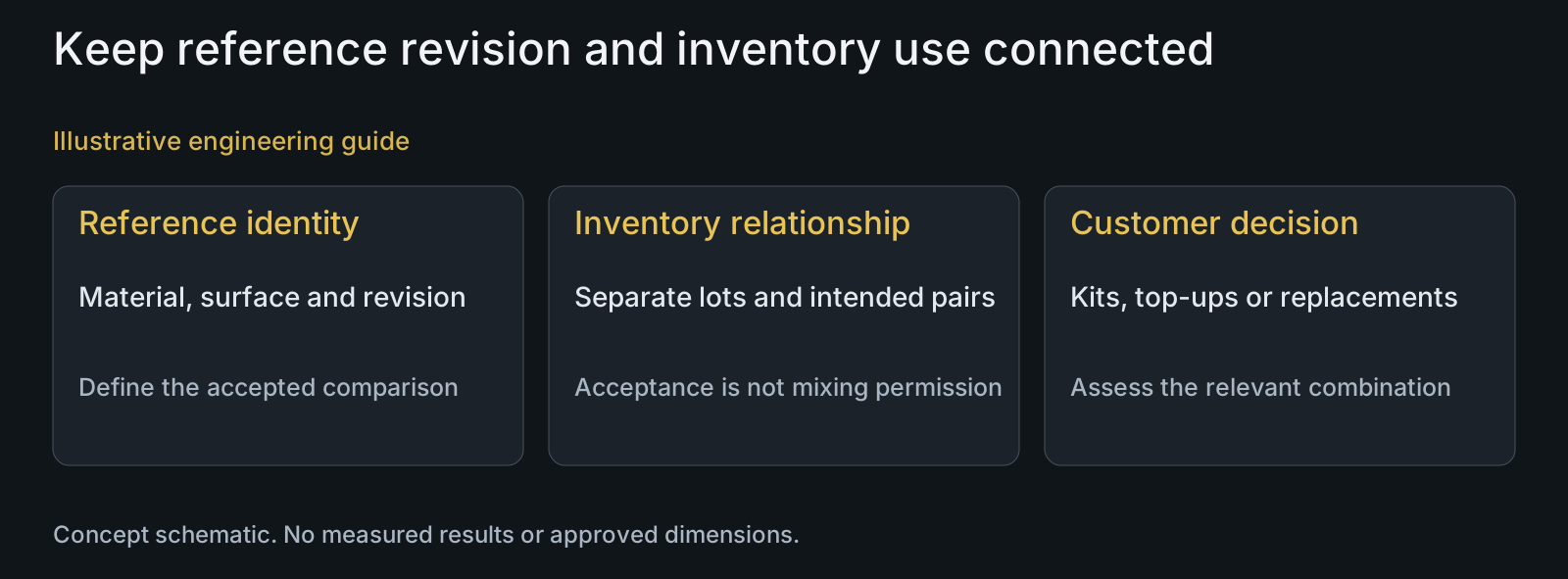
If an appearance reference changes, identify the revision and decide how old and new inventory may be used. Retaining both records supports interpretation, but does not by itself approve mixing. The purchasing team needs a disposition for existing kits, future production and service replacements that reflects the actual visible relationship.
A used or exposed part cannot be assumed to preserve the appearance of its original delivery state. Comparing a replacement with it is an application-specific review, not proof that the new batch departed from the retained new reference. No aging rate or universal matching guarantee is inferred here.
Lot grouping is a control choice, not a cosmetic cure
Keeping identified lots separate can prevent an unassessed combination from entering a kit. It does not correct an unacceptable batch or prove that every kit within one lot is visually matched. Decide whether kit comparison is needed and retain the relationship between the packed parts and their accepted appearance condition.
Do not automatically sort, strip or refinish parts to solve an appearance discrepancy. Sorting needs an agreed criterion; reprocessing needs review of material, final dimensions and the retained finish state. A cosmetic objective cannot authorize changes to working threads, seats or shoulder interfaces.
Discuss such changes with the manufacturing team using the component drawing and BOM. PremFixer manufactures from customer-defined inputs; this article does not establish an owned color laboratory, universal closed-loop color control or a guaranteed difference value across every order.
An acceptable top-up batch can leave a kit decision open
Illustrative engineering example: assume two separate batches of anodized caps each satisfy the agreed part-to-reference assessment. Some caps from the first batch remain in incomplete visible pairs, and the purchaser wants to finish those pairs with the second batch. No mixed-pair criterion was previously agreed.
The reviewer evaluates the intended old-lot/new-lot pairing under the relevant appearance conditions and clarifies whether the kit requirement is met. If that evidence is unavailable, the batch acceptance records remain valid for their stated purpose but do not establish permission for the proposed mixed pairing. A packing or replenishment decision stays open.
No failed lot, measured difference or successful remedy is invented. The useful action is to put the visible pairing and inventory intent into the RFQ before a repeat order is placed. For a full-suspension assembly, this may involve several neighboring caps rather than one isolated bolt.
Questions buyers need to confirm
Can two accepted batches be freely mixed?
Not automatically. Establish whether acceptance covers individual parts or their intended adjacent combination. A mixed-kit requirement needs a relevant comparison; two separate reference passes alone do not resolve it.
Is one delta-E limit enough for every pivot finish?
No universal limit is specified here. Agree the formula, reference, relevant surface and applicable method, then relate the criterion to the intended appearance use. Do not interchange results from different calculation systems or ignore texture and viewing conditions.
Should a repeat order match an installed used part?
Only if that comparison is expressly part of the requirement. Separate it from matching the retained new reference. The installed surface cannot be assumed unchanged, and no universal replacement-to-used-part appearance guarantee follows from new-batch acceptance.
What happens when the appearance reference changes?
Identify both revisions and decide how existing inventory, future kits and service replacements will be used. A reference revision does not automatically approve old and new parts for mixing in visible pairs.
Can a flat coupon replace examination of a curved cap?
Not without establishing that it represents the relevant appearance decision. Identify the visible region, positioning and comparison conditions for the actual cap. The coupon may support process review while leaving assembled-part harmony unresolved.
What belongs in a batch-color consistency RFQ?
Provide drawing, STEP or sample, material and finish route, visible regions, reference identity and revision, applicable comparison method, kit BOM and which parts sit together. State whether the order supplies complete kits, top-ups or replacements and whether different lots may be mixed.
Technical references and scope
ASTM D2244-25: calculation of color tolerances and differences. Public scope and significance for agreed tolerance, calculation-system identity and appearance context; no full paid procedure or universal numerical threshold adopted.
ASTM D1729-22: visual appraisal of colors and color differences. Public method scope and directional-appearance limits; not presented as a universal inspection method for all shiny anodized hardware.
Explore related component, material and sourcing decisions in the customer decision knowledge center. For a drawing review, use the Drawing/BOM RFQ path.
Define the visible pairing before ordering the next batch
Send drawing, STEP or sample and kit BOM with material, finish, reference revision, visible regions and intended lot combinations. Include retained inventory or replacement context so the review can distinguish part-to-reference acceptance from the actual kit or service appearance decision.
Discuss the drawing and BOM