
Ultrasonic cleaning does not by itself demonstrate that a pivot kit meets its supplied cleanliness requirement. Define what must be removed, which surfaces matter and how acceptance will be assessed after the relevant operations. For an OEM or SQE buying custom bolts, receivers and spacers, loose particles, machining oil, cleaner residue and retained moisture are different concerns. Specified assembly lubricant or protective treatment is also different from unwanted residue. Select cleaning, rinsing, drying and packing against that delivered condition; a clean-looking exterior or a process name cannot establish inaccessible surfaces, a quantitative result or compatibility with the intended assembly.
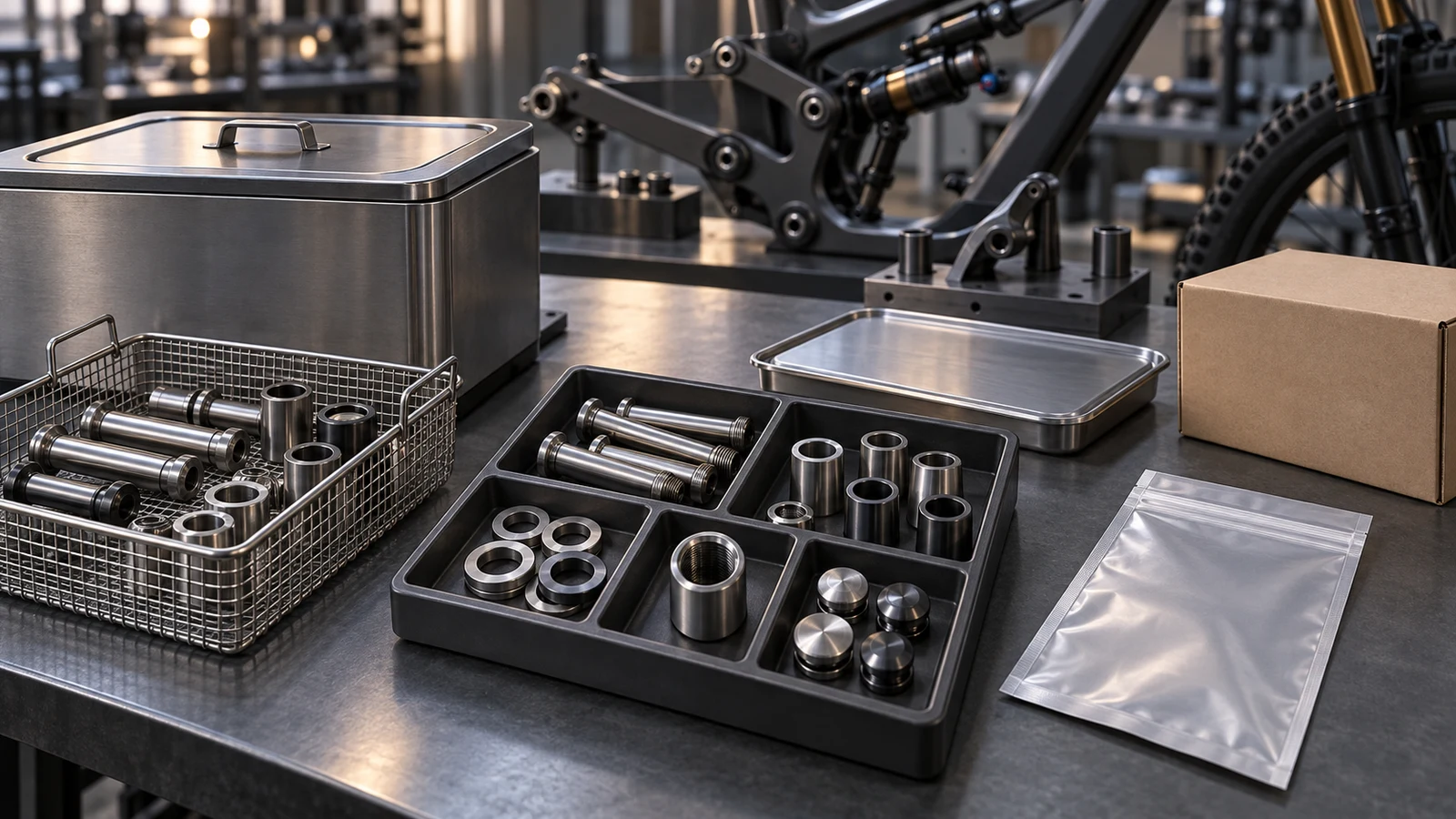
Hero: concept illustration of example hardware and its application. It is not a factory photograph, tested component or approved production geometry.
Separate unwanted residue from the intended supplied state
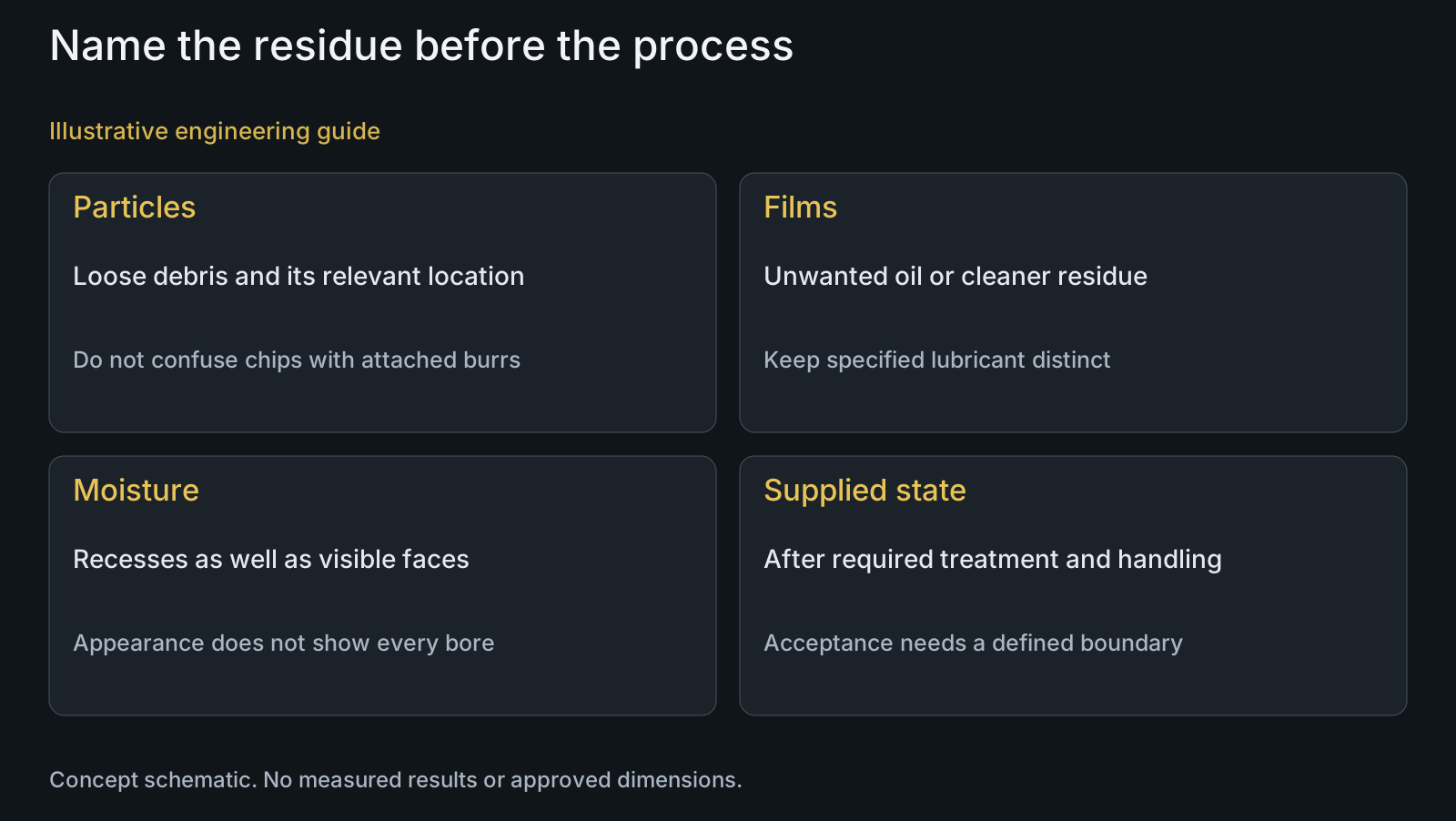
List the concern by substance and location: a loose chip in a receiver, a machining-oil film on a head, cleaning-agent residue near a thread mouth or moisture inside a bore. These conditions do not share one universal removal mechanism or inspection method.
State whether the part is supplied dry, with a specified lubricant, with a protective treatment or with another defined preparation. Calling every film contamination can lead to removing a treatment that belongs in the agreed supply scope. Conversely, the presence of a requested lubricant does not excuse unrelated chips or process residues.
Define the boundary for the individual component and complete kit. A bearing supplied separately with its required grease is not the same cleaning object as a bare machined axle. The materials review and actual BOM help identify the surfaces and substances that a proposed process will contact.
Select cleaning for geometry and contamination, not equipment prestige
Elma's ultrasonic explanation describes cavitation and identifies material, geometry, contamination and cleaning-medium conditions as process inputs. That mechanism supports an application review; it does not validate one bath or program for every pivot kit.
Show blind features, hollow axles, recesses and internal threads. Review how the proposed liquid reaches and leaves the relevant surfaces, and how the load is held without hiding an important region. A fully visible external shaft presents a different access question from an internally threaded receiver.
Check compatibility with the exact alloy, finish and any applied substances. A process suitable for bare stainless parts is not automatically suitable for a coated mixed-material kit or an already assembled bearing. Keep the cleaning proposal within its defined object rather than extending it because all items belong to one bicycle.
| Concern | Necessary distinction | Risk of a shortcut | Acceptance subject |
|---|---|---|---|
| Loose machining particle | Attached burr versus removable debris | Washing called burr removal | Relevant particle condition and edge requirement |
| Unwanted oil film | Machining residue versus specified lubricant | Particle report called oil-free evidence | Applicable film assessment and supplied-state definition |
| Cleaner residue | Original contamination versus process carryover | Wash completion called final cleanliness | Relevant post-process surface condition |
| Retained moisture | Visible exterior versus recessed volume | Dry head represents the entire receiver | Required dry condition at relevant locations |
| After-clean handling | Post-wash state versus delivered state | Earlier result represents later contacts | Acceptance boundary and handling/packing scope |
Rinsing and drying are separate process decisions
Elma presents cleaning, rinsing and drying as distinct parts of a cleaning system. For a pivot proposal, ask what each operation must remove or establish. Cleaning can address the original contamination while leaving a separate question about cleaning medium and retained liquid.
Specify rinse requirements against the proposed chemistry and supplied condition. A statement that deionized water is used describes one input, not proof that no residue remains. No universal water specification, rinse count or temperature follows from this article.
Review drying for the actual recesses and hollow regions, not only the exposed part. A visibly dry head does not establish a dry bore. The chosen temperature or drying method must suit the material, finish and any retained treatment; this guide provides no equipment setting or mandatory hot-air recipe.
A particle result cannot answer every film question
ISO16232:2018's public scope concerns particulate cleanliness inspection for road-vehicle components and systems. It excludes film contamination such as oils and greases and does not provide component-specific limit values. It is not an automatic bicycle requirement or a universal residual-mass limit.
If a project adopts a quantitative particle requirement, pair the limit with the identified part or sample, assessed area, applicable method, reporting unit and relevant measurement basis. A bare mass value without those fields leaves the buyer unable to compare what was actually evaluated.
Film or moisture concerns need their own applicable assessment. A particle report cannot be relabelled an oil-free result, while a visual observation cannot become a quantitative particle analysis. Detailed extraction-method qualification belongs in the laboratory scope; the manufacturing decision here is to agree the required residue and acceptance state before choosing the cleaning route.
Protect the condition through handling and packing
Map what contacts the part after cleaning: fixtures, transfer trays, gloves, counting surfaces, inspection tools and packaging. The point is to identify credible additions of residue or moisture, not to claim that any named handling accessory guarantees cleanliness.
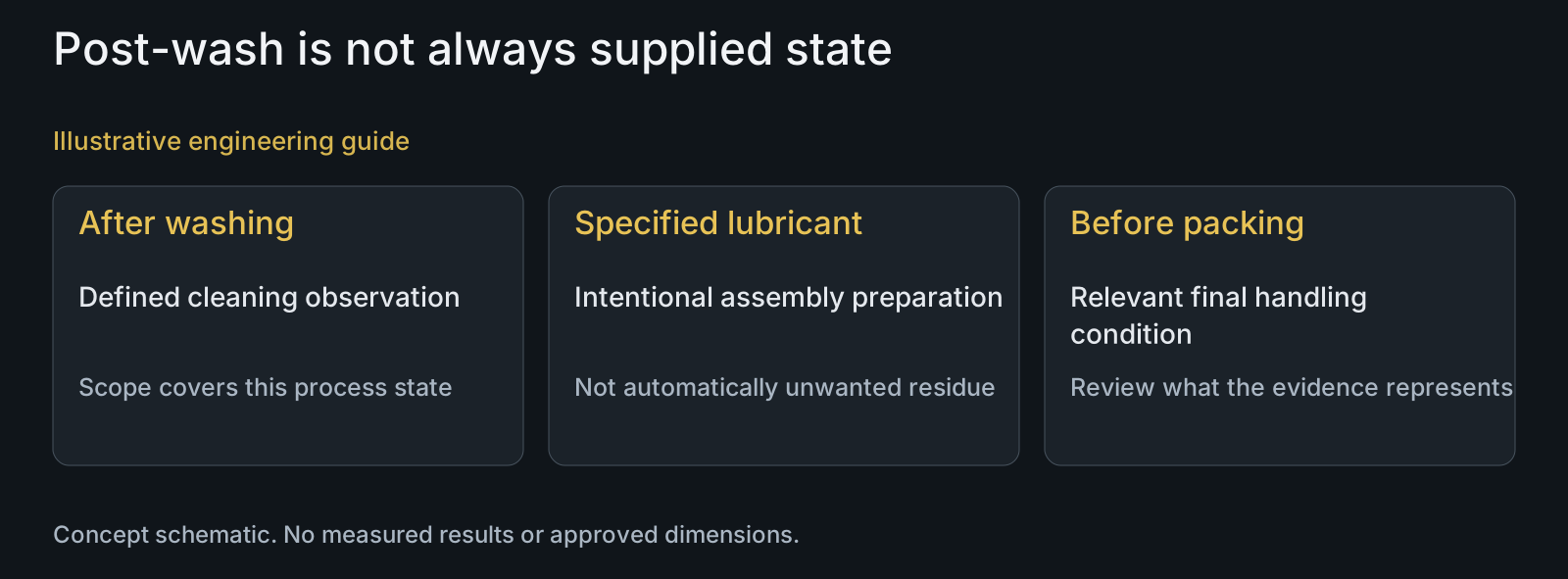
Place the relevant acceptance assessment at the state it is intended to represent. If a later operation applies lubricant, performs marking or opens the part to further handling, an earlier result has a narrower scope. Decide which controls or additional observations are required for the delivered state.
Sealing can preserve a defined condition but does not create it. Packaging also needs to protect functional surfaces from damage and keep components identifiable. The sealed-delivery guide addresses that related packaging task; this article does not claim a cleanroom, sterile pack or verified transport result.
Later lubrication changes the interpretation of a cleaning result
Illustrative engineering example: assume an OEM requires a receiver free of unwanted machining residues, then separately specifies an assembly lubricant before packing. A proposed inspection describes the part only immediately after washing. No actual residue value or cleaning trial is supplied.
The reviewer first distinguishes the intentionally added lubricant from prohibited residue. The supplied-state requirement must describe both, while the earlier observation can address only its stated post-wash condition. The team then reviews lubricant application and subsequent handling without incorrectly calling the requested film a cleaning failure.
If the buyer instead requires dry supply, that is a different scope and needs an explicit decision. Send the component drawing, residue concern and required supply state to manufacturing review. PremFixer can review cleaning and packing inputs; method capability, partner work and any quantitative evidence need confirmation for the project.
Questions buyers need to confirm
Does ultrasonic cleaning prove a pivot kit is clean?
No. It identifies a process. Define the contaminant, relevant surfaces, method and required supplied condition, then review whether the actual geometry and later operations are represented by the acceptance evidence.
Can a particle-mass report prove the absence of oil?
No. Particle and film contamination are different assessment subjects. Specify the unwanted film and applicable evidence separately; do not interpret a particle result as an oil-free certificate.
Must all pivot hardware be delivered completely dry?
Not universally. The order may require dry supply, a specified lubricant or protective treatment. State which applies to each BOM item and distinguish intentional preparation from prohibited residues.
Is deionized-water rinsing enough to guarantee no residue?
No. The rinse input does not establish the final result. Review the cleaning chemistry, relevant geometry, carryover removal and supplied-state acceptance rather than assuming one water description answers all of them.
Can inspection immediately after washing represent packed parts?
Only within an appropriate defined basis. Later lubricant application, marking, counting or packaging contact changes the process state. Identify those operations and decide what controls or final-state evidence are required.
What makes cleaning quotations comparable?
Provide component drawing and geometry, materials and finishes, residue concerns, required dry or lubricated state, quantities, acceptance method and units, reporting and packing scope. Avoid comparing a wash-only offer with one that includes the complete delivered-condition requirement.
Technical references and scope
Elma Schmidbauer: Ultrasonic cleaning. Full relevant cavitation, geometry/contaminant inputs and clean-rinse-dry descriptions read. No frequency, chemistry, temperature, universal residue-free or medical validation claims adopted.
ISO16232:2018 public scope. Full official abstract and current published status read. Particulate versus film scope and absence of component-specific limits only; full extraction/test clauses not accessed, no mandatory bicycle applicability claimed.
Explore related component, material and sourcing decisions in the customer decision knowledge center. For a drawing review, use the Drawing/BOM RFQ path.
Define cleaning for the hardware condition you need
Send drawing and BOM, materials and finishes, marked residue-sensitive areas, quantities, required dry or lubricated supply state and any cleanliness specification. PremFixer will review cleaning access, rinsing, drying, subsequent handling and the acceptance evidence that belongs in the manufacturing and packing scope.
Discuss the drawing and BOM