

A returned pivot bolt can be traced to a material heat only if its identity still connects to the relevant manufacturing and packing records. Begin with what the customer actually retained: a part marking, kit label, installation record or shipment reference. Then verify the path back to the represented stock and forward to other delivered groups. If several lots became indistinguishable after unpacking, report the possible population instead of assigning one heat to the loose bolt. For an OEM or SQE, the decision is whether the available links support a narrow investigation or leave a wider unresolved scope. Neither an MTC nor a kit label alone answers that question.
Hero: concept illustration of example hardware and its application. It is not a factory photograph, tested component or approved production geometry.
Start with the returned object, not a certificate
Photograph and describe the returned component before separating it from the available packaging. Record its part number, apparent revision, location in the assembly and any readable identification. Distinguish information observed on the object from information reconstructed from purchase history.
A label retained with the exact kit offers a different starting point from a loose axle found in a shared service bin. Do not select a convenient shipment solely because its date is near the reported problem. If the customer has replacement hardware or several purchases, those alternatives belong in the identity review.
The digital lot traceability guide explains the general record architecture. This review tests whether a specific returned object can actually use that architecture after receiving, assembly and service.
Verify each upstream link and identify the first ambiguity
Follow the available kit or component reference to its packing population, relevant finished group, processing history, cutting group and represented stock heat. The names may differ across records; an explicit relationship matters more than identical printed numbers.
GS1's Global Traceability Standard describes upstream origin queries and downstream population queries. It also distinguishes lot identification from identification of individual instances. These are useful general concepts, not evidence that a particular supplier uses GS1 or that every order has serial tracking.
If a cutting group contains stock from two heats without a surviving distinction, preserve both possibilities. A downstream inspection report does not restore the lost material identity. For the stock document's own subject and limits, use the material certificate guide.
| Available starting point | Potential conclusion | Unresolved risk | Useful review |
|---|---|---|---|
| Unique component identity with surviving links | One represented component history | Marking is readable but not linked to records | Retrieve its actual manufacturing and packing relationships |
| Retained kit identity with one component lot | A defined group-level origin | Substitutions occurred after receiving | Compare kit contents and installation history |
| Kit identity with mixed axle lots | Several possible axle origins | One possible heat is reported as certain | List each possible lot and its upstream link |
| Shipment reference only | A wider delivery population | Several kits or revisions are conflated | Separate item, revision and packed groups |
| Loose part from a shared service bin | Identity remains uncertain | Appearance is used as evidence of origin | Record the limit and investigate retained handling records |
| Known process subgroup | Related processed outputs | Every part from the same heat is treated as identical | Follow that subgroup to its actual delivery destinations |
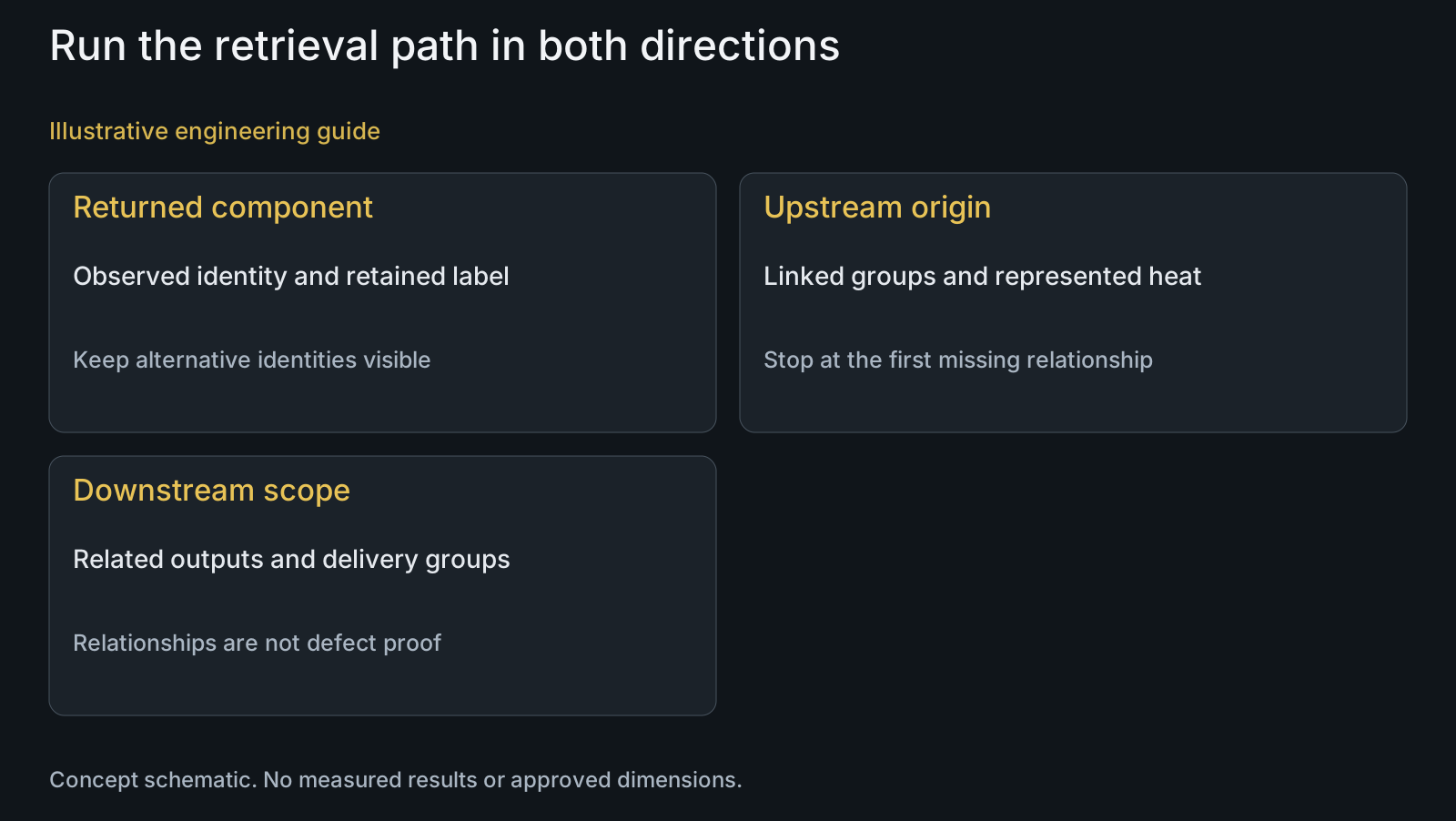
Reverse direction before deciding which deliveries are related
After identifying an upstream group, follow its outputs toward the relevant finished groups and delivered kits. One heat can feed several part revisions or processing routes. A stock-related question and a finish-related question therefore need not select the same population.
Describe the observation first. A suspected material issue may justify reviewing the represented stock population; a question about a particular rework route may concern its output subgroup. Traceability identifies relationships, while the technical investigation determines whether those relationships are relevant to the failure mechanism.
Do not equate common origin with proven common defects. Keep the customer quality team's containment decision separate from a supplier's record search. The pivot failure guide addresses mechanism review rather than treating trace links as a root-cause conclusion.
Preserve the identity through customer handling
Agree where the customer needs the identity to survive: unopened delivery, line-side replenishment, completed assembly or later service. A package-level reference may be sufficient for controlled receiving yet inadequate once identical axles enter a common bin.
Separate bins or a retained installation-to-kit relationship can support the agreed group-level review without individual serial marks. Permanent unit identification is a different design and handling requirement. Assess its location, readability and relevance rather than demand marking on a functional bearing seat by default.
The customer must also describe substitutions and replacement-kit handling. A service record that names only the bicycle model cannot establish which manufacturing group supplied a replaced axle. Agree responsibilities for the required records and retrieval period; no universal retention period is prescribed here.
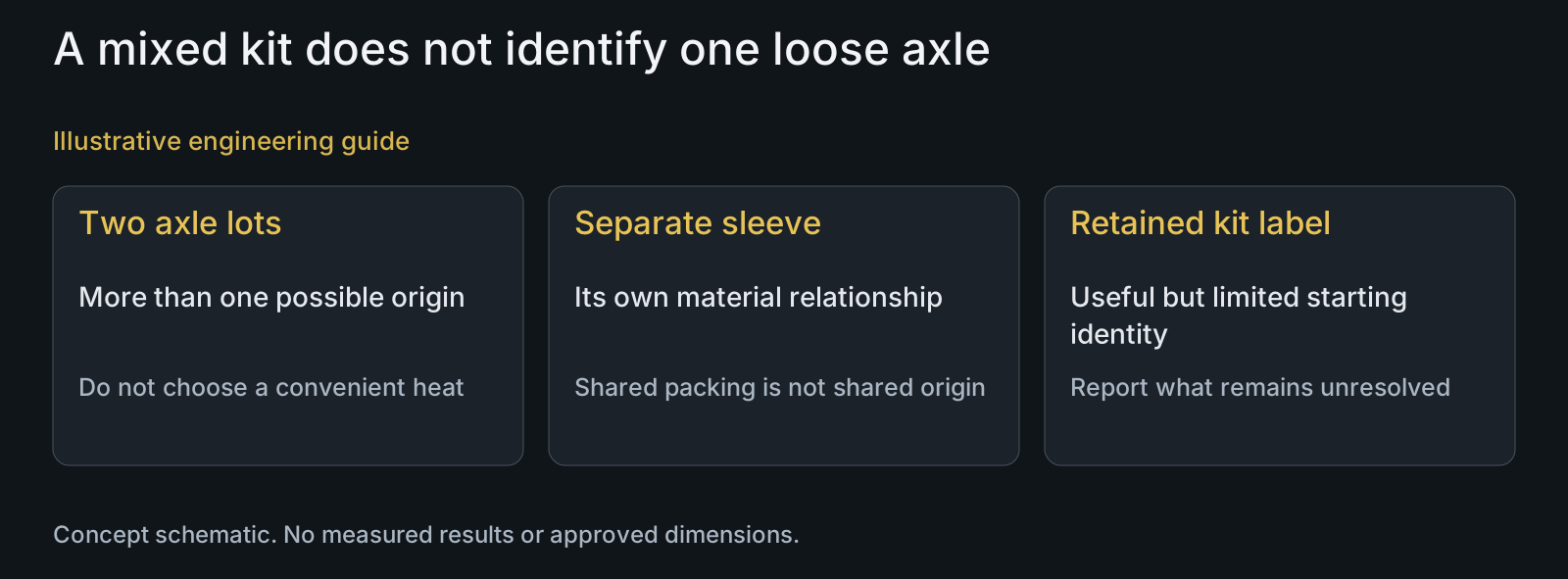
Illustrative engineering example: a kit label survives, an axle lot does not
Illustrative engineering example: assume a kit packing group contains axles from two finished lots and sleeves from a separate material source. A customer returns one loose axle with the kit reference, but the packing record does not distinguish which axle lot went into that individual kit. No actual defect, shipment or test result is assumed.
The kit reference leads to two possible axle populations. The sleeve's heat is irrelevant to identifying the axle and must not be copied into its record. Reviewing the upstream links may identify the represented heat for each possible axle lot, but it still cannot assign either heat uniquely to the returned piece.
The defensible output lists confirmed links and the unresolved alternative, then identifies the corresponding possible deliveries for further review. A future packing or handling change may narrow that uncertainty. It does not retrospectively prove the identity of this return or demonstrate a successful corrective action.
Review a retrieval result rather than promise every-piece traceability
Ask for a demonstration using one agreed reference: what can be retrieved, what population it represents and what cannot be distinguished? Compare the returned identity with the corresponding quantities and destinations where available. Quantity reconciliation is a useful inconsistency check, not proof that a missing link exists.
PremFixer manufactures custom hardware against customer inputs. The manufacturing scope and materials overview provide component context, not a guarantee that every project supplies every trace record. Define the requested links and customer-side handling conditions before treating them as order deliverables.
Keep the retrieval output concise: confirmed identity, possible alternatives, represented records and the missing relationship. Use the customer decision knowledge center for adjacent specification and quality questions. A transparent limit is more useful than a universal claim the available evidence cannot support.
Questions buyers need to confirm
Can every returned pivot bolt be traced to one heat?
Not automatically. The returned identity must distinguish the relevant origin through the retained records. A mixed kit or shared bin can leave several possible heats; record that uncertainty rather than claiming unique per-piece identification.
Does an intact kit label resolve a mixed axle-lot question?
Only if its component relationships distinguish the relevant axle population. A kit reference that leads to two possible lots identifies the alternatives, not which one supplied the loose return. Provide the packing and subsequent handling records.
Must every pivot bolt have an individual serial mark?
No universal requirement is asserted here. Choose the identity granularity for the intended receiving, assembly and service review. If unit-level distinction is required, assess marking and handling continuity; a package code alone may not preserve it.
Should all parts from a common heat be treated as having the same failure?
No. Common origin is a relationship, not a failure diagnosis. Establish the observation and compare relevant manufacturing, treatment, geometry and application evidence before the responsible quality team defines its investigation or containment scope.
Can a dimensional report repair a missing stock-to-part link?
No. It may describe the inspected population but cannot independently reconstruct lost material identity. Check its represented part and lot, retain any possible upstream alternatives and identify the specific missing relationship.
What should an OEM provide for a reverse-trace review?
Provide the returned-part photos, drawing revision, kit or shipment references, retained labels and installation or service history. Explain mixed-bin handling, replacements and the observed issue so PremFixer can discuss the records needed and the limits of the proposed retrieval.
Technical references and scope
GS1: Global Traceability Standard release 2.0. Public upstream/downstream query concepts and lot versus instance identification. No PremFixer GS1 system, certified implementation or prescribed universal identifiers asserted.
Explore related component, material and sourcing decisions in the customer decision knowledge center. For a drawing review, use the Drawing/BOM RFQ path.
Define a usable retrieval path for your pivot kit
Share the part drawings, item-level BOM, proposed kit structure, identification needs and any available return or shipment references. PremFixer can review the requested material, process and packing relationships and the customer handling information needed to make that retrieval useful.
Discuss the drawing and BOM