
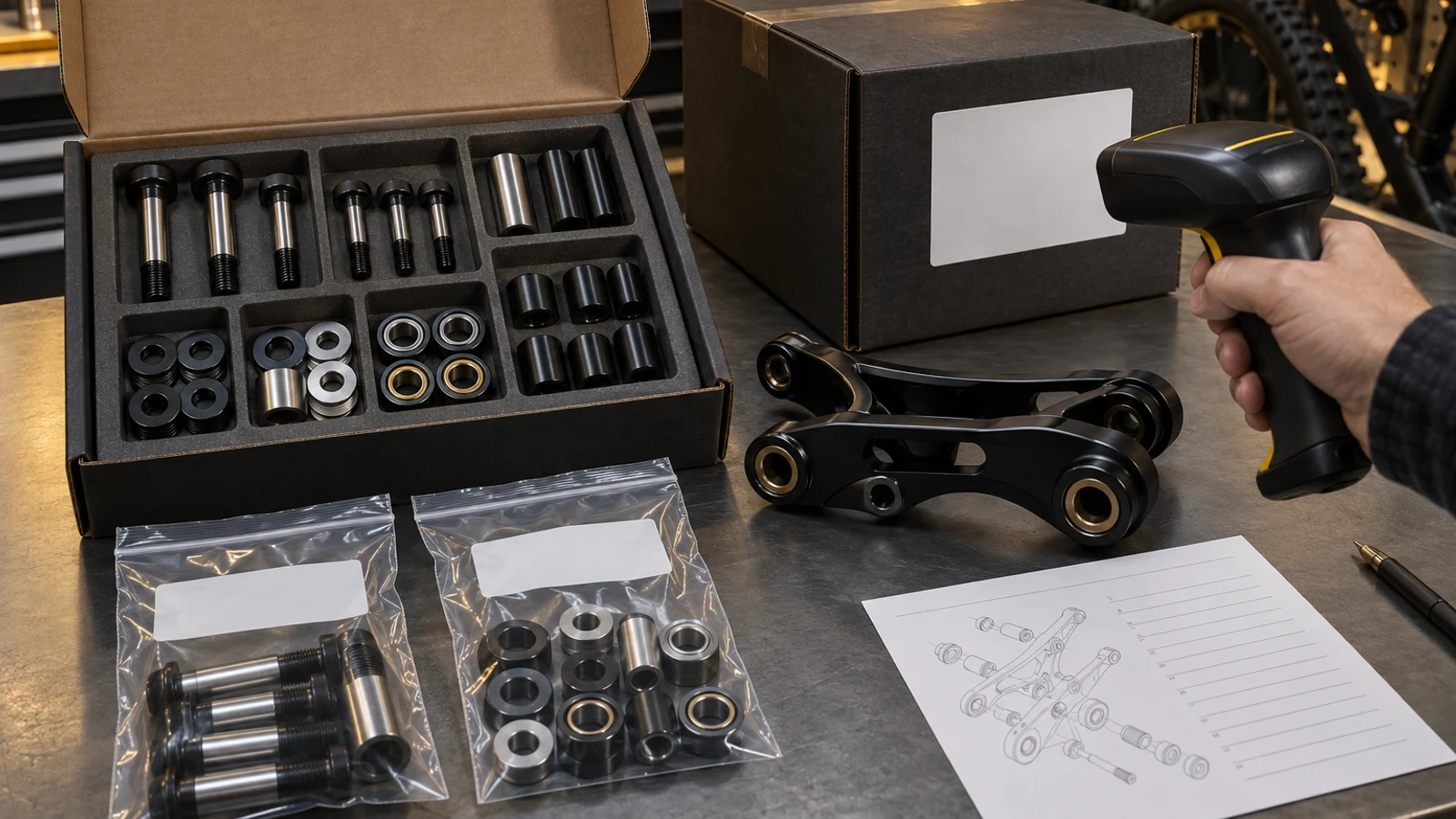
A pivot-hardware package label should let the receiving or assembly team identify the correct supplied part, revision, quantity and lot without guessing from appearance. Specify whether it identifies an individual component pack, a complete kit or an outer shipping unit. Then connect that identity to the BOM and shipment data at the same level. Look-alike bolts with different shoulders can share a finish yet belong to different joints. A readable label is therefore useful only when its content is correct and its meaning survives unpacking. Material, dates and standards references are additional agreed fields, not substitutes for component identity or proof of conformity.
Hero: concept illustration of example hardware and its application. It is not a factory photograph, tested component or approved production geometry.
Start with the person using the label
Receiving needs to reconcile the delivery with the order. An assembly station needs to distinguish the item it will install. Service supply may need a kit configuration and applicable customer model or revision. Those tasks can require different information even when the physical hardware is unchanged.
Identify the label's use before specifying its layout. A prominent outer-carton number helps locate a shipment but may be useless once small bags are separated at the line. Retain the necessary identity on the layer that remains with the parts during the intended handling route.
Do not infer universal bicycle compatibility from a service label. Any platform applicability should come from the customer's controlled definition. PremFixer supplies to drawing, sample, interface and BOM requirements; a product image or familiar bolt appearance is not an approved fitment list.
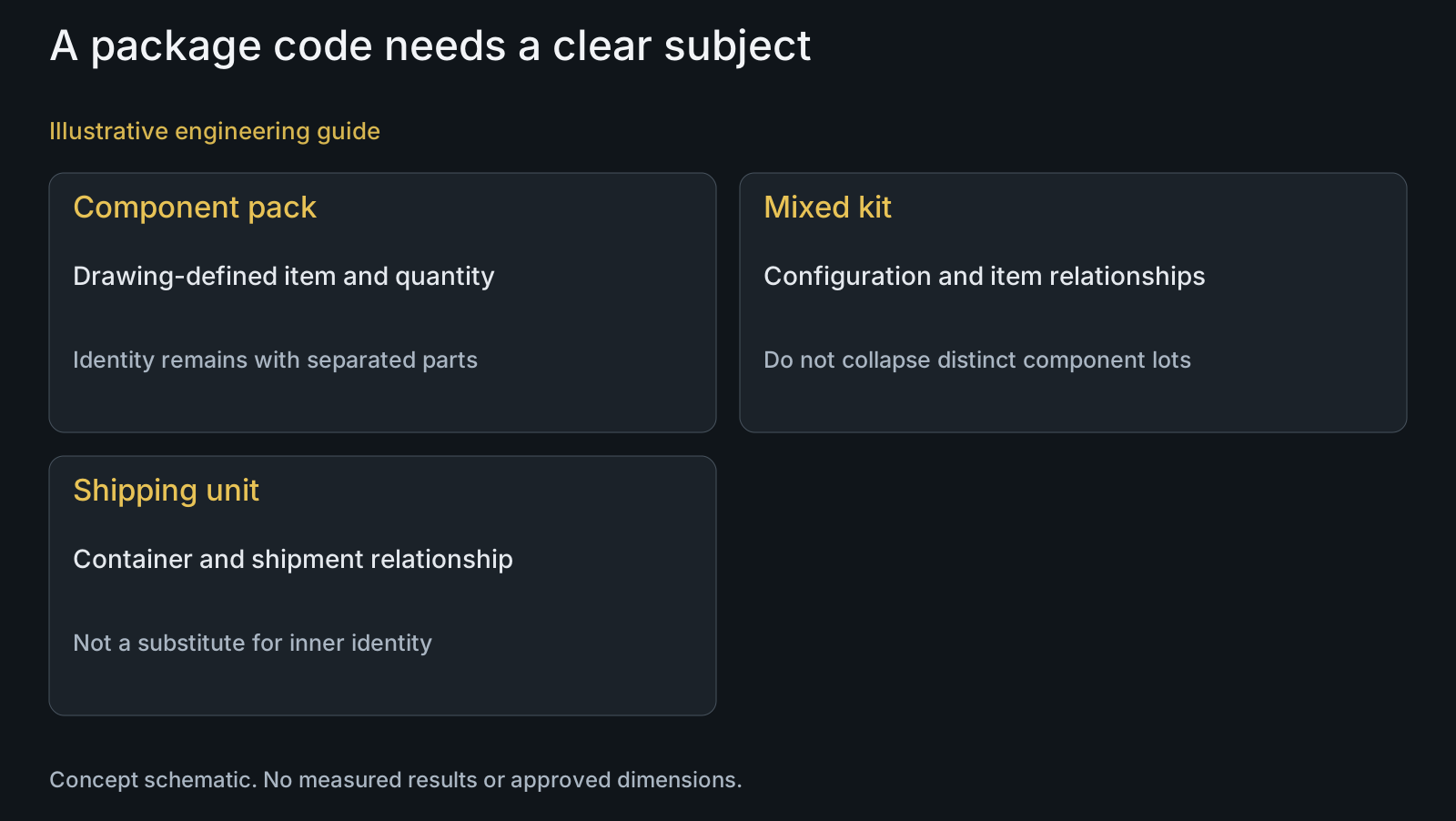
Separate component, kit and shipping-unit identities
A component part number identifies a particular drawing-defined item. A kit identity represents a specified combination and quantities. A shipping-unit identity represents the container used for logistics. Reusing one unexplained code at every level can make receiving appear orderly while losing item-level meaning.
For mixed kits, define how each component's production or material records relate to the kit. One kit code does not establish that all enclosed parts share one material or production lot. Preserve the actual relationships without putting an ambiguous single lot against unlike components.
The GS1 logistics-label explanation identifies SSCC as the required identifier within that labeling system and explains its connection to electronic messages. That system-level rule is not a universal mandate for every custom pivot bag, nor a replacement for the customer's item and revision requirements.
| Packaging level | Useful identity | Ambiguity risk | Review method |
|---|---|---|---|
| Single component pack | Part, applicable revision, pieces and lot | Similar geometry called one generic bolt | Reconcile label with item drawing |
| Mixed kit | Kit configuration and component mapping | One kit lot mistaken for all component lots | Reconcile quantities with BOM |
| Outer carton | Shipment/container and contained packs | Identity lost when carton is discarded | Trace unpacking route |
| Line-side refill | Retained item and count units | Pieces confused with sets | Observe station interpretation |
| Service pack | Controlled configuration/applicability | Appearance used as fitment evidence | Check customer definition |
| Machine-readable label | Agreed fields and encoding | Beep mistaken for correct data entry | Check received field values |
Give each printed field a defined meaning
State which part number and revision the pack represents. If the supplier and customer use different identifiers, define their mapping rather than rely on matching descriptions. The same short phrase, such as black pivot bolt, can describe multiple non-interchangeable geometries.
Define quantity units explicitly: pieces, sets or complete kits are different counts. Where each set contains several components, the quantity per set belongs to the BOM relationship. A carton with the expected total number of pieces can still contain the wrong balance of components.
Material, production date, packaging date or a standards reference may be useful when agreed, but their subject must be clear. A date without an event definition is ambiguous. Printing a material standard on the package does not itself prove the allocated material's conformity or the finished part's inspection result.
Treat scanning as data interpretation, not just a beep
Agree the customer's required encoding and data structure before preparing the label. A scanner successfully detecting a symbol does not establish that the receiving system reads the intended item, quantity and lot into the correct fields. Test the interpretation using the customer's actual workflow.
Keep human-readable identity usable when a scanner is unavailable or the pack is partially handled. Check the label location, contrast and survival through the intended protective layer. Do not specify arbitrary dimensions or barcode grades without the applicable customer or system requirements.
Use a clearly identified layout example for this discussion, not invented live lot numbers. If the customer requires GS1 logistics identification, the GS1 guideline is the relevant system reference. Customer-specific internal codes need their own defined receiving agreement rather than being presented as GS1-compliant by appearance.
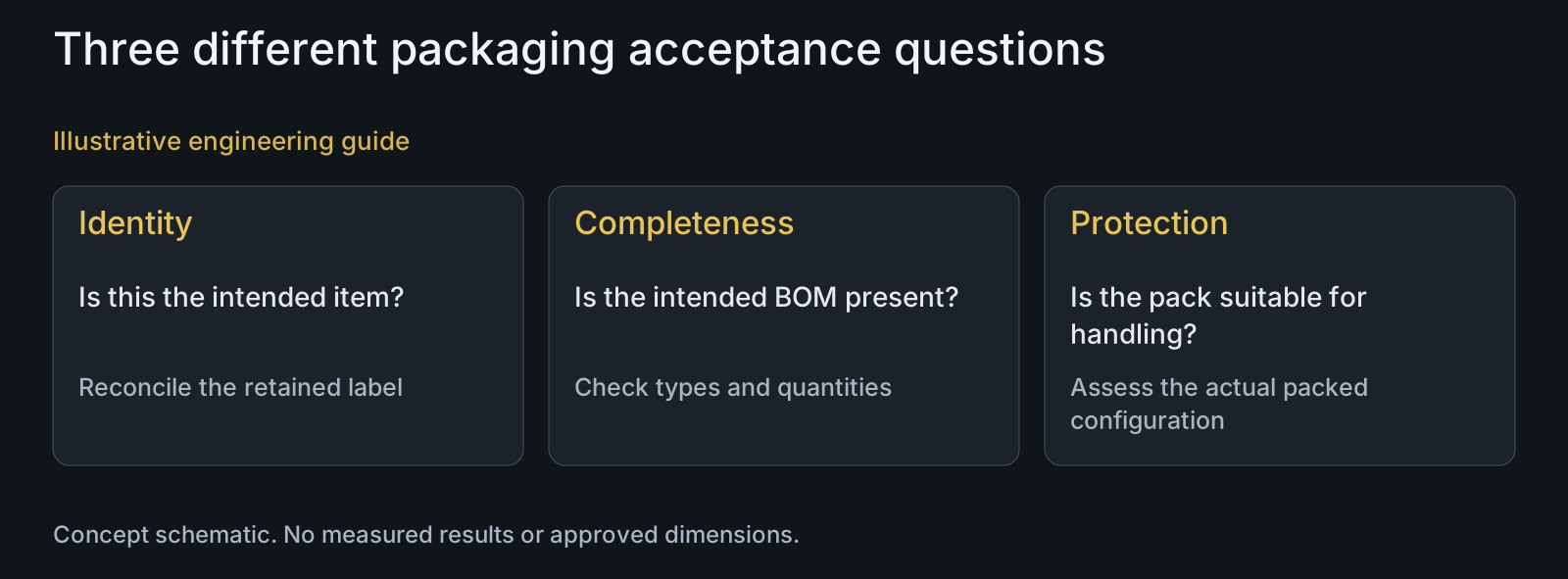
Keep protection, completeness and identity separate
Sealing a bag can preserve separation, but it does not show that the enclosed item or count is correct. Reconcile the actual kit content with the specified BOM before treating a label as a complete-kit statement. Handed components and similar spacers deserve explicit identification where confusion is possible.
Packaging protection has a different question: whether movement, contact, moisture and handling can damage the delivered parts. The packaging-protection guide addresses that scope. A neat label or sealed presentation is not a cleanroom classification, corrosion guarantee or successful transport test.
For repeat supply, control label changes alongside relevant item or kit changes. Avoid leaving obsolete identities on reused outer packaging. Coordinate the agreed format with manufacturing and the shipment scope in the export-deliverables guide.
Illustrative review: a kit becomes separate line-side packs
Illustrative engineering example: assume an OEM receives a kit containing two visually similar shoulder-bolt types and several spacer types. The outer carton names the kit, but its inner packs carry only a generic material description. No wrong installation or measured improvement is assumed.
At the assembly station, the carton is discarded and each pack moves to a different bin. The outer identity no longer helps the operator distinguish the two bolts. The review therefore adds the necessary component identity, revision relationship and quantity unit to the retained inner-pack labels while preserving the kit-to-component mapping.
A sample layout is then read and scanned through the agreed receiving process. The decision is about keeping identification usable after unpacking, not adding every possible field to every label. The example does not claim an implemented customer system or proven error-rate reduction.
Questions buyers need to confirm
Must every pivot bag show the same universal fields?
No. Define the customer's receiving and use requirements at the relevant packaging level. Part identity, revision relationship, quantity and lot often serve distinct purposes. Additional dates, materials or standard references need agreed meanings rather than an unexplained mandatory list.
Can one outer-carton label identify all inner packs?
Only while the required relationship remains usable. If packs are separated, the necessary item identity should stay with them. Review the unpacking and line-side route rather than assume the outer carton always accompanies the parts.
Can a kit lot replace all component lot identities?
Not without preserving their actual relationship. A mixed kit can contain parts from different production or material allocations. Specify the mapping needed for traceability instead of implying that one kit code makes all enclosed histories identical.
Does a successful scan prove the label is correct?
No. Confirm that the receiving system interprets the intended values in the intended fields. Also check the represented item, count unit and lot relationship. Symbol detection alone does not validate the underlying data.
Does printing a standard number prove the hardware complies?
No. A printed reference describes an agreed requirement only when its subject is clear. Actual material or part conformity requires the applicable evidence. Avoid making a package label stand in for a report it does not contain.
What should accompany a labeling RFQ?
Send the BOM, identifiers and revision rules, quantities per item or set, lot relationships and customer label/data requirements. Add the unpacking route and a clearly marked layout example. PremFixer can review the delivered identification scope without inventing live batch data.
Technical references and scope
GS1: compulsory data within its logistics label system. SSCC's logistics-unit role and electronic-message connection; not asserted as a universal requirement for custom pivot packs.
GS1 Logistic Label Guideline. System-specific logistics labeling reference only; no compliant example identifier, label dimension or barcode verification result fabricated.
Explore related component, material and sourcing decisions in the customer decision knowledge center. For a drawing review, use the Drawing/BOM RFQ path.
Define the identity that must stay with each pack
Share the BOM, component and kit identifiers, revision relationships, quantities and customer label format. Add receiving-system fields and the handling route after unpacking. PremFixer can review how packaging identity connects to the supplied configuration and manufacturing records.
Discuss the drawing and BOM