
Changing a bicycle pivot supplier requires more than sending a previous sample to a new machine shop. Transfer the controlled component and kit requirements, qualify the proposed production scope and establish a cutover that preserves supply and identification. Decide separately whether components from the two sources may be combined. That is the direct approach for a brand replacing a bolt, axle or complete pivot kit. Similar appearance and matching nominal thread size do not establish an approved mixed assembly. Plan overlap, existing-stock use and service support around documented requirements and responsible decisions; no fixed transition duration or uninterrupted-supply guarantee follows from a new quotation.
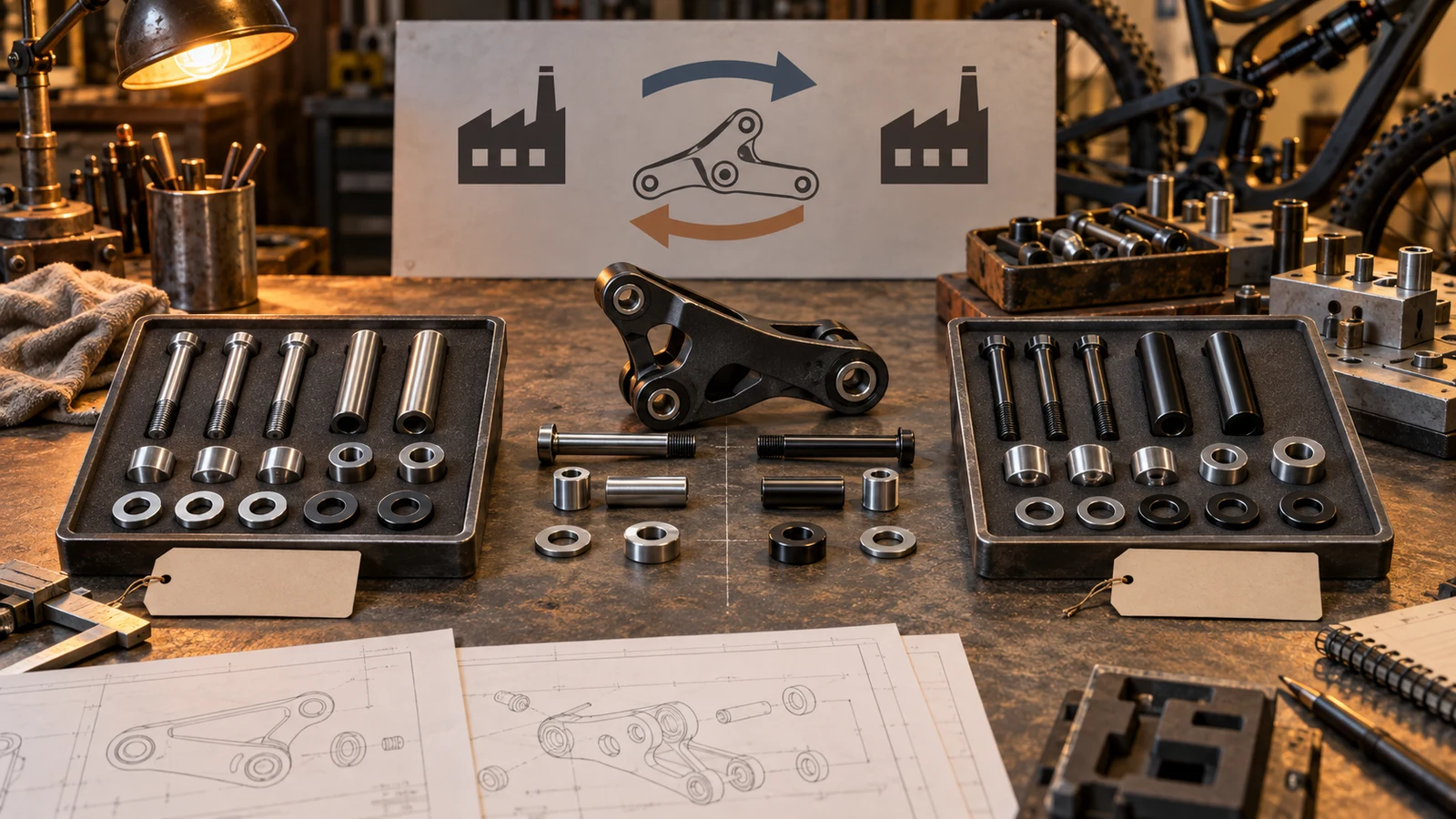
Hero: concept illustration of example hardware and its application. It is not a factory photograph, tested component or approved production geometry.
Transfer a controlled definition, not only an old part
Identify the drawings and revisions, kit BOM, specified materials, finishes, interfaces and assembly requirements being transferred. Explain whether the replacement scope is one component or the whole kit. A sleeve made to a separate drawing remains part of the fit and clamped-stack decision even if the new quotation lists only the bolt.
A physical sample can clarify features but may include wear, an earlier revision or undocumented processing. Resolve differences between sample, drawing and current approved configuration before making the sample the only acceptance basis. Send mating-interface information where the isolated part cannot define its function.
Identify available tooling and the permitted use of transferred files or hardware. Do not assume ownership, transfer rights or suitability from possession of a sample. The drawing-file RFQ guide helps organize usable inputs; unresolved rights and existing obligations require the parties' own review.
Qualify the new route for the requirements that matter
Compare the proposed material condition, machining, forming, threading, finishing and measurement route with the evidence needed for the ordered hardware. A new source can retain the product definition while using different equipment or process partners. Earlier supplier evidence should not silently stand for that different route.
Define first-article dimensional scope, representative production checks and customer assembly or application validation where relevant. These answer different questions. A sample that enters the frame does not alone establish every finished feature or repeat-production condition. Specify the represented configuration and the responsible reviewer.
PremFixer's manufacturing scope and sample route provide discussion paths, not automatic source approval. Project-specific requirements determine what can be supplied and what additional customer or qualified-partner work needs confirmation.
| Transfer choice | Potential useful scope | Risk if assumed | Evidence or authority needed |
|---|---|---|---|
| Sample-only transfer | Clarify visible geometry | Wear or old revision treated as current | Reconcile with controlled requirements |
| New-source sample | Evaluate identified features | Fit sample treated as serial readiness | Match production and finished condition |
| Two complete kits in overlap | Retain source-specific populations | Components mixed at receiving | Keep kit identities and approved uses |
| Cross-source component mix | Use selected existing stock | Independent conformity mistaken for fit | Evaluate exact interfaces and combination |
| Full purchasing cutover | Move defined future supply | New route or quantity still unresolved | Confirm qualification and usable supply |
| Older service stock | Support identified earlier platforms | New kit approval applied to old bicycles | Retain authorized service mapping |
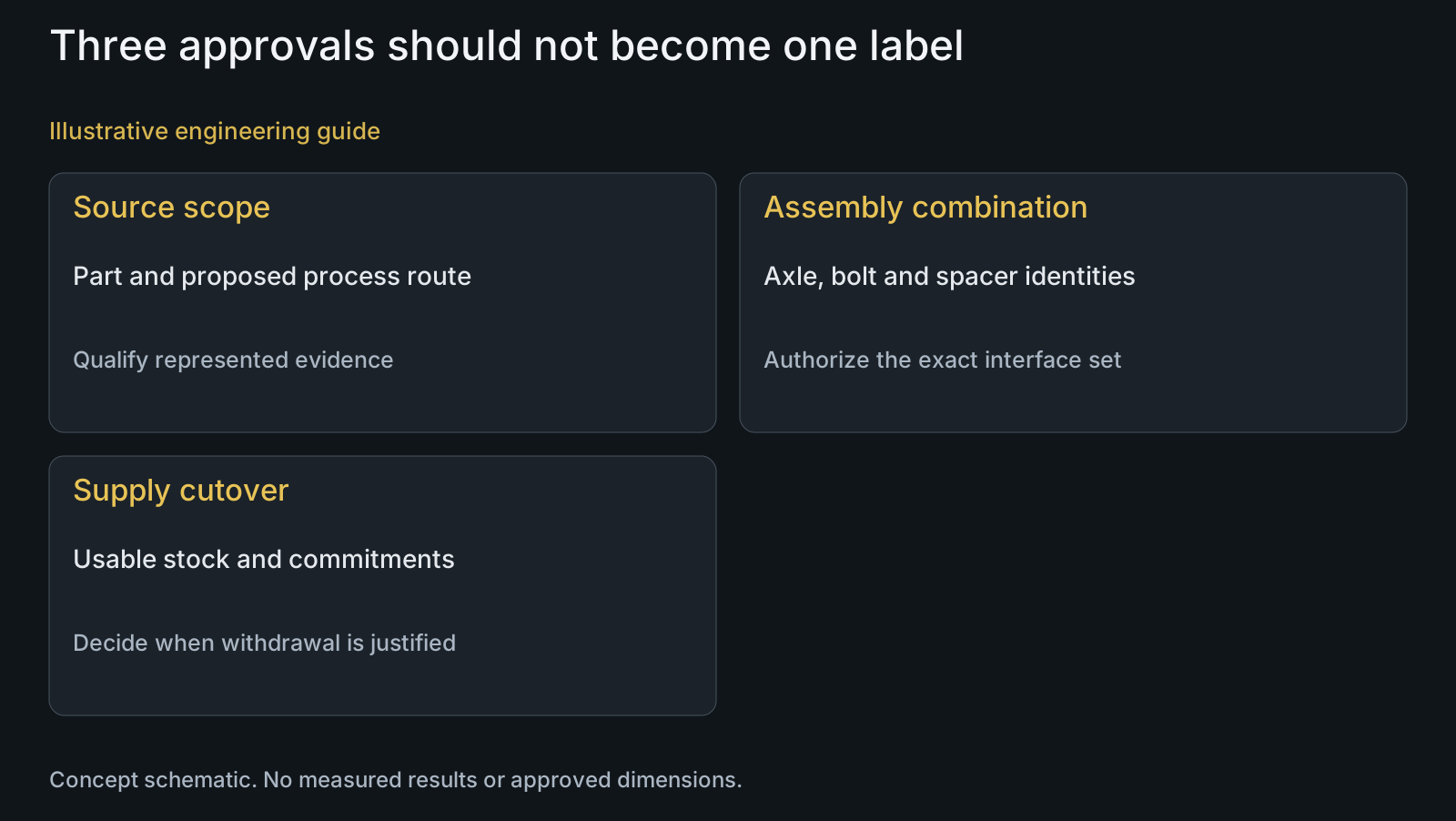
Treat overlap supply as separation until mixing is authorized
Supply overlap can protect the schedule while qualification remains in progress, but it also creates two physical populations at receiving. Keep source, part, revision and kit relationships distinguishable. A bin of look-alike bolts removes the information needed to manage an unresolved compatibility question.
List intended combinations: former complete kit, replacement complete kit and any proposed cross-source component combinations. Check the actual shoulder, spacer stack, bearing contact, seating and thread-engagement relationships for the combinations that might occur. Do not infer compatibility because each component independently conforms to its own drawing.
The revision-compatibility guide addresses changed component definitions. A source transfer adds a separate question about represented production evidence, even when drawing revisions remain unchanged. Keep those boundaries visible rather than forcing an unnecessary revision or assuming no review is needed.
Base cutover on readiness and usable supply
Separate a preferred-source decision from permission to withdraw the previous supply. Confirm required new-source decisions, usable quantities, production scope and the supply arrangement actually available. A promised capacity slot is not the same as accepted and available hardware at the buyer's operation.
Identify what happens if qualification or a necessary partner process takes longer than expected. Possible choices include extending authorized overlap, changing the cutover scope or agreeing an interim complete-kit arrangement. Each needs its own commercial and technical basis; none is a blanket promise to eliminate every interruption.
NASA's configuration-management planning outline identifies supplier or responsibility changes as reasons to reevaluate configuration planning. This supports the general need to revisit interfaces and responsibilities. Its aerospace context is not adopted as a mandatory bicycle supplier-transfer procedure.
Give existing stock and service supply their own decisions
Separate raw material, work in progress, finished components, complete kits and service packs. Their usability may differ. A former-source complete kit can remain relevant to its original platform while an isolated component still lacks authorization for a new-source mixed assembly.
Agree the authorized use, hold, rework, return or other disposition of each affected population. A purchasing cutover date does not make earlier physical parts disappear or change their geometry. Retain identification so receiving and service teams can apply the actual decision.
For service support, define the relevant bicycle configuration and whether replacement is at component or complete-kit level. Transfer of new production does not establish backward interchangeability. Do not relabel older stock as a replacement-source lot or assume that every obsolete purchasing item must be discarded.
Illustrative review: a replacement axle with existing spacers
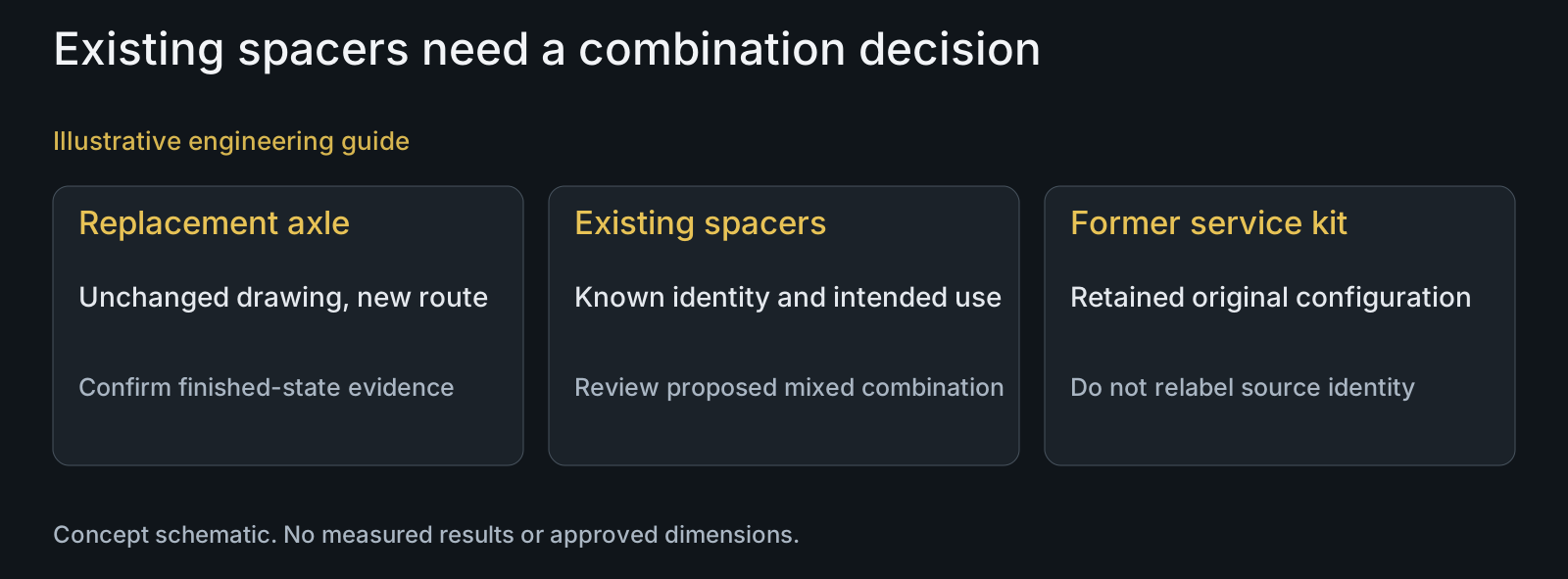
Illustrative engineering example: assume a brand proposes sourcing an axle from a new supplier while holding former-source spacers and service kits. The axle drawing is unchanged, but the new proposed route uses different machining and finishing arrangements. No actual inventory quantities, dimensions or qualification results are provided.
The team first defines the new-source evidence needed for the finished axle. It separately examines the proposed axle-and-existing-spacer combination and retains former complete kits under their existing configuration identity. A passing isolated axle report, if later obtained, would not by itself establish every service combination.
The cutover decision depends on those required reviews and the usable supply arrangement. Until then, separated populations preserve options without claiming approval. The example illustrates a transfer decision; it does not document a successful PremFixer takeover, a customer incident or a guaranteed overlap period.
Questions buyers need to confirm
Is an old pivot sample enough to change suppliers?
Not as the sole controlled definition. Reconcile it with the current drawings, material and finish requirements, kit BOM and mating interfaces. A sample may be worn or represent an earlier revision. Resolve those differences before defining acceptance for the replacement source.
Does an unchanged drawing eliminate new-source qualification?
No. The proposed manufacturing and finishing route can differ even when the product definition remains unchanged. Identify what evidence must represent the new conditions and who accepts it. Do not automatically transfer another supplier's reports to the new source.
Can parts from both suppliers be used during overlap?
They can remain in separately identified authorized populations. Mixing components requires a basis for the exact assembly combination, not just similar appearance or separate drawing conformity. Check the relevant shoulder, stack, bearing, seating and engagement relationships.
When should the former supplier be phased out?
When the agreed new-source qualification, usable supply and relevant transition obligations support withdrawal. A new quotation date is not sufficient. Retain an identified contingency for unresolved production or partner-process readiness instead of assuming a universal overlap duration.
Must all former-source stock be scrapped at cutover?
No automatic disposition follows. Identify raw stock, work in progress, finished parts and service kits and agree their use or other action. Older complete kits may remain valid for their original configuration; a mixed-source use needs a separate decision.
What should a supplier-transition RFQ include?
Send controlled drawings and revisions, STEP models, the kit BOM and mating-interface requirements, proposed transfer scope, permitted sample and tooling information, qualification criteria and service needs. State the intended cutover and current-stock questions without assuming approval or a fixed schedule.
Technical references and scope
NASA Systems Engineering Handbook, Appendix M: CM Plan Outline. General configuration-planning context identifies changes in suppliers and responsibilities as reasons for reevaluation; not a bicycle qualification standard or transfer schedule.
Explore related component, material and sourcing decisions in the customer decision knowledge center. For a drawing review, use the Drawing/BOM RFQ path.
Define the hardware and evidence being transferred
Share the controlled drawings, STEP models, kit BOM, finished-state requirements, mating interfaces and proposed cutover scope through the Drawing/BOM RFQ path. PremFixer can review the manufacturing inputs and project evidence needs while keeping source qualification, mixed-kit authorization and existing-stock decisions separate.
Discuss the drawing and BOM