
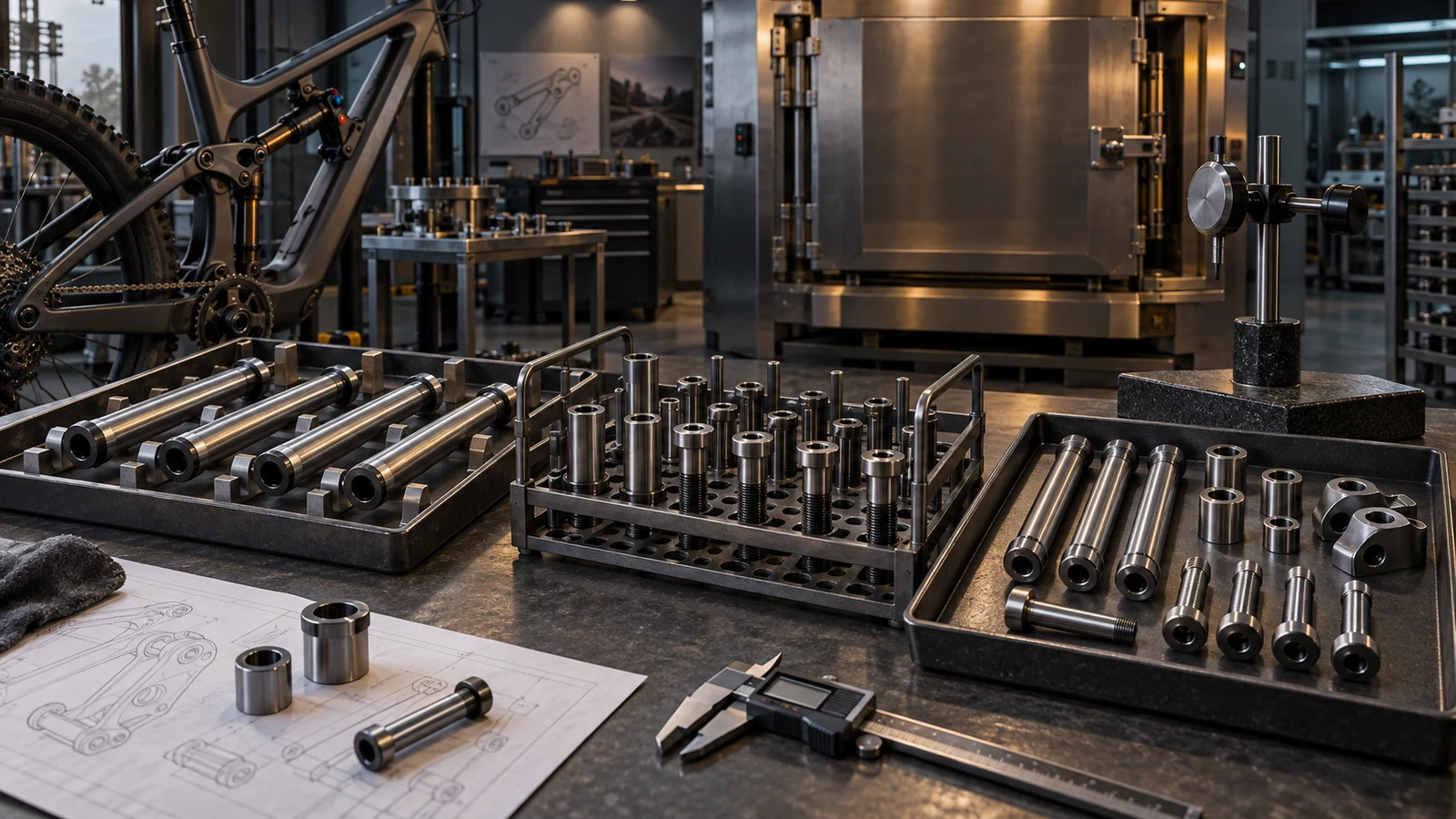
Heat treatment can change the geometry of a pivot axle or shouldered bolt, but a single small distortion figure does not prove the finished part fits. An OEM reviewing a thermal route needs separate answers for shaft size, straightness, shoulder relationships and required material properties. Loading supports and cooling conditions must suit the actual component and treatment objective. Some movement may be recoverable through planned finish machining; insufficient stock, inaccessible features or an incorrect material condition cannot be resolved by calling the average movement acceptable. Compare the route against the finished drawing rather than assume that a vacuum furnace guarantees precision.
Hero: concept illustration of example hardware and its application. It is not a factory photograph, tested component or approved production geometry.
Define the dimensional question before comparing furnaces
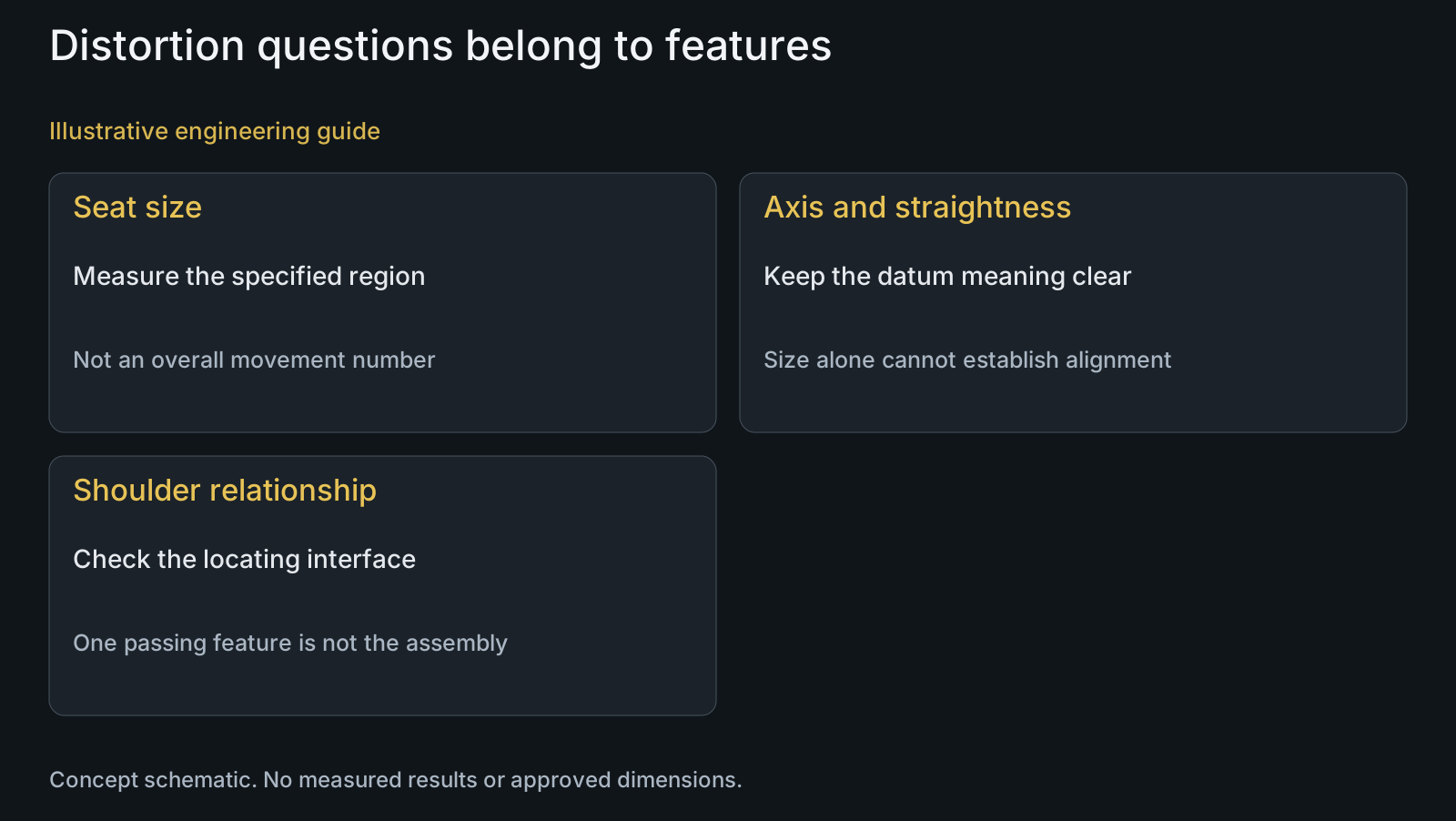
Specify what the reported movement means. Is it a diameter change, deviation from straightness, displacement of a shoulder, or a relationship between two axes? These quantities are not interchangeable. Ask which datum, measurement location and processing state produced the result.
For engineering review, map each affected feature to its function. A bearing contact diameter controls a different fit question from an end shoulder locating a spacer. One acceptable dimension does not establish the other. The full-suspension interface context helps identify which relationships matter to the assembly.
Compare before and after measurements using compatible definitions, not unrelated inspection summaries. If the original drawing does not identify a relationship needed for fit, resolve that omission with the design owner rather than invent a manufacturing acceptance limit.
Loading is a mechanical arrangement as well as a batch count
Bodycote specialists' gear heat-treatment discussion distinguishes pre-existing stress, high-temperature support effects and quench-related distortion. Its gear examples show why support and geometry matter; they do not qualify an orientation or fixture for a bicycle pivot.
Ask the processor where a long or hollow axle is supported, which surfaces touch the rack and how nearby parts are arranged. A proposal should describe the represented load boundary. Do not turn a general preference for vertical or horizontal loading into a universal instruction for every component.
If a denser batch or a different support arrangement is proposed, identify the features whose outcome needs comparison. The decision is whether the revised arrangement still supports the required result, not whether fewer parts always produce less movement.
| Feature or condition | Possible route decision | Risk to resolve | Useful verification |
|---|---|---|---|
| Long axle straightness | Review support and loading arrangement | Orientation assumed suitable for all shapes | Defined straightness in represented final state |
| Bearing seat diameter | Retain permitted finishing stock | Stock exists but not at the affected region | Final size and relevant form requirements |
| Shoulder-to-seat relationship | Plan the post-treatment setup | One dimension passes but relationship does not | Datum-based relationship measurement |
| Internal feature | Assess access before promising recovery | External finishing leaves bore issue unresolved | Specified internal geometry after the route |
| Material properties | Keep applicable cooling constraints | Less movement accepted with wrong condition | Specified material acceptance evidence |
| Treated surface layer | Review material removal permission | Recovery removes required surface condition | Remaining specified layer or property scope |
Cooling must preserve the material objective
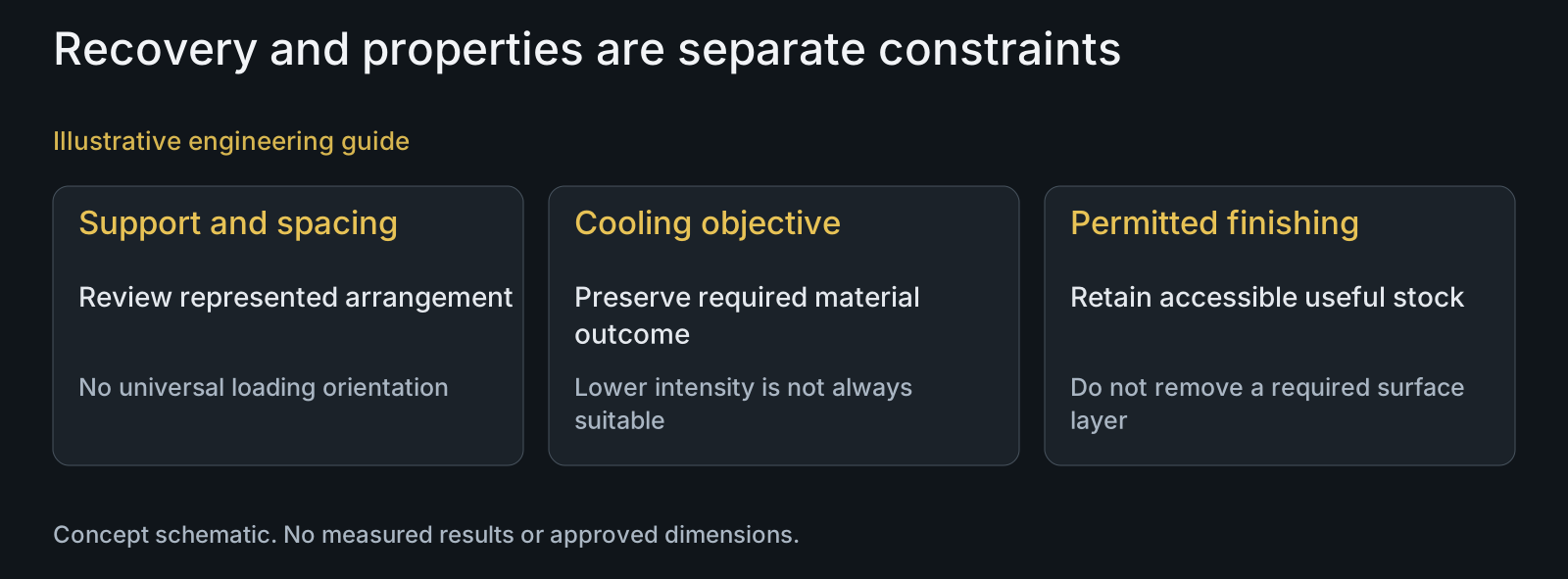
Ipsen's gas-quenching explanation discusses controllable circulation and temperature differences during cooling. Equipment pressure or cooling capability is a process input, not evidence that every loaded part retains its geometry.
For suitable steels, Bodycote's neutral-hardening description makes cooling part of obtaining the intended structure. Therefore, reducing cooling intensity solely to reduce movement is not automatically an acceptable change. The required properties remain a separate constraint.
An annealed titanium axle, a hardened steel bolt and an aluminum component in a specified temper do not share one cooling prescription. Use the material and treatment applicability guide to establish the relevant family, then have the thermal specialist assess the actual route.
Recovery needs accessible stock and a compatible final state
Planned finishing is useful only where material remains in the right places and the feature is accessible. Engineering review should identify the locating surfaces for the next setup, the areas allowed to be machined and the final relationships that must survive that setup.
Do not assume that additional allowance is harmless. On a component with a specified treated surface layer, removing material can conflict with that requirement. A material specialist must resolve the retained layer or property requirement before the machining route is accepted.
Machining an external seat does not by itself correct an inaccessible bore, an unacceptable material condition or an unapproved repair. Use the thermal and machining sequence guide for sequencing, while this review determines whether the particular feature is actually recoverable.
A changed load exposes a recovery gap
Illustrative engineering example: assume a steel pivot design requires a final bearing seat and a shoulder-to-seat relationship after a specified hardening route. The proposal changes from spaced supports to a denser arrangement, while leaving machining allowance and the quoted distortion description unchanged. No measured result is supplied.
The reviewer asks whether the allowance covers movement at both relevant features and whether the subsequent setup can establish their relationship. A diameter check alone cannot resolve that question. The processor also needs to show that any cooling adjustment remains compatible with the required material outcome.
The decision may be to retain the original arrangement, qualify the changed route, revise permissible finishing, or revisit the design. No option is declared successful without evidence. The example explains why an unchanged furnace name and one overall number leave important acceptance questions unanswered.
Quote the feature outcome rather than a furnace promise
Provide the CNC turning team with final datums, critical seats and allowable finishing regions. Connect the thermal requirement to the manufacturing process scope, including which inspection occurs before treatment and which represents the delivered component.
PremFixer can coordinate a defined partner-supported heat-treatment requirement with manufacturing from the customer drawing, sample and BOM. This is not a claim of furnace ownership, a fixed distortion capability or a universal repair route. An RFQ should distinguish development uncertainty from accepted finished-part requirements.
Questions buyers need to confirm
Does a vacuum furnace guarantee low distortion?
No. Furnace type does not establish the outcome for the actual geometry. Identify support, load arrangement, cooling requirements and feature-specific final measurements, together with material acceptance.
Is one reported distortion figure sufficient?
Not unless it answers the specified feature question. Identify whether it describes size, straightness or a datum relationship, where it was measured and whether the state is before or after finishing.
Should every long axle be loaded vertically?
No universal orientation is established here. Ask the processor to assess geometry, support contacts and the treatment conditions. A published example for another shape or material does not approve this loading.
Can slower cooling solve the dimensional problem?
It may change movement but must remain compatible with the material process. For a hardening route, cooling has a metallurgical purpose. Require assessment of both geometry and required properties rather than select speed alone.
Can all distortion be machined away?
No. Recovery needs accessible stock, an achievable locating setup and permission to remove material. Internal features, treated layers and incorrect material properties can prevent the proposed finishing from producing an acceptable part.
What should a distortion-control RFQ include?
Send drawing and STEP, alloy and incoming condition, required final properties, datums and critical interfaces, permitted finishing regions, quantities and the proposed thermal route. Include existing before-and-after measurements with their definitions and load context, if available.
Technical references and scope
Ipsen: Inert gas quenching technology. Cooling control and temperature-difference context; no numerical pressure, rate or dimensional capability adopted.
Bodycote: Neutral hardening. Cooling and intended steel structure; not a treatment prescription for titanium or aluminum.
Bodycote specialists: Heat Treat Process for Gears, 2013. Gear-context distortion causes and finishing constraints; no loading orientation, case depth or measured performance transferred to pivots.
Explore related component, material and sourcing decisions in the customer decision knowledge center. For a drawing review, use the Drawing/BOM RFQ path.
Review the thermal route against the finished pivot
Submit drawing, STEP and BOM or a representative sample, with material condition, critical datums, thermal requirements, finishing permissions and quantities. The review will separate loading and cooling questions from recoverable geometry and identify the evidence needed for the delivered interfaces.
Discuss the drawing and BOM