
Before approving branded pivot packaging, decide who receives the pack and what they must do with its contents. A production station, distribution warehouse and service technician can need different layouts for the same released hardware. Approve the protective arrangement, supplied quantities, identity fields and authorized artwork together. A prominent logo does not prove that the right parts are present, that a scan returns the intended information or that a package protects the kit on its planned route. Discuss your actual BOM and handling conditions with PremFixer; do not treat a conceptual package image as a tested design or a standard retail offer.
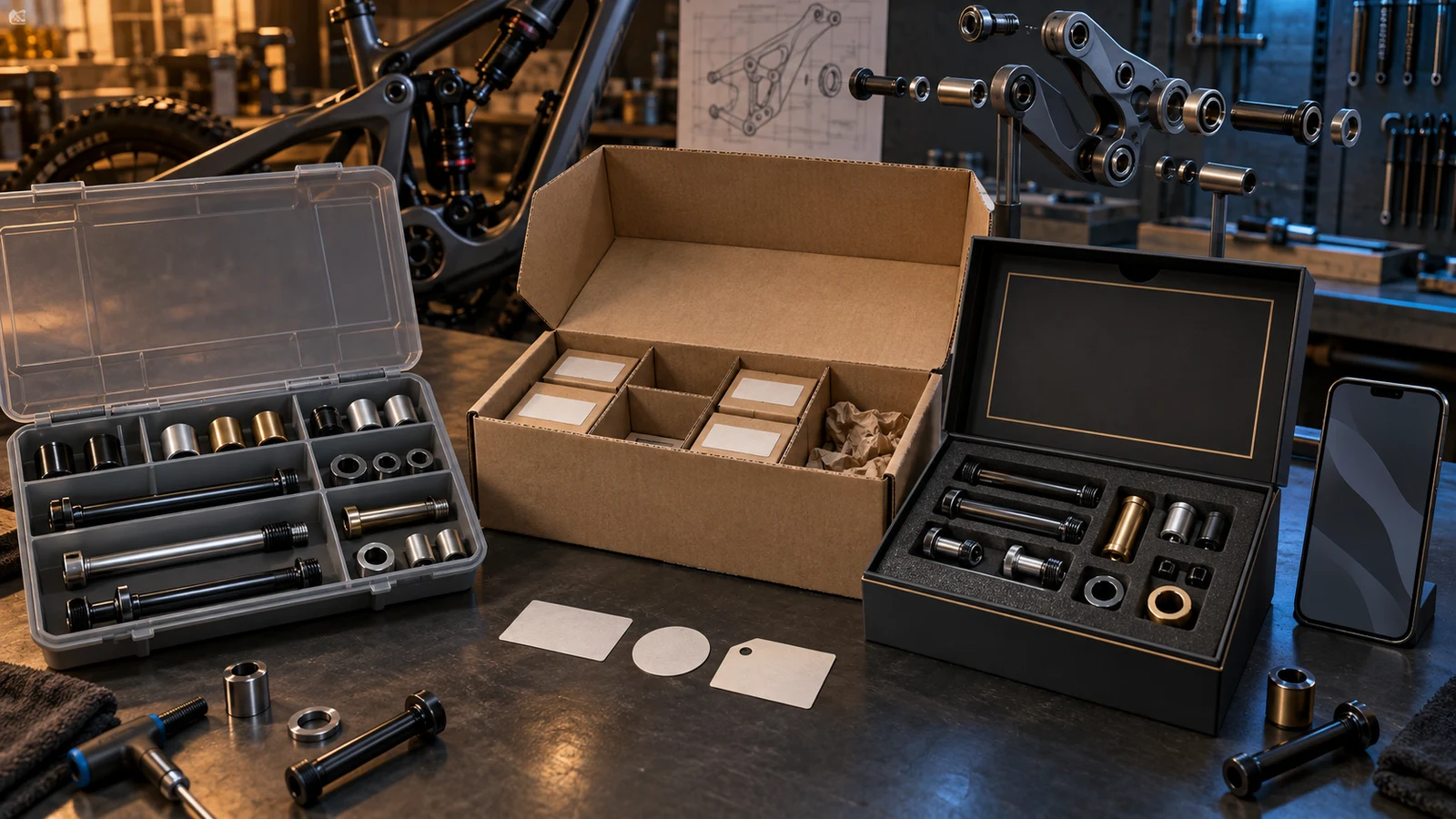
Hero: concept illustration of example hardware and its application. It is not a factory photograph, tested component or approved production geometry.
Choose the mission before choosing the presentation
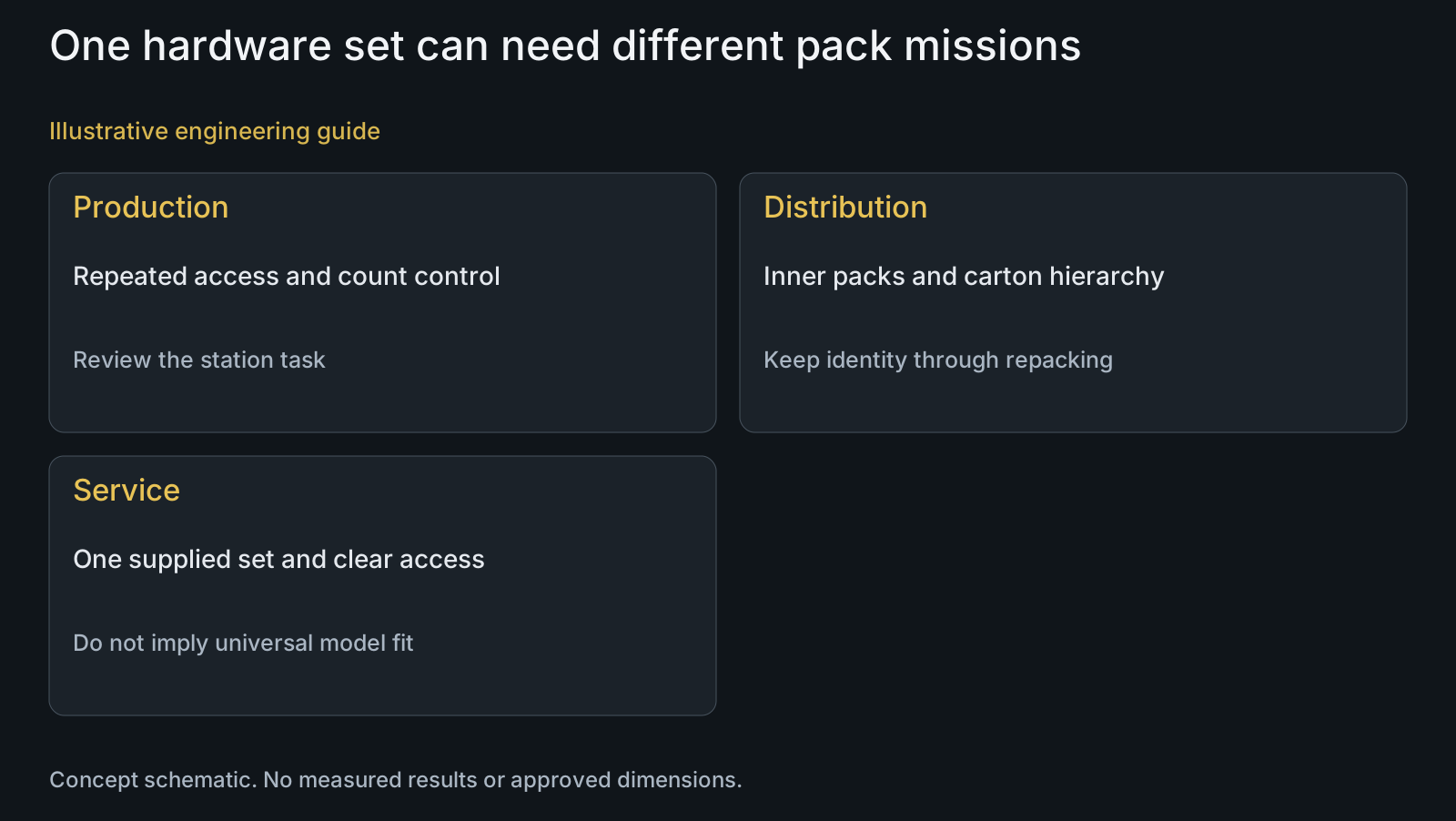
For line feeding, consider how the operator receives and takes parts for the intended assembly task. Distinct lengths or component roles may need visible separation. A layout that looks impressive in a photograph can be awkward if it conceals the needed count or opening sequence.
For distribution, establish how inner packs relate to carton quantities and how the warehouse identifies them. For service, decide which supplied unit the technician needs to recognize and open. A carton containing many production parts is not automatically a convenient service kit.
Keep the underlying hardware configuration independent of the presentation. The packaging and marking guide addresses identification fields and marked parts. This article chooses the pack's use mission and the tradeoffs between layouts, not a new component-marking process.
Compare access, separation and handling costs
A divided layout can keep easily confused parts apart and make a missing position noticeable. It still needs an accurate packing definition: an empty-looking position may be intentional, while an occupied one can hold the wrong item. Layout visibility does not replace content reconciliation.
Individual packs may suit separately issued service items, but repeated opening can add handling at a production station. Bulk arrangements may simplify line feeding while needing a defined count and surface-separation method. Compare the actual work instead of declaring one format universally better.
Review important surfaces, part-to-part contact and the way the pack will be moved and opened. The protective-packaging discussion treats component protection separately. No untested layout here is guaranteed against scratches, moisture or transport damage.
| Pack mission | Useful priority | Main tradeoff | Review before approval |
|---|---|---|---|
| Repeated line feeding | Access and component separation | Too many opening steps | Station task and count method |
| Warehouse distribution | Inner/carton quantity hierarchy | Identity lost during repacking | Receiving and split-pack workflow |
| Single service set | Recognizable supplied configuration | Presentation hides item differences | Contents and intended service scope |
| Separately issued component | Individual identity after opening | Extra packaging and handling | Issue unit and retained records |
| Branded display | Authorized artwork and legibility | Graphics obscure useful fields | Identity and content alongside artwork |
| Changed distribution route | Relevant protection/evaluation | Old pack result overextended | Actual product/package and route |
Relate protection to the distribution route
Identify the actual handling and transport arrangement, including whether the original inner pack will be retained or replaced downstream. A service box shown at delivery may not experience the same route as a production tray inside a larger shipment.
The ISTA design and testing guide explains that distribution flow, handling and storage matter to test selection and interpretation. Use that distinction to discuss a relevant evaluation, not to claim that a branded layout is already ISTA-tested or certified.
State the acceptance concern before requesting a package test. Protecting a locating surface and preserving a printed carton can be different objectives. A transport result must be interpreted for the represented product/package combination; no test values, damage rates or successful shipments are invented here.
Approve artwork alongside the receiving information
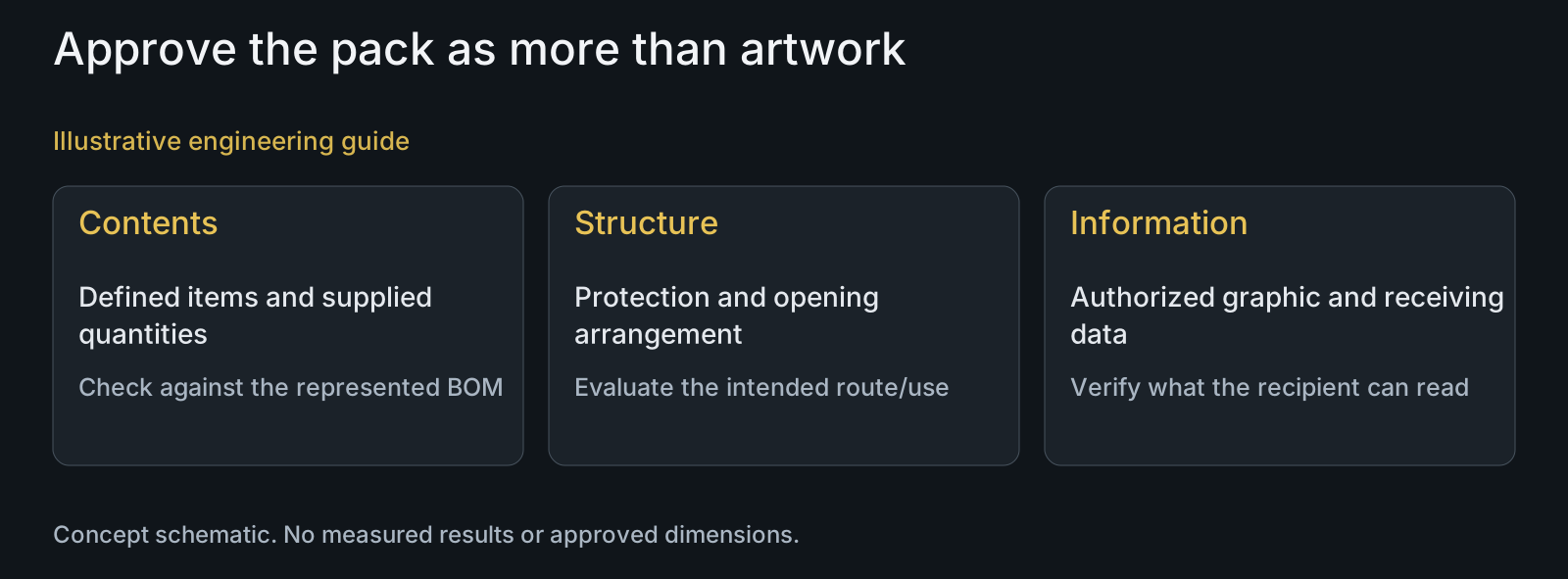
Provide authorized artwork and identify the intended branded areas. Keep useful receiving fields legible at the point where the recipient needs them. Decorative graphics should not make quantity, item identity or a required handling note difficult to find.
The GS1 barcode explanation describes a barcode as a machine-readable representation of information. A printed symbol therefore needs agreed data and a receiving workflow; it is not independently a complete traceability system.
Discuss the actual decoded meaning or destination when a code is requested. Preserve a practical human-readable identity where needed. Do not infer registered identifiers, a customer portal or compatibility with every scanner from a label mockup.
Use a production-to-service example to test the layout
Illustrative engineering example: assume the same released axle, sleeve and spacer set is supplied to an OEM line and later issued as a service set. The production station takes several sets in one shift, while service receives a single pack. No actual customer, throughput or shipping result is assumed.
A divided line tray can be evaluated around repeated access and count control. A service pack can be evaluated around identifying the set and retaining unused items. Neither task requires inventing a different hardware design or claiming universal bicycle-model fit.
If the warehouse repacks the line quantity into service units, define the contents and identity that must survive that operation. The original branded carton no longer accompanies every component. The review should therefore consider the downstream pack rather than approve only the attractive first shipment.
Manage layout changes separately from hardware changes
A change in artwork, inner count or opening arrangement can affect receiving without changing the component drawing. Conversely, a revised component can require a packing update even if the graphic layout is retained. Identify which approval subject actually changed.
For a revised pack, confirm the intended use, contents and represented protection rather than automatically repeat every unrelated hardware decision. If the distribution route changes, assess whether earlier packaging evidence still applies. No automatic reuse or universal retesting prescription is established here.
PremFixer's drawing-led manufacturing discussion can include the requested supplied package. Send the material/finish context and intended bicycle application where relevant, while retaining the customer's authority over branding, configuration and application suitability.
Questions buyers need to confirm
Can PremFixer discuss branded pivot packaging?
Yes, bring the requested supplied package, authorized artwork and BOM to the manufacturing discussion. Confirm the proposed layout, variable fields and delivery scope. No universal retail SKU, standard branded-pack policy or already approved customer format is implied.
Should production and service use the same pack?
Not necessarily. Production may prioritize repeated access and count control; service may prioritize recognizing one supplied set and retaining items. Compare the receiving task while preserving the same released component identities.
Does a branded sealed box prove a complete kit?
No. Reconcile the represented item numbers, revisions and quantities with the BOM. Protection, appearance and content completeness are separate subjects; the right logo cannot reveal every substitution or missing item.
Does a barcode automatically provide full traceability?
No. Agree the encoded information, its interpretation and the records it connects to. A machine-readable symbol or generic webpage destination is not proof of every component's manufacturing history or a configured receiving system.
Can the distributor repack the hardware for service?
Discuss that downstream operation and what contents, identity and protection must be preserved. The original carton may no longer accompany the parts. Do not assume its label or layout remains adequate after the supplied unit changes.
Does an earlier packaging evaluation cover a new route?
Not automatically. Compare the represented product/package combination, distribution and handling conditions with the new scope. Identify any affected protection question rather than infer suitability from unchanged artwork.
Technical references and scope
ISTA: Getting Started with Design and Testing. Actual distribution, handling and storage inform package evaluation; not an ISTA test, certified package, damage guarantee or PremFixer result.
GS1: What Is a Barcode?. Machine-readable information representation; no registered identifier, portal implementation or verified receiving system asserted.
Explore related component, material and sourcing decisions in the customer decision knowledge center. For a drawing review, use the Drawing/BOM RFQ path.
Describe the pack's recipient and next use
Send the BOM and quantities per supplied unit, component/finish context, intended line, warehouse or service use, distribution route and receiving fields. Add authorized artwork and any package-reference samples so PremFixer can discuss the requested layout, protection and identity scope.
Discuss the drawing and BOM