
A custom pivot kit cannot be specified completely as 'stainless, aluminum and titanium hardware.' Assign a material requirement, product form and condition, geometry, finished surface and quantity to each BOM item, then review the mating interfaces together. PremFixer's drawing-led manufacturing discussion can coordinate that package without making the parts interchangeable or authorizing substitutions. A grade name alone does not define finished-bolt strength, spacer contact behavior or an assembled corrosion result. Start with your available item drawings and BOM. Keep unresolved material fields explicit so one supply contact does not conceal several different technical requirements.
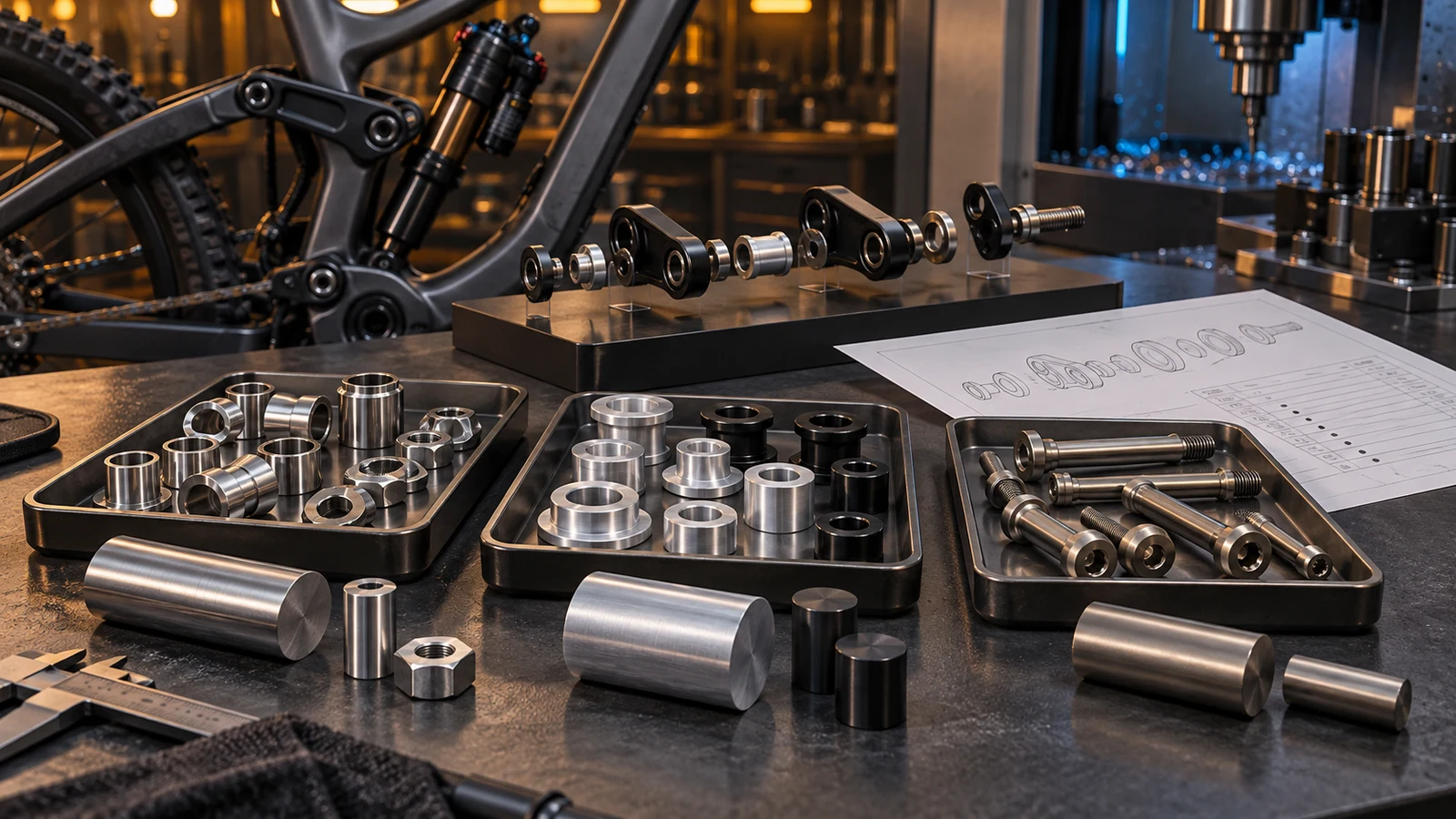
Hero: concept illustration of example hardware and its application. It is not a factory photograph, tested component or approved production geometry.
Specify materials at the part-number level
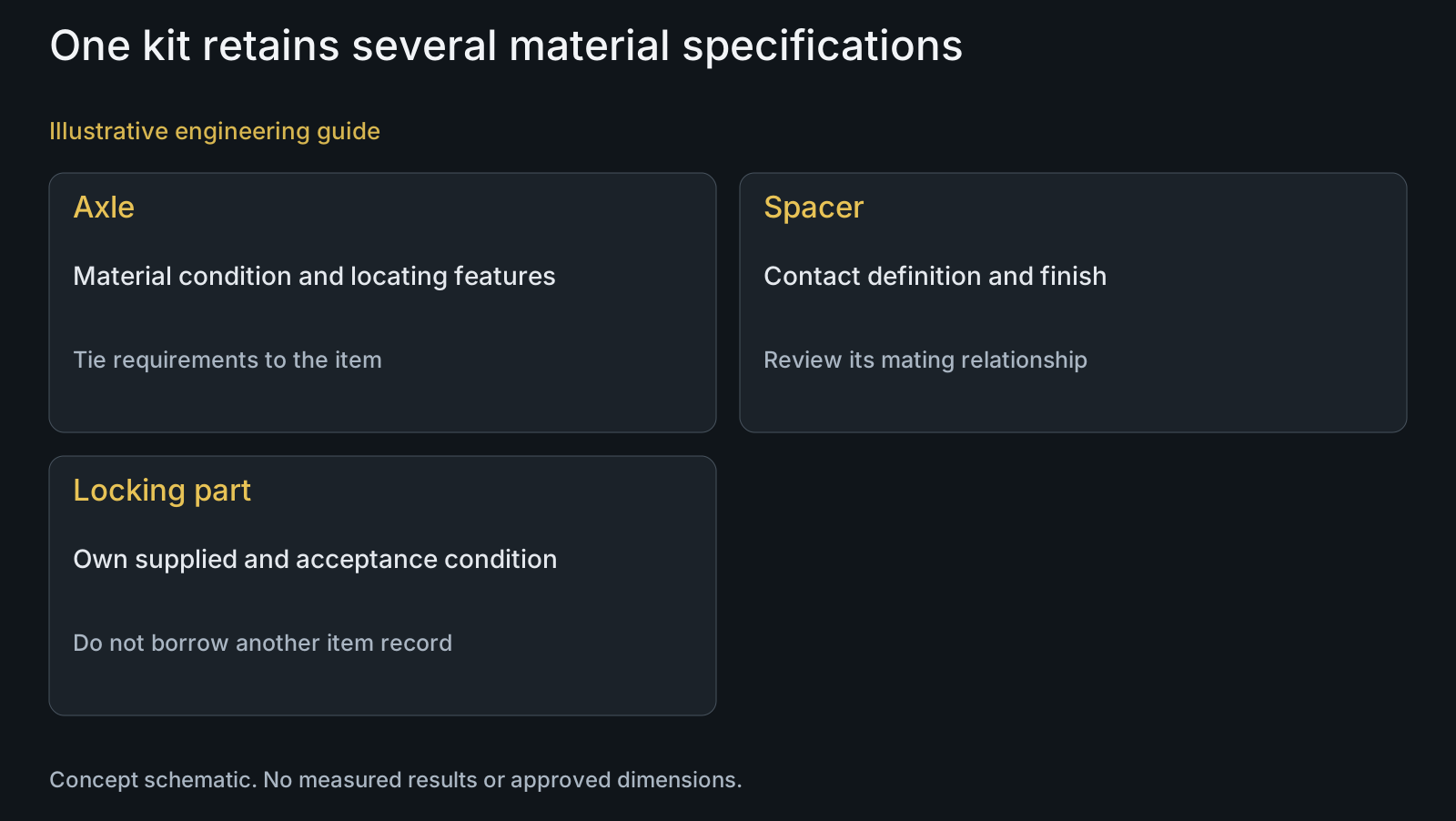
A pivot kit can include an axle, sleeve, spacer and locking component with different jobs. List each item's drawing revision and quantities per set. State the specified material against that identity, rather than attach a single material note to the whole package.
A request might name 304 or 316 stainless, 6061 or 7075 aluminum, or a titanium grade. Those names still need the applicable specification and supplied condition. Treat them as requirements to discuss, not a claim that every form, condition or quantity is automatically available.
Distinguish the material requirement from the finished-fastener requirement. A stock description does not by itself establish every property of a machined bolt. The pivot material-selection guide addresses choosing a material; this article addresses preserving the choices within a coordinated order.
Do not turn one supplier into one processing route
Different components may require different machining, surface-treatment and handling routes. Coordination means the parts reach their defined supplied conditions together; it does not mean they pass through identical operations or use interchangeable inspection assumptions.
Specify where a finish applies and which features are accepted after finishing. A kit-wide color description is not a sufficient definition of a locating surface or contact face. Align the surface-treatment discussion with the item drawing rather than copy one treatment across every material.
If a supplier proposes a different route, identify the affected item and the reason. Preserve the required final condition and discuss any changed acceptance evidence. A convenient combined shipment cannot compensate for a component that does not represent its specification.
| Kit description | Required item detail | Risk if omitted | Review that resolves it |
|---|---|---|---|
| Stainless locking part | Grade, specification and finished requirement | Family name treated as full strength definition | Match material and component requirements |
| Aluminum spacer | Grade, condition and contact surfaces | Available stock treated as equivalent | Review item duty and mating contact |
| Titanium axle | Specified grade/form/condition and features | Trade name substituted for specification | Compare the actual material callout |
| One appearance | Treatment by material and applicable surface | Color taken as identical functional finish | Review finished feature and treatment scope |
| One complete kit | BOM identity and item quantities/revisions | Mixed parts or missing items | Reconcile the represented combination |
| Alternative material | Original/proposed item requirements | Unapproved substitution hidden in quote | Customer design review of affected scope |
Review material pairs at the actual contact
Do not evaluate each material in isolation and then assume the kit is suitable as assembled. Map which components touch, the represented surfaces and the expected exposure. A sleeve touching an axle presents a different question from a spacer contacting the frame.
The Outokumpu corrosion guide explains that galvanic corrosion can involve electrically connected dissimilar metals in a corrosive environment. That mechanism is a reason to review the contact and exposure; it is not proof that every mixed-material bicycle kit will fail.
If an insulating interface is proposed, evaluate its intended electrical function alongside the contact geometry and mechanical duty. Do not assume a decorative finish proves insulation or prescribe a universal barrier. Use the corrosion application discussion for the relevant project review.
Keep a substitution visible as a separate proposal
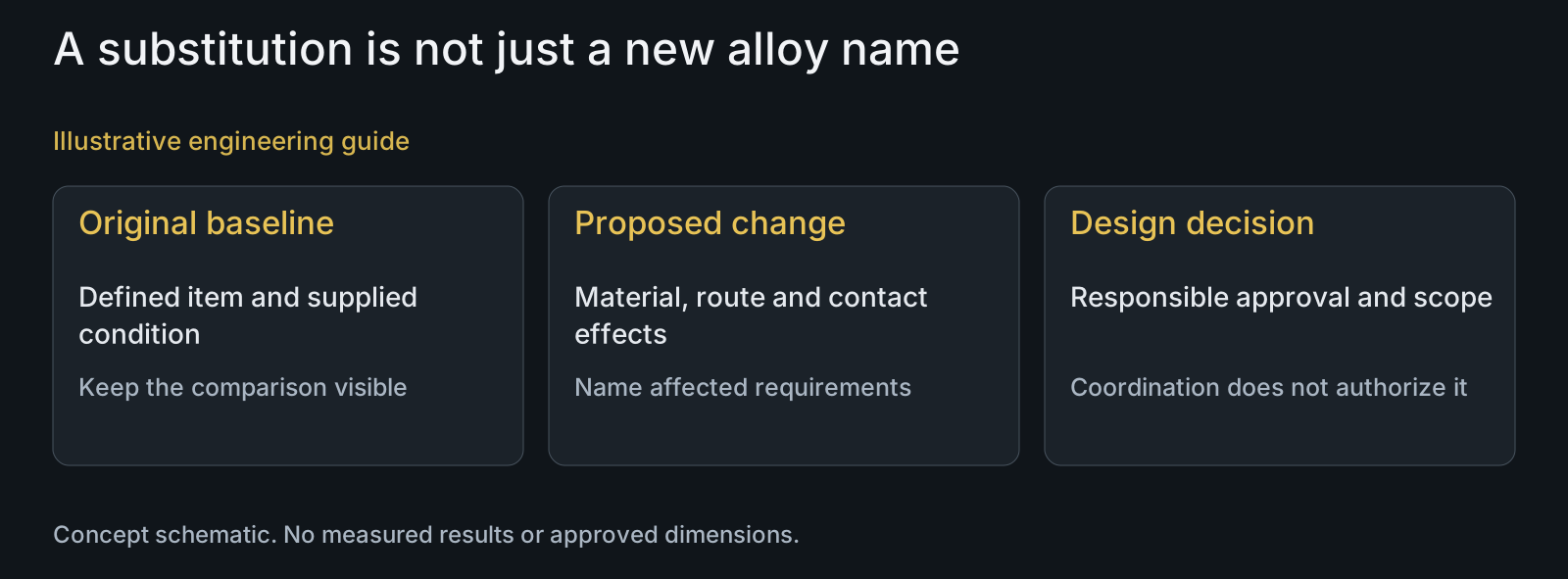
An available material is not automatically an approved substitute. Compare the original and proposed specification, product form and condition for the affected item. Identify what the change would mean for manufacturing, finishing, contact and acceptance.
Keep the original requirement as the comparison baseline. A quote for an alternative alloy should not silently become a quote for the released material. Ask the supplier to distinguish the proposal and its assumptions before purchasing compares costs.
The responsible design team retains the substitution decision. Similar appearance, a familiar trade designation or an unchanged nominal dimension does not establish equivalence. If the proposal affects a mating component, include that interface instead of treating the change as an isolated purchasing action.
Apply the item map to an illustrative mixed kit
Illustrative engineering example: assume an OEM discusses a titanium axle, an aluminum spacer and a stainless locking part for a full-suspension pivot. The initial BOM lists material families but leaves product conditions and finished-contact requirements incomplete. No actual customer configuration or successful validation is assumed.
The buyer can retain the proposed material allocation while assigning the missing fields to each item. The axle drawing needs its specified titanium condition and finished features; the spacer needs its aluminum condition and contact definition; the locking part needs its own finished requirement. One generic 'premium kit' description cannot close them.
If an alternative spacer material is then proposed, compare that item and its mating contact without rewriting the other two material specifications automatically. The useful outcome is a defined review boundary, not an invented conclusion that the alternative is stronger, cheaper or already approved.
Coordinate a complete BOM without flattening its differences
Use one package revision to identify the intended combination while retaining each item revision. A complete BOM can contain different materials and acceptance scopes. Unified version control does not require identical tolerances, finishes or material documents.
State what evidence is requested for each item and what it represents. A material record for one component cannot identify another alloy merely because both arrive in one kit. Preserve the relationship between the record, item and represented supplied condition.
The mixed-kit synchronization guide addresses coordinated readiness. For specification review, provide the available drawings, material requirements, BOM and intended bicycle application. Separate manufacturing feasibility from application approval and requested commercial scope.
Questions buyers need to confirm
Can one supplier coordinate a stainless, aluminum and titanium kit?
A coordinated scope can be discussed against the item drawings and BOM. Confirm material form and condition, finished requirements, quantities and requested evidence per item. A broad material list does not establish every combination, route or quantity as an available offer.
Can we specify only 304, 7075 or a titanium grade?
Those names are useful starting inputs, but add the governing specification, product form and condition plus the finished-component requirements. These fields distinguish the represented stock and acceptance basis; a family or grade label alone is incomplete.
Should every component in the kit use the same material?
Only if the responsible design review supports that allocation. An axle, spacer and locking part can have different contact and manufacturing requirements. Retain item-level definitions even where a common material is chosen.
Does mixing metals automatically make the kit unsuitable?
No. Review electrical contact, exposure, surfaces and the mechanical interfaces. The general galvanic mechanism identifies a question to evaluate, not a universal failure verdict or a validated corrosion result for your assembly.
Can the factory replace an alloy with similar available stock?
Not without the applicable approval. Identify the original and proposed specification and condition, the affected item and the consequences for its finished requirements and interfaces. Keep the alternative separate from the original quoted scope.
Does one material document cover every item in the kit?
Not automatically. Establish which items and supplied material the document represents, then compare that scope with the BOM. A record for one alloy or item cannot be transferred to other components solely because they share a package.
Technical references and scope
Outokumpu: Corrosion Resistance. General galvanic mechanism and role of electrically connected dissimilar metals/exposure; not a validated bicycle design, recommended universal barrier or PremFixer test result.
Explore related component, material and sourcing decisions in the customer decision knowledge center. For a drawing review, use the Drawing/BOM RFQ path.
Share the item-level material and interface map
Send the drawing or STEP for each component, the BOM with quantities and revisions, material specifications and conditions, required finishes and mating-material/exposure context. PremFixer can discuss coordinated manufacturing while keeping item requirements and any proposed substitutions explicit.
Discuss the drawing and BOM