

A South African buyer should not accept a custom bicycle pivot from the words SANS 1700 alone. Identify the relevant part and edition, the characteristics being ordered and the evidence needed to accept them. Define the bearing shoulder, clamp faces and receiver separately where standard screw requirements do not describe the complete interface. A sample test report can answer a defined test question, but it is not SABS product certification. Confirm any applicable compulsory specification with the responsible party rather than infer it from a national standard reference. This makes the purchase requirement both more precise and easier to evaluate.
Hero: concept illustration of example hardware and its application. It is not a factory photograph, tested component or approved production geometry.
Turn a standard name into an acceptance requirement
SANS 1700 is a multipart fastener series, not one interchangeable specification for every feature. A South African government standards notice illustrates separate references for terminology, threads and other fastener subjects. That historical notice establishes the multipart distinction; it does not confirm today's edition or the correct reference for your pivot.
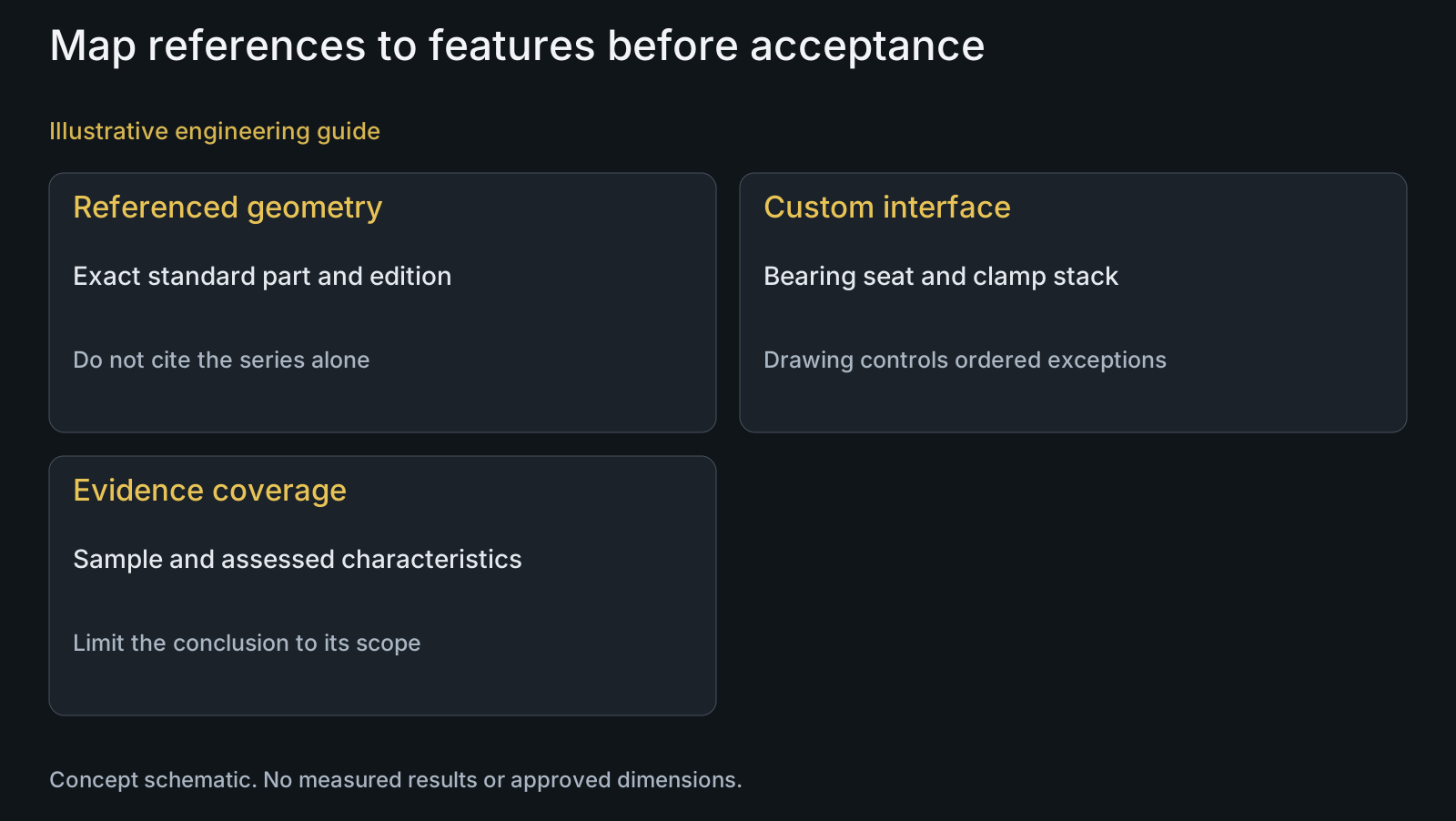
Ask the buyer to identify the complete part designation, edition and required characteristics using the current publisher record and applicable text. A request for a standard socket-head form should not silently become a claim that the bearing seat, shoulder length and receiver interface are also standardised.
Translate the purchase requirement into feature-level acceptance language: which dimensions follow the cited reference, which drawing controls a custom feature, and what evidence is requested for each. The drawing and BOM guide helps identify the actual supplied parts rather than describe a whole pivot kit as one screw.
Keep custom pivot function visible in the order
A conventional screw reference can coexist with a custom shoulder and receiver, but the distinction must remain visible. Identify where the bearing locates, which faces transmit clamp load and how the spacer stack relates to the bolt length. These are engineering inputs, not details that a national standard label can fill in.
A bolt may meet a specified head or thread requirement and still interfere with a bearing, bottom in a receiver or leave the intended stack unclamped. Review the assembled section and mating limits, not only the isolated bolt drawing. This mechanism explains why evidence about one feature should not be extended to the complete joint.
Use full-suspension application guidance to frame the interface discussion and CNC turning for the ordered shoulder geometry. These links describe application and manufacturing decisions, not universal vehicle fit or SANS certification.
| Buyer wording | What must be defined | Risk | Verification action |
|---|---|---|---|
| SANS 1700 compliant | Exact part, edition and characteristics | Series name hides incomplete scope | Confirm reference and map ordered features |
| Standard head, custom shoulder | Referenced geometry and drawing exceptions | Standard screw report applied to bearing fit | Measure custom seat and review mating stack |
| Sample tested | Sample identity, methods and coverage | One tested characteristic treated as full approval | Read report and limit the acceptance conclusion |
| SABS Approved | Actual product certification and permit scope | Laboratory report mistaken for certification | Verify the requested certification evidence |
| Meets buyer specification | Drawing revision, finish state and acceptance criteria | Contract term confused with a legal determination | Agree evidence and separately establish regulation |
| Finished joint acceptable | Bearing, receiver and spacer interfaces | Bolt-only evidence misses assembled interference | Review section and validate intended clamp condition |
Read the report before accepting the claim
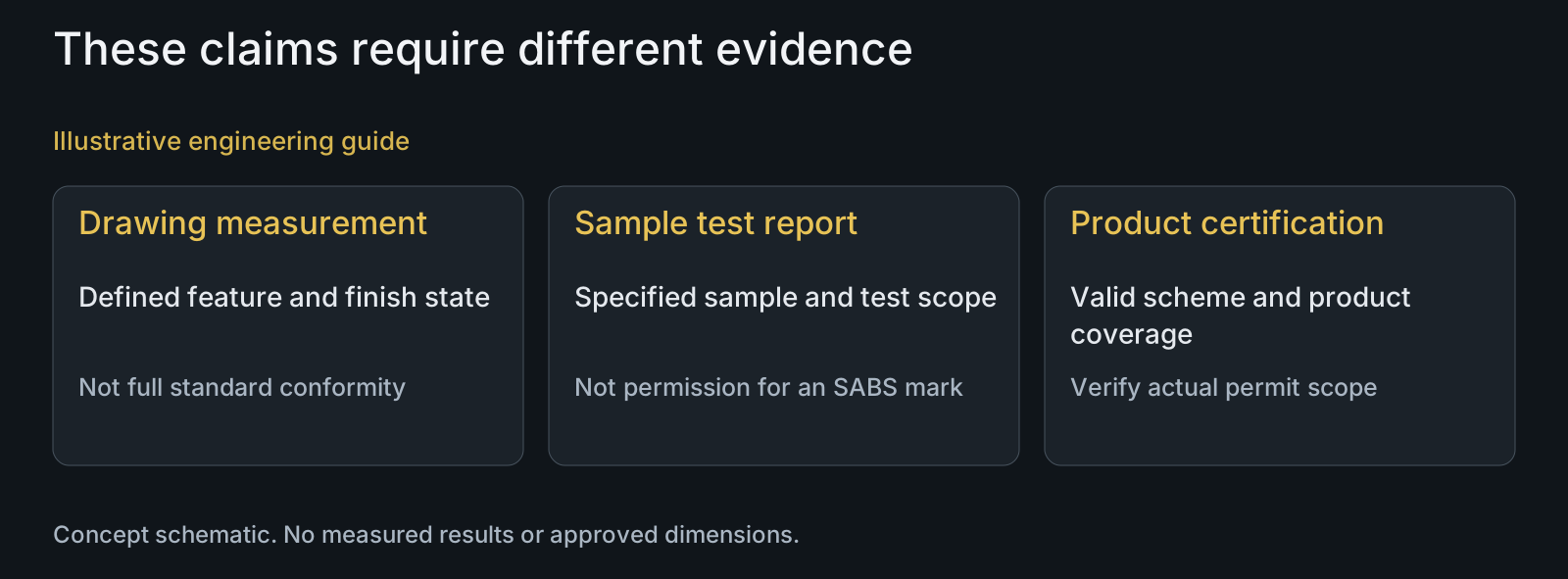
SABS explicitly distinguishes laboratory test reports from product certification. Its January 2022 explanation states that a report concerns the tested sample and is not permission to describe the product as SABS Approved. Its mark brochure separately connects use of the mark to a valid permit and the relevant scope.
For a proposed report, identify the sample description, drawing revision, tested characteristics, methods and reported outcome. A report about material chemistry does not answer whether the finished bearing seat meets its drawing limits. A report containing measurements is also not necessarily a statement that every requirement of a named standard was assessed.
Ask what the report is intended to establish before specifying a lab document. SABS's public laboratory explanation distinguishes customer-specific or partial testing from other assessment scopes. Keep the acceptance conclusion within the report's actual coverage, and do not turn a successful sample check into a claim about every future unit.
Separate buyer terms from certification and regulation
A buyer may contractually request specific standards, tests or documentation. That request needs clear wording even when it is not a statutory requirement. Conversely, a purchase agreement cannot waive an applicable compulsory specification. NRCS explains that compulsory specifications are technical regulations; applicability must be established for the actual supplied goods.
If product certification is requested, identify the scheme, certified product, site and permitted scope rather than accept a logo in a catalogue. No PremFixer SABS product permit is established by this article. If the buyer only needs defined sample evidence, do not describe that narrower requirement as a certification programme.
The quality-system guide addresses controlled manufacturing information and quality-system scope. This article addresses a different decision: whether the ordered component features and acceptance evidence actually support the claim made on the order. A quality-system certificate does not substitute for that mapping.
Illustrative engineering example: an incomplete pivot order
Illustrative engineering example: assume a buyer orders a custom shoulder pivot using the wording SANS 1700, with a supplier sample report for a standard screw. The pivot adds a bearing seat and receiver not identified in that report. No real customer, test result or certified product is assumed.
The reviewer first asks for the relevant standard part and edition, then separates its ordered characteristics from the custom drawing. The report's sample identity and tested features are compared with that map. Head or thread evidence may be useful within its stated scope, but it cannot establish the custom bearing seat or assembled clamp condition.
The buyer can request additional measurements for the uncovered drawing features, revise an inaccurate certification claim or seek genuine certification if the contract requires it. The appropriate choice follows the intended acceptance claim, not the number of documents supplied. This example reaches a review decision without inventing a measured pass or an approval.
Prepare an RFQ that can be reviewed without guessing
Send the drawing or STEP, mating assembly section, BOM, material and finish, plus the complete requested standards references. State whether acceptance needs drawing measurements, a particular test, a conformity statement or product certification. Include the intended use of each document so its scope can be agreed.
Identify whether dimensions apply before or after surface treatment, and show the bearing and clamp surfaces that must remain functional. A finish change can alter the feature being inspected even when the standard designation remains unchanged. Establish those conditions before choosing the inspection evidence.
PremFixer manufactures to customer-defined drawings, samples and interfaces. Discuss the manufacturing and evidence inputs through manufacturing and the customer decision knowledge centre. An RFQ review can identify unresolved requirements; it is not a regulatory classification or a promise of an SABS mark.
Questions buyers need to confirm
Is SANS 1700 alone enough for a custom pivot order?
No. Identify the applicable part, edition and ordered characteristics, then define custom bearing and clamp features on the drawing. A series-level reference does not tell the reviewer which requirements or evidence establish acceptance.
Does a SABS laboratory report mean the pivot is SABS Approved?
No. SABS distinguishes sample test reports from product certification. Read the sample identity and tested scope, and request actual certification evidence if that is what the buyer requires. Do not add a mark or broaden the report's conclusion.
Can a standard screw report cover a custom bearing shoulder?
Not without relevant coverage. Compare the reported sample, revision and tested characteristics with the ordered shoulder geometry and finish state. An assessment of the head or material does not establish bearing-seat size or assembled clamp behaviour.
Are all buyer-requested standards automatically compulsory in South Africa?
Do not assume that. A contractual requirement and an applicable compulsory specification are distinct. Establish regulatory applicability for the actual supplied goods with the responsible party while separately agreeing the buyer's acceptance criteria.
What should be checked when certification is specifically requested?
Check the requested scheme, actual certified product and site, relevant scope and valid permit evidence. A quality-system certificate, catalogue logo or sample test report answers a different question and should not be substituted without the buyer's agreement.
What should accompany a South African pivot-hardware RFQ?
Provide drawing or STEP, mating section, BOM, material, finish and complete standards references. State the required evidence and its intended use, including sample identity, feature coverage and whether certification is required, so missing inputs can be identified before quotation.
Technical references and scope
SABS: certification is more than a test report. January 2022 explanation distinguishes a tested sample report from SABS product certification. It does not certify the example parts.
SABS: mark brochure. Published rules connect mark use to a valid permit and applicable product scope, not possession of a test report alone.
SABS: laboratory testing scope explanation. Public explanation distinguishes customer-specific and partial testing and report statements according to agreed assessment purposes.
NRCS: about compulsory specifications. Public explanation identifies compulsory specifications as technical regulations. It does not classify a particular pivot shipment.
South African government: historical standards notice. 2010 notice demonstrates separate parts within SANS 1700. Historical identities are not a current-edition recommendation or complete standard review.
Explore related component, material and sourcing decisions in the customer decision knowledge center. For a drawing review, use the Drawing/BOM RFQ path.
Specify the features and evidence the buyer will accept
Send the pivot drawing or STEP, mating section, BOM, material and finish, plus complete standard references and requested evidence. PremFixer can review custom manufacturing inputs and identify uncovered acceptance questions without claiming SABS certification, universal fit or regulatory clearance.
Discuss the drawing and BOM