
A stainless pivot bolt in an aluminum-frame receiver needs a review of the thread pair and assembly condition; the material names alone do not predict seizure or damage. First distinguish galling, corrosion, stripped threads, cross-threading and bottoming. The buyer is deciding which requirement or mechanism a proposed coating, lubricant, receiver revision or material substitution must address. A bolt that becomes difficult to turn is an observation, not a diagnosis. Titanium is not a universal cure, and an isolation washer under the head does not establish protection at engaged threads. Check the receiving material, useful engagement, surface state and approved retention method before changing the supplied hardware.
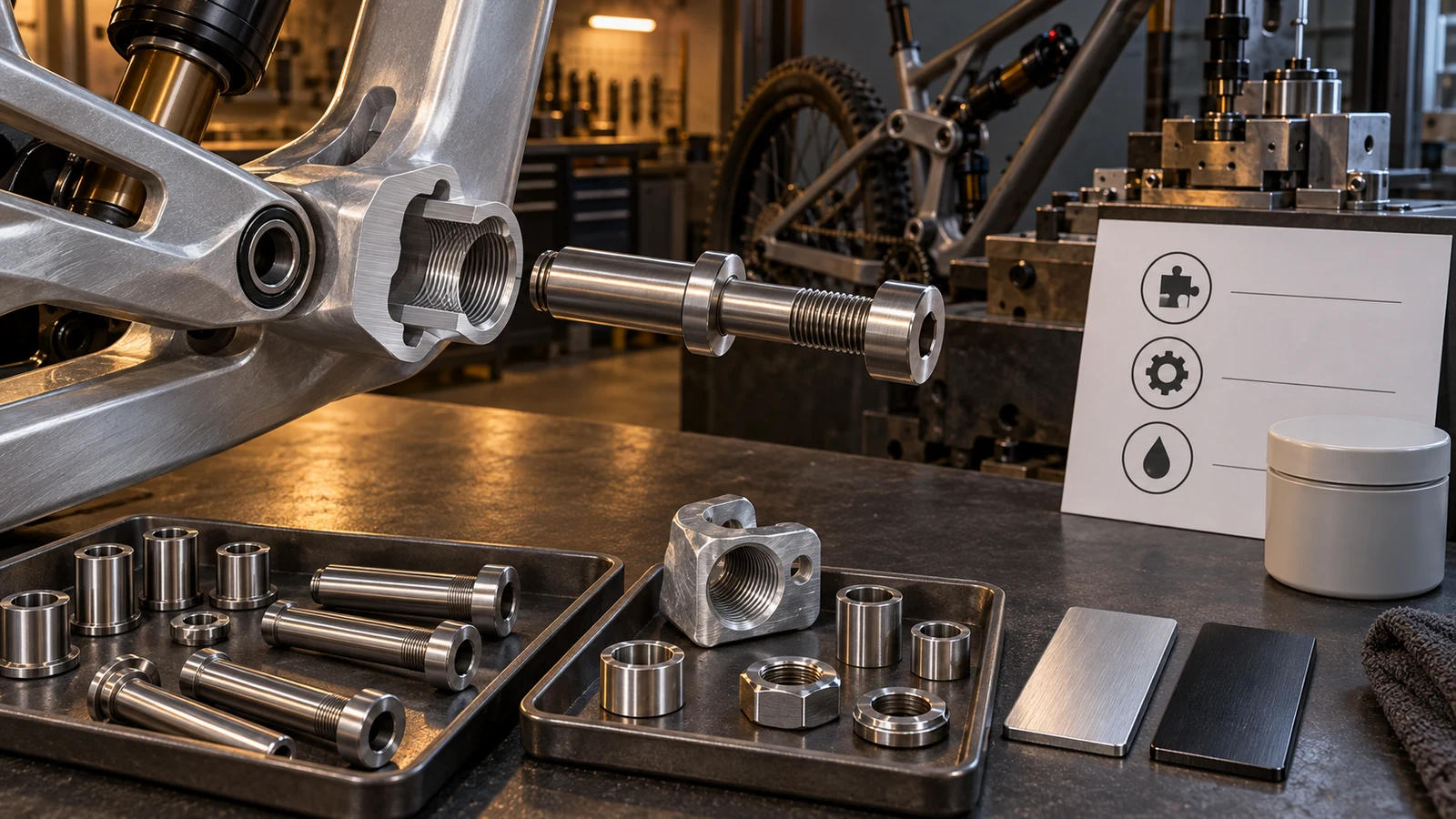
Hero: concept illustration of example hardware and its application. It is not a factory photograph, tested component or approved production geometry.
Separate the observed symptom from the mechanism
Record when resistance occurred: initial entry, continued engagement, final tightening or later authorized removal. Preserve the relevant identity, surface condition and assembly history. Increasing torque to overcome unexpected resistance can change or damage the evidence instead of establishing the original cause.
PEM's galling technical sheet describes adhesive damage between sliding thread surfaces and identifies material, finish, alignment and assembly factors. That mechanism is different from a receiver thread stripped under load or a bolt stopped by a blind-hole bottom. Its industrial examples do not establish a failure frequency for bicycle pivots.
Corrosion also requires its own contact and exposure review. Do not rename every seized pair galvanic corrosion or conclude that a shiny bolt proves the aluminum receiver is unaffected. Several mechanisms can coexist; keep unresolved observations visible until appropriate evidence distinguishes them.
Identify the receiver that actually carries the thread
An aluminum frame can contain a native tapped boss, a metal insert or a separate receiving component. Obtain its drawing, material condition and supplied surface. The frame's general material description does not identify the actual internal thread or the geometry transferring load around it.
Bossard's engagement tool separates bolt properties, counter-thread material, hole arrangement and effective overlap. It illustrates why a diameter-only rule is insufficient. No calculator defaults, numerical material values or calculated result are adopted as the requirement for this pivot.
Use the effective engagement guide to examine complete working overlap, bottom clearance and insert boundaries. Here the decision is whether the proposed remedy addresses the identified receiver problem, not how to assign one universal engagement multiplier.
| Concern | Evidence to distinguish it | Misleading remedy | Decision to review |
|---|---|---|---|
| Adhesive thread damage | Surfaces, alignment and assembly history | Assume titanium eliminates it | Defined pair, finish and friction |
| Galvanic interaction | Connected materials and electrolyte path | Head washer protects every thread | Actual isolation boundary |
| Receiver stripping | Both material conditions and useful overlap | Stronger bolt improves receiver equally | Receiver and complete joint limits |
| Bottoming or obstruction | Installed section, thread ends and contacts | Compound creates clearance | Geometry and seated position |
| Changed lubricant or plating | Represented friction and locking state | Reuse dry-condition torque | Approved retention instruction |
| Suspect used receiver | Identity, condition and permitted assessment | New bolt authorizes service | Responsible frame disposition |
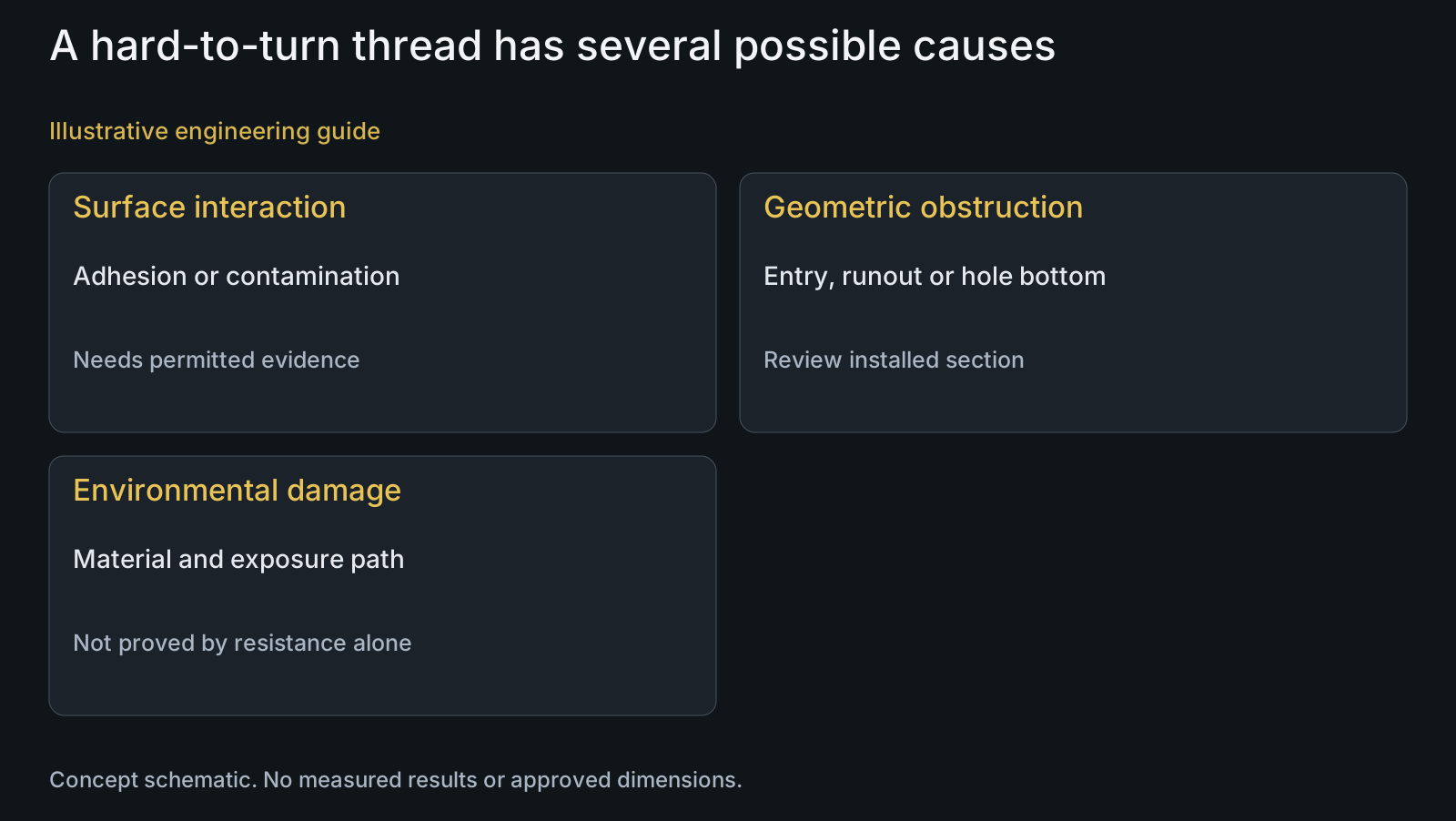
Keep galvanic protection distinct from thread lubrication
The FAA galvanic-corrosion discussion identifies electrical contact and electrolyte exposure as relevant conditions. Use that general principle to examine the actual stainless-to-aluminum path and surrounding parts. Its aircraft examples are not bicycle inspection or repair instructions.
An isolation component under the bolt head may separate that contact while leaving the threaded pair electrically connected. Map the barrier's actual boundary and any alternate path. A lubricant or locking product should not be credited with corrosion protection beyond its specified and supported function.
For corrosion-focused proposals, use the anti-corrosion solution context and provide the defined exposure and final surfaces. Do not prescribe titanium solely to protect an unchanged aluminum receiver; a material change still requires review of contacts, assembly and relevant evidence.
Review friction changes with the retention method
A lubricant, anti-seize or changed plating can alter thread friction and the relation between tightening torque and clamp force. PEM explicitly calls for torque reevaluation when lubricant or plating changes. The approved tightening basis must represent the proposed delivered and assembled condition.
Do not add an unspecified compound while retaining a dry-condition torque by assumption. Conversely, reducing torque without review can leave the intended retention unresolved. Identify the product specification, application location, contact surfaces, locking method and responsible approval of the assembly instruction.
If adhesive locking is specified, consider its product-specific surface preparation and permitted coexistence with other compounds. Anti-seize, threadlocker and an isolation layer are not interchangeable answers. This article supplies no universal application recipe or instruction to mix products on a used bicycle.
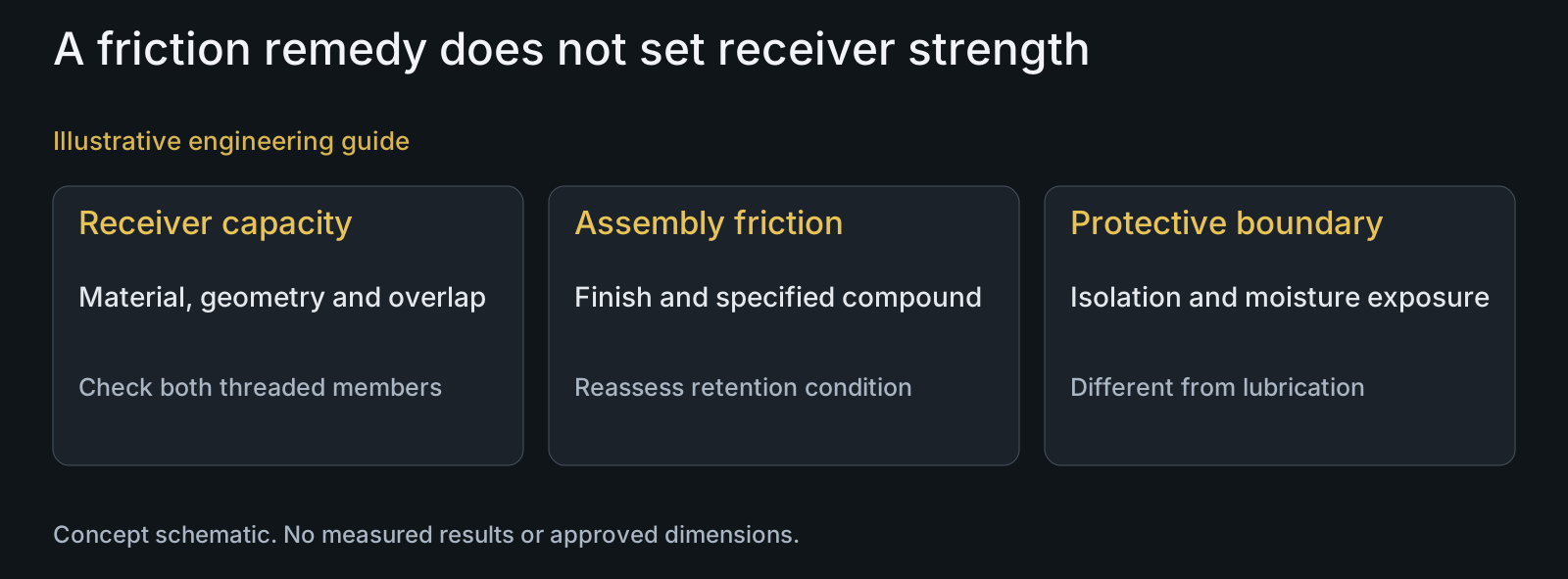
Compare remedies against the particular failure question
A receiver geometry change addresses a different limit from a friction change. More complete overlap or a specified insert may be considered for a demonstrated strength requirement, while contamination, misalignment or damaged thread form needs its own correction. No insert is approved as a repair by this comparison.
A finish proposal must retain final thread conformity and required contact geometry. The surface-treatment route should identify allowance, masking and inspection state where applicable. A passing sample engagement cannot establish receiver strength or validate every later installation.
PremFixer's manufacturing review can address drawing-defined external hardware and supplied receiving components within scope. The responsible frame team retains receiver acceptance, repair and service decisions. Manufacturing a different bolt is not diagnosis or authorization to return a suspect assembly to use.
Illustrative review: resistance before the contacts seat
Illustrative engineering example: assume a stainless bolt develops unexpected resistance before its intended shoulder contacts seat in an aluminum receiver. A team proposes titanium and anti-seize. The receiver drawing and current surface condition are not yet confirmed, and no actual damage or customer result is reported.
The reviewer separates possible thread interference, bottoming, contamination and adhesive damage. The assembled section and useful thread position can address the geometric questions, while permitted examination and history address the surface questions. Neither proposed remedy establishes which mechanism caused the resistance.
If a supported friction change is selected, the retention instruction needs review for that condition. If geometric obstruction is identified, lubrication cannot create missing bottom clearance. The example shows why diagnosis and assembly-condition approval precede a material substitution, without predicting a failure or claiming a successful repair.
Questions buyers need to confirm
Does difficult tightening prove that the stainless bolt galled?
No. Identify when resistance appeared and review thread form, alignment, contamination, installed geometry and permitted surface evidence. Bottoming or cross-threading can present resistance without establishing galling; do not force the pair to obtain a diagnosis.
Will changing to titanium prevent all aluminum receiver problems?
No. It does not establish useful engagement, bottom clearance, receiver capacity or protected contacts. Review the supported mechanism and both members before accepting the substitution; titanium is not a universal seizure or corrosion remedy.
Does an isolation washer protect the engaged thread pair?
Not necessarily. It separates only its defined boundary. Identify whether the internal and external threads or another contact remain electrically connected and exposed to moisture. The full path determines the protection question.
Can anti-seize be added without changing the torque instruction?
Do not assume so. Specify the compound, location and represented friction and locking condition, then obtain review of the retention basis. A torque instruction for a different surface state may not represent the intended clamp condition.
Is engagement length based only on the bolt diameter?
No. Include both material conditions, complete working overlap, thread geometry, required loading and receiver construction. Blind-hole bottom clearance is separate. A stronger external bolt does not automatically strengthen an unchanged internal thread.
What should be sent for an aluminum receiver review?
Provide both thread drawings, assembled section, material conditions, finishes, useful overlap, bottom clearance and approved retention method. Include observed facts and history if a problem prompted the request, with responsible disposition for suspect used components.
Technical references and scope
PEM, Thread Galling technical sheet. 2019 manufacturer guidance on adhesive thread interaction, assembly factors and reevaluating torque when lubricant or plating changes. Source test values, recipes and customer-frequency statements are not transferred.
Bossard, thread engagement length calculator. Public input structure distinguishes screw properties, receiving material, blind/through-hole arrangement and effective engagement. No values, result or standard compliance inferred.
FAA AC 43-4B, section2.5.3. General galvanic contact/electrolyte principle in aircraft corrosion guidance, not a bicycle repair procedure or predicted rate.
Explore related component, material and sourcing decisions in the customer decision knowledge center. For a drawing review, use the Drawing/BOM RFQ path.
Specify both sides of the pivot thread pair
Submit the bolt and receiver drawings, assembly STEP or section, mating BOM, material conditions, final finishes and retention requirements through the Drawing/BOM RFQ path. PremFixer can discuss manufacturability and defined interface options; damage diagnosis, receiver repair and frame service release need the responsible assessment.
Discuss the drawing and BOM