
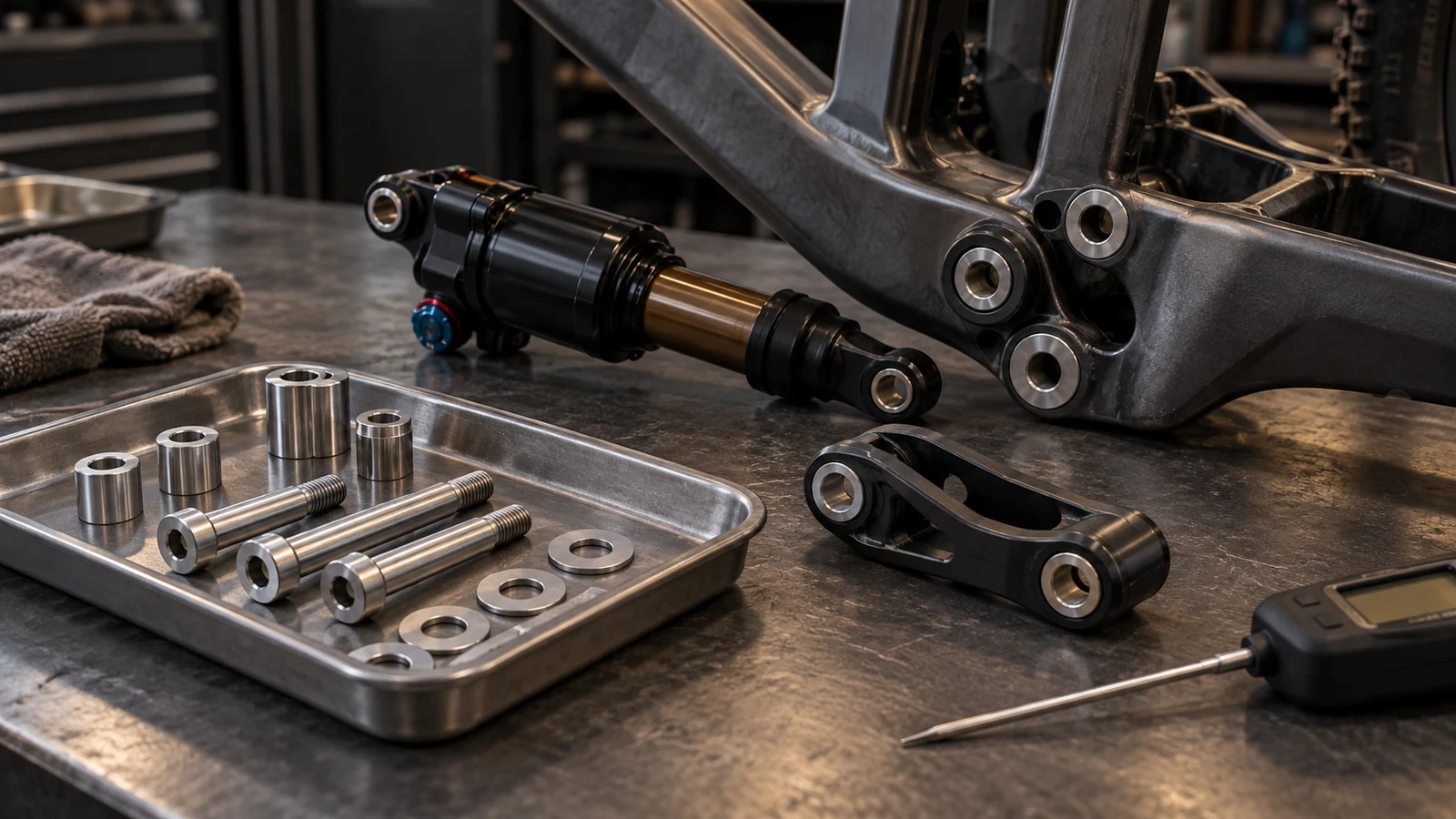
A warm shock body does not establish the temperature or mechanical condition of a nearby stainless pivot bolt. Define the exposure at the bolt shoulder, threaded contact and mating parts, including peak temperature, duration and thermal cycling. Then assess the specified material condition and the joint geometry at those conditions. A room-temperature property class does not prove unchanged performance across a broad temperature range. Differential expansion can alter a fit or clamped stack even when bolt-strength loss is not the main concern. Use the actual temperature case to decide whether the question is material capability, interface behavior or another component's operating limit.
Hero: concept illustration of example hardware and its application. It is not a factory photograph, tested component or approved production geometry.
Measure the component of interest rather than borrowing a temperature
Identify the location behind each temperature statement. A shock-body measurement, exposed bolt-head measurement and concealed shoulder temperature are different observations. Proximity alone does not make them equal. Airflow, conduction through the assembly and operating duration can change the temperature distribution, so record the operating condition with the measurement.
Agree a measurement approach suitable for the feature and the engineering question. Record instrument method, measurement position and any relevant limitations. A reflective surface reading or a single point after the assembly cools should not silently become the peak internal-joint temperature. Avoid assigning a universal correction factor without the appropriate measurement assessment.
The evidence should distinguish a brief peak, sustained operation and repeated heating/cooling. Those cases may lead to different component reviews. If no measurement exists, label the temperature case as an assumption to be assessed. An editorial image showing a probe is not a recorded experiment or proof that PremFixer performed a thermal test.
Do not stretch an ambient property claim into a service envelope
ISO 3506-1's public scope states the ambient range used for its specified mechanical and physical properties. That scope is not a statement that a finished stainless pivot retains unchanged strength at all possible operating temperatures. For a temperature-dependent assessment, obtain data applicable to the alloy, product form and supplied condition at the proposed exposure.
A broad stainless temperature-use statement is insufficient for a custom bolt. Mechanical response, exposure duration and the required functional margin are part of the review. Do not declare that all 304 or 316 components remain mechanically stable from cryogenic to very high temperatures, nor assume that a temperature observed near a shock establishes high-temperature material failure.
Ask which requirement is at risk. A material-strength question needs the applicable properties and load case. A fit question needs dimensions and thermal expansion. A lubricant or seal question needs its manufacturer's limits. Separating these questions avoids changing the bolt alloy when the evidence actually concerns another part of the assembly.
| Observed or proposed issue | Input needed | Assessment | Conclusion to avoid |
|---|---|---|---|
| Warm shock body | Bolt and joint locations under the operating case | Establish relevant exposure | Shock temperature equals bolt temperature |
| Material-strength concern | Alloy, condition, temperature history and load | Applicable temperature-dependent properties | Ambient class guarantees every temperature |
| Radial fit concern | Mating diameters, materials and local temperatures | Expansion and installed fit | Material names alone quantify clearance |
| Clamp-stack concern | Effective lengths, contacts and joint stiffness | Constrained thermal response | Free expansion alone proves preload change |
| Changed rotational resistance | Bearing, lubricant and original assembly state | Contact and component suitability | Motion change proves bolt-strength failure |
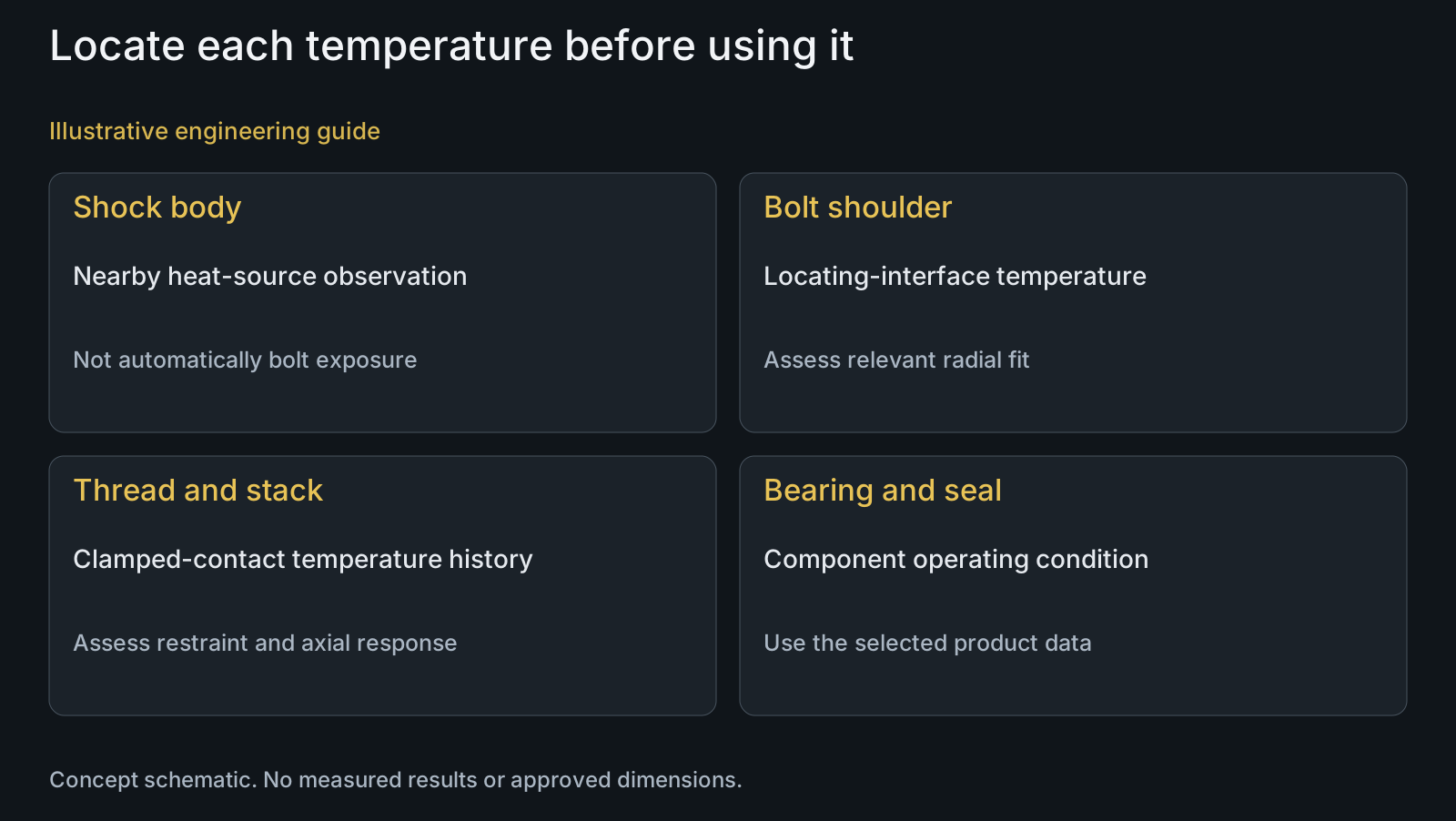
Compare differential expansion along the actual interface
As an engineering screening model, free linear expansion can be estimated from initial length, the applicable expansion coefficient and temperature change. Use the coefficient for the stated material and temperature interval. The model is an approximation of unconstrained behavior, not a complete calculation of clamp load in a joint.
For a radial fit, compare the shoulder and receiving feature with their actual diameters and temperatures. For an axial clamped stack, compare the bolt's effective length with the supported members. Different temperatures can matter even when two parts use similar materials. Conversely, a named material mismatch alone does not quantify the clearance change.
Joint restraint and stiffness affect the installed response. Do not subtract two free-expansion estimates and label the result a proven preload change. Provide the section, contact arrangement and component properties for the responsible engineering assessment. Pivot-system solutions is the relevant assembly context; the supplied bolt drawing alone may omit the sleeve and bearing support that determine the result.
Review the bearings, seals and assembly products in the same case
The bolt is only one member exposed to the thermal condition. Record the actual bearing or bushing, seal, grease and locking product used in the joint. SKF's lubricant guidance treats temperature as part of grease operating suitability; it does not assign a universal thermal limit to every bicycle pivot. Use the selected component or product data for this assembly.
Define the observation that prompted the inquiry: play, changed rotational resistance, loosening or only a warm neighboring surface. Compare it with the temperature record and original assembly state. Noisy or stiff motion is not a thermometer and does not by itself identify a damaged bolt alloy. Preserve the assembly details needed to distinguish a contact, lubrication or dimensional question.
If a manufacturing change is proposed, identify its purpose and affected drawing fields. PremFixer's manufacturing review can assess the supplied hardware geometry and material requirement. Thermal qualification of the complete customer assembly remains a separately defined engineering and testing scope, not an implied benefit of selecting stainless steel.
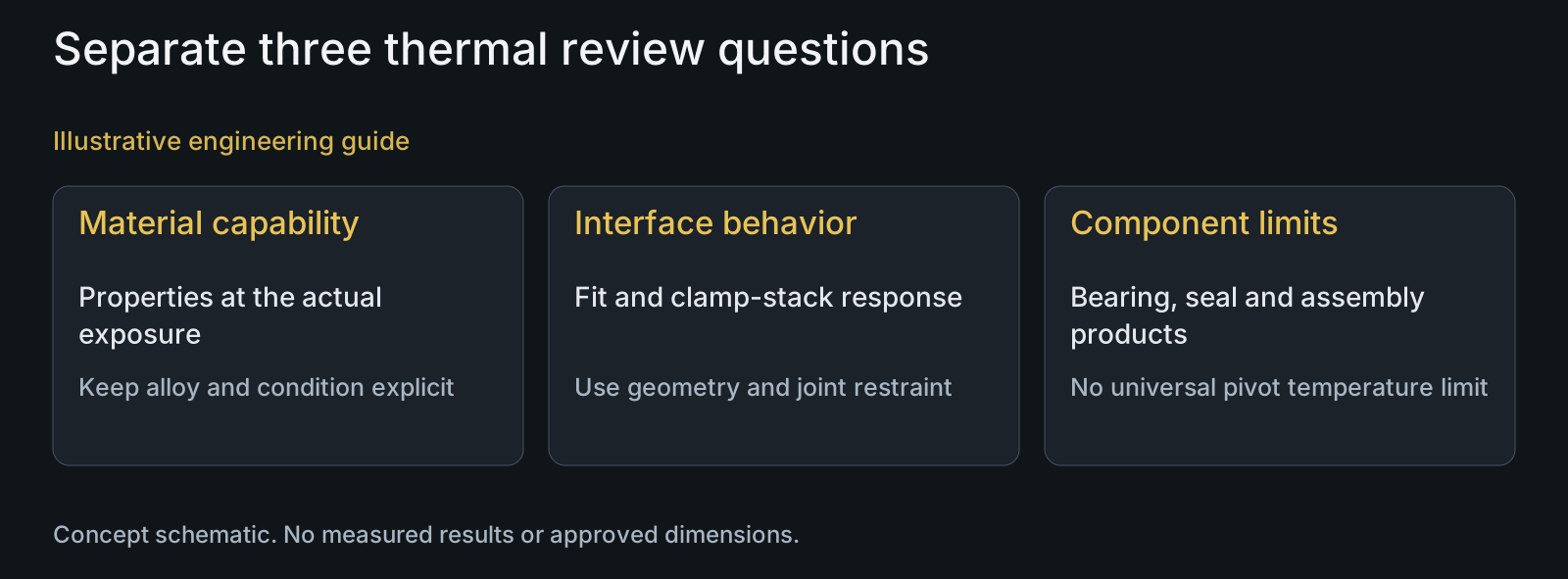
Illustrative review of a warm shock and changed pivot feel
Illustrative engineering example: assume a development bicycle shows a warm shock body and a change in pivot rotational resistance after operation. The stainless bolt's material condition is documented, but temperatures at the shoulder and bearing are not. No permanent deformation or measured strength loss has been established.
The team first defines the operating case and relevant measurement locations, retaining the original sleeve, bearing and assembly details. It then compares any observed temperature history with the component data and reviews the supported fit and axial stack. If the evidence points to lubricant suitability or differential fit, that issue is evaluated instead of treating every thermal observation as proof that the bolt needs a new alloy.
The example contains no measured temperature, calculated clearance change or validated test result. Its decision structure separates location, mechanism and acceptance. The useful supplier input is therefore the actual thermal case and joint geometry, not an isolated maximum-temperature number for a metal family.
Questions buyers need to confirm
Does a hot shock prove the pivot bolt is at the same temperature?
No. Establish the relevant bolt and joint temperature locations under the operating condition. Record measurement method, duration and gradients rather than transferring a neighboring component's reading to a concealed interface.
Can an ambient stainless property class define the whole thermal service range?
No. Use applicable temperature-dependent data for the specified alloy and condition together with the load and exposure case. The ambient property scope is not a guarantee of unchanged performance across every service temperature.
Can differential expansion matter without bolt-strength failure?
Yes. A fit or clamped stack can change through unequal expansion. Compare actual dimensions, temperatures and joint restraint; do not interpret a fit concern as proof of reduced bolt strength.
Does a free-expansion calculation prove how preload changes?
No. It is a screening estimate of unconstrained dimensional change. A clamped joint also requires effective lengths, stiffness and contact conditions for the installed-response assessment.
What should accompany a temperature-related hardware inquiry?
Provide the joint drawing or STEP assembly, material conditions, component and lubricant identities, operating case and any actual temperature records. Describe the observed change and assembly state so the review can distinguish material, fit and component-limit questions.
Technical references and scope
ISO 3506-1:2020: ambient mechanical-property scope. Public scope; not extrapolated into a universal high- or low-temperature component guarantee.
SKF: grease lubrication mechanisms and temperature suitability. General lubricant operating-window principle; no industrial-bearing limit is transferred to a bicycle pivot.
Explore related component, material and sourcing decisions in the customer decision knowledge center. For a drawing review, use the Drawing/BOM RFQ path.
Define the thermal case before changing the bolt
Share the assembly section, pivot BOM, material conditions and actual or explicitly assumed temperature history, with the observed behavior. PremFixer will review the supplied hardware requirements and identify the joint information needed for a meaningful manufacturing RFQ.
Discuss the drawing and BOM