
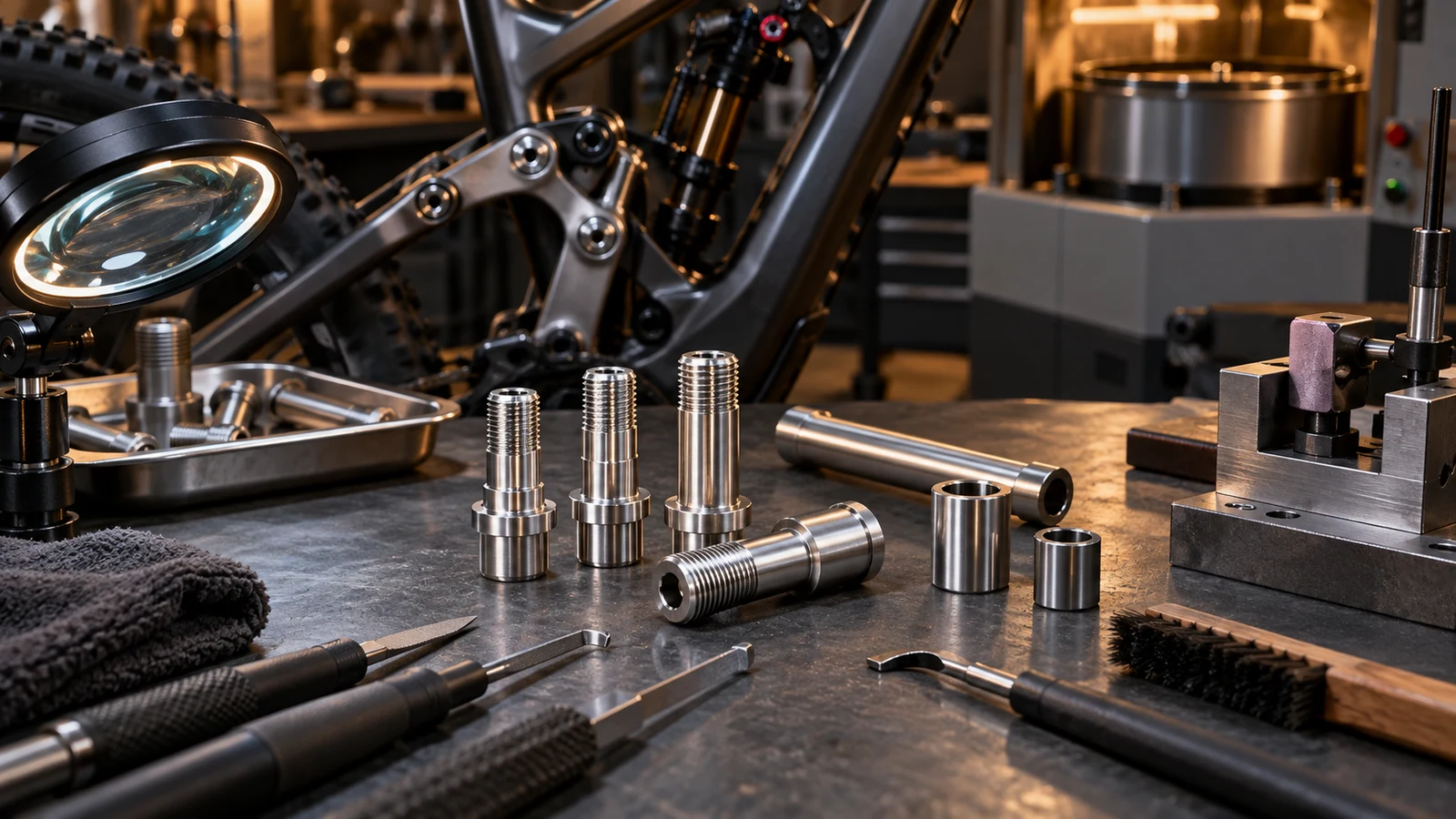
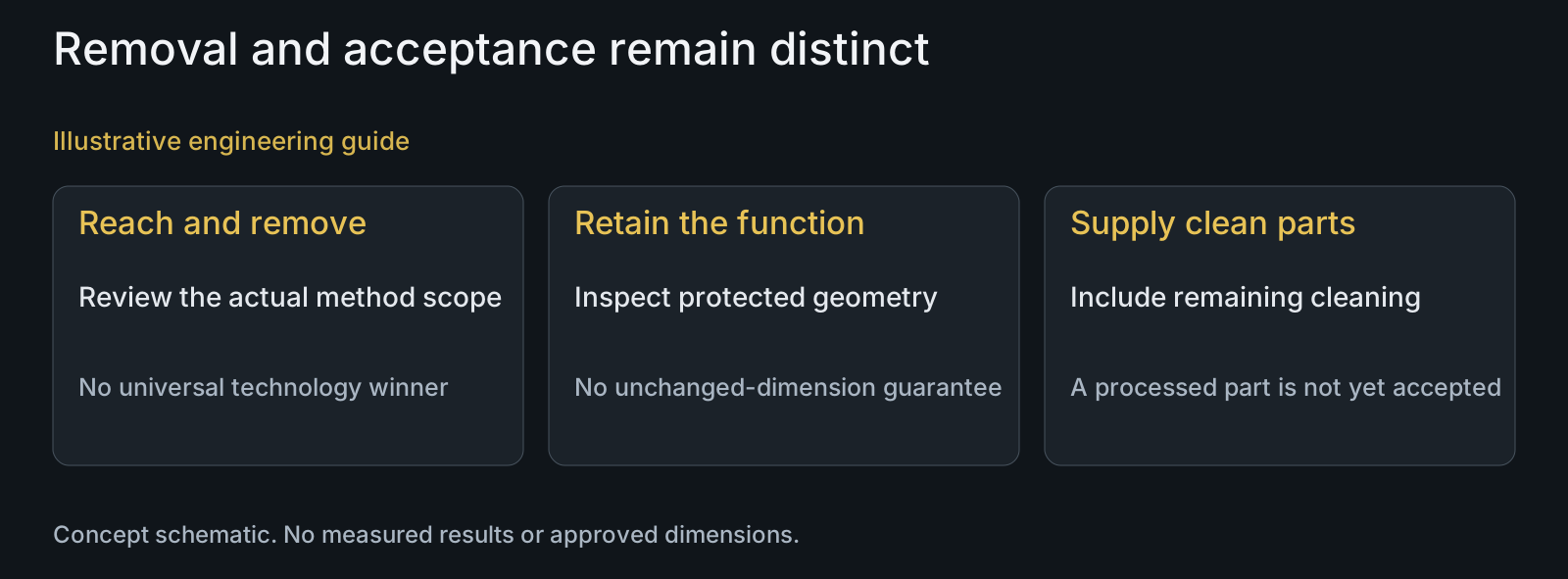
Choose a stainless pivot deburring method by the actual burr location, permitted edge condition and protected geometry. A reachable thread entry is a different task from an internal intersection or a burr close to a functional thread surface. Manual or mechanical treatment may address accessible areas; electrochemical and thermal proposals need their own application review. None should be accepted on the assumption that the method leaves every dimension unchanged. The buyer should compare removal access, the retained thread and locating geometry, and the cleaning needed for the supplied part. Removing an unwanted projection and proving the finished component acceptable are connected but distinct tasks.
Hero: concept illustration of example hardware and its application. It is not a factory photograph, tested component or approved production geometry.
Identify a burr without redefining the thread
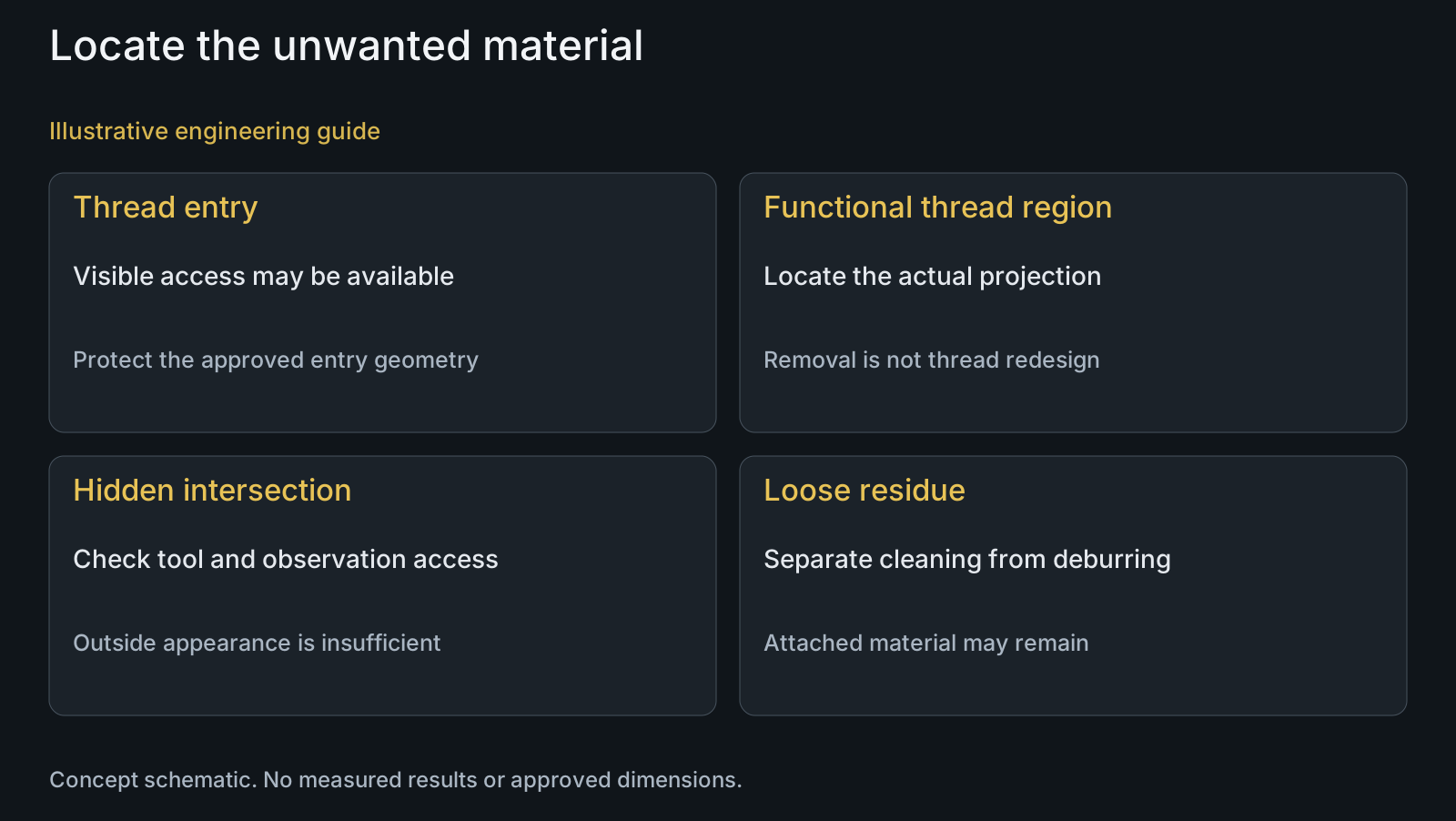
Locate the unwanted projection on an annotated drawing or sample view. Distinguish the thread entry, end of the threaded region, an adjacent drilled intersection and a separate shoulder edge. A general note saying deburr all edges leaves the supplier guessing which material is unwanted and which geometry must remain.
State any permitted edge break or chamfer through the approved component definition. Burr removal is not permission to enlarge the entry, shorten usable engagement or reshape a functional flank. If a supplier proposes a geometry change for access, keep that proposal separate from the approved delivered drawing.
Also distinguish a burr from loose chips or another defect. The removal method and acceptance task can differ. Photographing a bright external thread does not resolve a suspected internal projection, and washing away loose material does not necessarily remove attached material.
Manual or mechanical methods depend on access
A targeted hand or mechanical operation can be considered where the tool reaches the affected region and the adjacent surface can be protected. Compare the actual access path, tool contact and means of controlling the final edge, rather than assuming that every hand-finished thread receives the same result.
Ask how the affected region is observed after treatment. Access sufficient to touch an edge may not be sufficient to confirm the final condition. A reachable external entry and a hidden internal crossing should not receive identical inspection descriptions merely because both are called deburring.
Avoid unnecessary removal from surrounding functional surfaces. If the proposal uses brushing or abrasive contact, identify which regions are exposed and what must be retained. EMAG's deburring discussion notes the possibility of secondary burr formation during burr removal; the finished condition still needs evaluation.
| Method proposal | Useful condition to review | Risk to resolve | Evidence for acceptance |
|---|---|---|---|
| Targeted manual or mechanical | Tool can reach and control the specified region | Adjacent removal, incomplete access or secondary edge | Finished edge and protected-feature observations |
| Electrochemical removal | Application-specific removal region and tool arrangement | Contact-free is mistaken for zero material removal | Retained geometry, edge definition and cleaned condition |
| Thermal deburring | Actual material and geometry suit the specialist proposal | Access claim substitutes for suitability or cleaning | Application basis, retained features and oxide removal |
| Combined feature-specific route | Different locations require different access | Extra operations alter a previously accepted feature | Final requirements after the complete sequence |
Electrochemical removal is still material removal
EMAG's ECM explanation describes selective material removal through electrolysis in an electrolyte and identifies internal deburring among its applications. Non-contact describes the process mechanism. It does not mean that no material is removed or that every surrounding dimension is automatically unchanged.
For a pivot proposal, identify the intended removal region, tool arrangement, protected surfaces and resulting edge definition. A method that reaches an internal location must still satisfy the retained feature requirements. Do not transfer a manufacturer's result on another geometry to a stainless bicycle thread without an appropriate application basis.
Include post-process cleaning and supplied-surface requirements in the offer. Ask what remains to be checked after removal and before any later finish. This article gives no electrolyte recipe, process setting or guaranteed thread-root result, and it does not claim an installed ECM line at PremFixer.
Thermal removal adds an oxide-cleaning question
Extrude Hone's thermal-deburring resource describes oxidation of burr material in specialized equipment and an oxide residue requiring subsequent removal. This is a different mechanism from a directed hand tool or electrochemical removal, not an interchangeable finishing label.
Require an application review for the actual alloy condition, component geometry and unwanted projections. Identify which finished surfaces and later operations must remain compatible with the proposed treatment. The method's ability to reach a region does not establish the accepted result on every thin section or functional edge.
Keep oxide removal in the quoted route and acceptance scope. A component that has undergone a burr-removal operation is not automatically ready for assembly or specified coating. No universal temperature, pressure, cycle time, cost or guaranteed stainless-pivot suitability is adopted from equipment marketing.
A hidden intersection changes the comparison
Illustrative engineering example: assume a custom stainless pivot component has an accessible thread entry and a drilled feature creating a hidden intersection. The team is comparing targeted mechanical treatment with an electrochemical proposal and a thermal proposal. No burr measurements, method trials or actual inspection results are assumed.
The accessible entry may permit a directly controlled treatment, while the hidden location requires a demonstrated access and observation basis. For each proposal, the team identifies the intended edge, protected thread geometry and remaining cleaning. It does not select a method simply because the quote says internal deburring.
The preferred route remains conditional on evidence that the required finished geometry and supplied cleanliness can be met. An offer omitting the cleaning or internal verification task is not equivalent to one covering them. The example establishes comparison scope, not a winning technology, guaranteed dimensions or quantified savings.
Quote the finished edge and supplied condition
Send the drawing, STEP, material condition and quantities with marked burr locations or sample concerns to the CNC manufacturing review. Specify protected features and any agreed edge requirement so the removal proposal addresses the actual component.
Connect cleaning and later finish to the surface-treatment scope. If the thread definition itself needs review, the custom stainless-thread guide addresses that separate design decision; deburring should not silently revise it.
PremFixer manufactures to the customer's agreed definition and coordinated supply scope. Specialized electrochemical or thermal treatment must be assessed and explicitly scoped rather than presented as a standard in-house service. Include any application trial, retained-feature inspection and cleaning requirements in the comparison.
Questions buyers need to confirm
Does electrochemical deburring leave every thread dimension unchanged?
No such blanket assumption is justified. It removes material. Define the intended removal region and protected thread geometry, then use acceptance methods appropriate to the finished requirements.
When is targeted manual deburring worth considering?
When the tool can reach and control the affected location while retaining adjacent requirements. Identify contact, permitted edge condition and post-treatment observation; do not extend a visible-entry result to hidden intersections.
Can thermal deburring eliminate the need for cleaning?
Not automatically. The cited equipment explanation identifies oxide residue after removal. Include the appropriate subsequent cleaning and required supplied surface in the application review and quoted scope.
Is burr-free the same as meeting the thread drawing?
No. A part can lack an unwanted projection yet have excessive edge removal or another geometric issue. Retain the required entry, functional thread and related locating features as separate acceptance characteristics.
Can one method be specified for every edge on the pivot?
Only with a suitable basis for all affected regions. Identify accessible and hidden locations, protected surfaces and final condition. Different features may justify different operations rather than a blanket treatment.
What information makes deburring quotations comparable?
Send marked burr locations, drawing and STEP, alloy condition, protected features, edge requirements, final finish, quantities and cleaning expectations. Identify any application trial or internal inspection that must be included, not assumed.
Technical references and scope
EMAG: ECM technology. Manufacturer mechanism and internal-deburring application explanation read. No zero-stress, zero-burr, unlimited-material, roughness, cycle or cost claim transferred.
EMAG: Deburring and electrochemical deburring. Relevant full deburring section436–463 read; access and secondary-burr issue. Pump-housing case and numeric savings/cycles not treated as pivot evidence.
Extrude Hone: Thermal deburring technology. Full technical explanation70–137 read; oxidation mechanism and follow-on oxide removal only. No equipment settings, universal suitability, harmlessness, output rate or economic claims adopted.
Explore related component, material and sourcing decisions in the customer decision knowledge center. For a drawing review, use the Drawing/BOM RFQ path.
Review a deburring route for your stainless pivot
Send the drawing, STEP, alloy condition, quantities and sample photographs with the affected regions marked. PremFixer will review access, retained thread and locating requirements, specialist-treatment scope where relevant, and the cleaning and acceptance work needed for the supplied component.
Discuss the drawing and BOM