
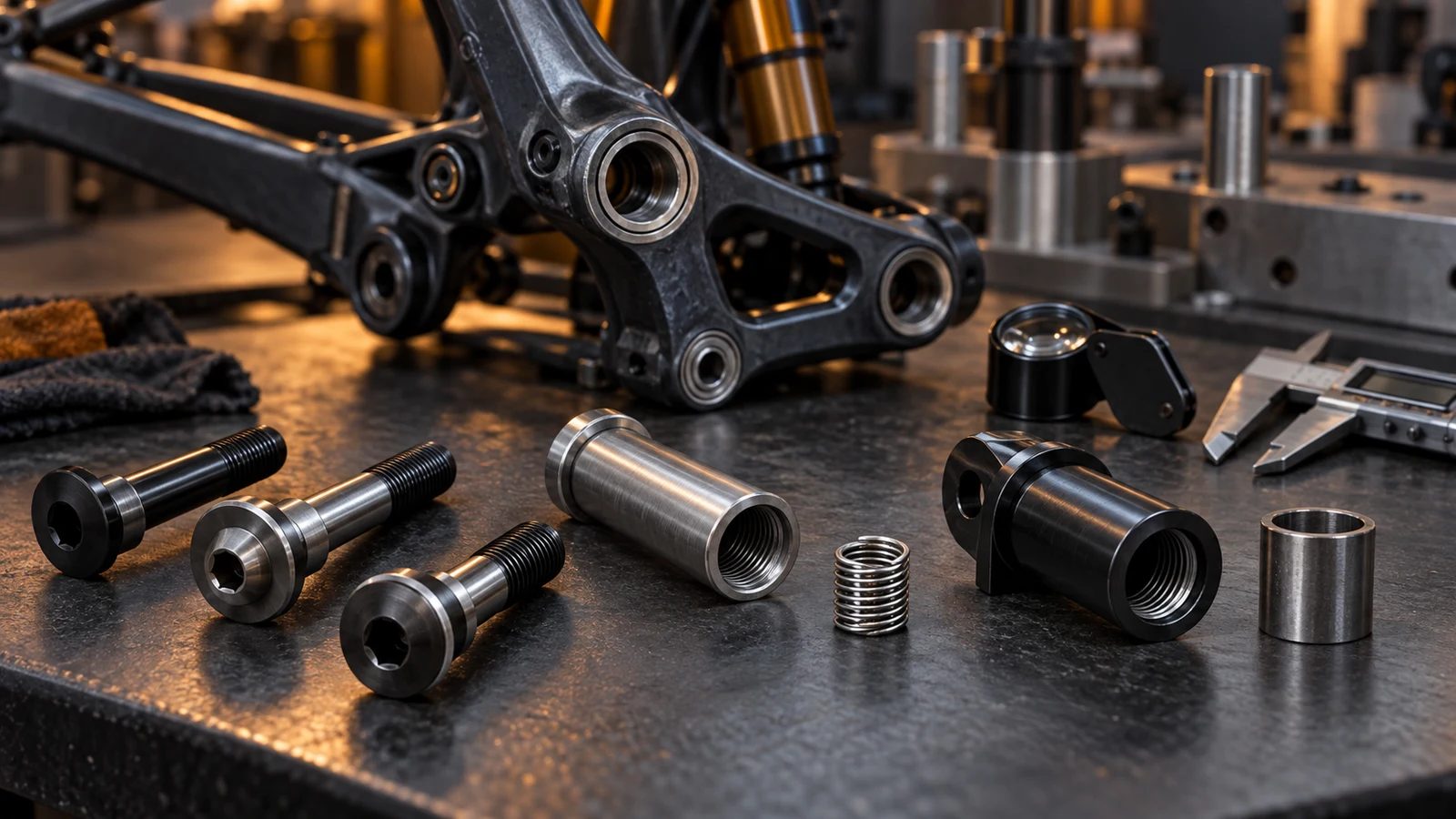
A stripped pivot receiver should not simply be drilled larger or fitted with a thread insert because a repair kit is available. First identify whether damage affects the external bolt thread, a replaceable receiving component or a frame-integrated feature. Obtain the applicable service disposition for that component. A repair can change remaining wall, thread engagement, axis position and the connection to adjacent bearing contacts. An insert provides another threaded interface; it does not establish that the surrounding structure is acceptable. Keep the bicycle out of use while structural security is uncertain and separate custom replacement manufacture from repair and return-to-service approval.
Hero: concept illustration of example hardware and its application. It is not a factory photograph, tested component or approved production geometry.
Identify the damaged member before selecting a kit
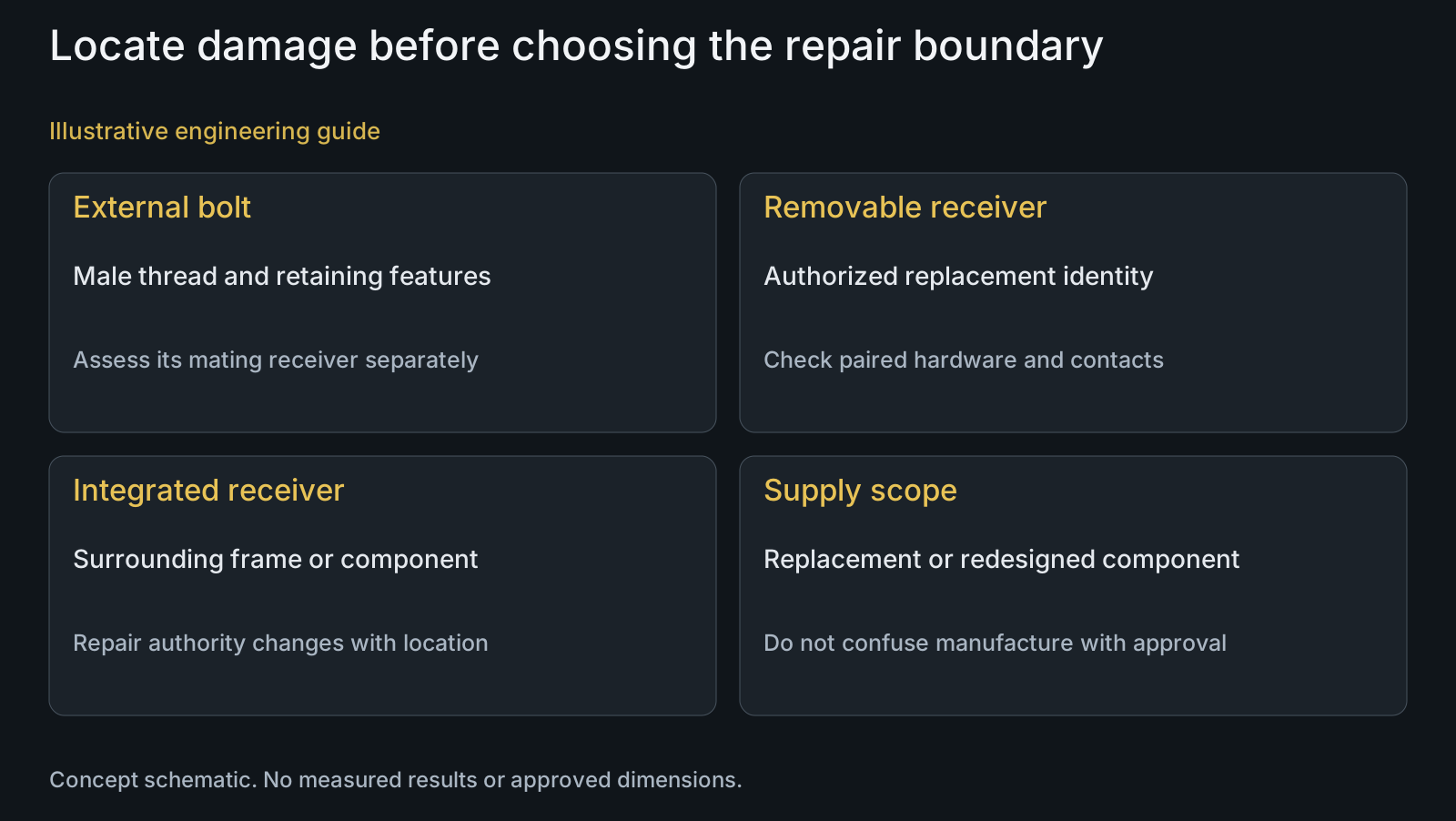
Locate the male thread, female receiver and surrounding structure on the exact pivot section or exploded view. A damaged retaining screw, removable axle and bonded frame insert are different service items. The permitted action for one does not authorize the same action for another.
A screw that spins without securing the joint is an observation, not a complete account of where damage occurred. Preserve both members for assessment under the approved service procedure. Check for any existing repair, substitution or service change that affects the current configuration.
Do not conclude that only the bolt needs replacement because its threads look worse. The receiving thread and relevant surrounding contacts need their own criteria. The seized-pivot guide addresses extraction boundaries; here, the decision begins with the receiving feature after its condition is established.
Review the material that will remain after the proposed change
Overlay the proposed receiving feature on the actual component section. Identify remaining wall toward free edges, bearing seats, recesses and other openings. Include the usable axial depth and access required by the selected system rather than compare only the old and new nominal screw diameters.
Böllhoff's HELICOIL Plus design guide links minimum wall and insert-length decisions to operating data, parent material and engagement. Its tabulated guide conditions are system-specific. No single wall multiplier from that document is adopted here as approval of a damaged bicycle receiver.
The assessment must also preserve the intended axis and contact relationships. A thread may accept a screw while being misaligned with the opposite member. Use the geometric-tolerance discussion to define relevant relationships in a revised drawing; do not infer alignment from easy hand assembly.
| Route | Potentially relevant when | Change or risk to assess | Required basis |
|---|---|---|---|
| Replace damaged external bolt | Receiver and contacts meet service criteria | Unrecognized female-thread damage remains | Both members assessed and correct replacement identity |
| Replace removable receiver | Authorized service part is available | Wrong revision alters bearing or bolt interfaces | Released BOM and service compatibility |
| Defined thread insert | Approved parent geometry can receive it | New parent interface, wall and installation scope | Selected system data and component-specific approval |
| Larger native thread | A redesigned mating arrangement is permitted | Material removal and changed bolt/contact geometry | Revised assembly and acceptance requirements |
| Frame or component replacement | Repair is disallowed or condition unacceptable | A hardware-only order leaves structural damage unresolved | Responsible product/service disposition |
| Trial screw fits | Checking entry under a permitted assessment | Fit called proof of restored strength | Separate dimensional, structural and function criteria |
Compare replacement, insert and larger-thread routes
Replacing an authorized removable receiver can retain the original hardware interface without machining the frame. Confirm that the replacement identity, bearing contacts and paired fastener match the released revision. A look-alike receiving axle is not automatically an interchangeable service part.
An insert proposal aims to provide the intended internal thread through a defined parent receiving feature. Review its exact system, installed scope, surrounding material and service compatibility. The question is whether that new interface is suitable here, not whether inserts are generally used for repair.
A larger native thread changes the mating bolt definition as well as the receiver. Review head or shoulder geometry, clearance, drive access and stack contacts as part of that substitution. It can turn a local thread change into a revised hardware system; do not describe one size larger as an automatically stronger repair.
Specify the parent feature and installed insert separately
Böllhoff's installation section specifies system-dependent holding-thread tooling and its own thread-gauge check. This demonstrates why the insert's receiving feature cannot be specified simply as the original bolt thread. Follow the selected system's current instructions within the component's approved repair route.
On a drawing-based enquiry, distinguish a machined receiving feature from a component supplied with an installed insert. State who supplies the system, performs the permitted installation and checks the delivered condition. Do not hide installation responsibility inside the word repaired.
The thread-engagement guide explains installed working overlap and bottom clearance. Confirm those relationships for the revised configuration. Neither a longer insert nor a gauge result alone establishes the required strength and contact closure of the assembled pivot.
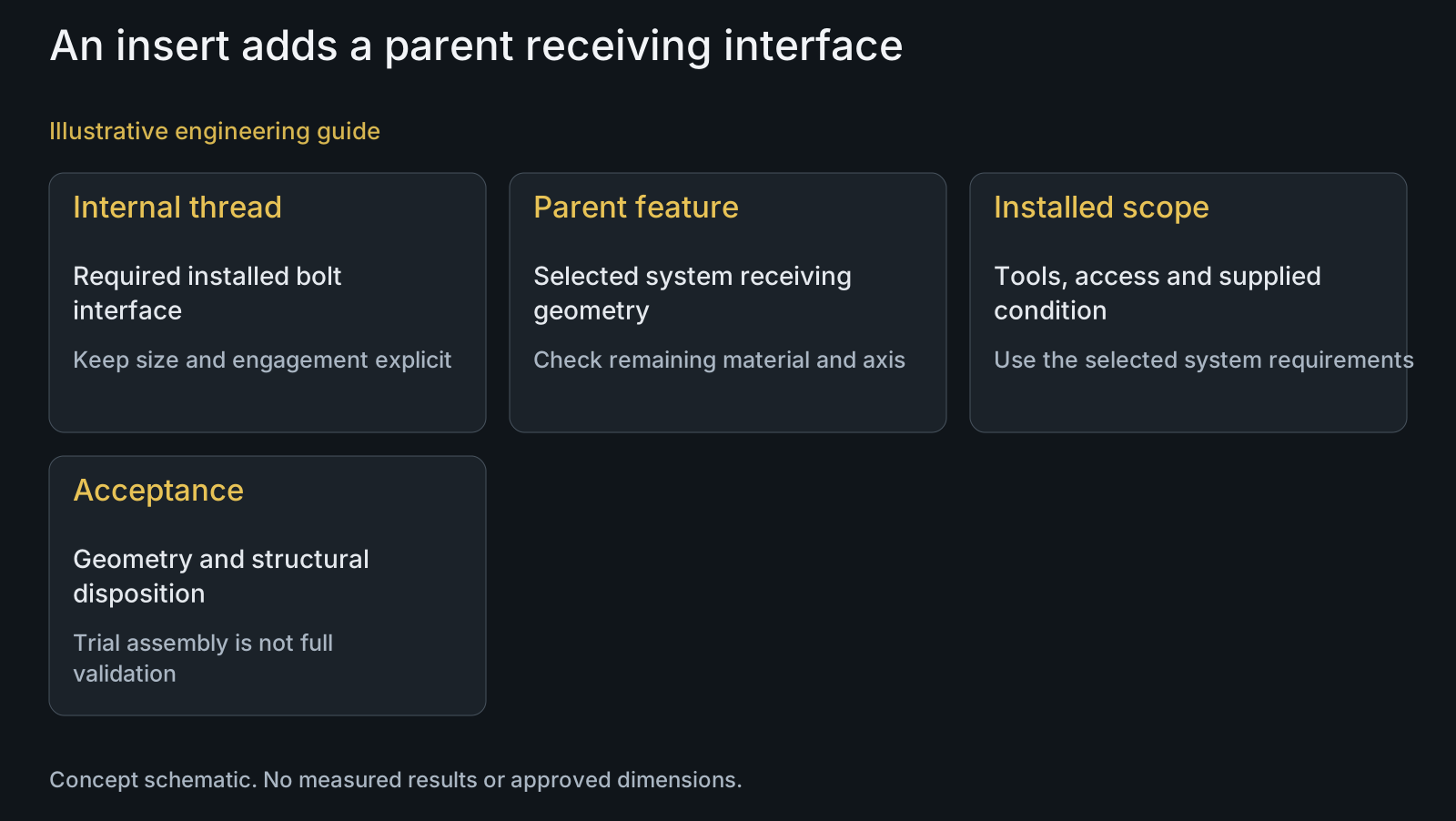
Define acceptance without treating trial assembly as proof
The responsible product or repair authority should define whether repair is permitted and what evidence will support acceptance. This may include receiving-feature geometry, installed system condition and the relevant assembly relationships. Do not invent a proof load or tightening value for an unknown frame.
A dimensional check answers its stated dimensional question. A replacement bolt reaching a setting answers neither whether the surrounding receiver was weakened nor whether every load path is intact. Keep thread conformity, structural disposition and final assembly function as separate acceptance tasks.
For new manufactured components, use CNC turning and materials to define the proposed replacement. PremFixer can review manufacture against the supplied requirement, but that review is not authorization to machine or reuse the customer's existing frame.
Review example: replaceable receiver or frame machining?
Illustrative engineering example: assume an OEM is reviewing a stripped internal thread in a removable receiving axle. An identical approved replacement is available, while a proposed insert would require a revised parent feature. No dimensions, damage extent or test outcome are assumed.
The reviewer compares replacing the axle with modifying it, including the installed contacts and paired bolt identity. Replacement may preserve the released interface if its authorized identity is confirmed. The insert remains a design and service proposal requiring the actual geometry and acceptance basis.
If the same observation instead concerned a frame-integrated receiver, the replacement decision would involve a different structural boundary and authority. The enquiry must identify that distinction before ordering tooling or custom bolts. This scenario explains a decision branch, not a completed repair or cost-saving result.
Questions buyers need to confirm
Can a stripped pivot receiver be tapped one size larger?
Not as a general repair instruction. The change removes material and requires a different mating bolt. Review remaining geometry, axis relationships, shoulder/head contacts and the component owner's permitted service route before approving a redesign.
Does a thread insert automatically restore the original strength?
No universal result is supported. The selected system transfers load through a parent receiving feature, whose material, geometry and installed condition matter. An available repair kit is not evidence that a damaged frame is acceptable.
Should we replace only the bolt if its thread is visibly damaged?
Assess the receiver too. Identify both members and any service or substitution history. External damage does not establish female-thread conformity or surrounding structural condition; use the applicable criteria before ordering a hardware-only replacement.
Is an insert receiving thread the same as the original bolt thread?
Do not assume that. The selected system defines its parent receiving feature and tooling separately from the internal thread it provides. State the exact system and whether machining, installation and inspection belong to the requested delivery.
Does a new bolt fitting the repaired hole prove it is safe?
No. Entry does not establish the remaining wall, axis relationship or structural acceptance. Separate thread checks from component disposition and assembly function, using the responsible authority's requirements rather than an improvised tightening trial.
What do we need for a replacement or repair-design RFQ?
Provide the damaged-member identity, component section, drawings or represented samples, material condition, BOM and mating hardware. Include available service disposition, any prior repair and the proposed supplied scope. PremFixer can review manufacture; repair authorization and return-to-service remain separate.
Technical references and scope
Böllhoff HELICOIL Plus Metric Thread Technical Guide. Pages 13 and 16 to 17: parent-material, engagement and wall dependencies; system-specific receiving-thread tooling and gauging. No guide dimensions or bicycle repair approval transferred.
Explore related component, material and sourcing decisions in the customer decision knowledge center. For a drawing review, use the Drawing/BOM RFQ path.
Specify the receiver and the permitted supply route
Share the pivot section, bolt and receiver drawings or STEP, BOM, material/finish definitions and available condition findings. State whether the request is an authorized replacement, a new receiving feature or a defined installed-insert component, with quantities and acceptance requirements. PremFixer can assess the manufacturing scope without treating the enquiry as approval to alter or reuse an existing frame.
Discuss the drawing and BOM