
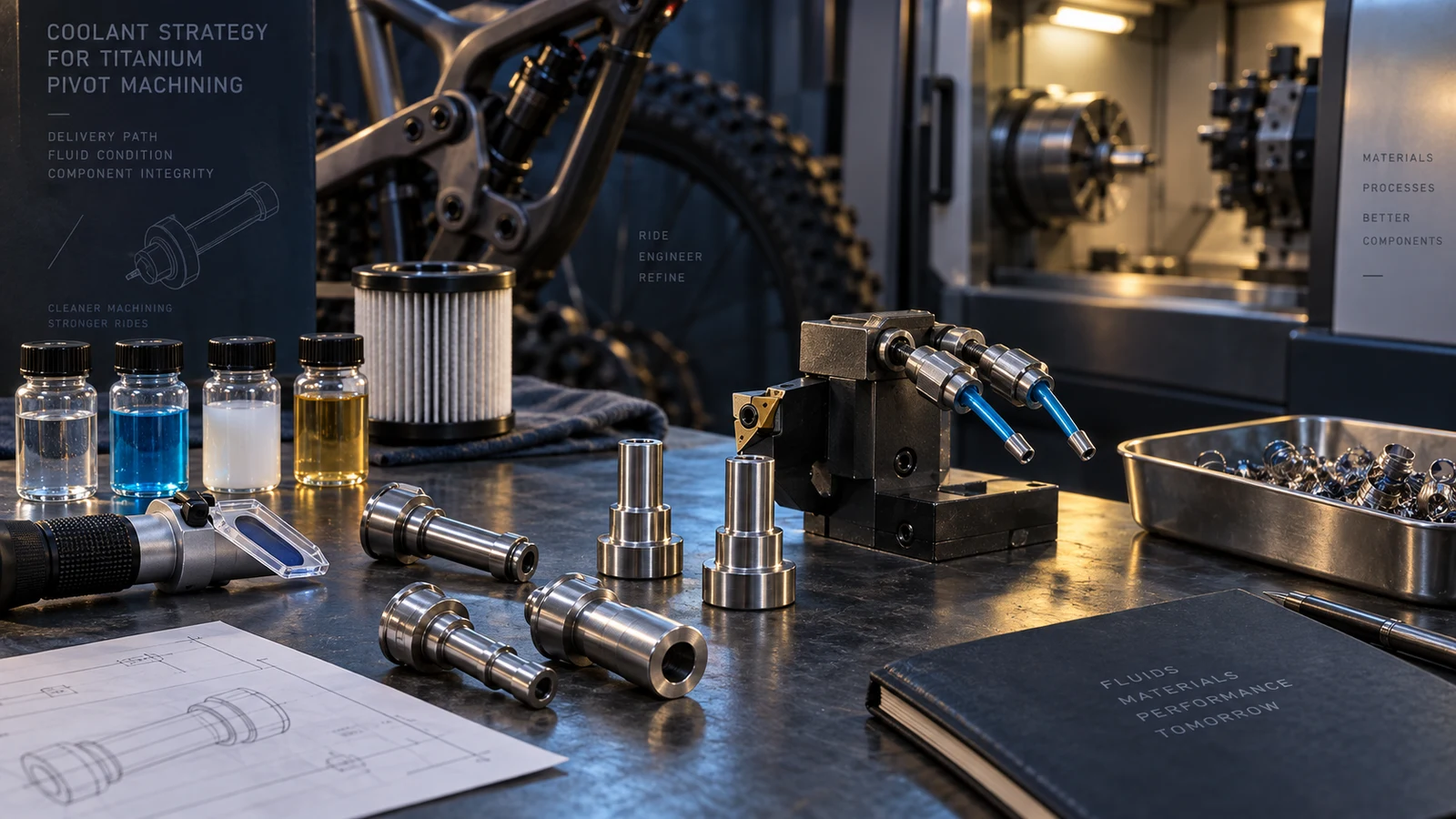
A titanium pivot coolant strategy must address the actual cut, not simply exceed a quoted pump pressure. Review the axle feature, tool-supported delivery path, chip exit and suitable fluid condition together. Titanium's cutting-zone heat and tool response make that review important, but they do not establish one pressure or titanium-only product for every turning, boring and secondary operation. A pump rating does not prove coolant reaches a recessed feature, and a fluid label does not prove its in-use condition. PremFixer's manufacturing review should identify the intended setup and required part evidence without claiming an unconfirmed coolant brand, concentration or universal pressure threshold.
Hero: concept illustration of example hardware and its application. It is not a factory photograph, tested component or approved production geometry.
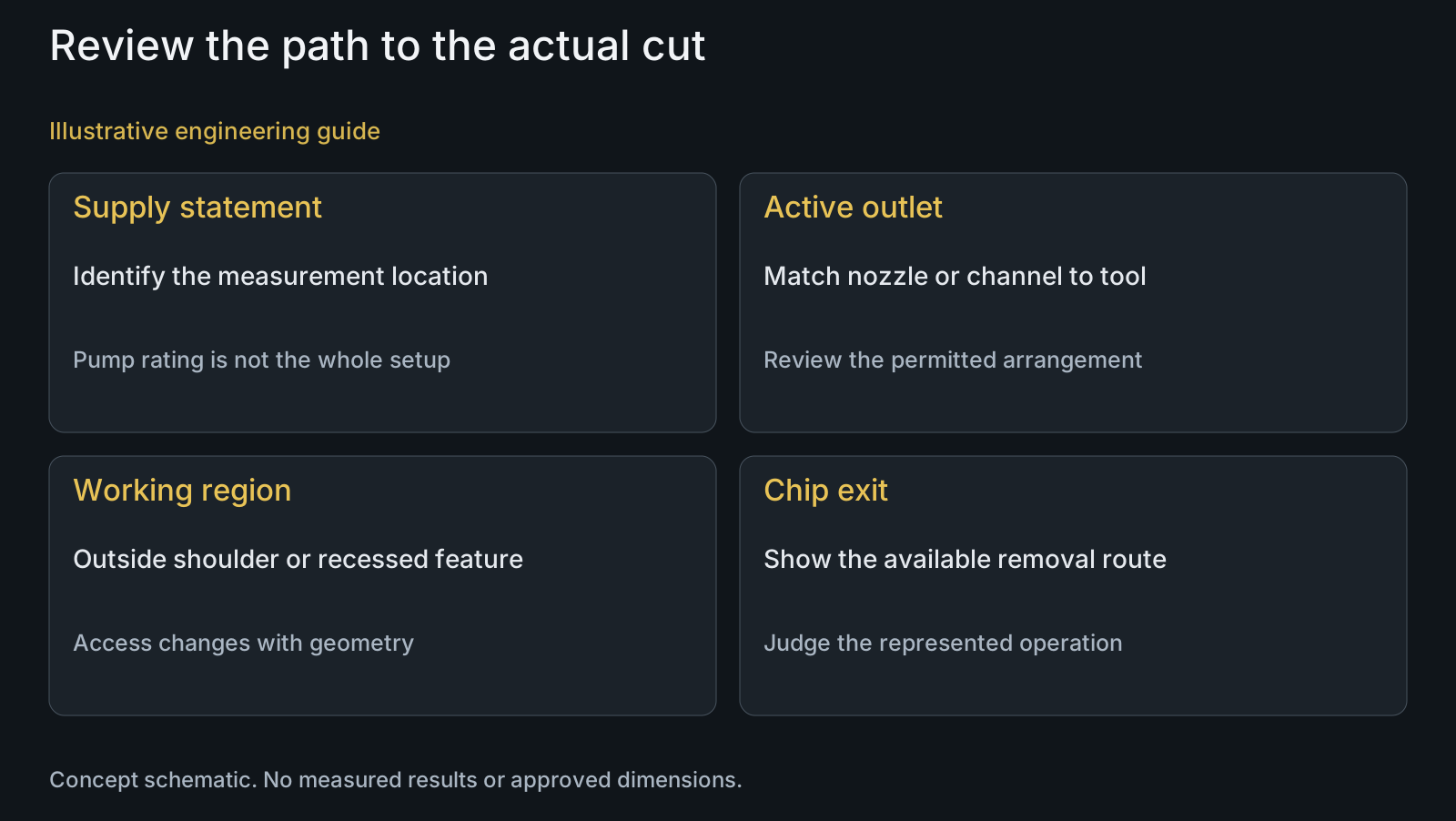
Locate the working region before specifying coolant
An exposed shoulder cut and a recessed internal feature create different access questions. Show the bore depth, shoulder obstruction and tool approach on the proposed operation. A part can be small overall while its working region remains difficult to reach. Treat the coolant path as part of that geometry review.
Sandvik Coromant's workpiece-material guidance explains titanium's demanding heat and cutting-edge conditions. The relevant principle is to review thermal management at the operation, not infer an approved setup from a material-property number.
The five titanium machining challenges connect heat, support and internal access to manufacturing scope. This article addresses the coolant system specifically; it does not repeat that guide's broader quotation comparison or prescribe machine-ready cutting data.
Pressure, flow and direction answer different questions
Record where the stated pressure is measured and which delivery arrangement is active. A nominal pump capacity and the operating condition at a tool are not interchangeable descriptions. Review the permitted setup using the actual machine, holder, connections and nozzle arrangement rather than a borrowed headline value.
Sandvik's high-pressure coolant transcript describes its directed-nozzle tooling and the chip-control mechanism of a focused jet. That tool-specific example supports reviewing delivery direction. Its pressures, productivity language and payback claims are not adopted as PremFixer pivot outcomes.
In the project review, identify whether coolant has a clear path to the working zone and whether the delivery arrangement changes between operations. More fluid elsewhere in the enclosure does not answer that question. Increasing pressure is not a substitute for confirming permitted operation and the actual path.
| Review item | What to identify | Risk of a shortcut | Useful verification |
|---|---|---|---|
| Pressure statement | Measurement location and active setup | Pump capacity is called cutting-zone delivery | Actual machine and tooling supply arrangement |
| Delivery geometry | Outlet, access and represented feature | External-cut setup is transferred to a recess | Tool and feature path review |
| Chip exit | Space and route for chip removal | Spray appearance replaces operation evidence | Relevant process observations and feature results |
| Fluid condition | Exact product and applicable checks | Titanium label becomes a universal recipe | Supplier-supported condition and monitoring basis |
| Delivered component | Cleaning, later finish and acceptance state | Machining evidence approves all later processing | Required final feature and route review |
Chip removal belongs in the same setup review
Identify how chips leave the feature and whether the tool arrangement leaves them a usable exit. A coolant proposal for external turning should not silently approve a different internal operation. The inspection and process observations should represent the cut being evaluated, not a visually impressive spray demonstration.
If chip behavior changes, record the active tool, feature and delivery state with the observation. Investigate the relevant setup rather than declaring pressure the cause from one photograph. Tool geometry, cutting conditions and support may also have changed; a complete review should disclose those differences.
The tool-life guide distinguishes output observations from edge condition and controlled actions. It provides a useful boundary here: chip behavior may inform investigation, but it does not independently accept the pivot's diameter, surface or shoulder relationship.
Choose the fluid and control its represented condition
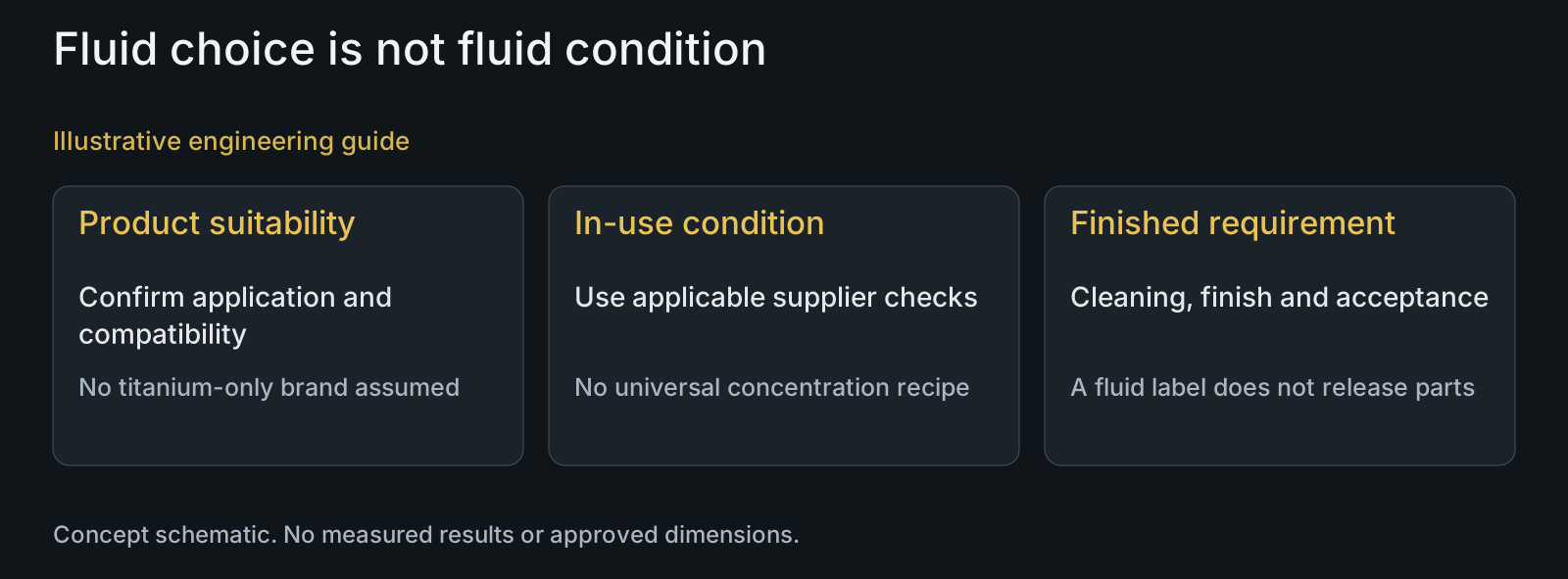
Request the exact proposed product and its supplier-supported application, not only the phrase special titanium coolant. Distinguish a product-selection question from an in-use maintenance question. Confirm applicability to the stock, operation, machine arrangement and subsequent cleaning requirements before making a product part of the project scope.
Blaser's water-miscible coolant handling guide discusses water quality, concentration, pH, filtration and monitoring. It is product-context guidance, not a universal concentration range or maintenance schedule. No Blaser product use by PremFixer is established here.
A working-fluid observation should identify the relevant measurement and product basis. Do not turn one acceptable condition reading into proof of all fluid properties or machining performance. Ask what action follows an out-of-range observation under the actual supplier-supported procedure; avoid inventing a generic top-up or disposal recipe.
A changed nozzle can invalidate a pump-only comparison
Illustrative engineering example: assume a titanium axle proposal retains the pump setting used for an external shoulder operation but adds a recessed bore with a different tool. The review receives no actual flow observations or machining results. The nominal setting has remained the same, while the delivery path and feature have changed.
First locate the new working region and the intended coolant outlet. Then review chip exit and the tool's permitted supply arrangement. Compare the resulting feature evidence under the represented setup. The unchanged pump description is not enough to conclude that the new operation has equivalent coolant delivery.
A revised nozzle or internal-delivery proposal may be worth evaluating, but the example reports no successful trial, tool-life improvement or pressure optimization. Its judgment is narrower: when the delivery geometry changes, the original setup description no longer answers the entire new manufacturing question.
Connect coolant choices to the finished supply requirement
Identify the machining state and the delivered state separately. Residue removal and compatibility with later surface treatment belong in the route review when relevant. A good initial machining appearance does not establish that the component is ready for every downstream process.
Request the accepted dimensions and surface characteristics for the actual pivot. Keep those requirements independent from the brand of fluid or pump capability. If the project asks for a numerical improvement, define its baseline, represented operation and evidence before using the figure in a purchasing comparison.
PremFixer can review CNC manufacturing scope from the customer drawing, material condition and BOM. The offer should explain the feasible operation and agreed acceptance, not promise a proprietary fluid, high-pressure system or processing result that has not been confirmed for the order.
Questions buyers need to confirm
Does every titanium pivot operation require one minimum coolant pressure?
No universal threshold is supplied. Identify the operation and permitted delivery arrangement, then assess the represented output. A pump rating alone does not establish conditions at a shoulder or recessed bore.
Does high pressure compensate for a nozzle that misses the cut?
Do not assume that. Review the outlet direction and access to the working region with the actual tooling. A pressure increase cannot substitute for confirming an appropriate, permitted delivery path.
Must the fluid be sold as titanium-only?
Not necessarily. Confirm the exact product's supplier-supported suitability for the material, operation and machine arrangement. A marketing category does not define in-use condition or downstream cleaning compatibility.
Can a fluid concentration reading prove the whole process is controlled?
No. It addresses one product-dependent condition measurement. Other relevant fluid checks and the required part characteristics remain separate; use the applicable product guidance rather than a universal reading or interval.
Can the external-turning setup be copied to a new internal bore?
Not automatically. The tool, access and chip exit can change. Review those differences and obtain relevant feature evidence before extending the earlier setup's conclusion.
What supports a titanium coolant-strategy RFQ?
Provide the drawing and STEP file, alloy condition, internal-feature depths, critical surfaces, final finish and quantities. Identify which operation is in question and whether an existing setup or a new delivery proposal needs review.
Technical references and scope
Sandvik Coromant: Workpiece materials. Titanium machining section read; cutting-zone heat context, not a numeric coolant requirement.
Sandvik Coromant: High pressure coolant transcript. Full technical transcript read. Directed-nozzle chip-control concept only; numerical pressure, guaranteed gains and payback not transferred.
Blaser: Handling and care of water-miscible coolants. Full four-page document read. Product-context water/condition/monitoring principles; no numeric limits, mixing directions or universal schedule adopted.
Explore related component, material and sourcing decisions in the customer decision knowledge center. For a drawing review, use the Drawing/BOM RFQ path.
Review coolant access for your titanium pivot features
Send the axle drawing, STEP file, material condition, recessed-feature details, critical surfaces and intended finish. PremFixer will review the manufacturing scope and setup questions that affect coolant access and accepted output, without assuming a universal pressure or unconfirmed fluid product.
Discuss the drawing and BOM