
A finished titanium pivot can be traced back to bar stock only when its manufacturing identity connects to identified stock and the corresponding original material document. Start by distinguishing the material manufacturer, the stock supplier and the company machining the pivot. They may be different organizations. Then establish which heat or other material population the document represents and how the received bars became the supplied parts. An EN 10204 document type alone does not establish that relationship or approve the finished pivot. For purchasing and SQE, the decisive evidence is a usable origin link with an explicit subject, not a certificate title repeated on an invoice.
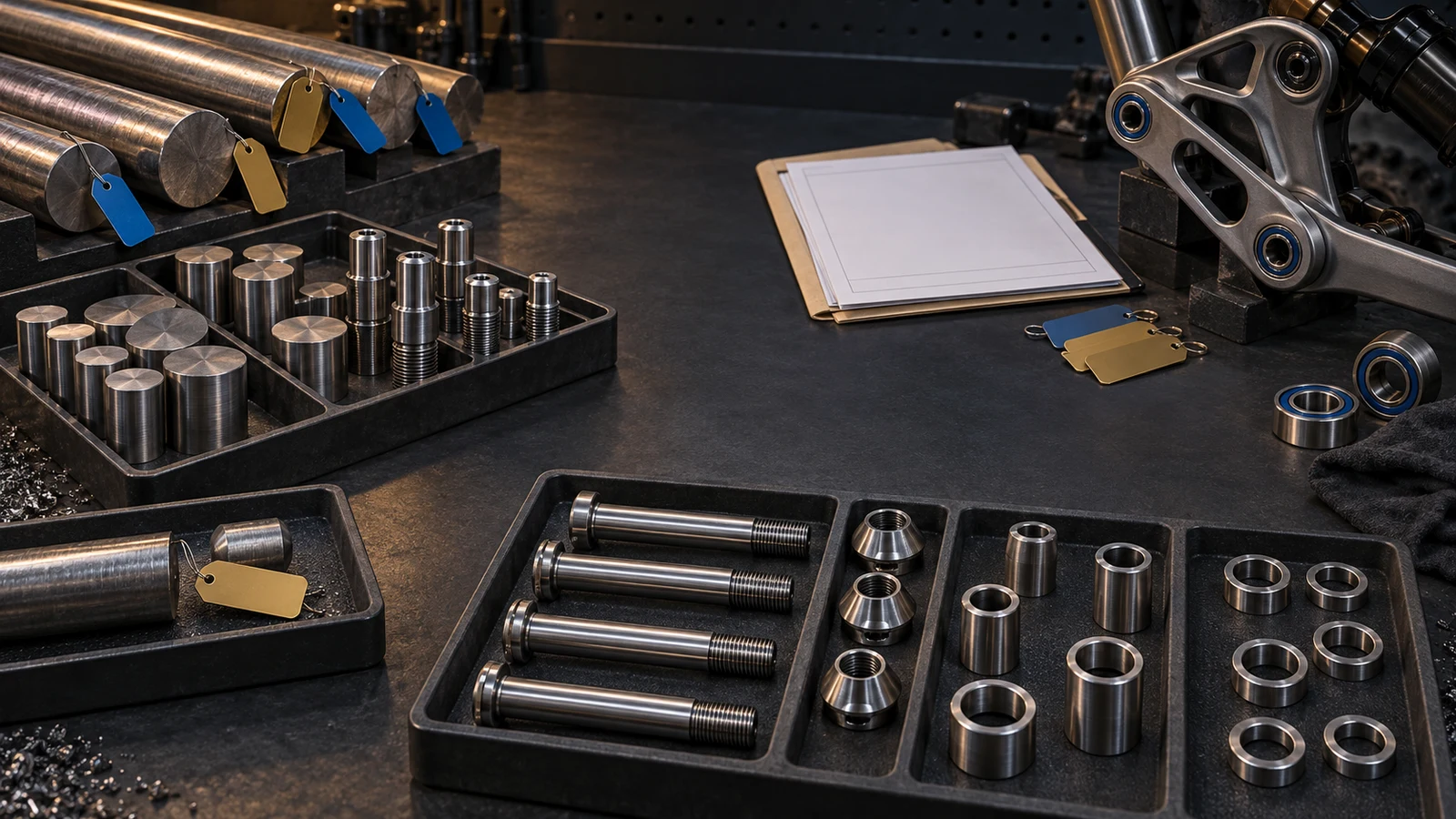
Hero: concept illustration of example hardware and its application. It is not a factory photograph, tested component or approved production geometry.
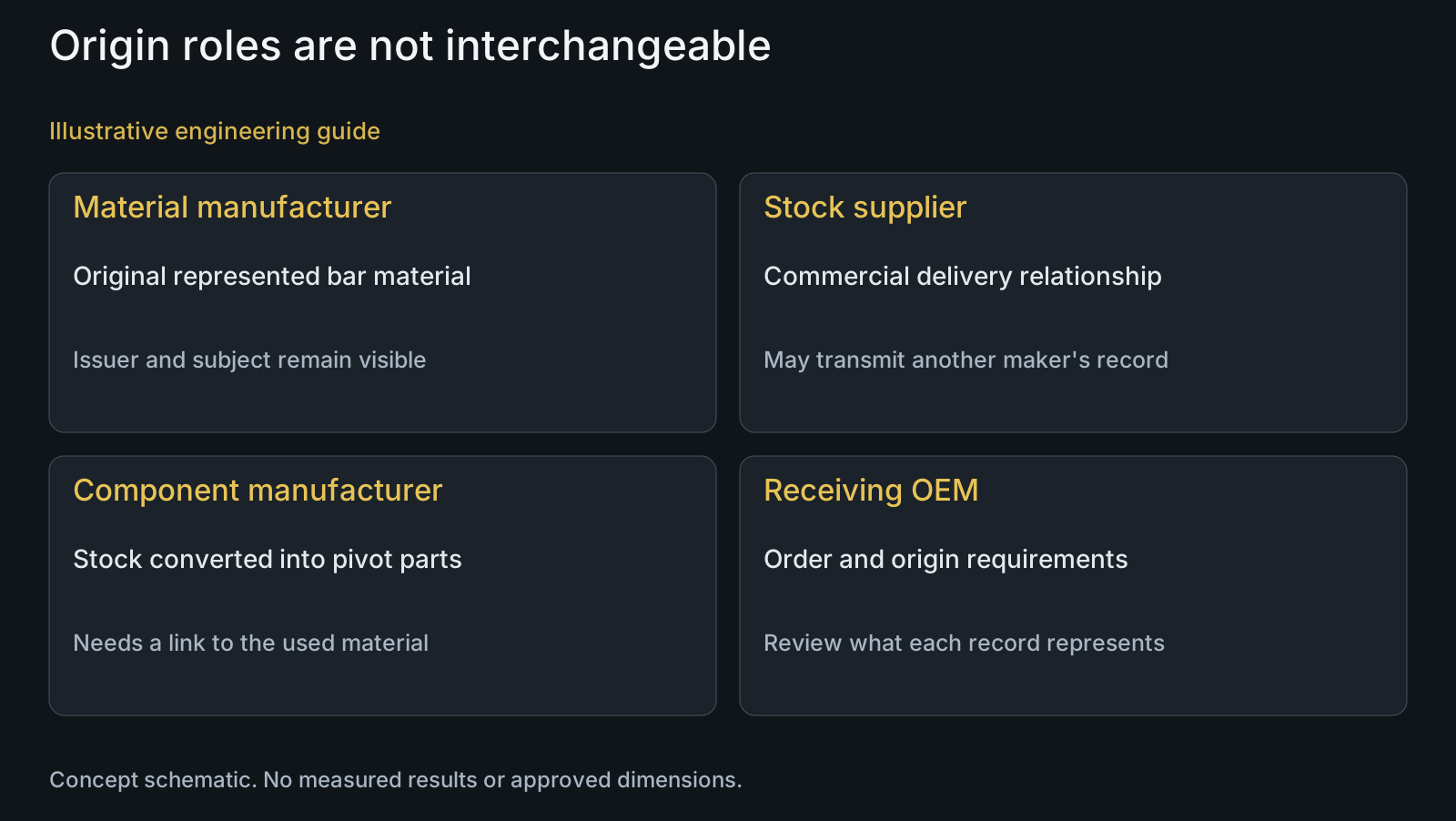
Distinguish the bar manufacturer from the stock supplier
A distributor can supply stock made by another company. A machining supplier can turn that stock into an axle without becoming its original material producer. Identify these roles in the material package so the buyer knows who made the bar, who supplied it and who manufactured the component. A commercial supplier name is not automatically evidence of melt or material-manufacturing origin.
If the project requires an approved material source, name the required organization or approval rule before ordering. Ask what available document establishes that source and what supplied stock it covers. Do not infer approved origin from the same nominal titanium grade, a familiar trading name or a previous order made from another stock population.
Read the document subject before interpreting its results
Review the material specification and edition, grade, product form, condition, represented identity and reported test subject. A material result must be interpreted against the relevant requirement. ASTM B348/B348M-25, for example, concerns annealed titanium and titanium-alloy bars and billets and addresses material chemistry and tensile testing. Its bar-stock scope should not be presented as complete pivot-system qualification.
For a supplied record, distinguish reported chemistry, reported material properties and information merely copied into a commercial description. Determine whether the properties concern the material population required by the order. A tensile result from stock is not a fatigue-life result for the machined axle, and a drawing's component requirements do not disappear when a material document is available.
| Question | Evidence to connect | Weak substitute | Review decision |
|---|---|---|---|
| Who made the bar? | Identified original material issuer and subject | Distributor name on invoice | Confirm the required origin role |
| Which stock is represented? | Received identity linked to the material record | Same grade on all packages | Reconcile separate supplied populations |
| What does 3.1 mean here? | Applicable document type and validation | Third-party claim from the label alone | Review issuer and represented product |
| Does the record cover the ordered properties? | Specification, condition and test subject | Chemistry accepted as every property | Compare individual order requirements |
| Which parts used this stock? | Cut-stock and manufacturing-group link | One certificate attached to the order | Identify relevant part families |
| Can an offcut be reused with known origin? | Retained remainder identity | Visual similarity to the original bar | Preserve the link before stock return |
EN 10204 identifies a document type, not the whole supply chain
BSI's EN 10204 listing describes inspection-document types for metallic products, used with the applicable delivery conditions. The document designation does not replace the material specification. If type 3.1 is required, also define which product or material it must represent and what order requirements it addresses.
TÜV NORD's inspection-document explanation describes type 3.1 as containing specific inspection results validated by a manufacturer's representative independent of production. It is not automatically a third-party-issued certificate. Do not relabel the stock manufacturer's document as a finished-component certificate or imply that a separate factory audit supplies the missing material relationship.
Keep an original document distinguishable from a copy, supplier summary or later component inspection report. If an intermediary transmits material information, request the relationship to the received stock and any document changes. An unclear issuer or altered subject warrants clarification rather than an assumption of equivalence. Contractual document validation must follow the applicable requirements.
Preserve the origin link at cutting and stock return
At cutting, connect the received material identity to the blank population and part number being made. If one bar supplies several part families, the finished identities differ even when they share a material origin. If several material identities feed one order, keep their relationships distinct instead of assigning the order one unexplained material reference.
Returned offcuts are a particular origin problem: a shortened piece may no longer retain the initial marking or packaging. Agree how its identity survives return to stock before it is used for a later component. A record that shows the correct certificate once received but cannot identify the remainder is not sufficient evidence for that remainder's later use.
Downstream processing and kit relationships are covered in the digital lot traceability guide. Here the narrower task is establishing what material origin those manufacturing records lead back to. More process history cannot repair a missing stock-to-document connection.
Illustrative review: two deliveries from one distributor
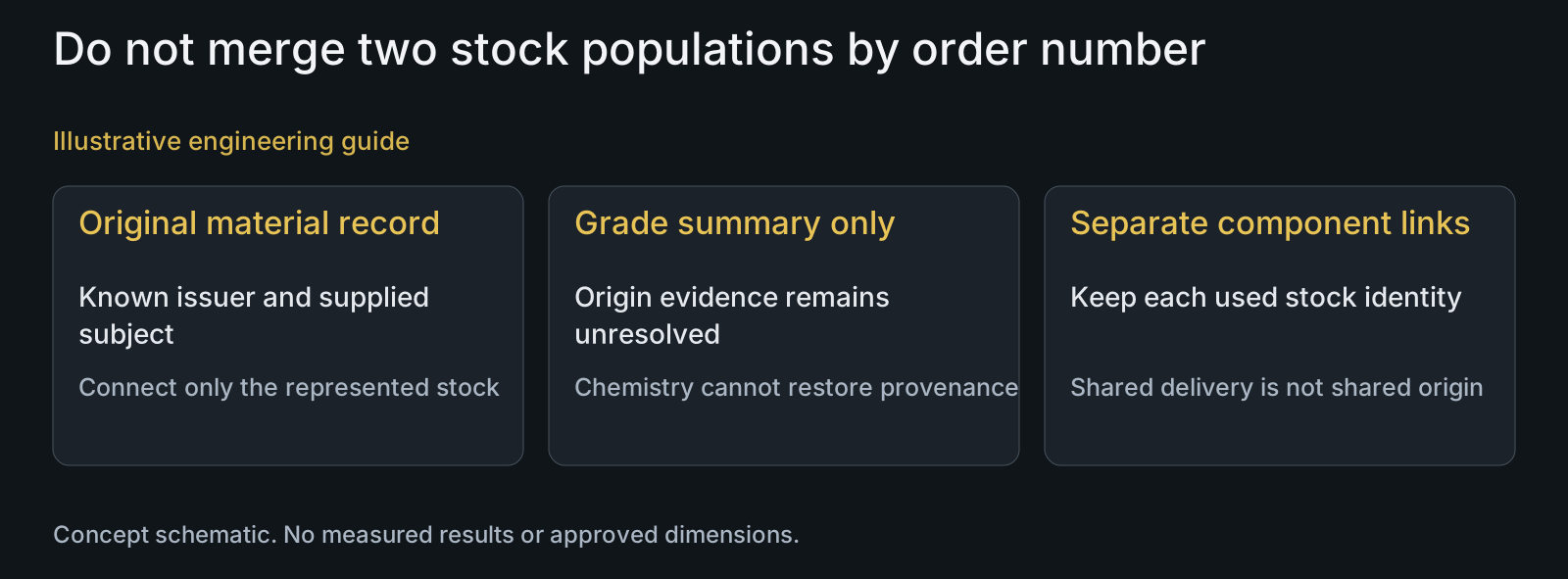
Illustrative engineering example: assume a distributor supplies titanium bars for one pivot order from two documented material populations. One original material record identifies a manufacturer and supplied condition; another document is only a distributor's grade summary. No supplier, certificate number or test result is invented. The buyer can evaluate the first record's subject but cannot assume the summary proves the same manufacturer or represented properties.
The required response depends on the order. If approved material origin is mandatory, request the missing origin evidence before using the affected stock. If particular properties are required, review whether the corresponding results represent it. Additional chemical analysis might resolve a composition question, but it does not identify the original manufacturer or reconstruct an undocumented supply history.
Keep the two stock populations distinct during this review. Even if both eventually meet the required specification, their evidence may follow different origin links. The objective is a supported supply decision, not an automatic rejection because a distributor was involved or a claim that extra paperwork proves identical performance.
Specify origin evidence and finished-part evidence separately
In the materials review, identify the titanium specification, stock form and condition, required source approval, inspection-document type and expected origin depth. Provide the BOM so an axle's material record is not applied to a spacer or screw from another source. For the manufacturing scope, identify how the requested links and documents will accompany the supplied components.
PremFixer can discuss those requirements with the drawing and order scope. This article does not establish a universal type 3.1 document for every titanium shipment, a named approved mill or a particular retention period. Agree availability and deliverables before stock procurement; retain separate requirements for component dimensions, finish and application validation.
Questions buyers need to confirm
Can a titanium pivot be traced to the bar supplier and manufacturer?
That requires an agreed evidence chain identifying both roles and connecting the used stock to the finished group. Ask which original material document and supplied identity support it. A stock-supplier invoice alone may identify the commercial source without establishing the material manufacturer.
Does EN 10204 type 3.1 mean third-party certification?
No, not automatically. Type 3.1 involves specific inspection results and manufacturer validation independent of production. Identify the issuer, product subject and applicable order requirements. Do not treat the designation as external certification of the finished pivot.
Does the bar certificate prove the finished axle's fatigue performance?
No. Stock material evidence and component fatigue performance concern different subjects. Provide the required material condition and component validation requirements separately. Machining geometry, transitions, surface condition and the assembly still need their appropriate acceptance or validation.
Can a distributor supply acceptable titanium stock?
Yes, distributor involvement does not by itself make stock unacceptable. The required material, source approval and document relationships must still be supported. Ask for the original record and its link to the supplied bars rather than assuming either approval or rejection from the seller's role.
Can chemical testing recreate a lost material-origin link?
No. Suitable chemistry testing can answer a composition question but does not identify the original manufacturer or restore historical document relationships. If source approval is required, the missing origin evidence needs separate resolution.
Will every titanium order include an original type 3.1 document?
That universal deliverable is not confirmed here. Specify the required document type, material population, source approval, availability date and finished-part linkage in the RFQ. Confirm the agreed package before material procurement rather than assuming it follows from a titanium grade name.
Technical references and scope
BSI, BS EN 10204:2004. Official current listing and public document-type scope. The applicable material and order requirements remain separate.
TÜV NORD Netherlands, EN 10204 inspection documents. Inspection-service provider explanation of type 3.1 validation. No third-party certification or service relationship is attributed to PremFixer.
ASTM B348/B348M-25, Titanium bars and billets. Official current public scope for annealed bar and billet material. Not a certification of a finished pivot or its fatigue life.
Explore related component, material and sourcing decisions in the customer decision knowledge center. For a drawing review, use the Drawing/BOM RFQ path.
Define the titanium origin your project must demonstrate
Send the pivot drawing and BOM, titanium specification and edition, stock form and condition, quantities and source-approval requirements. State the required inspection-document type and whether the chain must identify the material manufacturer, distributor, heat or individual stock group. PremFixer can review document availability and manufacturing linkage separately from finished-pivot validation.
Discuss the drawing and BOM