
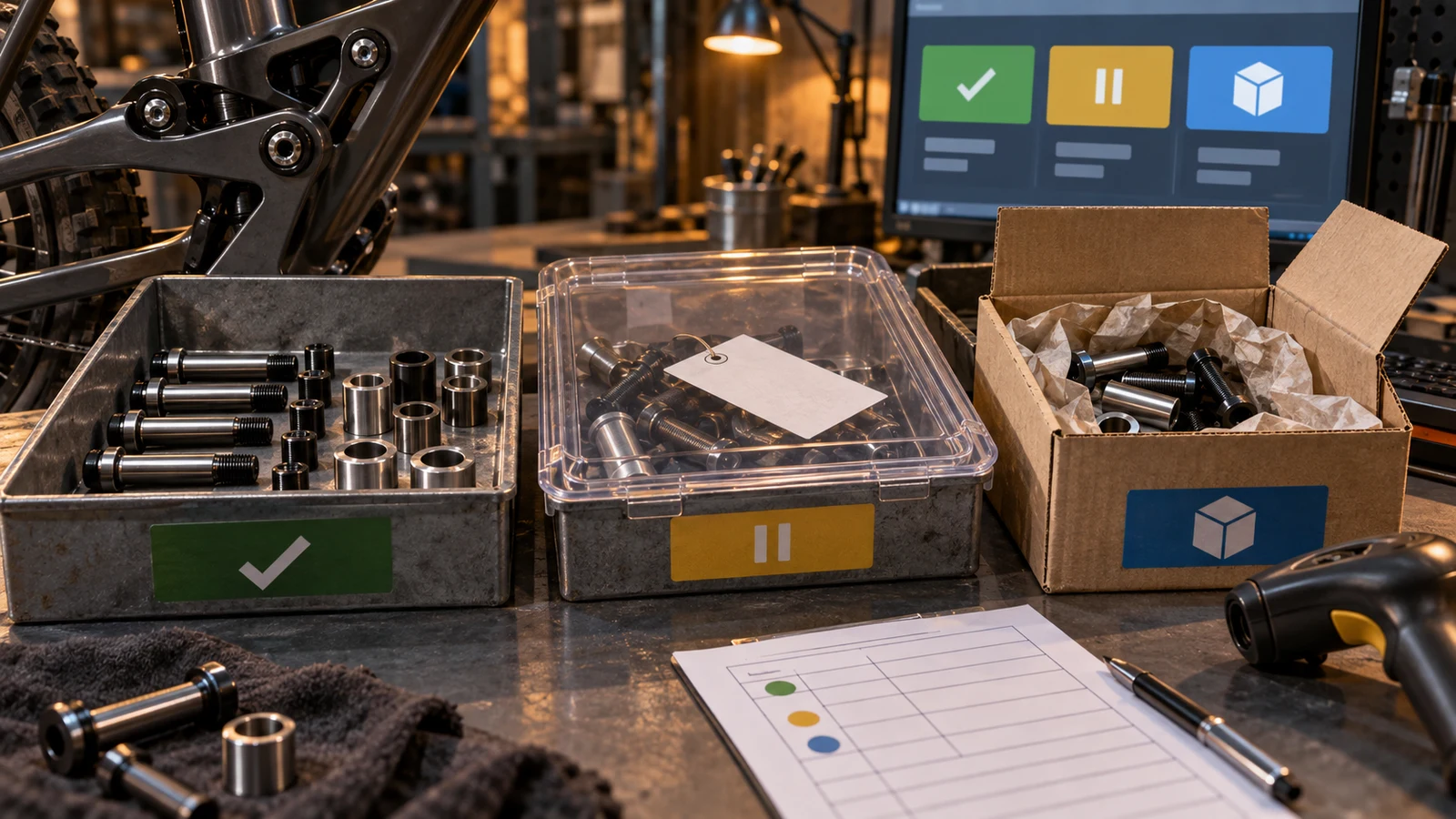
VMI for bicycle pivot fasteners works through an agreed stock signal and replenishment authority, not through a minimum quantity alone. For each custom bolt, sleeve or kit, identify the revision, usable stock, actual consumption and existing incoming supply before deciding what to replenish. Keep held or superseded parts visible without presenting them as current assembly stock. Agree who can change a threshold or suspend the signal, and define ownership and payment separately. Supplier management does not automatically mean consignment, free inventory or unrestricted production. Start with a bounded operating arrangement and a comparable cost/service baseline; no generic savings percentage establishes its value for your program.
Hero: concept illustration of example hardware and its application. It is not a factory photograph, tested component or approved production geometry.
Define the decision the stock signal may authorise
Specify the item, revision, location and supplied state to which the signal applies. A signal for finished bolts should not silently authorise a new material purchase or a different sleeve revision. State whether it creates a review request, permits manufacture within agreed limits or releases a shipment.
Oracle's VMI components documentation illustrates distinct replenishment requests, purchase orders, shipment, receipt and payment events. It also distinguishes supplier and enterprise planning roles. This is one primary software example, not a requirement to adopt Oracle or evidence of PremFixer integration.
The VMI/JIT responsibility guide explains ownership and work-release boundaries. This article instead tests the replenishment signal and its value. Use the existing guide for contract definitions rather than assume that better stock visibility establishes legal ownership or a payment event.
Reconcile physical stock with usable stock
A count answers what is physically present at a defined location and time. The replenishment decision also needs to know which units are usable for the intended release. Separate accepted parts, inspection holds, rejected goods and revision-specific stock before judging shortage or surplus.
Record the snapshot time and any consumption or receipts not yet reflected in it. A correct count that is already stale can still generate the wrong action. Agree the update basis with the supplying team and distinguish corrected transactions from a change in actual demand.
If a part is held, identify the disposition owner and whether its absence creates an immediate assembly need. Do not automatically replace every held item without checking incoming supply; equally, do not count it as usable simply to suppress a shortage signal. The quality decision and replenishment response are related but not identical.
| Observed input | Question to resolve | Risk of shortcut | Targeted response |
|---|---|---|---|
| Low physical count | Is the dated usable balance correct? | Wrong quantity triggers more work | Reconcile count and unposted activity |
| Incoming delivery | Does it cover the same revision and need? | Duplicate or falsely assured supply | Link identity, order and required point |
| Quality-held stock | Who decides disposition and timing? | Held units counted as assembly-ready | Separate hold from usable balance |
| Changed drawing | Which bins and orders are affected? | Old configuration replenished again | Pause and update affected signal |
| Threshold adjustment | Who can change the authorised limit? | Forecast becomes unlimited commitment | Use agreed intervention rights |
| Fewer purchase actions | Which costs and service changed? | Transferred work called total savings | Compare consistent program baseline |
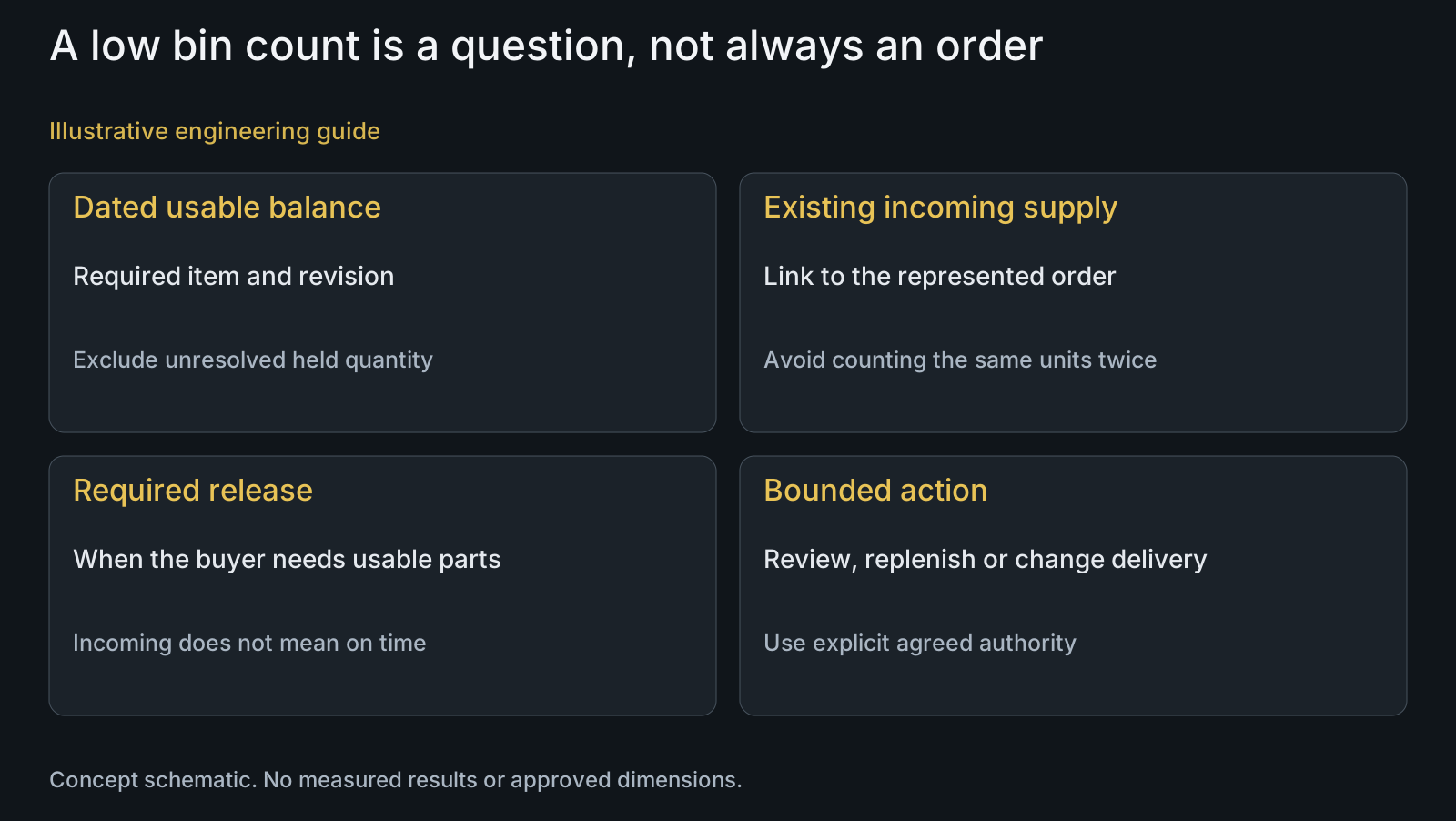
Prevent repeated requests from multiplying the same need
Connect a replenishment request to its existing order and incoming status. If the next snapshot still shows low physical stock, the team needs to know whether the shortage is already covered or whether the incoming delivery will miss the required point. A persistent low count is not necessarily a new uncovered requirement.
Agree which supply is considered in the review and why. An unacknowledged request, confirmed order, dispatched goods and received goods awaiting release carry different uncertainty. Avoid pooling them into one assured quantity or counting the same shipment in both an open order balance and its incoming balance.
Document the treatment of partial delivery, cancelled supply and changed dates. A fresh incoming quantity should be tied to the actual item and revision, not merely a supplier's aggregate shipment. The decision is whether more action is needed for the same demand, not whether another portal entry can be generated.
Give revision changes and exceptions an intervention path
Specify who can suspend replenishment for an affected part, correct its represented revision and release the revised signal. Changing the drawing does not automatically correct a bin identity, open order or recurring stock instruction. Avoid replenishing an obsolete configuration while its replacement is being reviewed.
Different exceptions need different responses. A suspect count needs reconciliation; overdue supply needs a delivery review; a quality hold needs a disposition decision; a design revision needs an affected-stock and order review. Sending all four directly to a larger automatic order can increase the original problem.
Keep temporary intervention bounded. Record which item is paused, which releases still have authority and who closes the exception. Use the engineering-change guide for affected component requirements, and the manufacturing overview for the work represented by a replenishment proposal.
Test the signal with a delayed-receipt scenario
Illustrative engineering example: assume an OEM sleeve bin is below its agreed review threshold. A previously authorised delivery of the same revision is already incoming, while a separate group of sleeves is held for quality review. No actual inventory, threshold value, late shipment or customer result is assumed.
The reviewer first reconciles the dated usable balance and the represented incoming order. It then checks whether that delivery can support the required release and whether the held sleeves affect the same demand. Low physical stock alone cannot answer either question.
If incoming supply covers the defined need on the required basis, another request may duplicate it. If it does not, the response might be an explicit additional quantity or a revised delivery arrangement. The scenario demonstrates distinct actions after reconciliation; it does not claim that the held stock passed, the delivery arrived or the program avoided a shortage.
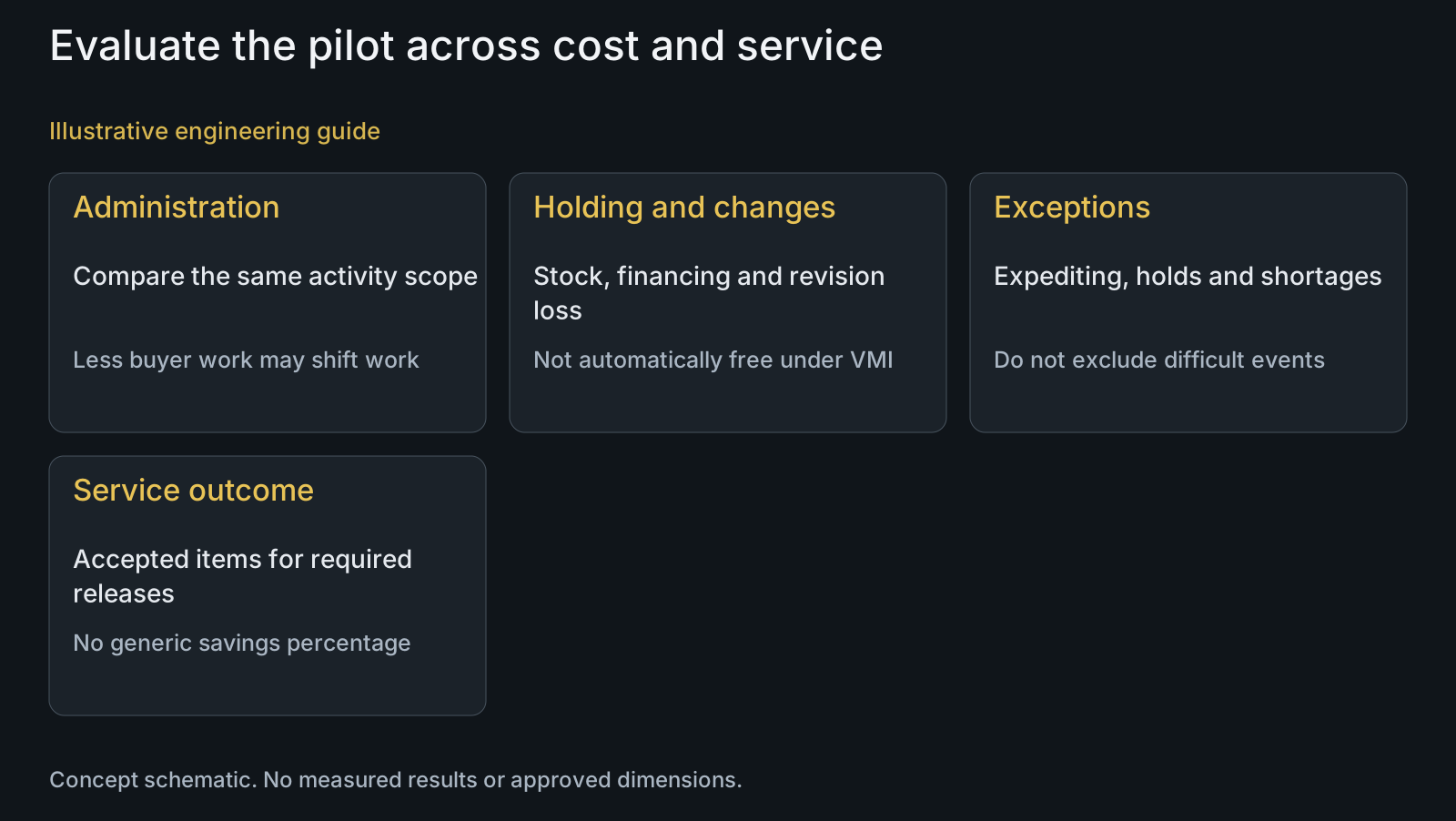
Measure value without shifting costs out of view
Choose the same item population, period and activity definitions for the baseline and pilot. Record administration time separately from stockholding, expedited transport, shortage effects and revision disposition. Fewer buyer orders can reflect changed work allocation without proving a lower total program cost.
Review service on the buyer's actual release need. Track whether accepted required items were available, not only whether a supplier shipped something. Keep unresolved holds, emergency actions and changed demand visible so a favourable result is not obtained merely by excluding difficult events.
Agree who bears stock, financing, replenishment and change costs in the proposed arrangement. PremFixer can discuss drawing-led supply and partner coordination, but no deployed VMI platform, free reserve or guaranteed saving is asserted here. Use the materials overview for specified item requirements and the knowledge center for related sourcing decisions.
Questions buyers need to confirm
How does VMI work for custom pivot fasteners?
The parties agree a part-and-revision stock signal and the supplier's replenishment authority. Define usable balances, incoming supply, triggers and intervention rights. Ownership, payment and obsolete-stock responsibilities remain separate agreed terms, not automatic consequences of supplier management.
Should low physical stock always trigger another order?
No. Reconcile the dated usable balance and existing incoming supply against the required release. The same need may already be covered, or the incoming order may be unsuitable or late. Use the agreed decision rule rather than treat every repeated low count as new demand.
Can held parts be included in available inventory?
Not as usable supply while their acceptance is unresolved. Keep their identity and disposition status visible, then assess how the hold affects the required release. The physical quantity alone cannot establish availability or the additional replenishment needed.
Who should be allowed to change replenishment thresholds?
The arrangement should name the authorised owner and limits for each item or location. A supplier may monitor stock without having unlimited authority to commit new production. Define temporary overrides, notification and closure so a revised forecast does not silently rewrite commitments.
How should a drawing revision affect the VMI signal?
Identify affected bins, incoming orders and recurring instructions before further replenishment. Pause only the affected scope under agreed authority, review stock disposition and update the represented configuration. A new drawing file does not itself correct every inventory or order identity.
Does VMI guarantee a large management-cost reduction?
No. Compare the same baseline and pilot scope, including administration, holding, expediting, shortages and revision losses. Separate transferred effort from genuine total-cost change and review service alongside cost. No verified savings percentage or PremFixer VMI deployment is claimed here.
Technical references and scope
Oracle VMI components documentation. Primary software example distinguishes planning roles and request/order/shipment/receipt/payment events. Not a universal contract or proof of supplier software integration.
Explore related component, material and sourcing decisions in the customer decision knowledge center. For a drawing review, use the Drawing/BOM RFQ path.
Define a reliable replenishment arrangement
Submit the drawings, STEP models or samples, BOM revisions, dated stock states and demand/release pattern through the Drawing/BOM RFQ path. Add incoming-order information, proposed intervention rights and ownership/payment terms. PremFixer can review the scoped supply discussion and unresolved signal inputs; platform integration and cost targets need a separate agreed basis.
Discuss the drawing and BOM